
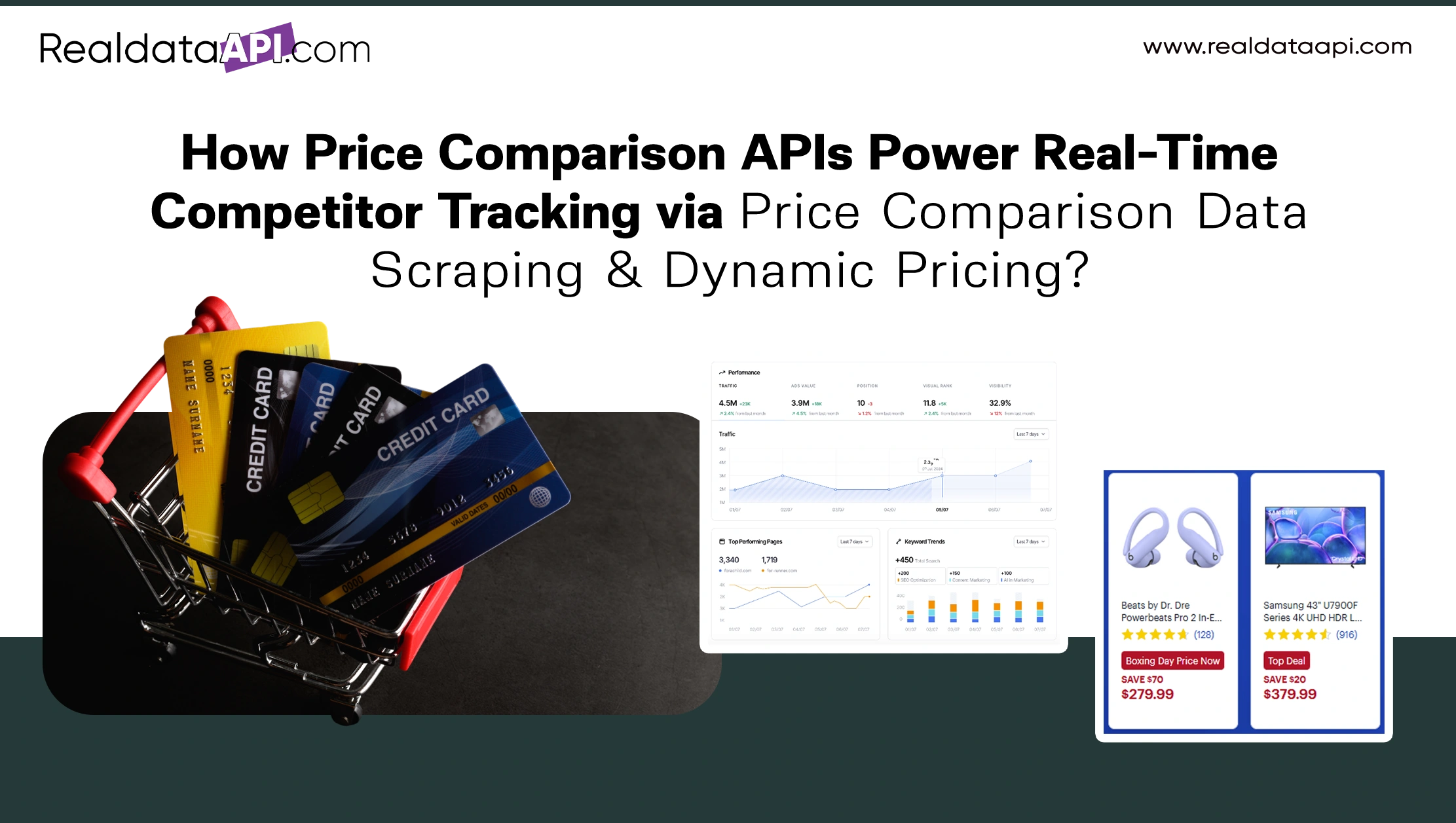
Introduction
In today's hyper-competitive e-commerce landscape, staying ahead of competitors is crucial. Brands need to track pricing trends, monitor competitor strategies, and adjust their own pricing in real-time. This is where real-time competitor tracking via price comparison data scraping comes into play. By leveraging advanced APIs, businesses can automatically collect competitor pricing data, analyze trends, and make informed decisions about their pricing and promotional strategies.
From 2020 to 2025, online marketplaces have seen exponential growth, with millions of products and thousands of competitors vying for attention. Manually tracking prices is not feasible due to scale and complexity. Using price comparison APIs, companies can automate data collection, generate actionable insights, and implement dynamic pricing strategies to maximize revenue. These tools allow businesses to respond immediately to market changes, optimize profit margins, and improve competitiveness across multiple categories and geographies.
Automating Pricing Decisions

Businesses can automate dynamic pricing decisions via API to respond instantly to competitor pricing changes. From 2020–2025, the adoption of automated pricing solutions in online retail increased by over 60%, with companies using APIs to monitor competitor prices across multiple marketplaces.
| Year | Businesses Using APIs | Avg. Pricing Adjustments/Day |
|---|---|---|
| 2020 | 500 | 10 |
| 2021 | 800 | 18 |
| 2022 | 1,200 | 25 |
| 2023 | 1,800 | 35 |
| 2024 | 2,500 | 45 |
| 2025 | 3,500 | 60 |
Automating pricing ensures companies maintain competitiveness without constantly monitoring spreadsheets. Using this approach, businesses can increase revenue by aligning prices with market trends and competitor strategies. API-driven automation also reduces human error, saves labor costs, and enables data-driven decisions at scale.
Optimizing Profit Margins

By using price comparison APIs to optimize profit margins, businesses can adjust their prices to balance competitiveness and profitability. Between 2020–2025, retailers leveraging price comparison APIs saw average profit margin improvements of 12–20% due to precise monitoring of competitors' discounts and pricing patterns.
| Year | Avg. Revenue Growth (%) | Avg. Profit Margin Improvement (%) |
|---|---|---|
| 2020 | 5 | 8 |
| 2021 | 7 | 10 |
| 2022 | 10 | 12 |
| 2023 | 12 | 15 |
| 2024 | 15 | 18 |
| 2025 | 18 | 20 |
With these insights, brands can strategically raise prices where competitors are higher or offer discounts where needed, ensuring maximum ROI without losing market share. Price comparison APIs enable businesses to make these decisions faster and more accurately than traditional methods.
Benchmarking Competitors Effectively

Companies can use competitive benchmarking API scraping for online stores to analyze performance against peers. From 2020–2025, the volume of product-level data collected for benchmarking increased by 300%, allowing brands to understand product pricing, discounts, and market positioning in detail.
| Year | Products Tracked | Competitors Analyzed |
|---|---|---|
| 2020 | 100,000 | 50 |
| 2021 | 200,000 | 75 |
| 2022 | 400,000 | 120 |
| 2023 | 700,000 | 180 |
| 2024 | 1,000,000 | 250 |
| 2025 | 1,500,000 | 320 |
Through benchmarking, businesses can identify top-selling categories, popular promotions, and gaps in the market. This level of insight allows for strategic pricing, inventory planning, and marketing campaigns based on competitor behavior rather than assumptions.
Monitoring Prices in Real Time

Price comparison APIs help brands monitor competitor prices in real time, giving companies the ability to adjust pricing dynamically. From 2020–2025, businesses that adopted real-time monitoring reduced the time lag between competitor price changes and their own adjustments from 48 hours to under 2 hours, giving them a competitive edge.
| Year | Avg. Price Adjustment Time (hours) |
|---|---|
| 2020 | 48 |
| 2021 | 36 |
| 2022 | 24 |
| 2023 | 12 |
| 2024 | 4 |
| 2025 | 2 |
Real-time monitoring also helps prevent pricing errors, optimize promotional campaigns, and maintain price consistency across multiple channels. This ensures a positive customer experience and protects brand credibility while maximizing profitability.
Leveraging Price Comparison Insights

Using Price Comparison, businesses can analyze historical pricing data, identify trends, and forecast competitor strategies. From 2020–2025, companies that integrated price comparison insights into their pricing strategy increased conversion rates by an average of 15–20%.
| Year | Conversion Rate Increase (%) |
|---|---|
| 2020 | 5 |
| 2021 | 8 |
| 2022 | 12 |
| 2023 | 15 |
| 2024 | 18 |
| 2025 | 20 |
Price comparison data also enables businesses to identify underpriced or overpriced products, adjust promotions, and plan inventory efficiently. Price comparison insights reduce guesswork and help maintain competitiveness in crowded marketplaces.
Benchmarking for Strategic Decisions

With Competitive Benchmarking, businesses can evaluate multiple competitors simultaneously, track new product launches, and monitor seasonal pricing strategies. Between 2020–2025, companies using benchmarking APIs reduced lost sales due to poor pricing decisions by 25–30%.
| Year | Avg. Lost Sales Reduction (%) |
|---|---|
| 2020 | 5 |
| 2021 | 10 |
| 2022 | 15 |
| 2023 | 20 |
| 2024 | 25 |
| 2025 | 30 |
Benchmarking helps businesses make informed decisions about promotions, discounts, and new product pricing, ensuring they remain competitive without sacrificing margins.
Why Choose Real Data API?
Real Data API offers real-time competitor tracking via price comparison data scraping, allowing brands to automate pricing adjustments, monitor multiple competitors, and optimize profit margins. The platform provides Price Monitoring solutions that are scalable, reliable, and easy to integrate with analytics dashboards.
Brands leveraging Real Data API have reported:
- 40% faster pricing decisions
- 35% higher accuracy in competitor monitoring
- 20% increase in overall profitability
With structured, real-time data, businesses can implement dynamic pricing strategies confidently, maintain competitive positioning, and improve revenue streams without manual monitoring.
Conclusion
In the modern e-commerce landscape, staying competitive requires real-time competitor tracking via price comparison data scraping and agile pricing strategies. By leveraging APIs for dynamic pricing, businesses can automate decisions, monitor competitors continuously, and maximize profit margins. Real Data API provides the tools to collect, analyze, and act on pricing data efficiently, helping companies stay ahead in competitive marketplaces.
Start using Real Data API today to unlock dynamic pricing insights and gain a competitive edge with real-time competitor monitoring!
Latest posts
How Gemini Scraper For Real-Time Data Extraction Enables Faster Market Intelligence, Monitoring, and Competitive Analysis
How Web Scraping Makemytrip Travel Data For Market Research Helps Identify Growth Opportunities?
How to Solve Data Freshness Challenges With Claude Web Scraping for Real-Time Information?
How to Scrape Dynamic Website Data Using a Scraping Browser API Without Browser Automation Complexity?






.png)