
Introduction
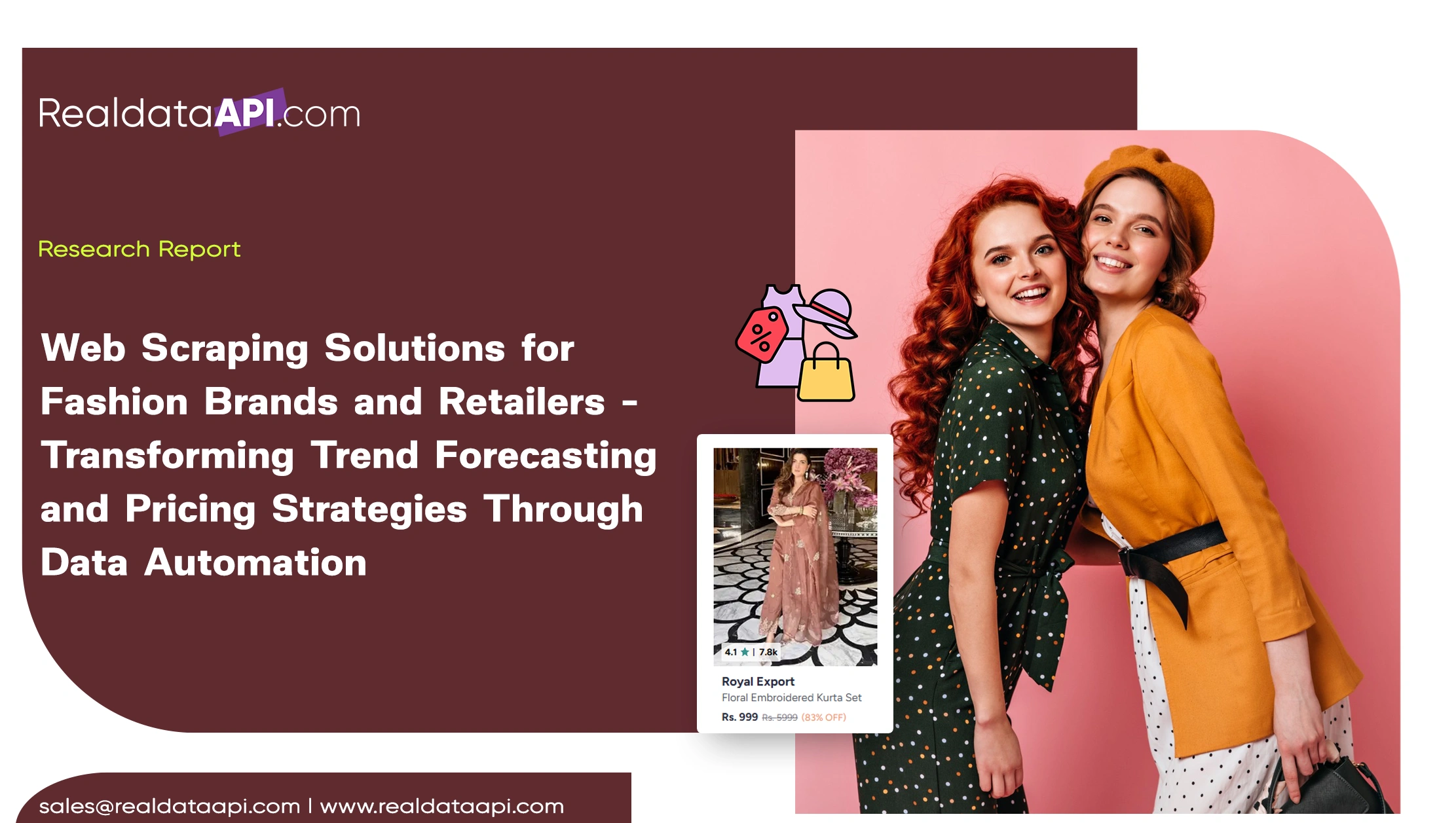
The fashion industry is increasingly driven by real-time data intelligence, competitive benchmarking, and predictive analytics. As brands race to respond to changing consumer behavior, digital shelf dynamics, and pricing volatility, advanced web scraping solutions for fashion brands and retailers are enabling data-backed decisions at scale. With the support of a robust Fashion Scraping API, companies can automate competitive monitoring, product catalog tracking, and demand forecasting across global marketplaces.
This research report explores how data automation transforms trend forecasting and pricing strategies between 2020 and 2026, supported by structured data extraction, analytical frameworks, and scalable intelligence systems powered by Real Data API.
Strategic Price Intelligence and Competitive Benchmarking
Accurate fashion product pricing data extraction has become essential for maintaining competitive advantage in a market defined by flash sales, influencer-driven demand spikes, and cross-border eCommerce expansion. Between 2020 and 2026, pricing volatility in online fashion retail increased significantly due to supply chain disruptions, inflation, and dynamic discounting models.
Retailers leveraging automated data extraction tools have reported measurable improvements in margin optimization and competitor response time. By capturing SKU-level pricing, discount depth, promotional cycles, and regional price variations, brands can implement dynamic pricing algorithms aligned with demand elasticity.
Online Fashion Pricing Volatility (2020–2026)
| Year | Avg. Price Change Frequency (Monthly) | Discount Depth Variation (%) | Cross-Border Price Gap (%) |
|---|---|---|---|
| 2020 | 3.2 | 18% | 12% |
| 2021 | 4.1 | 22% | 15% |
| 2022 | 5.6 | 27% | 19% |
| 2023 | 6.3 | 30% | 23% |
| 2024 | 7.5 | 34% | 26% |
| 2025 | 8.2 | 38% | 29% |
| 2026 | 9.0 (Projected) | 42% (Projected) | 32% (Projected) |
Automated extraction pipelines enable brands to track competitor markdown strategies, monitor premium positioning, and detect early signals of pricing wars. As digital channels dominate apparel sales, structured price intelligence is no longer optional—it is foundational for profitability.
Data-Driven Forecasting of Consumer Preferences
Modern forecasting relies heavily on apparel market trend analysis using scraped data to identify patterns across categories, materials, colors, and silhouettes. Trend cycles have shortened dramatically, with micro-trends emerging and fading within weeks rather than seasons.
Scraped product listings, reviews, ratings, and social commerce signals help brands detect high-growth segments early. From sustainable fabrics to oversized silhouettes, trend forecasting powered by structured datasets reduces inventory misallocation and improves sell-through rates.
Trend Acceleration Indicators (2020–2026)
| Year | Avg. Micro-Trend Duration (Weeks) | Sell-Through Improvement with Data (%) | Inventory Waste Reduction (%) |
|---|---|---|---|
| 2020 | 18 | 8% | 5% |
| 2021 | 15 | 12% | 9% |
| 2022 | 12 | 16% | 14% |
| 2023 | 10 | 19% | 17% |
| 2024 | 9 | 23% | 21% |
| 2025 | 8 | 26% | 24% |
| 2026 | 7 (Projected) | 30% (Projected) | 28% (Projected) |
Brands integrating scraped trend signals into planning systems achieve faster product lifecycle adjustments and more accurate production volumes. Predictive analytics powered by structured data ensures relevance in an increasingly volatile marketplace.
Real-Time Competitive Intelligence and Demand Monitoring
The rise of omnichannel retail has increased the importance of real-time fashion retail analytics data scraping. Static reports are no longer sufficient; decision-makers require live dashboards that track stock levels, price shifts, reviews, and competitor assortment changes instantly.
Real-time scraping allows brands to monitor new product launches, influencer collaborations, limited drops, and regional demand spikes. This capability became particularly critical between 2020 and 2023 during supply chain instability and unpredictable demand swings.
Real-Time Monitoring Impact Metrics (2020–2026)
| Year | Avg. Stock-Out Detection Time (Hours) | Pricing Reaction Speed (Days) | Revenue Lift from Real-Time Insights (%) |
|---|---|---|---|
| 2020 | 48 | 5.2 | 6% |
| 2021 | 36 | 4.1 | 9% |
| 2022 | 24 | 3.0 | 13% |
| 2023 | 18 | 2.4 | 17% |
| 2024 | 12 | 1.8 | 21% |
| 2025 | 8 | 1.2 | 25% |
| 2026 | 4 (Projected) | 1 (Projected) | 30% (Projected) |
Continuous monitoring reduces missed revenue opportunities and enhances promotional timing accuracy. Retailers equipped with automated intelligence platforms outperform competitors in responsiveness and pricing agility.
Structured Product Intelligence and Catalog Expansion
The ability to Scrape Fashion Product catalog data empowers brands to build comprehensive SKU libraries covering attributes such as fabric type, size range, color variations, material composition, sustainability tags, and product descriptions.
Structured catalog extraction supports assortment benchmarking, private-label strategy development, and supplier gap analysis. Between 2020 and 2026, digital SKUs across leading marketplaces expanded significantly, intensifying the need for automated catalog mapping.
Online Fashion SKU Growth (2020–2026)
| Year | Avg. SKUs per Major Marketplace | New Monthly Listings (%) | Private Label Expansion (%) |
|---|---|---|---|
| 2020 | 1.2M | 6% | 4% |
| 2021 | 1.6M | 8% | 6% |
| 2022 | 2.1M | 11% | 9% |
| 2023 | 2.8M | 14% | 12% |
| 2024 | 3.5M | 18% | 16% |
| 2025 | 4.3M | 21% | 19% |
| 2026 | 5.0M (Projected) | 25% (Projected) | 22% (Projected) |
Automated catalog intelligence ensures brands remain aligned with category innovations, material shifts, and competitive assortment depth. Data-driven product development reduces blind launches and improves market fit.
Scalable Data Infrastructure for Market Expansion
Comprehensive Fashion & Apparel Datasets are central to AI-driven merchandising and pricing optimization models. From regional pricing benchmarks to customer sentiment metrics, structured datasets power advanced machine learning systems.
Between 2020 and 2026, fashion retailers expanded into new geographies and digital marketplaces, increasing data complexity. Aggregated datasets allow cross-regional performance comparisons and standardized KPIs.
Dataset Utilization in Retail Strategy (2020–2026)
| Year | Retailers Using Advanced Data Models (%) | AI-Based Pricing Adoption (%) | Market Expansion Success Rate (%) |
|---|---|---|---|
| 2020 | 22% | 15% | 54% |
| 2021 | 29% | 21% | 58% |
| 2022 | 37% | 28% | 63% |
| 2023 | 45% | 36% | 69% |
| 2024 | 54% | 44% | 74% |
| 2025 | 63% | 52% | 79% |
| 2026 | 72% (Projected) | 60% (Projected) | 84% (Projected) |
Centralized datasets reduce operational silos and provide unified intelligence across merchandising, marketing, and supply chain teams.
Visualization and Executive Decision Enablement
Advanced visualization systems such as a Fashion Dashboard transform raw data into actionable insights for executive teams. Dashboards integrate pricing trends, SKU performance, competitor activity, and demand signals into real-time visual interfaces.
Between 2020 and 2026, dashboard adoption accelerated as retailers prioritized rapid decision-making and KPI transparency.
Dashboard Adoption and Impact (2020–2026)
| Year | Dashboard Adoption Rate (%) | Decision-Making Speed Improvement (%) | Margin Optimization Impact (%) |
|---|---|---|---|
| 2020 | 34% | 10% | 5% |
| 2021 | 42% | 14% | 9% |
| 2022 | 51% | 18% | 13% |
| 2023 | 60% | 23% | 17% |
| 2024 | 69% | 27% | 21% |
| 2025 | 77% | 32% | 25% |
| 2026 | 85% (Projected) | 38% (Projected) | 30% (Projected) |
Visual intelligence reduces reaction time, aligns cross-functional teams, and supports strategic pricing decisions.
Real Data API delivers enterprise-grade Web Scraping API infrastructure built for scalability, compliance, and accuracy. Our advanced web scraping solutions for fashion brands and retailers provide structured, real-time, and customizable data extraction across global marketplaces.
Key advantages include:
- High-frequency automated data collection
- Dynamic price and SKU monitoring
- Clean, structured, analytics-ready outputs
- Scalable architecture for global retail expansion
- Secure, compliant, and reliable data pipelines
Our technology empowers brands to convert fragmented online signals into strategic intelligence.
Conclusion
The transformation of trend forecasting and pricing strategies in fashion retail is driven by automation, analytics, and structured intelligence systems. From real-time monitoring to predictive modeling, advanced web scraping solutions for fashion brands and retailers are redefining competitive advantage in the digital era.
As fashion cycles accelerate and global competition intensifies, data automation is no longer optional—it is essential.
Partner with Real Data API today to unlock the full potential of web scraping solutions for fashion brands and retailers and lead the future of data-driven fashion intelligence!
Latest posts
How Target API Simplifies Product, Price, Category, Inventory & Retail Data Collection for Retail Intelligence
How Pull & Bear Fashion Dataset Solves Fashion Intelligence Challenges Across Products, Prices, Categories, and Apparel Trends?
How Levi's Fashion Dataset Improves Fashion Intelligence Across Products, Prices, Categories, and Denim Market Trends?
How Myntra Fashion Dataset Solves Fashion Intelligence Challenges Across Products, Prices, Brands, and Fashion Market Trends?






.png)