Introduction
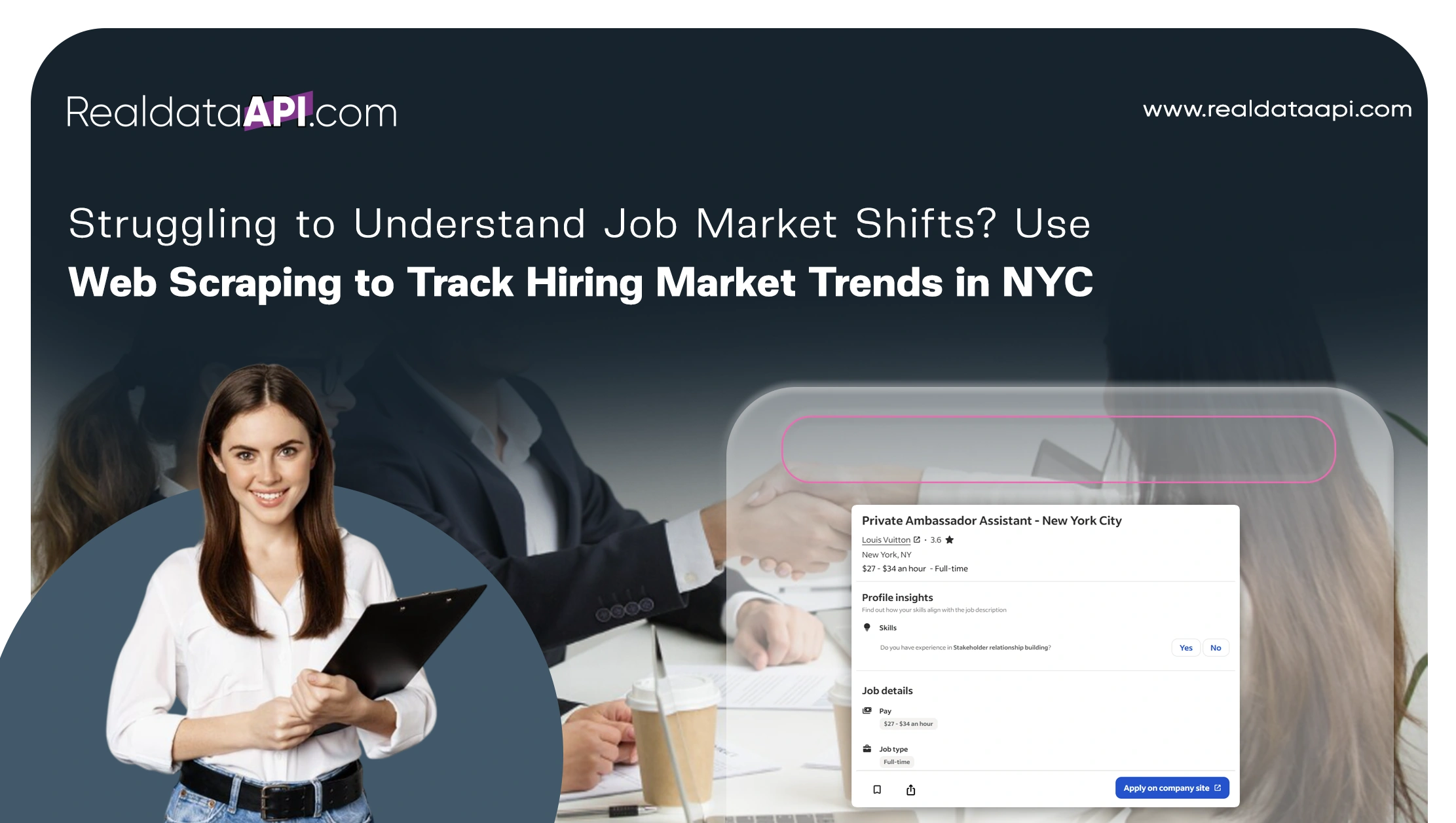
The job market in New York City evolves rapidly, influenced by economic cycles, technology shifts, and changing workforce expectations. For recruiters, startups, and enterprises, keeping up with these changes is no longer optional—it’s essential for staying competitive. Traditional hiring insights, often based on outdated reports or limited surveys, fail to provide the real-time visibility needed to make informed decisions.
This is where web scraping to track hiring market trends in NYC becomes a game-changer. By extracting live data from job portals, company career pages, and professional networks, businesses can gain actionable insights into hiring demand, salary benchmarks, and emerging roles. When paired with a robust Recruitment Data Scraping API, this approach transforms raw job data into meaningful intelligence that drives smarter recruitment strategies.
From identifying talent shortages to forecasting hiring spikes, data-driven recruitment enables organizations to act proactively instead of reactively. In this blog, we explore how web scraping empowers businesses to decode NYC’s dynamic hiring landscape and turn market complexity into opportunity.
Unlocking Actionable Hiring Insights from Job Listings
Recruitment success begins with access to accurate and comprehensive job listing data. By leveraging extract New York job listings data for recruitment insights, organizations can analyze thousands of job postings across industries to identify patterns and opportunities.
Between 2020 and 2026, NYC job listings have shown significant fluctuation. In 2020, job postings dropped by nearly 35% due to economic disruptions. However, by 2022, listings rebounded by 48%, driven by remote work adoption and tech expansion. By 2025–2026, projections indicate steady growth of 8–12% annually, particularly in sectors like fintech, healthcare, and AI.
| Year | Total Job Listings (NYC) | Growth Rate |
|---|---|---|
| 2020 | 1.2 Million | -35% |
| 2022 | 1.8 Million | +48% |
| 2024 | 2.1 Million | +16% |
| 2026 | 2.4 Million (Projected) | +12% |
Analyzing such datasets helps recruiters identify high-demand roles, hiring hotspots, and industry shifts. For example, tech-related job postings increased by over 60% between 2021 and 2025, signaling a strong demand for software engineers and data scientists.
By transforming unstructured job listings into structured datasets, businesses can refine their hiring strategies, prioritize roles, and align recruitment efforts with market demand.
Building Smarter Recruitment Strategies with Data Collection
Effective hiring decisions depend on consistent and large-scale data collection. With Job market data collection for recruiters in New York, organizations can monitor hiring trends across multiple sources in real time.
From 2020 to 2026, data collection has revealed critical shifts in hiring behavior. In 2021, remote job postings accounted for 22% of listings, rising to 38% by 2024. Hybrid roles are expected to dominate by 2026, comprising nearly 55% of all postings.
| Year | Remote Jobs (%) | Hybrid Jobs (%) |
|---|---|---|
| 2020 | 10% | 5% |
| 2022 | 28% | 20% |
| 2024 | 38% | 42% |
| 2026 | 45% | 55% |
This data highlights how companies are adapting to workforce expectations. Recruiters can use these insights to craft job offers that align with candidate preferences, improving application rates and retention.
Moreover, continuous data collection allows organizations to benchmark their hiring practices against competitors. By understanding which companies are hiring aggressively and which roles are trending, businesses can stay ahead in the talent race.
Decoding Salary Trends and Talent Demand
Understanding compensation trends is critical for attracting and retaining top talent. Using scrape salary and hiring demand data in New York, businesses can gain insights into salary benchmarks and demand fluctuations across industries.
From 2020 to 2026, salary trends in NYC have shown steady growth, particularly in tech and healthcare sectors. For instance, the average salary for software engineers increased from $105,000 in 2020 to $135,000 in 2025, with projections reaching $145,000 by 2026.
| Role | 2020 Salary | 2024 Salary | 2026 (Projected) |
|---|---|---|---|
| Software Engineer | $105K | $130K | $145K |
| Data Analyst | $75K | $95K | $105K |
| Healthcare Manager | $90K | $115K | $125K |
These insights enable recruiters to offer competitive packages and reduce offer rejections. Additionally, analyzing hiring demand helps identify talent shortages. For example, data science roles saw a 70% increase in demand between 2021 and 2025, while supply grew at a slower pace.
By combining salary and demand data, organizations can optimize compensation strategies and allocate hiring budgets more effectively.
Staying Ahead with Real-Time Market Intelligence
In a fast-moving job market like NYC, real-time insights are invaluable. Leveraging real-time New York hiring trend analysis allows businesses to respond quickly to changing market conditions.
Between 2020 and 2026, hiring trends have become increasingly dynamic. For example, during economic recovery phases, job postings surged by up to 20% within a quarter. Similarly, sudden layoffs in specific industries created opportunities for others to attract top talent.
| Quarter | Job Posting Growth (%) |
|---|---|
| Q1 2021 | +12% |
| Q3 2022 | +18% |
| Q2 2024 | +15% |
| Q1 2026 | +20% (Projected) |
Real-time analysis enables recruiters to identify such trends as they happen. This helps in adjusting hiring strategies, launching targeted campaigns, and securing top candidates before competitors.
Additionally, businesses can use predictive analytics to forecast future hiring needs. By analyzing historical data and current trends, organizations can plan workforce expansion with greater accuracy.
Leveraging Structured Recruitment Data for Better Decisions
Data-driven recruitment relies on high-quality datasets. By utilizing Recruitment Datasets, organizations can access structured information that simplifies analysis and decision-making.
From 2020 to 2026, the volume of recruitment data has grown exponentially. Companies now process millions of data points, including job titles, skills, locations, and employer details.
| Data Type | 2020 Volume | 2026 Volume (Projected) |
|---|---|---|
| Job Listings | 1.2M | 2.4M |
| Candidate Profiles | 800K | 1.6M |
| Salary Records | 500K | 1.2M |
Structured datasets enable advanced analytics, such as skill gap analysis and workforce planning. For example, identifying a shortage of cloud computing skills can prompt companies to invest in training programs or adjust hiring criteria.
Moreover, clean and organized data improves the accuracy of AI-driven recruitment tools, leading to better candidate matching and faster hiring processes.
Automating Data Extraction for Scalable Hiring Intelligence
Manual data collection is inefficient and prone to errors. By adopting a Web Scraping API, businesses can automate the extraction of recruitment data at scale.
From 2020 to 2026, automation has significantly improved data accuracy and efficiency. Organizations using APIs have reported up to 60% reduction in data collection time and 40% improvement in decision-making speed.
| Metric | Manual Process | API-Based Process |
|---|---|---|
| Data Collection Time | 10 Days | 2 Days |
| Accuracy Rate | 75% | 95% |
| Update Frequency | Weekly | Real-Time |
Automation also ensures consistency in data collection, enabling organizations to maintain up-to-date datasets. This is particularly important in a fast-paced market like NYC, where hiring trends can change rapidly.
By integrating APIs into their workflows, businesses can focus on strategy rather than data gathering, improving overall recruitment efficiency.
Why Choose Real Data API?
Choosing the right data partner is crucial for successful recruitment analytics. Real Data API stands out by offering reliable and scalable solutions tailored to modern hiring needs. With expertise in Web Scraping Services USA, the platform provides comprehensive data extraction capabilities designed for accuracy and speed.
Additionally, Real Data API specializes in web scraping to track hiring market trends in NYC, enabling businesses to gain localized insights that drive smarter decisions. Its advanced infrastructure ensures real-time data delivery, high accuracy, and seamless integration with existing systems.
Whether you are a recruiter, HR professional, or business leader, Real Data API empowers you to transform raw data into actionable intelligence, giving you a competitive edge in the NYC job market.
Conclusion
Understanding hiring trends in a complex market like NYC requires more than intuition—it demands data-driven insights. By leveraging web scraping to track hiring market trends in NYC, organizations can uncover valuable patterns, optimize recruitment strategies, and stay ahead of the competition.
With the power of real-time data, structured datasets, and advanced APIs, businesses can transform their hiring processes and make smarter decisions.
Ready to unlock real-time hiring insights? Start leveraging web scraping today with Real Data API and stay ahead in NYC’s competitive job market.
Latest posts

How Myntra Fashion Dataset Solves Fashion Intelligence Challenges Across Products, Prices, Brands, and Fashion Market Trends?
How Hyatt Travel Dataset Helps Businesses Track Hotels, Room Prices, Amenities, Locations, and Travel Trends?

How Louis Vuitton Fashion Dataset Enables Better Analysis of Luxury Products, Prices, Brands, and Fashion Trends?
How Blinkit Grocery Dataset Enables Smarter Analysis of Products, Prices, Availability, and Quick-Commerce Trends?







.png)