.gif)
.png)

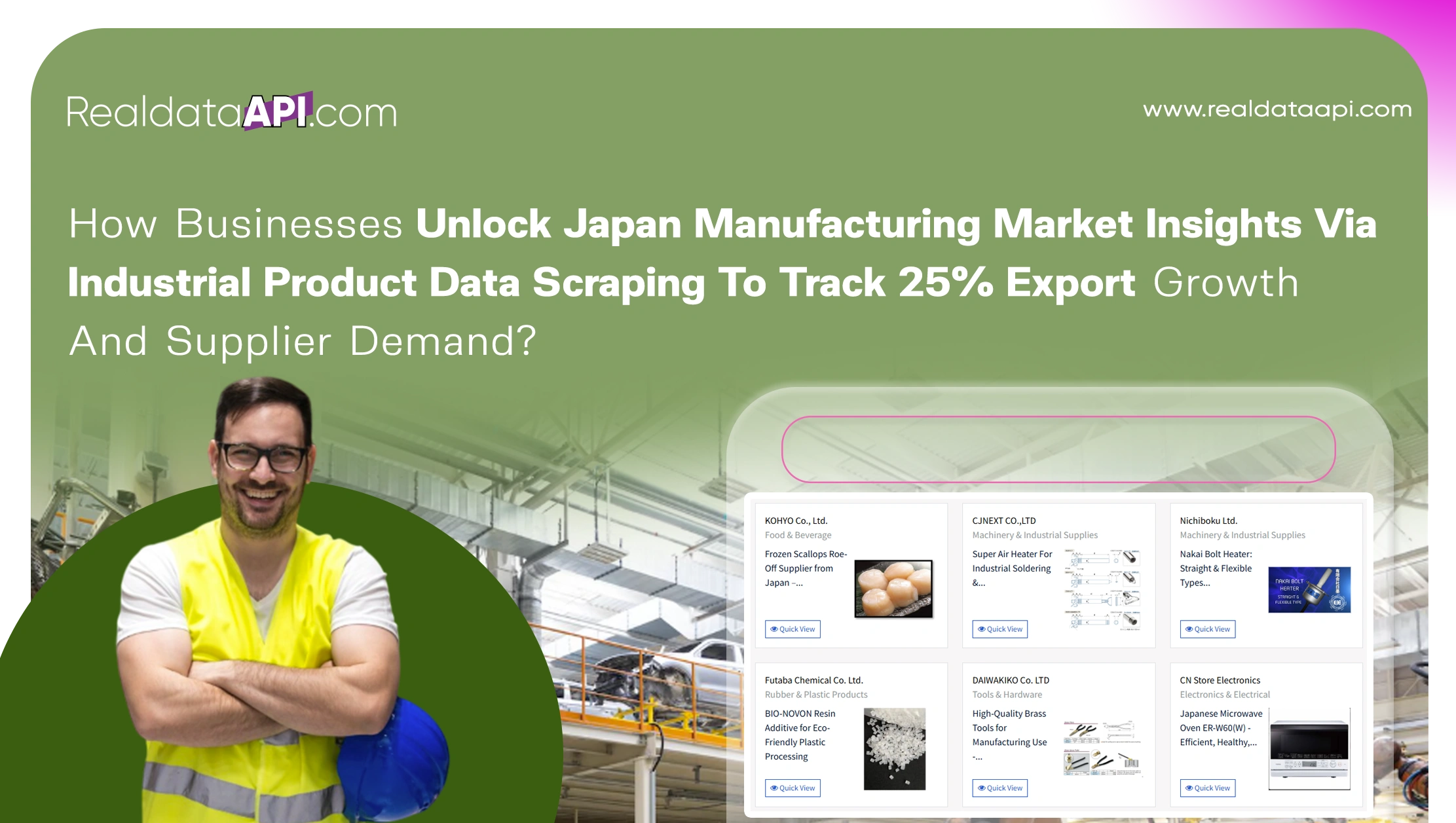
Introduction
Japan is one of the world’s leading manufacturing powerhouses, contributing significantly to global industrial supply chains in sectors such as automotive, robotics, electronics, and heavy machinery. The country’s manufacturing ecosystem consists of thousands of suppliers, distributors, and industrial product catalogs spread across online marketplaces, B2B portals, and supplier directories. However, collecting reliable market intelligence from these sources manually can be time-consuming and inefficient.
Today, companies rely on automated data extraction technologies to gain Japan manufacturing market insights via industrial product data scraping. By extracting product catalogs, supplier listings, pricing data, and export trends, businesses can better understand market demand and supplier competition. These insights are especially valuable for procurement teams, manufacturing analysts, and supply chain strategists who need real-time industrial market information.
Advanced Web Scraping Services enable organizations to gather structured datasets from multiple industrial product platforms across Japan. From tracking equipment prices to monitoring supplier inventory trends, automated data pipelines help businesses stay competitive in a rapidly evolving manufacturing landscape.
Between 2020 and 2026, Japan’s manufacturing exports have grown steadily due to rising global demand for precision equipment, electronic components, and industrial automation technologies. Data-driven insights allow businesses to analyze supplier performance, identify emerging product categories, and optimize procurement strategies. Through large-scale industrial product scraping, organizations can transform scattered online data into powerful manufacturing market intelligence.
Industrial Product Catalog Intelligence
Japan’s industrial sector includes extensive online product catalogs containing machinery components, automation equipment, electrical parts, and manufacturing tools. Companies often use Japan industrial product catalog data extraction to analyze product listings, technical specifications, and supplier inventories.
| Year | Catalog Listings Collected | Industrial Categories | Export Demand Index |
|---|---|---|---|
| 2020 | 420,000 | 280 | 100 |
| 2021 | 470,000 | 300 | 105 |
| 2022 | 520,000 | 320 | 110 |
| 2023 | 590,000 | 345 | 116 |
| 2024 | 650,000 | 370 | 120 |
| 2025 | 720,000 | 400 | 125 |
| 2026 | 800,000 | 435 | 132 |
The steady growth in industrial product listings reflects increased manufacturing activity and digitalization of supplier catalogs. Automated catalog extraction allows companies to track emerging product types, identify new manufacturers, and analyze equipment specifications across thousands of listings.
For procurement teams, these insights simplify vendor comparison and sourcing decisions. Manufacturers can also analyze competitor offerings and adjust product portfolios to match evolving market demand.
Industrial Equipment Price Monitoring
Industrial equipment pricing fluctuates based on raw material costs, production capacity, and global demand. Businesses frequently scrape industrial equipment pricing data Japan to monitor machinery costs and track pricing patterns across supplier platforms.
| Year | Avg Equipment Price Index | Machinery Listings | Demand Growth (%) |
|---|---|---|---|
| 2020 | 100 | 180,000 | 4 |
| 2021 | 104 | 195,000 | 6 |
| 2022 | 108 | 210,000 | 9 |
| 2023 | 112 | 230,000 | 12 |
| 2024 | 118 | 255,000 | 16 |
| 2025 | 123 | 280,000 | 20 |
| 2026 | 130 | 310,000 | 25 |
By monitoring pricing trends, businesses can detect market inflation, negotiate supplier contracts more effectively, and optimize procurement budgets. Industrial price scraping also reveals regional price variations across manufacturers.
These insights are particularly valuable for global companies sourcing machinery from Japan, as they enable data-driven purchasing strategies and improved cost forecasting.
Supplier Network Intelligence
Japan’s manufacturing ecosystem includes a vast network of component suppliers, equipment manufacturers, and distribution partners. Using a Japan manufacturing supplier data scraper, businesses can track supplier profiles, product availability, and partnership opportunities.
| Year | Suppliers Tracked | New Supplier Registrations | Active Exporters |
|---|---|---|---|
| 2020 | 58,000 | 4,200 | 18,500 |
| 2021 | 61,500 | 4,800 | 19,900 |
| 2022 | 65,000 | 5,200 | 21,300 |
| 2023 | 69,000 | 5,800 | 22,700 |
| 2024 | 73,500 | 6,300 | 24,100 |
| 2025 | 78,000 | 6,900 | 25,900 |
| 2026 | 83,000 | 7,500 | 27,600 |
Supplier intelligence enables organizations to build diversified supply chains and reduce dependency on single vendors. By analyzing supplier data, companies can also detect emerging manufacturers entering the industrial market.
Data-driven supplier monitoring supports better risk management and helps procurement teams quickly identify alternative vendors during supply disruptions.
B2B Industrial Pricing Insights
Industrial B2B marketplaces contain valuable information about component pricing, bulk order discounts, and supplier offers. Companies often Extract B2B industrial product pricing data Japan to analyze cost structures across the manufacturing ecosystem.
| Year | B2B Listings Analyzed | Avg Bulk Order Discount (%) | Supplier Price Variance |
|---|---|---|---|
| 2020 | 240,000 | 6 | 8% |
| 2021 | 260,000 | 7 | 9% |
| 2022 | 285,000 | 8 | 10% |
| 2023 | 315,000 | 9 | 11% |
| 2024 | 345,000 | 10 | 12% |
| 2025 | 380,000 | 11 | 13% |
| 2026 | 420,000 | 12 | 14% |
B2B pricing insights reveal negotiation opportunities and bulk purchasing advantages for manufacturing companies. Procurement departments can compare supplier offers, evaluate cost efficiency, and identify the best sourcing strategies.
These insights also help distributors analyze market competitiveness and optimize pricing strategies for industrial products.
Large-Scale Data Collection Systems
Modern manufacturing analytics requires scalable data collection infrastructures. Many organizations rely on Enterprise Web Crawling technologies to gather industrial product data from multiple supplier websites and marketplaces simultaneously.
| Year | Data Sources Crawled | Records Collected | Market Indicators Generated |
|---|---|---|---|
| 2020 | 85 | 900K | 150 |
| 2021 | 100 | 1.1M | 180 |
| 2022 | 120 | 1.3M | 210 |
| 2023 | 145 | 1.6M | 240 |
| 2024 | 170 | 1.9M | 280 |
| 2025 | 200 | 2.3M | 320 |
| 2026 | 240 | 2.7M | 360 |
Enterprise-scale crawling ensures continuous monitoring of industrial marketplaces and supplier directories. By collecting millions of product records, businesses gain comprehensive visibility into market movements and emerging product trends.
Such infrastructure supports predictive analytics models and helps organizations identify manufacturing opportunities earlier than competitors.
Real-Time Industrial Data Integration
Modern analytics platforms require continuous data feeds from multiple sources. Companies integrate industrial data pipelines through a Web Scraping API that delivers real-time product listings, supplier updates, and pricing information.
| Year | API Requests Processed | Industrial Sources Integrated | Insights Generated |
|---|---|---|---|
| 2020 | 1.3M | 60 | 180 |
| 2021 | 1.6M | 75 | 210 |
| 2022 | 2.0M | 90 | 250 |
| 2023 | 2.5M | 110 | 290 |
| 2024 | 3.0M | 130 | 330 |
| 2025 | 3.6M | 155 | 370 |
| 2026 | 4.3M | 180 | 420 |
API-driven scraping allows organizations to integrate manufacturing datasets directly into analytics dashboards and enterprise systems.
This real-time access to industrial data supports dynamic pricing models, supplier monitoring systems, and automated procurement platforms.
Why Choose Real Data API?
Real Data API offers advanced data extraction solutions designed to help organizations generate Japan manufacturing market insights via industrial product data scraping at scale. Our technologies allow businesses to collect and analyze vast amounts of industrial data from supplier directories, B2B platforms, and manufacturing catalogs.
With powerful tools like Instant Data Scraper, companies can quickly gather structured product information, supplier profiles, and pricing details from industrial websites.
Our platform supports:
- Large-scale industrial product scraping
- Supplier and pricing intelligence
- Manufacturing market analytics
- Procurement optimization insights
- Industrial trend forecasting
Through advanced automation and analytics capabilities, Real Data API transforms raw industrial listings into meaningful manufacturing market intelligence.
Conclusion
Japan’s manufacturing sector continues to expand with strong export growth, increasing supplier networks, and rising global demand for industrial equipment. Businesses that leverage Japan manufacturing market insights via industrial product data scraping gain a competitive advantage by accessing accurate product catalogs, pricing intelligence, and supplier data.
By utilizing advanced Web Scraping Services, organizations can collect large-scale industrial datasets, monitor manufacturing trends, and make smarter procurement decisions in real time.
Start leveraging Real Data API today to unlock powerful manufacturing insights and transform industrial product data into strategic business opportunities!
Latest posts
Keeta scraper for monitoring food marketplace trends - Identify Discount Changes and Emerging Customer Demand
How to build a structured Nike product dataset for Product Intelligence and Retail Analytics
Allegro scraper for competitor price monitoring – How to Track Product Prices and Stay Ahead of Competitors

Ocado API data collection services for retailers - Track Competitor Prices and Deals







.png)