.gif)
.png)

Introduction
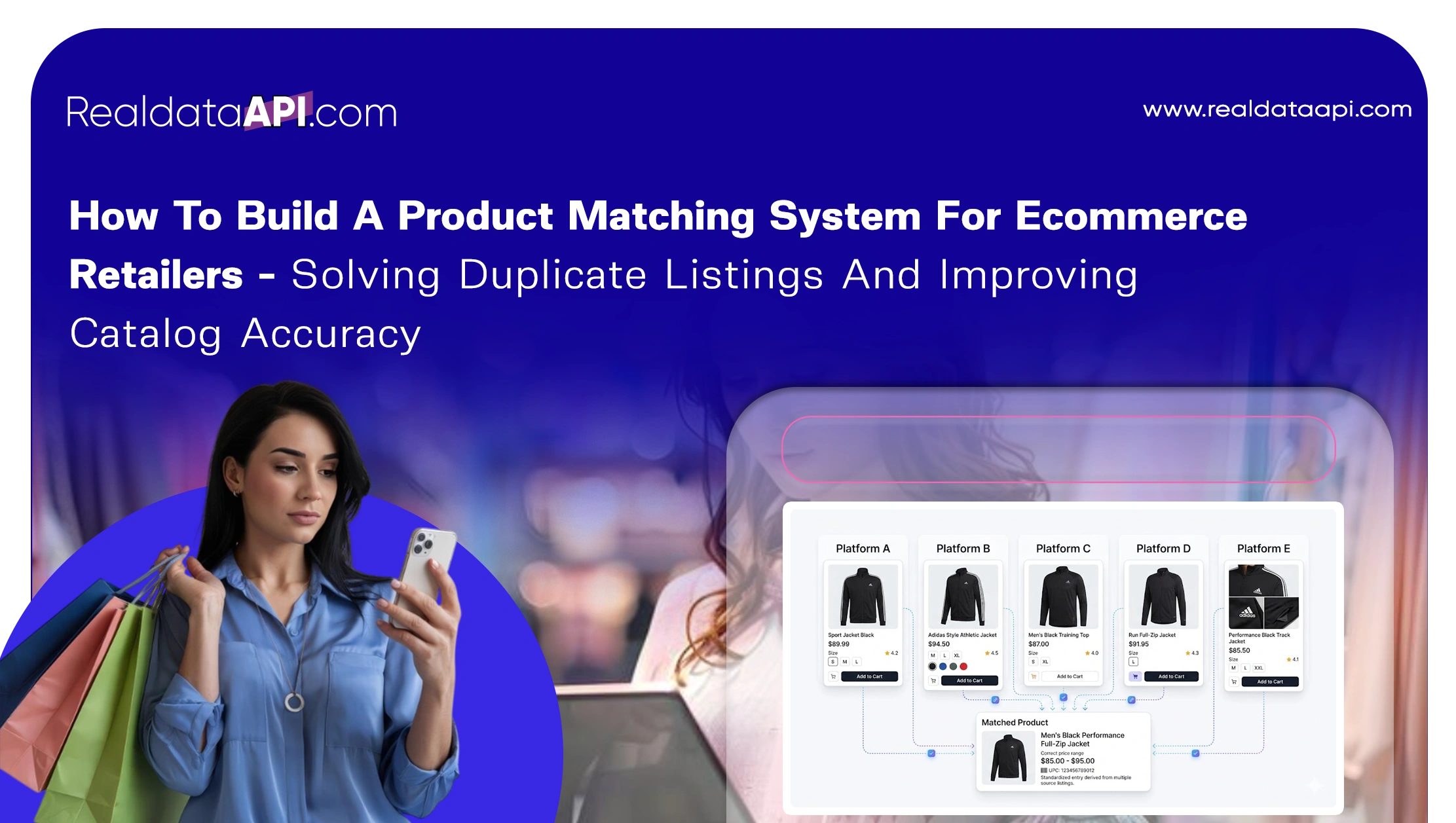
In today's competitive digital commerce landscape, maintaining accurate and consistent product catalogs is critical for success. However, ecommerce retailers often struggle with duplicate listings, inconsistent product descriptions, and fragmented data across multiple platforms. This creates confusion for customers and reduces the effectiveness of search, recommendations, and pricing strategies. Understanding how to build a product matching system for ecommerce retailers is essential to overcoming these challenges and ensuring a seamless shopping experience.
A robust product matching system identifies identical or similar products across different sources, even when names, formats, or attributes vary. By leveraging advanced technologies such as machine learning and natural language processing, retailers can standardize product data and improve catalog quality. An E-Commerce Data Scraping API plays a crucial role in gathering product data from multiple marketplaces, enabling real-time updates and comprehensive comparisons.
As ecommerce continues to grow, the ability to match products accurately becomes a key differentiator. This blog explores strategies, technologies, and data-driven approaches to building an effective product matching system that enhances accuracy, improves customer experience, and drives revenue growth.
Understanding Data Fragmentation Across Retail Platforms
One of the primary obstacles in ecommerce is managing fragmented product data. Addressing challenges in cross-retailer product matching and solutions requires a deep understanding of how data varies across platforms.
From 2020 to 2026, ecommerce product listings have grown exponentially:
| Year | Global Ecommerce Listings (Billions) | Duplicate Listing Rate (%) |
|---|---|---|
| 2020 | 2.5 | 18% |
| 2022 | 3.8 | 22% |
| 2024 | 5.5 | 27% |
| 2026* | 7.5 (Projected) | 32% |
This increase in listings has led to higher duplication rates, making manual matching impractical. Variations in product titles, descriptions, and attributes further complicate the process.
For example, the same product may appear with different names or specifications across multiple platforms, making it difficult to identify duplicates. A well-designed system uses data normalization techniques to standardize product attributes, ensuring consistency.
By addressing these challenges, retailers can reduce duplication, improve search accuracy, and enhance customer trust.
Building a Unified Product View Across Platforms
Creating a unified product catalog requires the ability to match products across multiple ecommerce websites. This involves aggregating data from various sources and aligning it into a single, consistent format.
Cross-platform data integration trends:
| Year | Multi-Platform Retailers (%) | Data Integration Efficiency (%) |
|---|---|---|
| 2020 | 35% | 40% |
| 2022 | 50% | 55% |
| 2024 | 65% | 70% |
| 2026* | 80% (Projected) | 85% |
Retailers increasingly operate across multiple platforms, making product matching more complex. A unified system ensures that identical products are grouped together, regardless of their source.
For instance, a smartphone listed on different marketplaces may have slight variations in naming or specifications. A matching system identifies these similarities and consolidates them into a single product entry.
This unified view improves catalog management, simplifies inventory tracking, and enhances the overall shopping experience.
Leveraging Advanced Algorithms for Accurate Matching
At the core of any product matching system are retail product matching algorithms that determine how products are identified and grouped.
Algorithm adoption trends:
| Year | AI-Based Matching Adoption (%) | Matching Accuracy (%) |
|---|---|---|
| 2020 | 30% | 70% |
| 2022 | 45% | 78% |
| 2024 | 60% | 85% |
| 2026* | 75% (Projected) | 92% |
Modern algorithms use techniques such as fuzzy matching, semantic analysis, and machine learning to identify similarities between products. These methods go beyond simple text matching to understand context and meaning.
For example, algorithms can recognize that "iPhone 13 Pro Max 256GB" and "Apple iPhone 13 Pro Max (256 GB)" refer to the same product.
By leveraging advanced algorithms, retailers can achieve higher accuracy and reduce false matches, ensuring a reliable product catalog.
Enhancing Customer Experience Through Accurate Comparisons
Accurate product matching enables effective ecommerce product comparison matching, which is essential for improving customer experience.
Customer behavior trends:
| Year | Users Relying on Product Comparison (%) | Conversion Rate Improvement (%) |
|---|---|---|
| 2020 | 40% | 12% |
| 2022 | 55% | 18% |
| 2024 | 70% | 25% |
| 2026* | 82% (Projected) | 32% |
When customers can easily compare products, they are more likely to make informed purchasing decisions. Matching systems ensure that comparisons are accurate and relevant.
For instance, comparing prices, features, and reviews across matched products helps customers choose the best option.
This not only improves user satisfaction but also increases conversion rates and sales.
Utilizing Structured Data for Scalable Solutions
A scalable product matching system relies on access to a structured E-Commerce Dataset that consolidates product information from multiple sources.
Dataset adoption trends:
| Year | Dataset Usage (%) | Data Processing Efficiency (%) |
|---|---|---|
| 2020 | 28% | 45% |
| 2022 | 45% | 60% |
| 2024 | 62% | 75% |
| 2026* | 80% (Projected) | 88% |
Structured datasets enable efficient data processing and integration with analytics tools. They also support advanced features such as predictive modeling and trend analysis.
For example, combining product data with sales data can help identify high-performing products and optimize inventory.
By leveraging structured datasets, retailers can scale their product matching systems to handle large volumes of data.
Driving Business Value Through Intelligent Matching
Ultimately, the goal of a product matching system is to create value. By focusing on Product Matching, retailers can improve operational efficiency and drive revenue growth.
Business impact trends:
| Year | Businesses Using Matching Systems (%) | Revenue Impact (%) |
|---|---|---|
| 2020 | 25% | 10% |
| 2022 | 40% | 18% |
| 2024 | 58% | 26% |
| 2026* | 72% (Projected) | 35% |
Accurate product matching reduces duplication, improves search relevance, and enhances pricing strategies. It also enables better inventory management and supplier coordination.
For example, retailers can identify duplicate listings and consolidate them, reducing operational costs and improving efficiency.
This creates a more streamlined and profitable ecommerce operation.
Why Choose Real Data API?
Real Data API provides advanced solutions for building and scaling product matching systems. With powerful tools for Price Comparison, businesses can analyze competitor pricing and optimize their strategies.
Additionally, how to build a product matching system for ecommerce retailers is fully supported through scalable data extraction and integration capabilities.
Key benefits include:
- High-quality structured datasets
- Real-time data access
- Advanced matching and analytics tools
- Scalable infrastructure
- Customizable solutions
By leveraging Real Data API, retailers can simplify complex data challenges and focus on delivering better customer experiences.
Conclusion
In a rapidly growing ecommerce landscape, understanding how to build a product matching system for ecommerce retailers is essential for solving duplicate listings and improving catalog accuracy. By leveraging advanced algorithms, structured datasets, and real-time data, businesses can create efficient and scalable matching systems.
From enhancing customer experience to optimizing pricing strategies, accurate product matching drives significant business value.
Start using Real Data API today to build a powerful product matching system and transform your ecommerce operations with data-driven intelligence.
Latest posts
Keeta scraper for monitoring food marketplace trends - Identify Discount Changes and Emerging Customer Demand
How to build a structured Nike product dataset for Product Intelligence and Retail Analytics
Allegro scraper for competitor price monitoring – How to Track Product Prices and Stay Ahead of Competitors
Ocado API data collection services for retailers - Track Competitor Prices and Deals







.png)