Introduction
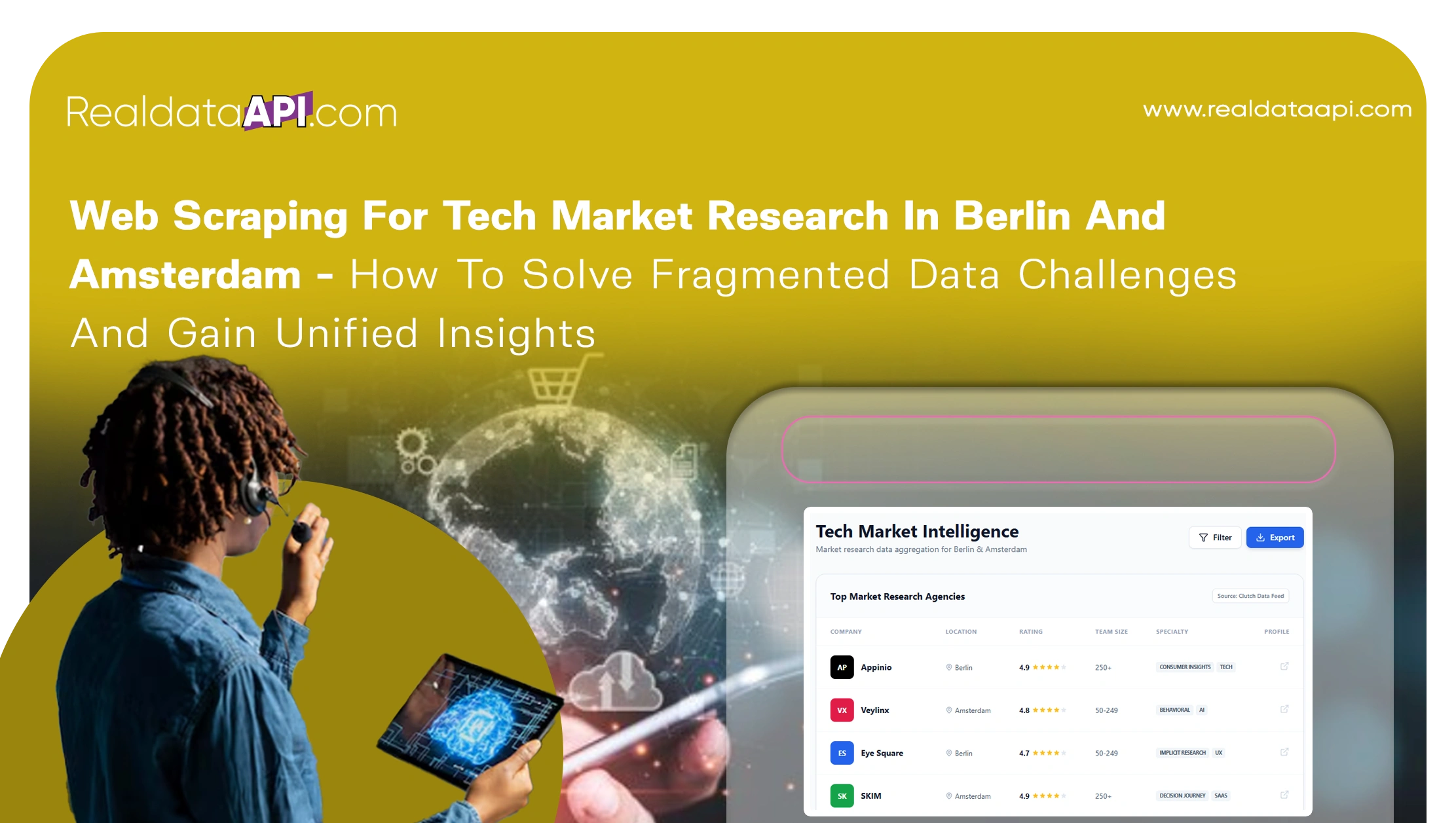
Modern tech ecosystems like Berlin and Amsterdam generate massive volumes of digital information across startups, SaaS platforms, funding portals, and product directories. However, this data is often fragmented across multiple sources, making it difficult for businesses to gain a unified view. web scraping for tech market research in Berlin and Amsterdam enables companies to consolidate this scattered information into structured, actionable insights.
With increasing competition in European tech hubs, relying on manual research is no longer efficient. A Web Scraping API helps automate the process of collecting, cleaning, and organizing data from diverse online sources such as company websites, job boards, and product listings.
This approach allows businesses to track innovation patterns, monitor competitor movements, and identify emerging market opportunities in real time. As Berlin and Amsterdam continue to grow as leading innovation centers in Europe, structured data collection becomes essential for making informed strategic decisions and reducing market uncertainty.
Building Structured Intelligence from Complex Tech Ecosystems
To succeed in competitive European markets, businesses need reliable access to structured datasets. Using extract tech company and product data for market insights Europe, organizations can analyze company growth, product launches, and funding activity across multiple regions.
Between 2020 and 2026, the European tech ecosystem has expanded rapidly:
| Year | Tech Companies (EU Hubs) | Product Launch Growth (%) |
|---|---|---|
| 2020 | 120,000 | 22% |
| 2022 | 160,000 | 35% |
| 2024 | 210,000 | 48% |
| 2026* | 280,000 (Projected) | 60% |
This growth creates challenges in tracking and comparing competitors manually. Scraped data helps unify fragmented information into structured dashboards, allowing companies to identify market gaps and emerging product trends.
For example, analyzing product updates across SaaS platforms in Europe can reveal innovation cycles and feature adoption rates. Businesses can also detect early-stage startups entering niche markets, giving them a strategic advantage.
By converting scattered web data into structured intelligence, companies can significantly improve forecasting accuracy and strategic planning.
Competitive Insights from Regional Tech Hubs
Understanding local ecosystems is critical for competitive positioning. Leveraging scrape Berlin Amsterdam SaaS and startup data for competitive analysis, businesses can track startups, funding rounds, and product evolution in two of Europe's most dynamic tech cities.
Key competitive indicators between 2020 and 2026:
| Year | SaaS Startups (Berlin & Amsterdam) | Avg. Funding Growth (%) |
|---|---|---|
| 2020 | 8,500 | 18% |
| 2022 | 12,000 | 27% |
| 2024 | 16,800 | 34% |
| 2026* | 22,500 (Projected) | 42% |
This data highlights the rapid acceleration of SaaS innovation in both cities. Scraping enables companies to monitor competitor pricing models, feature releases, and hiring trends in real time.
For instance, tracking job postings can reveal expansion strategies, while product updates can indicate shifts in target markets. This level of insight helps businesses anticipate competitor moves rather than react to them.
By combining data from Berlin and Amsterdam, companies gain a broader understanding of European SaaS competition and can refine their positioning accordingly.
Turning Data into Actionable Tech Insights
The ability to analyze tech trends using scraped data in Europe empowers businesses to move from observation to prediction. Instead of relying on static reports, companies can continuously monitor evolving patterns across multiple datasets.
Market trends from 2020–2026 show strong digital transformation across Europe:
| Year | Digital Adoption Rate (%) | Tech Investment Growth (%) |
|---|---|---|
| 2020 | 62% | 14% |
| 2022 | 70% | 21% |
| 2024 | 78% | 29% |
| 2026* | 85% (Projected) | 36% |
Scraped data helps identify shifts in technology preferences, such as cloud adoption, AI integration, and SaaS expansion. Businesses can analyze user reviews, product updates, and developer activity to detect emerging trends early.
This enables proactive decision-making, such as investing in high-growth technologies or entering underserved segments.
With structured analysis, companies can transform raw data into predictive intelligence that drives innovation and competitive advantage.
Monitoring Startup and Innovation Ecosystems at Scale
Tracking innovation requires continuous data collection from multiple sources. Using a European startup and innovation trends data scraper, businesses can monitor funding activity, accelerator programs, and product development trends across Europe.
Innovation growth trends between 2020 and 2026:
| Year | Active Startups | Innovation Index Score |
|---|---|---|
| 2020 | 2.8 Million | 65 |
| 2022 | 3.4 Million | 72 |
| 2024 | 4.1 Million | 80 |
| 2026* | 5.0 Million | 88 |
This data shows how rapidly Europe's innovation ecosystem is expanding. Scraping allows businesses to track venture capital flows, emerging sectors, and regional innovation hotspots.
For example, Berlin may show strong growth in AI startups, while Amsterdam may lead in fintech innovation. Identifying such patterns helps businesses allocate resources more effectively.
With continuous monitoring, companies can stay ahead of innovation cycles and identify opportunities before they become mainstream.
Scaling Data Operations with Professional Solutions
As data needs grow, many organizations turn to Web Scraping Services to manage large-scale data collection efficiently. These services handle technical complexities such as IP rotation, proxy management, and anti-bot detection.
Adoption of scraping services has increased significantly:
| Year | Businesses Using Scraping Services (%) | Data Volume Processed (TB) |
|---|---|---|
| 2020 | 22% | 6 TB |
| 2022 | 38% | 14 TB |
| 2024 | 55% | 28 TB |
| 2026* | 70% (Projected) | 45 TB |
Outsourcing scraping operations allows companies to focus on analysis rather than infrastructure. It also ensures higher data accuracy and scalability.
These services are particularly useful for tech market research, where data sources are constantly changing and expanding.
By leveraging professional scraping solutions, businesses can maintain consistent access to high-quality datasets without internal resource constraints.
Enterprise-Grade Data Infrastructure for Market Intelligence
Large organizations require robust systems to handle continuous data flows. Enterprise Web Crawling provides scalable solutions for collecting and processing massive datasets across global tech ecosystems.
Enterprise adoption trends:
| Year | Enterprise Adoption (%) | Avg. Data Sources Crawled |
|---|---|---|
| 2020 | 18% | 800 |
| 2022 | 30% | 1,500 |
| 2024 | 45% | 3,000 |
| 2026* | 60% (Projected) | 6,000 |
Enterprise crawling enables advanced analytics such as competitor mapping, predictive modeling, and market forecasting.
For companies operating across Berlin and Amsterdam, this ensures continuous visibility into evolving tech landscapes.
It also supports integration with AI systems, allowing businesses to automate decision-making based on real-time data.
Why Choose Real Data API?
Choosing the right data infrastructure provider is critical for success. Real Data API offers scalable and reliable solutions designed for modern tech research needs. With access to Web Scraping Datasets, businesses can quickly obtain structured, ready-to-use information.
Additionally, web scraping for tech market research in Berlin and Amsterdam is fully supported, enabling seamless tracking of competitors, startups, and innovation trends across Europe.
Key advantages include:
- High-quality structured datasets
- Scalable scraping infrastructure
- Real-time data access
- Compliance-ready solutions
- Customizable industry-specific data pipelines
Real Data API simplifies complex data challenges, allowing companies to focus on insights rather than data collection.
Conclusion
In today's fragmented digital ecosystem, web scraping for tech market research in Berlin and Amsterdam plays a crucial role in transforming scattered information into unified, actionable intelligence. From startups to enterprise-level organizations, structured data enables smarter decisions and stronger competitive positioning.
By leveraging advanced scraping tools, real-time analytics, and scalable infrastructure, businesses can unlock deeper insights into Europe's fast-evolving tech landscape.
Start using Real Data API today to unify your tech market research and gain a competitive edge in Berlin, Amsterdam, and beyond!
Latest posts
Truthsocial Data Scraping For Real-Time Social Media Insights

Zara Web Data Scraper For Fashion Trend Analysis - How Retailers Overcome Fast-Changing Fashion Demand & Inventory Challenges
How Real Estate Web Scraping Using Bayut API Solves Rental Pricing and Property Tracking Problems?

How Trendyol Data Collection for Ecommerce Market Research Solves Assortment, Pricing, and Market Intelligence Challenges?






.png)



