.gif)
.png)

Introduction
Modern businesses operate in an environment where information changes continuously. Product prices fluctuate, competitor websites update their offers, news and market signals emerge rapidly, and customer-facing content can change without notice. For companies that depend on digital intelligence, collecting information once a week or once a month may no longer provide enough visibility for timely decisions.
Gemini scraper for real-time data Extraction? can be positioned as part of a broader data intelligence workflow designed to collect, structure, and analyze publicly available web information. Businesses can use automated extraction to monitor product information, pricing, content changes, competitor activities, market trends, and other relevant signals at scale. Instead of depending entirely on manual research, organizations can establish repeatable processes for collecting information and delivering it to analytics systems.
A Gemini Scraper workflow can be useful for market researchers, AI teams, SaaS companies, e-commerce businesses, travel platforms, financial researchers, and competitive intelligence teams. When integrated with suitable storage, processing, and analytics tools, extracted information can become a continuous source of business intelligence.
The following sections explain how businesses can use automated extraction, APIs, structured datasets, and real-time monitoring workflows to improve market intelligence and competitive analysis.
Building Smarter Intelligence Pipelines for Changing Web Data
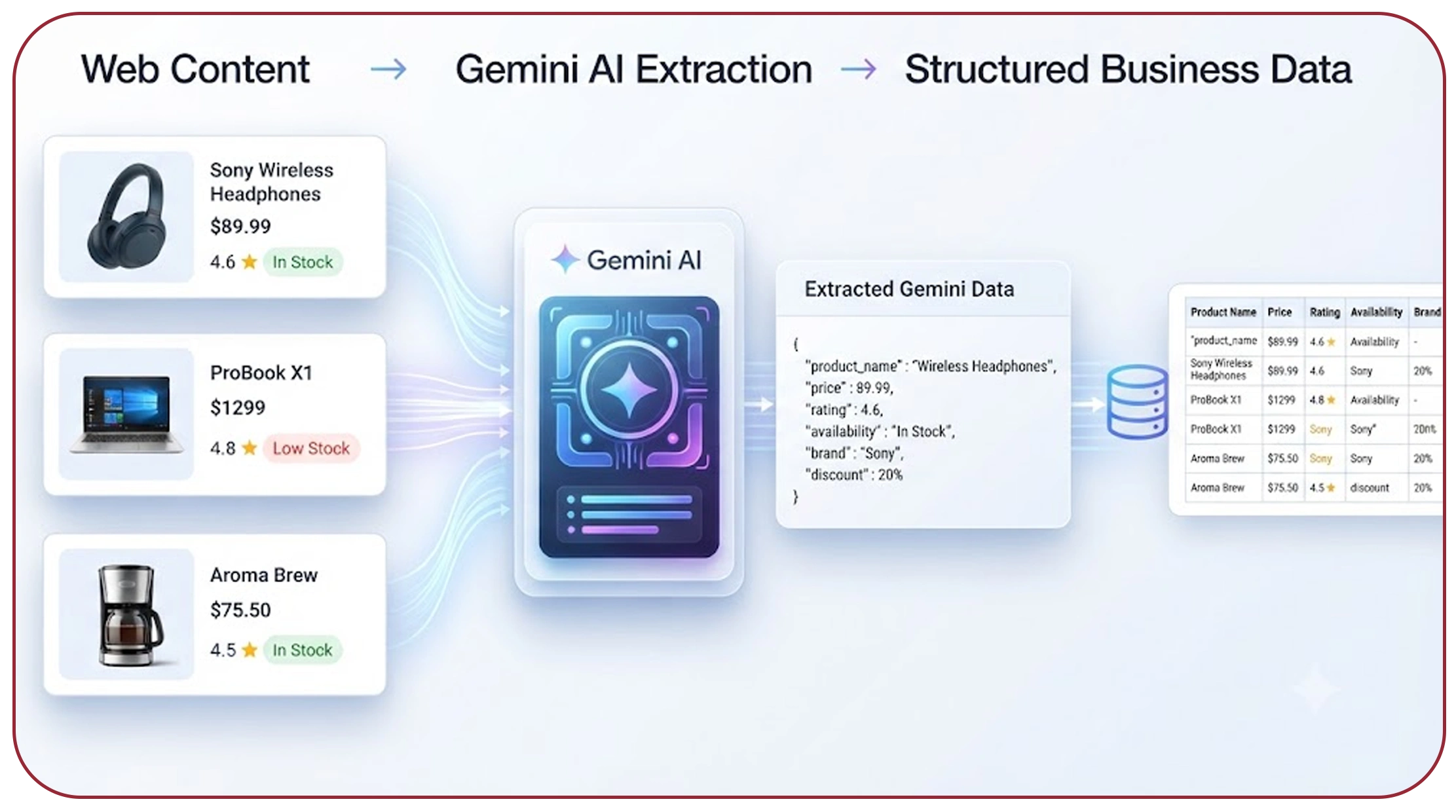
AI Chatbot web data extraction using GeminiExtraction? can help organizations process web information as part of an automated intelligence workflow. Traditional research often involves opening multiple websites, copying information, cleaning the results, and entering them into spreadsheets. This approach can become inefficient when hundreds or thousands of pages must be monitored regularly.
An AI-assisted workflow can help organize extraction requirements and prepare information for downstream analysis. Businesses can define the fields they need, establish collection schedules, validate extracted records, and send structured information into databases or analytical platforms. The purpose is not simply to gather more information but to create a repeatable process that converts changing web content into usable business data.
For example, a retailer could monitor competitor product descriptions and prices. A market research company could track industry websites and identify changes in product availability. An AI development team could collect fresh web information for applications that require current external signals.
The table below provides an illustrative maturity framework showing how organizations may evolve their data intelligence programs between 2020 and 2026. These figures are planning benchmarks, not industry statistics.
| Year | Illustrative Data Intelligence Maturity | Typical Business Approach |
|---|---|---|
| 2020 | 35% | Manual research and spreadsheets |
| 2021 | 43% | Basic automation |
| 2022 | 52% | Scheduled extraction |
| 2023 | 63% | Structured data pipelines |
| 2024 | 74% | Automated monitoring |
| 2025 | 84% | API-driven intelligence |
| 2026 | 92% | AI-assisted continuous analytics |
With a properly designed pipeline, businesses can reduce repetitive research and create more consistent datasets. This can improve competitive monitoring, trend identification, market research, and decision-making speed.
Scaling Collection Without Expanding Manual Research
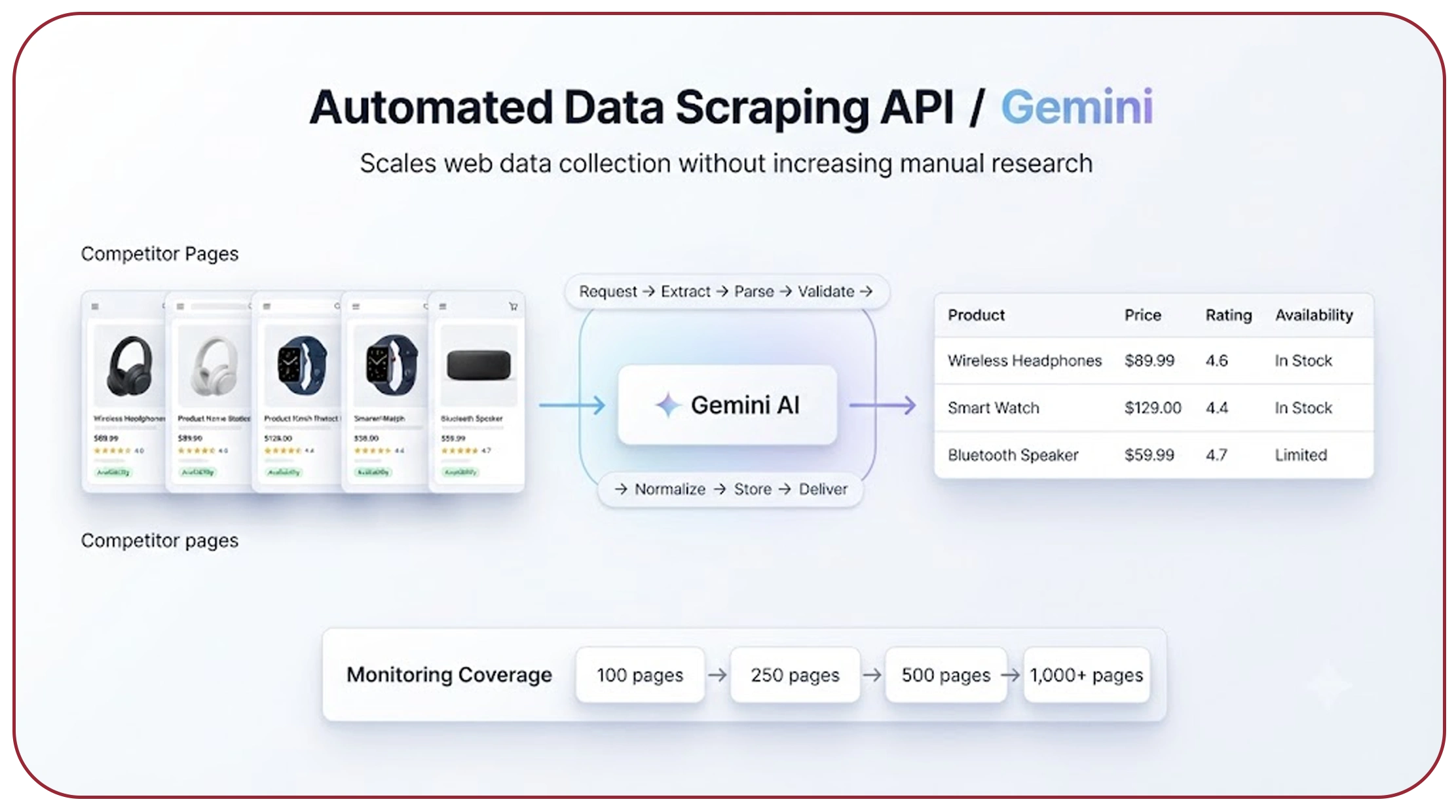
An automated data scraping API for GeminiExtraction? can provide an infrastructure layer between data sources and business intelligence applications. APIs are particularly useful when organizations need information on a recurring basis and want extracted data to flow automatically into databases, dashboards, analytics systems, or internal applications.
Consider a company monitoring 500 competitor pages. Manually checking those pages every day could require significant operational effort. An automated workflow can schedule collection, process responses, normalize fields, and store the results for comparison. Analysts can then concentrate on interpreting changes rather than repeatedly collecting raw information.
A scalable API-based architecture may include request management, extraction, parsing, validation, normalization, storage, and delivery. Depending on the use case, the resulting information can be provided in structured formats that are easier for analytics tools to process.
The following table illustrates a hypothetical progression in monitoring coverage as an organization matures its automation strategy.
| Year | Illustrative Pages Monitored | Primary Objective |
|---|---|---|
| 2020 | 100 | Initial research |
| 2021 | 250 | Competitor comparison |
| 2022 | 500 | Scheduled monitoring |
| 2023 | 1,000 | Market intelligence |
| 2024 | 2,500 | Large-scale tracking |
| 2025 | 5,000 | Continuous monitoring |
| 2026 | 10,000 | Automated intelligence |
These are illustrative operational scenarios and are not measured platform statistics.
For businesses, scalability is important because intelligence requirements often grow over time. A workflow that works for 50 pages may become difficult to maintain when the requirement reaches thousands of pages. API-based architecture can provide a more structured foundation for expanding coverage while maintaining consistent processing rules.
This can be particularly valuable for SaaS platforms, research firms, e-commerce businesses, and AI applications that require frequent data updates.
Turning Fresh Information Into Competitive Signals
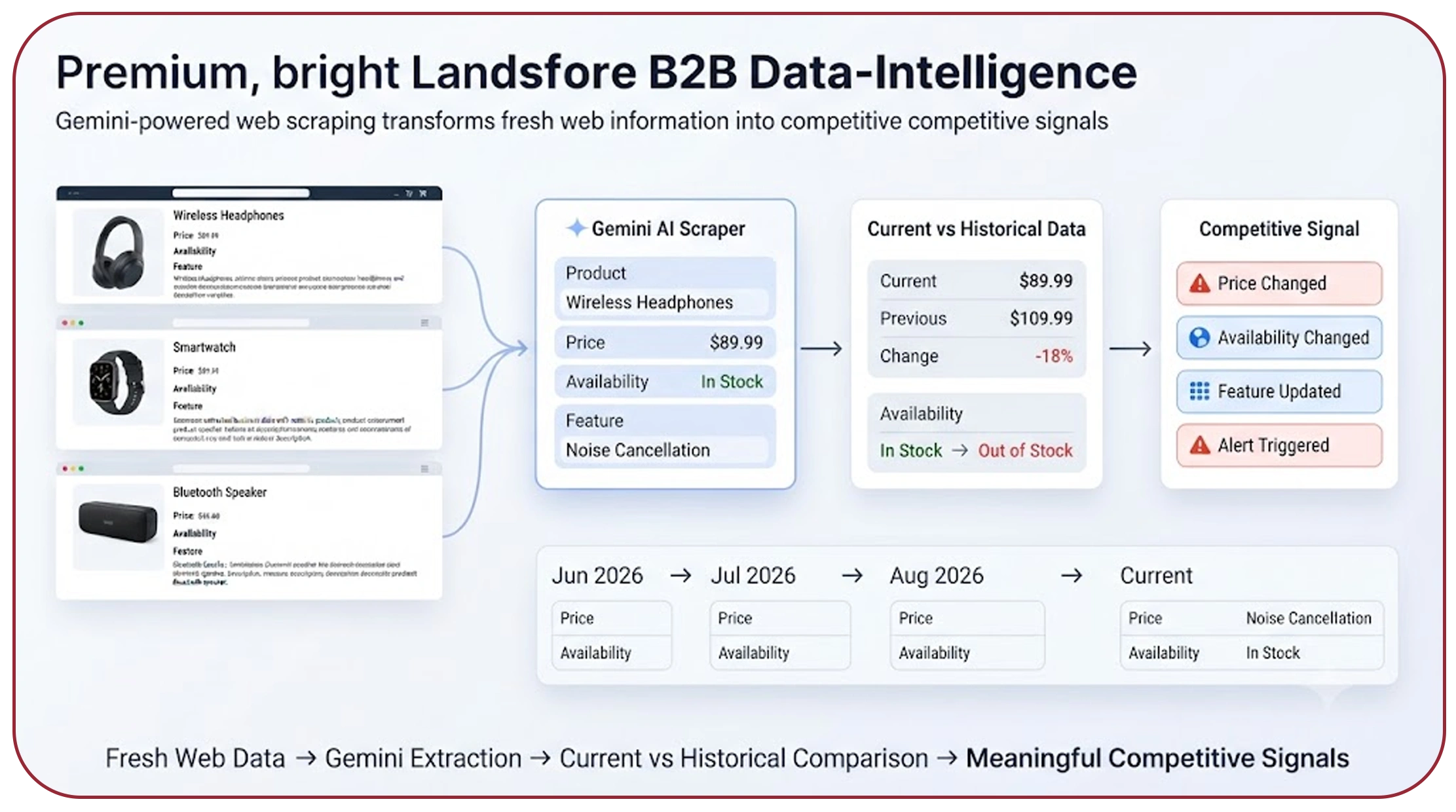
Businesses frequently need to know what changed, when it changed, and whether the change is commercially important. extract web data with Gemini scraperExtraction? workflows can help organizations collect relevant information from publicly accessible web pages and transform it into structured records for comparison.
The objective of competitive intelligence is not simply to archive web pages. It is to identify meaningful changes. For example, an e-commerce company may want to detect competitor price changes. A software company may monitor competitor feature pages. A market research organization may track new product launches or changes in public-facing offerings.
A recurring extraction workflow makes it possible to compare current observations with historical records. Analysts can calculate changes in price, product attributes, availability, content, or other fields. Alerts can then be generated when predefined thresholds are reached.
| Year | Illustrative Monitoring Frequency | Example Intelligence Goal |
|---|---|---|
| 2020 | Monthly | Establish baseline |
| 2021 | Biweekly | Identify major changes |
| 2022 | Weekly | Monitor competitors |
| 2023 | Daily | Track market movement |
| 2024 | Multiple times weekly | Detect faster changes |
| 2025 | Multiple times daily | Near-real-time monitoring |
| 2026 | Event-driven workflows | Rapid change detection |
These frequencies are examples of possible program maturity and should not be interpreted as historical industry measurements.
Fresh data can also support trend analysis. If a competitor repeatedly changes pricing before a major promotional period, historical records can reveal that pattern. If several businesses introduce similar products within a short period, monitoring can help identify an emerging category.
The combination of current information and historical records gives decision-makers greater context. Instead of responding to isolated events, businesses can evaluate changes against previous observations and determine whether they represent temporary fluctuations or broader market trends.
Connecting Web Extraction With Business Analytics
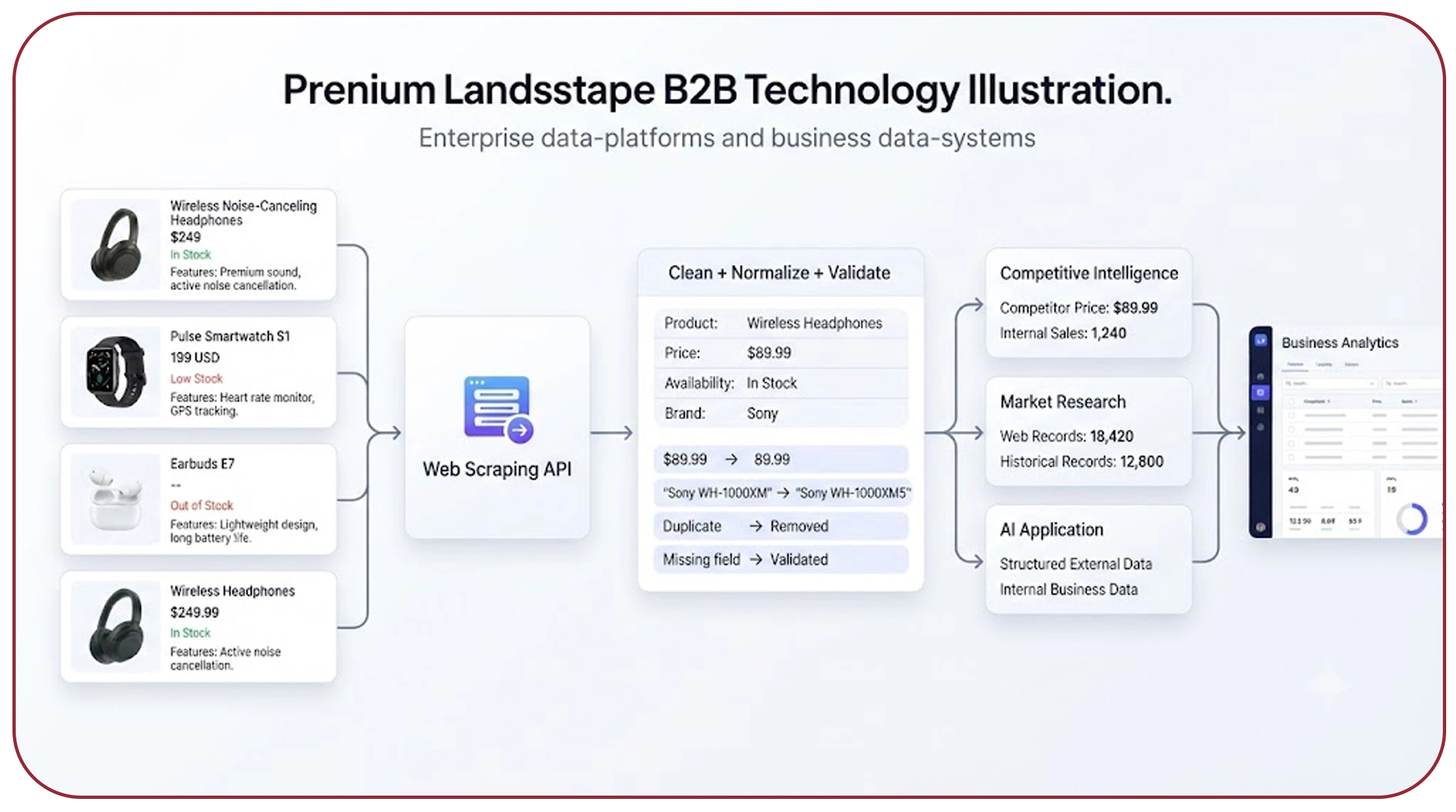
A scrape website content using web scraping APIExtraction? approach can help businesses connect public web information with their internal analytical systems. The extraction layer can collect relevant content, while downstream systems can clean, categorize, store, and analyze the information.
This separation is useful because raw web data is rarely ready for immediate business analysis. Pages may contain different layouts, inconsistent naming conventions, duplicate information, missing fields, or other variations. A structured pipeline can apply normalization and validation rules before the information reaches dashboards or analytical models.
For example, a competitive intelligence dashboard could combine extracted competitor pricing with internal sales information. A market research platform could combine web content with historical market datasets. An AI application could use structured external information as one input to a broader analytical workflow.
The following illustrative framework shows how data-processing priorities can evolve.
| Year | Illustrative Processing Focus | Business Outcome |
|---|---|---|
| 2020 | Manual cleaning | Basic reporting |
| 2021 | Field standardization | Better comparisons |
| 2022 | Automated validation | Improved consistency |
| 2023 | Database integration | Centralized intelligence |
| 2024 | Dashboard connectivity | Faster reporting |
| 2025 | Automated alerts | Faster response |
| 2026 | AI-assisted analysis | Advanced decision support |
These values are illustrative benchmarks rather than reported market statistics.
The greatest advantage comes from treating extraction as part of an end-to-end data pipeline. Collection, cleaning, storage, analysis, visualization, and alerting should work together. This creates a continuous intelligence loop in which new information can be collected, processed, compared against historical data, and delivered to decision-makers.
For organizations that depend on changing web information, this architecture can improve research efficiency while making market intelligence more actionable.
Supporting Large-Scale Research and Competitive Monitoring
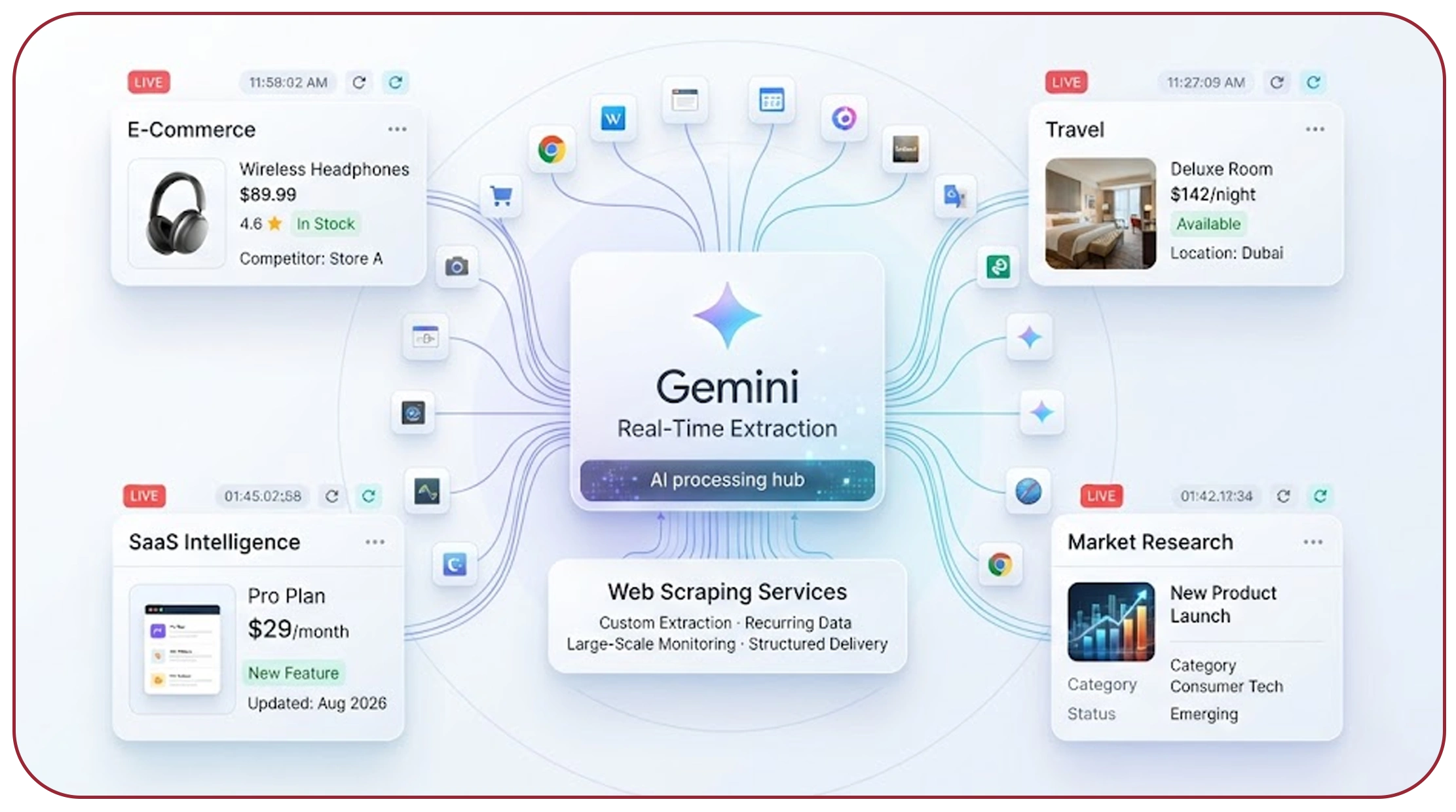
Professional Web Scraping Services can help organizations manage data extraction requirements when internal teams do not want to build and maintain every component of the collection infrastructure themselves. A managed approach can be useful for companies that need customized extraction, recurring datasets, large-scale monitoring, or structured delivery.
The role of Gemini scraper for real-time data Extraction? within such an ecosystem can be to support a workflow where relevant information is collected and prepared for downstream research. Businesses can define the websites, fields, frequency, and output requirements according to their use case, subject to the applicable website terms and legal requirements.
Large-scale research can cover many areas. E-commerce companies may monitor competitor catalogs and prices. Travel businesses can analyze public-facing accommodation or destination information. SaaS companies can track competitor product changes. Researchers can collect industry information to identify emerging market patterns.
| Year | Illustrative Research Coverage | Strategic Focus |
|---|---|---|
| 2020 | 10 sources | Basic market research |
| 2021 | 25 sources | Competitor monitoring |
| 2022 | 50 sources | Category analysis |
| 2023 | 100 sources | Broad market intelligence |
| 2024 | 250 sources | Large-scale monitoring |
| 2025 | 500 sources | Continuous intelligence |
| 2026 | 1,000+ sources | Enterprise research programs |
The source counts above are illustrative planning scenarios, not claims about service capacity or industry adoption.
A professional data service can also help with recurring maintenance. Websites change layouts, fields, navigation structures, and content patterns. A sustainable extraction strategy therefore requires monitoring and adaptation rather than assuming that a scraper will work indefinitely without maintenance.
For businesses, the combination of scalable extraction and structured delivery can reduce operational complexity and allow internal teams to focus more heavily on analysis, strategy, and decision-making.
Extending Intelligence Beyond Desktop Websites
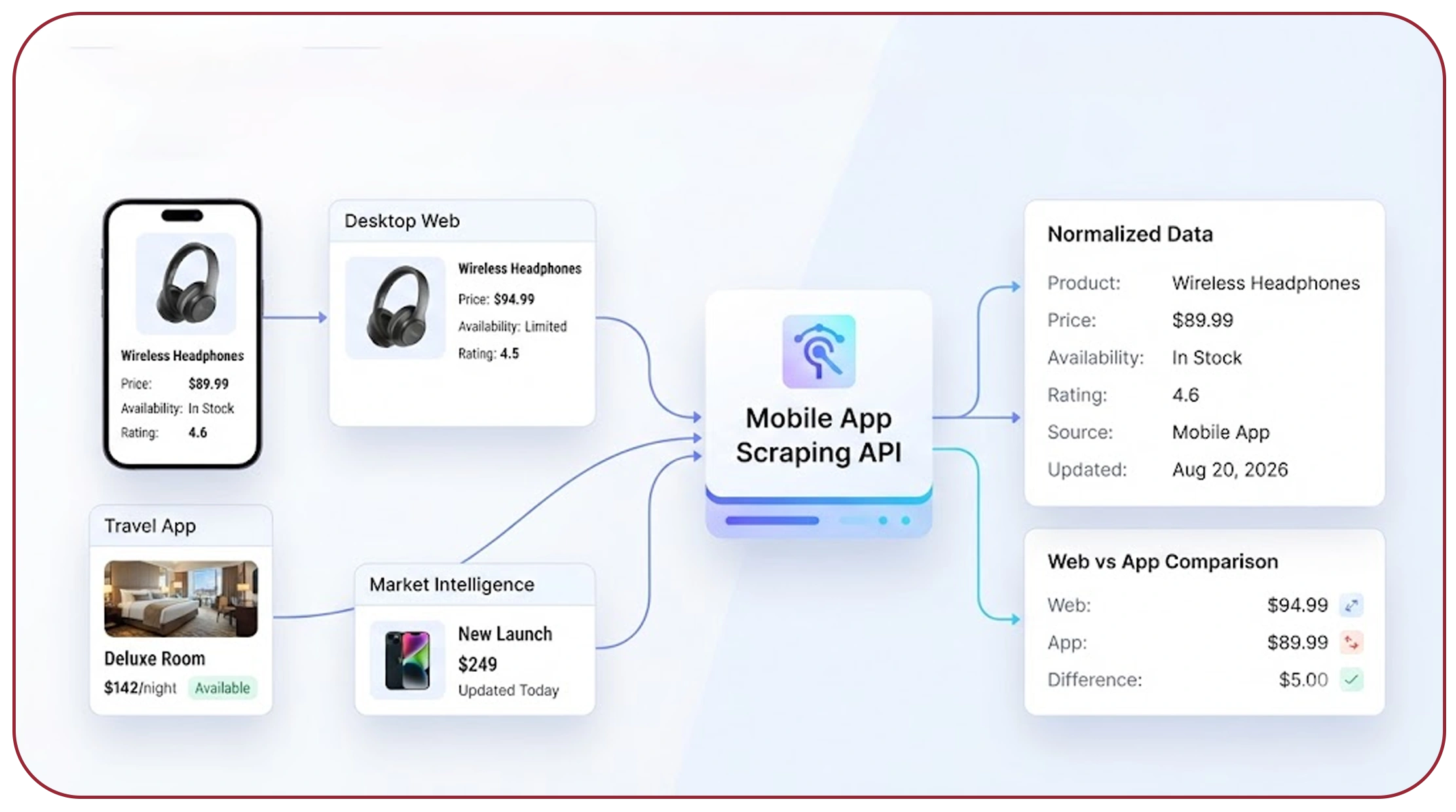
A Mobile App Scraping API can help businesses investigate publicly accessible information presented through mobile applications where appropriate and legally permitted. Many digital businesses now distribute information across websites and mobile apps, making multi-channel data intelligence increasingly relevant.
For example, a company researching an e-commerce market may need to understand whether product availability or pricing differs across digital channels. A travel researcher could analyze publicly available information presented through an application. A market intelligence platform may want to compare information from different customer-facing interfaces.
The objective should be to create a consistent data model regardless of the source channel. Information collected from different environments can be normalized into common fields so that analysts can compare records more effectively.
| Year | Illustrative Multi-Channel Focus | Potential Application |
|---|---|---|
| 2020 | Desktop websites | Basic web research |
| 2021 | Mobile web | Broader coverage |
| 2022 | Mobile applications | Channel comparison |
| 2023 | Website + app datasets | Unified intelligence |
| 2024 | Automated synchronization | Frequent updates |
| 2025 | Cross-channel analytics | Competitive monitoring |
| 2026 | AI-assisted multi-source analysis | Advanced market intelligence |
These are illustrative technology-adoption stages rather than measured market statistics.
Multi-channel collection can become especially valuable when customer-facing information varies between platforms. Comparing different channels can reveal pricing differences, availability patterns, content variations, or other commercially relevant signals.
For Real Data API customers, the broader objective is to create a flexible data architecture capable of supporting multiple sources and delivery requirements. When combined with historical datasets, automated monitoring, and analytics, multi-channel information can contribute to a more comprehensive view of market behavior.
Why Choose Real Data API?
Real Data API can help businesses develop scalable data collection and delivery workflows for market intelligence, competitive monitoring, research, and AI-driven applications. Instead of treating scraping as a one-time task, organizations can build repeatable pipelines designed around their specific data requirements.
A strong data workflow should consider source discovery, extraction, parsing, validation, normalization, storage, refresh frequency, and delivery. This approach helps businesses obtain information in a format that can be connected to dashboards, databases, analytical systems, and machine-learning workflows.
Real Data API can also support organizations that need customized extraction projects rather than generic datasets. Depending on the project requirements, businesses can define target sources, required fields, collection frequency, and output structure.
For companies competing in markets where information changes rapidly, reliable data infrastructure can become an important strategic capability. The combination of automation, structured data, scalable workflows, and analytics helps organizations move from reactive research toward continuous market intelligence.
Conclusion
Businesses cannot always make effective competitive decisions using information that is several days or weeks old. Prices change, products are updated, competitors launch new offerings, and customer-facing content evolves continuously. A structured approach to web data extraction can help organizations monitor these changes and turn them into actionable market signals.
By using Gemini scraper for real-time data Extraction?, companies can develop workflows for collecting relevant public web information, maintaining historical records, comparing market changes, and feeding structured datasets into analytics systems. This can support competitive intelligence, market research, pricing monitoring, trend discovery, and AI applications.
The real value comes from connecting extraction with the rest of the data lifecycle. Collection should be followed by validation, normalization, storage, analysis, and reporting so that fresh information becomes usable intelligence rather than simply another collection of raw records.
Contact Real Data API to create a customized real-time data extraction solution for your research, monitoring, and competitive analysis requirements!
Latest posts
Keeta scraper for monitoring food marketplace trends - Identify Discount Changes and Emerging Customer Demand
How to build a structured Nike product dataset for Product Intelligence and Retail Analytics
Allegro scraper for competitor price monitoring – How to Track Product Prices and Stay Ahead of Competitors
Ocado API data collection services for retailers - Track Competitor Prices and Deals






.png)



