Quick Summary
- Flipkart API for e-commerce competitor benchmarking helps businesses plan structured product comparisons, review advertised prices, and analyse competitive positioning using authorised data sources.
- A Flipkart E-Commerce Dataset can organise product attributes, listing details, prices, and timestamps for research, reporting, and assortment analysis. Reliable benchmarking requires consistent product matching, documented collection methods, and validation of observed data. Official API access, permissions, and available fields should be confirmed before implementing any automated workflow.
Introduction
Online marketplaces give businesses access to competing products, multiple sellers, and frequently changing offers. Flipkart API for e-commerce competitor benchmarking provides a useful framework for exploring how authorised marketplace data can support product comparisons, pricing research, and competitive analysis. Businesses can use structured information to examine product positioning, identify differences between comparable offers, and develop evidence-based pricing strategies. A Flipkart E-Commerce Dataset can bring product names, identifiers, categories, listed prices, images, and other available attributes into a consistent analytical format. The specific fields depend on the source and access permissions. Flipkart's official Seller API documentation focuses on seller operations, including listing management, pricing, inventory, order fulfilment, and reporting. It should not be assumed that these seller APIs provide unrestricted access to competitors' listings. Source: Flipkart Marketplace Seller API documentation.
For businesses evaluating marketplace data solutions, the first step is to define the research objective. Price comparisons, product assortment analysis, and listing availability monitoring each require different data fields and validation rules. A well-planned workflow also records source information and observation timestamps so that analysts can distinguish verified changes from incomplete or outdated records.
Understanding Product Information Across Online Retail Channels
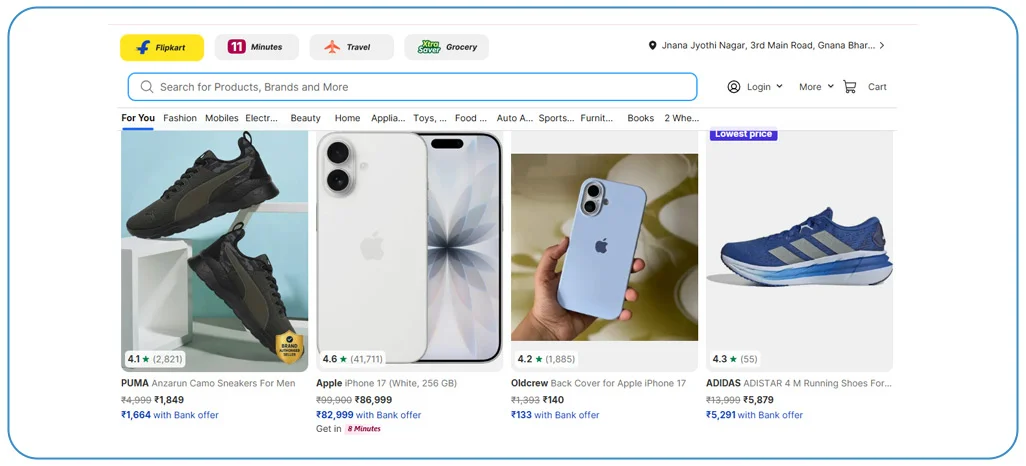
Flipkart product data web scraping is a term used for collecting product information from online pages or other permitted sources and organising it for analysis. Before choosing a collection method, businesses should determine whether the information is available through an official API, an authorised partner, a licensed dataset, or another permitted access method.
Useful product attributes may include product identifiers, titles, brands, categories, specifications, image references, and displayed prices. When comparing products across marketplaces, consistent identifiers and detailed attributes are particularly important. Two listings with similar titles may refer to different models, capacities, colours, or product conditions.
India's ecommerce market provides a strong commercial reason to invest in better product intelligence. Bain & Company's How India Shops Online 2025, produced in collaboration with Flipkart, estimated India's e-retail market at approximately US$60 billion in gross merchandise value in 2024. The report also noted that growth slowed to approximately 10%–12% that year, compared with historical growth above 20%. These are market-level estimates, not measurements of Flipkart's individual product categories. Source: Bain & Company, How India Shops Online 2025.
Published market context, 2020–2026
| Year | Verified data point | Relevance to product research |
|---|---|---|
| 2020 | Bain reported that online channels experienced accelerated adoption during the pandemic. | Reinforces the importance of tracking changing shopping behaviour. |
| 2021 | India's digital commerce continued developing as consumers adopted online shopping. | Supports maintaining consistent historical observations. |
| 2022 | Bain's research documented the expansion of digital payments and ecommerce enablers. | Highlights the importance of studying the wider digital retail ecosystem. |
| 2023 | Bain published an updated assessment of India's e-retail landscape. | Provides market context for changing retail operations and technology. |
| 2024 | India's e-retail market was estimated at approximately US$60 billion in GMV. | Establishes a published market-size reference point. |
| 2025 | Bain's 2026 report estimated India's e-retail market at US$65–66 billion in GMV. | Provides a more recent market benchmark. |
| 2026 | The 2026 report projected a US$170–180 billion market by 2030. | Offers a forecast, not a confirmed 2026 full-year result. |
Sources: Bain, How India Shops Online 2023, Bain, How India Shops Online 2025, and 2026 report coverage by NDTV Profit.
These figures describe India's broader e-retail market. They should not be interpreted as Flipkart-specific revenue or product-level statistics. For practical benchmarking, businesses should maintain their own source-verified product records and use published market figures only as broader context.
Examining Price Differences and Changes Over Time
Flipkart pricing data extraction involves collecting and structuring available price information so that comparable products can be assessed across sellers, channels, or observation dates. A useful dataset should distinguish displayed selling price from maximum retail price, shipping fees, discounts, and other charges whenever the source provides these fields.
Flipkart's official Seller API documentation describes listing-management operations for sellers, including retrieving listing details and managing selling prices, maximum retail prices, shipping fees, and inventory. These functions are intended for authorised seller workflows; they do not establish universal access to competitor pricing. Source: Flipkart Listing Management API overview.
A consistent comparison process should include several checks:
- Product identity: Match brand, model, product identifier, and specifications before comparing prices.
- Price definition: Keep selling price, maximum retail price, and shipping charges separate.
- Currency and timing: Record the currency and the date and time of each observation.
- Promotional context: Record discounts or offers only when they are explicitly available in the source.
- Data freshness: Revalidate records according to the research schedule and permitted access method.
The following calculations can help explain observed changes:
| Metric | Calculation or interpretation |
|---|---|
| Absolute price difference | Current observed price minus previous observed price |
| Percentage price change | Price difference divided by previous price, multiplied by 100 |
| Discount against MRP | Difference between MRP and selling price, divided by MRP, multiplied by 100 |
| Price spread | Difference between the highest and lowest comparable observed prices |
These are standard analytical calculations, not reported outcomes from a specific retailer. Each metric requires comparable records and a valid baseline. For example, a product's listed price may decrease because a promotion has started, while another listing may represent a different model or package size. A monitoring system should flag these situations instead of automatically treating every difference as a competitive price change.
Tracking Competitors with Reliable Product Comparisons

Businesses that Scrape Flipkart data for competitor monitoring need to build a repeatable workflow that separates verified listing information from assumptions about competitors. The objective is to understand observable differences in product offerings, displayed prices, and listing status rather than to infer sales or strategy from incomplete evidence.
A practical workflow begins by defining a product category and identifying the attributes that make products comparable. Analysts can then organise permitted source data, standardise product names, validate identifiers, and compare observations across reporting periods. Records that cannot be confidently matched should remain separate until further verification is available.
A competitor-monitoring report can include:
| Reporting field | Business purpose |
|---|---|
| Product identifier | Helps prevent incorrect product matching |
| Brand and category | Supports category-level comparisons |
| Displayed price | Records the observed asking price |
| Observation timestamp | Establishes when the price was recorded |
| Listing status | Records the status only when it can be verified |
| Source reference | Supports traceability and review |
| Match confidence | Identifies uncertain product comparisons |
The results can support pricing reviews, assortment decisions, and research into how products are presented across marketplaces. However, advertised prices do not establish final transaction prices, and missing listings do not prove that a product has sold out. Such conclusions require additional evidence.
Collection permissions must also be reviewed before implementation. Flipkart's official API documentation explains that access requires appropriate registration and authentication. API use is governed by the applicable terms and access scope. Source: Flipkart Marketplace Seller APIs.
Evaluate your competitor research requirements and identify an authorised data collection method that fits your target categories, reporting frequency, and analytical goals!
Get Insights Now!Converting Marketplace Records into Business Insights
Extract Flipkart marketplace data for business intelligence describes the process of preparing authorised marketplace information for dashboards, reports, and strategic analysis. Raw product records often require cleaning and standardisation before they can support meaningful business decisions.
A business intelligence workflow can group products by category, brand, price range, and product attributes. Analysts may then examine the distribution of observed prices, identify products with incomplete information, and review changes between comparable observations. Historical records can help teams investigate whether a price difference is temporary or part of a longer pattern, provided the collection schedule and product matching remain consistent.
A well-structured reporting model should distinguish observations, calculated metrics, and interpretations.
| Data layer | Example content | Quality control |
|---|---|---|
| Source records | Original product attributes and observed prices | Preserve permitted source references |
| Standardised records | Normalised names, categories, and currencies | Apply consistent field definitions |
| Analytical metrics | Price differences and category counts | Validate formulas and input data |
| Business reports | Category comparisons and trend summaries | Explain coverage and limitations |
For example, analysts can compare the distribution of observed prices for a defined group of matching products. This can identify differences that deserve further investigation, but it cannot independently establish which competitor has the greatest sales or profitability.
The need for careful interpretation is especially important in a growing retail market. Bain's 2025 research estimated India's e-retail market at approximately US$60 billion in 2024 and described slower growth than in previous years. The figures offer useful context, but they do not explain the performance of an individual seller or product. Source: Bain & Company.
Good business intelligence therefore depends on documented definitions, source transparency, and clear limitations. A report should state which products and time periods it covers, how missing records were treated, and whether its findings represent a sample or a complete authorised dataset.
Selecting an Appropriate Integration Method
A Flipkart API integration can support automated workflows where the required data and operations are available through approved endpoints. Flipkart's official Seller API documentation describes application registration, authentication, listing operations, and other seller-management functions. Access is not automatically granted simply because a business has a seller account; API application setup and permissions are part of the process. Source: Flipkart API documentation.
Before selecting an integration, teams should define the intended use case. Seller listing management, inventory synchronisation, order processing, and competitor research are different requirements. An API designed for a seller to manage its own catalogue should not be assumed to provide unrestricted information about other sellers.
An integration assessment should address:
- Endpoint coverage: Confirm that the approved API exposes the required fields.
- Authentication: Follow the official registration and token-handling procedures.
- Data access: Verify the scope of permitted accounts, listings, and operations.
- Update frequency: Confirm the supported access pattern and any applicable limits.
- Error handling: Plan for expired credentials, incomplete responses, and temporary failures.
- Data governance: Define access controls, retention, and approved downstream uses.
Flipkart's listing documentation also describes batch retrieval for certain listing operations. Its product-search endpoint documentation specifies a maximum of 20 listings per batch for the documented operation. This is an endpoint-specific limit, not a general limit for every Flipkart API. Source: Flipkart product-search API reference.
Integration decisions should therefore be based on the current official documentation and the permissions actually granted. If a required competitor-data field is unavailable through the approved API, the business should investigate another authorised source rather than assume that the field can be obtained through the same endpoint.
Maintaining a Reliable Collection and Reporting Pipeline
A Flipkart Scraper may refer to software that collects and structures information from accessible web pages or other approved sources. Before deployment, businesses should confirm that the collection method is authorised and that its use complies with applicable platform terms, privacy requirements, and data-protection laws.
Technical reliability matters because product catalogues and prices are not static. Records may be duplicated, fields may be missing, and product pages may change. A collection pipeline should therefore include validation, logging, and clear handling for failed requests or incomplete records.
Recommended operational checks include:
- Validate required fields before storing a record.
- Preserve source identifiers and observation timestamps.
- Detect duplicate records without removing distinct seller offers.
- Standardise currencies and numerical formats.
- Flag suspicious values for review rather than deleting them automatically.
- Monitor changes to source structures and update integrations when authorised documentation changes.
- Document which categories, sources, and periods are covered.
A useful reporting schedule should match the business question and the access conditions. Some research projects may need periodic snapshots, while others may require more frequent observations if the approved source supports them. No specific refresh interval should be promised without confirming source capabilities and access restrictions.
Data governance is equally important. Teams should limit collected fields to those required for the stated purpose, restrict access to authorised users, and establish retention rules. These safeguards help make the resulting analysis more transparent and reproducible.
Finally, reports should separate directly observed facts from calculated metrics and business interpretations. This makes it easier for decision-makers to verify conclusions and reduces the risk of presenting an incomplete dataset as a comprehensive view of the marketplace.
Why Choose Real Data API?
Real Data API can be considered for businesses planning structured product-data workflows and competitive research. A useful solution should begin with clear requirements, source verification, consistent field definitions, and a realistic assessment of authorised access.
Flipkart Product Data Scraping projects benefit from quality checks that address duplicate listings, product matching, timestamps, missing attributes, and inconsistent prices. Teams should also confirm whether their intended fields are available through official APIs, authorised partners, or other permitted sources before development begins.
A well-planned workflow can help organise product information for reporting and comparison without promising unsupported coverage or guaranteed results. The appropriate scope depends on the source, access permissions, required fields, and reporting objectives. Documentation and validation should remain part of the process from collection through final analysis.
Conclusion
Effective competitor research requires reliable product identification, consistent price observations, and careful interpretation. Flipkart API for e-commerce competitor benchmarking can help frame a data strategy for comparing products and monitoring marketplace information, provided the chosen collection method supports the required fields and is authorised for the intended use.
Businesses should prioritise traceable sources, documented calculations, and regular data-quality checks rather than relying on isolated prices or unsupported market assumptions. Official API capabilities and permissions should be verified before implementation.
Ready to improve your marketplace research workflow? Contact Real Data API to discuss your product-data requirements, authorised data sources, and competitor benchmarking objectives!
Frequently Asked Questions
1. What is marketplace competitor benchmarking?
It compares observable product attributes and prices across competing offers. Flipkart API for e-commerce competitor benchmarking requires suitable data access and consistent product matching for meaningful results.
2. What does a product dataset contain?
A Flipkart E-Commerce Dataset may include product titles, categories, identifiers, prices, and image references, depending on source availability, permissions, and the dataset's documented scope.
3. Can businesses collect competitor prices through official APIs?
Flipkart pricing data extraction depends on the endpoints and permissions available. Seller APIs should not be assumed to provide unrestricted competitor information or universal catalogue access.
4. How frequently should product information be updated?
Scrape Flipkart data for competitor monitoring only through permitted methods, using a schedule suited to the research objective and the source's supported access conditions.
5. How can Real Data API support product research?
Real Data API can discuss structured product-data workflows, field requirements, and validation needs. Flipkart API access and available data must be verified for each intended use case.
Latest posts

How Myntra scraper for online fashion retail analytics Helps Track Trends, Prices, and Product Demand

Web scraping services for real-time market insights - How Businesses Can Track Trends and Competitors

How to Use a Meesho ecommerce scraper 2026 to Analyze Product Listings, Pricing, and Market Opportunities
How a Blinkit scraper for retail market research Helps Brands Track Competitor Pricing and Product Trends




.png)


