
Quick Summary
- A Flipkart India daily ecommerce dataset for market research helps businesses examine product listings, pricing patterns, promotional offers, and assortment changes using structured marketplace observations.
- A Flipkart Scraper can support authorized data collection workflows, subject to platform terms, access permissions, and applicable laws.
- Consistent data validation and historical comparisons help retailers understand competitive positioning, evaluate market opportunities, and improve commercial decisions. Industry reports provide additional context, but marketplace observations should not be confused with actual sales, consumer demand, or inventory levels.
Introduction
India's online retail sector offers businesses opportunities to study product assortment, pricing, promotions, and competition across digital marketplaces. A Flipkart Scraper can help brands, manufacturers, sellers, and analysts collect and organize marketplace data into a consistent format for commercial analysis. When collected through authorized channels, these records can support product comparisons, pricing research, competitor monitoring, and historical trend analysis. Their usefulness depends on accurate product matching, reliable timestamps, representative coverage, and clear definitions of the metrics being measured.
Businesses that Scrape Flipkart India product data daily need a structured approach to access permissions, data quality, storage, and reporting. A recurring collection schedule can help researchers compare observations over time, but daily collection alone does not guarantee complete coverage or current prices. Businesses should also distinguish visible product listings from completed transactions, actual stock quantities, and verified customer demand.
This article explains six ways structured marketplace data can inform retail research, examines India's e-retail growth from 2020 through 2026, and outlines how businesses can evaluate data workflows responsibly. It also discusses the role of Real Data API in planning data requirements and identifying appropriate, authorized data solutions.
Organizing Marketplace Observations for Better Decisions
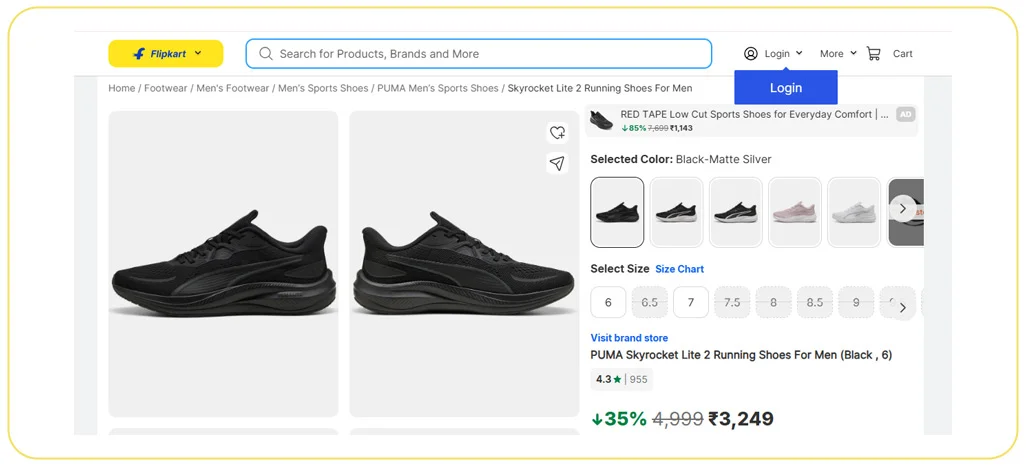
Businesses need structured information to compare product attributes, identify changes in listings, and prepare reliable retail reports. The ability to extract Flipkart product data into structured datasets depends on having an authorized source and a consistent schema that makes records comparable across observation dates.
A useful dataset may include product identifiers, brand names, category labels, pack sizes, displayed prices, promotional information, listing URLs where permitted, and observation timestamps. These fields allow analysts to distinguish products with similar names and identify when a listing has changed. The exact fields available depend on the approved data source.
For example, a retailer comparing two products should account for differences in quantity, model, colour, or specifications before drawing conclusions about price competitiveness. A lower displayed price does not necessarily indicate a better offer when the products are not equivalent.
Recommended data structure
| Field | Research purpose |
|---|---|
| Product identifier | Supports consistent product matching. |
| Brand and category | Enables brand and category comparisons. |
| Displayed price | Records the observed listing price. |
| Product specifications | Helps distinguish comparable and non-comparable items. |
| Promotion details | Captures explicitly displayed offers. |
| Observation timestamp | Establishes when the information was collected. |
| Collection status | Helps identify incomplete or unsuccessful observations. |
Industry context from 2020 to 2026
Bain & Company and Flipkart's How India Shops Online 2022 estimated India's e-retail market at approximately $40 billion in 2021, following a pandemic-related acceleration in online shopping. Their 2023 report estimated the market at $57–60 billion for that year.
These estimates describe the overall Indian e-retail market, not Flipkart's individual product listings. For businesses, the distinction matters: industry figures explain the wider commercial environment, while authorized product-level observations help investigate specific categories and competitive conditions. A consistent dataset makes it easier to audit findings, identify missing information, and share comparable evidence across pricing, merchandising, and strategy teams.
Choosing an Appropriate Data Access Method
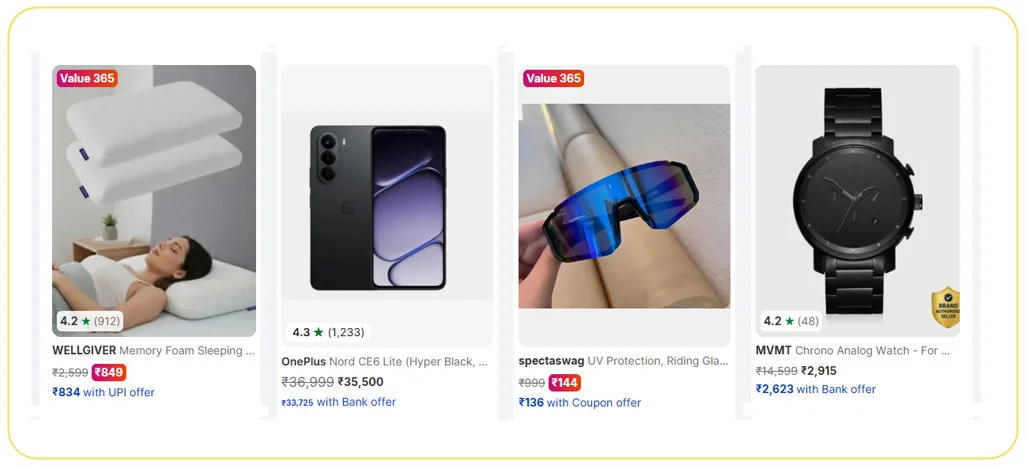
A Flipkart API for ecommerce dataset collection may be suitable when an authorized interface provides the required fields, access frequency, and usage rights. Before adopting an API, businesses should confirm its availability, authentication requirements, permitted use, and any applicable restrictions.
An API and a web-based collection process are not interchangeable. An API typically returns data through defined requests and responses, while browser-based collection may encounter changing page layouts, incomplete fields, or access controls. Neither method should be assumed to provide unrestricted access to marketplace information.
Questions to resolve before implementation
- Which product categories and attributes are required?
- Is historical information available, or will the dataset begin with new observations?
- How frequently may records be collected under the applicable authorization?
- Can products be matched consistently across observation dates?
- What limits apply to storage, commercial reuse, and redistribution?
- How will missing values and unexpected changes be validated?
The answers should guide the architecture rather than selecting a tool first and defining the research objective afterward.
What the market figures tell us
Bain & Company's 2025 report, developed in collaboration with Flipkart, estimated India's e-retail gross merchandise value at approximately $60 billion in 2024. It reported that annual growth slowed to 10–12% in 2024, compared with 25–30% between 2020 and 2023.
Those figures illustrate why a single annual growth rate may conceal meaningful differences between periods. Retail teams need to examine their chosen category, product group, and observation period instead of assuming that the overall market trend applies uniformly to every seller.
Businesses should review Flipkart's official terms of use and establish an appropriate authorization route before collecting marketplace data. Terms and access arrangements should be checked directly because permission to view a listing does not automatically grant permission to extract or commercially reuse it.
Understanding Seller and Competitive Positioning
Flipkart seller data scraping for market research is a term used to describe gathering seller-related marketplace information for competitive analysis. Any such activity must be limited to data that the business is authorized to access and use. Public visibility alone does not establish permission for automated extraction or unrestricted reuse.
Where authorized seller and listing records are available, analysts can compare product assortment, displayed prices, promotional positioning, and listing characteristics. They can also examine how many sellers offer comparable products within a defined dataset. Such comparisons should use consistent product-matching rules and should clearly state the scope of the observations.
Practical areas of investigation
Assortment coverage: Examine which brands, models, and variants appear in the approved dataset. Changes may reflect new listings, discontinued products, or differences in collection coverage, so analysts should investigate before interpreting them.
Price positioning: Compare equivalent products and normalize quantities or specifications where necessary. A displayed price is an observation at a particular time, not proof of a seller's profit margin or final transaction price.
Promotional activity: Record offers only when the source explicitly displays them. Do not assume that a promotion applies to every customer, location, or purchase condition.
Listing consistency: Identify missing specifications, inconsistent naming, duplicate records, and changes to product identifiers. These checks reduce the risk of comparing unrelated products.
Evidence and limitations
The Bain–Flipkart 2025 report estimated that India had more than 270 million online shoppers in 2024. It also described India as the world's second-largest e-retail shopper base. That scale supports the importance of online retail research, but it does not establish individual seller performance. Seller-level conclusions require appropriate evidence, a clearly defined sample, and verified records.
Looking to improve your retail data strategy? Explore authorized data access options and establish a research workflow built around your business objectives.
Get Insights Now!Making Data Integration More Reliable
A Flipkart API can provide a structured way to exchange information when an authorized interface supports the required data and business use case. Its suitability depends on the available documentation, permitted fields, request limits, authentication procedures, and the reliability of the returned records.
Before implementation, businesses should map each required field to its source and decide how records will be validated, stored, and updated. A well-designed integration should also retain timestamps and collection status so that analysts can distinguish newly observed information from older records.
Essential components of a data workflow
| Component | Function |
|---|---|
| Access management | Enforces approved credentials and permissions. |
| Data validation | Checks required fields, formats, and unexpected values. |
| Product matching | Identifies equivalent items across observations. |
| Historical storage | Preserves records for permitted longitudinal analysis. |
| Monitoring | Flags failed requests, incomplete records, and unusual changes. |
| Reporting | Converts validated information into business metrics. |
The workflow should account for missing data rather than automatically replacing it. If a product is absent from a response, analysts need to determine whether it was unavailable, omitted from the source, excluded by the query, or affected by a collection failure.
Security is equally important. Credentials should be protected, access should be limited to authorized personnel, and retention policies should reflect contractual and legal requirements.
What changed between 2020 and 2026?
Bain & Company and Flipkart estimated that India's e-retail market reached approximately $65–66 billion in 2025, growing by 19–21% in value terms. Their How India Shops Online 2026 report projected a market value of $170–180 billion by 2030. The 2030 figure is a projection, not an observed 2026 outcome. For research teams, the distinction reinforces the importance of separating historical measurements, current observations, and forecasts in reports.
A well-governed integration should make those distinctions explicit so business stakeholders can evaluate evidence without confusing market projections with product-level results.
Developing a Useful Historical Research Resource
A Flipkart E-Commerce Dataset can support historical comparisons when its underlying records have been collected lawfully, consistently, and with sufficient documentation. Its value depends not only on the number of records but also on whether the observations can be matched across time and interpreted within their original context.
A dataset designed for longitudinal analysis should preserve product identifiers, category information, observation dates, relevant specifications, displayed prices, and the source of each record where permitted. Analysts should also document changes to collection methods, since differences in coverage can create apparent trends that do not reflect changes in the marketplace itself.
How to compare observations over time
- Establish a baseline: Record the first verified observation and the scope of the dataset.
- Standardize products: Match equivalent models, variants, and pack sizes.
- Measure change: Compare observed prices, listing status, and available product attributes across consistent periods.
- Check data quality: Investigate missing records, duplicates, and inconsistent identifiers.
- Document limitations: Explain gaps, access restrictions, and changes in collection coverage.
Historical analysis should use actual retained records. Current listings cannot reliably establish what a product cost or whether it was available several years ago unless contemporaneous evidence exists.
India's e-retail timeline
| Year or period | Reported market context | Source |
|---|---|---|
| 2020–2021 | The pandemic accelerated online retail adoption; the market was estimated at approximately $40 billion in 2021. | Bain–Flipkart 2022 report |
| 2022 | India's online retail market continued to expand after the pandemic-related acceleration. | Bain–Flipkart 2023 report |
| 2023 | Estimated e-retail market value reached $57–60 billion. | Bain & Company |
| 2024 | Estimated e-retail market value reached approximately $60 billion. | Bain–Flipkart 2025 report |
| 2025 | Estimated e-retail market value reached $65–66 billion. | Bain–Flipkart 2026 report coverage |
| 2026 | Industry analysis and forecasts provide context, but the 2030 projections should not be reported as actual 2026 market results. | Business Standard |
These figures describe the wider e-retail market and should not be interpreted as Flipkart-specific revenue or daily product-level metrics.
Applying Product-Level Evidence to Business Strategy
Flipkart product data scraping for market research should be approached as a governed data project rather than an assumption that every marketplace record can be collected and reused. Businesses need appropriate access rights, clear research objectives, and validation rules before drawing conclusions from online product information.
Once authorized records are available, retail teams can use them to investigate specific business questions. Pricing teams may compare equivalent products across observation periods. Category managers may examine changes in listed assortment. Brand teams may assess how visible promotions and product attributes differ among comparable listings.
Turning observations into decisions
Pricing strategy: Compare observed prices for genuinely equivalent products, taking pack sizes and specifications into account. Do not infer costs or margins from displayed prices alone.
Assortment planning: Review which products are represented in the dataset and identify changes in listing coverage. Validate whether apparent additions or removals reflect genuine marketplace changes.
Promotional planning: Track explicitly displayed offers and record the dates on which they were observed. Historical promotion comparisons require consistent definitions and sufficient observations.
Market research: Combine product-level evidence with credible industry reports, company disclosures, and other authorized sources. This helps distinguish an individual listing change from a broader retail trend.
Management reporting: Include source dates, coverage limitations, and metric definitions alongside every major finding. Decision-makers should be able to see how a conclusion was reached.
Measuring success responsibly
| Research objective | Useful measure | Important limitation |
|---|---|---|
| Compare pricing | Observed price differences | Does not reveal margins or transaction prices. |
| Monitor assortment | Number of distinct matched products | Depends on dataset coverage. |
| Review promotions | Count of explicitly recorded offers | Does not prove customer redemption. |
| Track listing changes | Verified changes between observations | Missing records may have other causes. |
| Assess market growth | Published industry estimates | Not a substitute for platform-level data. |
The strongest analysis combines consistent product observations with careful interpretation. Businesses should avoid presenting sample counts as total market coverage or treating listing visibility as proof of sales.
This approach supports more defensible retail decisions and gives analysts a clear way to explain both the value and the limits of their findings.
Why Choose Real Data API?
Choosing a data provider requires evaluating the actual service capabilities, permitted data sources, documentation, quality controls, and suitability for the intended research. Real Data API can be considered as part of that evaluation when businesses are planning structured data workflows.
A Flipkart India daily ecommerce dataset for market research should be assessed against clear requirements rather than assumed to contain every product, seller, price, or historical observation.
Before committing to a solution, businesses should verify:
- Source authorization: Confirm that the proposed collection method and commercial use are permitted.
- Data coverage: Establish which categories, fields, and observation periods are actually available.
- Historical depth: Verify whether historical records exist or collection will begin prospectively.
- Data consistency: Evaluate product matching, timestamp accuracy, missing values, and duplicate handling.
- Integration requirements: Confirm that the available format supports the intended analytics tools and reporting workflow.
- Support and documentation: Review the technical documentation, service commitments, and available assistance before implementation.
A provider's advertised capabilities should be checked against the specific requirements of the project. Businesses should not assume that a particular marketplace API, daily update schedule, or historical dataset is available without confirmation.
For a successful retail intelligence initiative, combine an authorized source with documented data-quality checks, clear analytical objectives, and a repeatable reporting process. This helps teams turn marketplace observations into evidence they can evaluate and use responsibly.
Conclusion
Online retail research is most effective when businesses can compare consistent observations, verify product matches, and distinguish marketplace information from broader industry estimates. Historical records can help teams investigate pricing changes, assortment patterns, and promotional activity, provided the underlying data is reliable and properly authorized.
A Flipkart India daily ecommerce dataset for market research can form part of this process by organizing product-level observations into a structured resource for analysis. However, the value of that resource depends on its actual coverage, collection permissions, data quality, and suitability for the business question.
Ready to strengthen your retail research strategy? Contact Real Data API to discuss your data requirements, evaluate suitable authorized data-access options, and plan a structured approach to ecommerce analysis!
FAQs
1. Why do businesses use a Flipkart Scraper?
A Flipkart Scraper can support authorized collection of marketplace information for competitive research, provided businesses comply with applicable platform terms, access permissions, and data-use requirements.
2. Can businesses collect daily product information?
Scrape Flipkart India product data daily only through an authorized method, with appropriate safeguards for data quality, collection frequency, credentials, and applicable contractual restrictions.
3. How can product information support analysis?
Businesses can extract Flipkart product data into structured datasets to organize product attributes, compare observed prices, monitor listing changes, and prepare consistent reports for retail research.
4. What should businesses check before choosing a data solution?
A Flipkart API for ecommerce dataset collection should be evaluated for authorization, documented fields, historical coverage, request limits, data quality, and suitability for intended commercial use.
5. How can Real Data API support retail research?
Real Data API can be evaluated for suitable data workflows by verifying available sources, access permissions, supported fields, historical coverage, integration options, and documented service capabilities before implementation.
Latest posts

How to Use a Meesho ecommerce scraper 2026 to Analyze Product Listings, Pricing, and Market Opportunities
How a Blinkit scraper for retail market research Helps Brands Track Competitor Pricing and Product Trends
Why Businesses Need a Flipkart India daily ecommerce dataset for market research for Smarter Retail Decisions
Grocery Data Scraping for Competitive Benchmarking - Key Strategies for Retail Success in 2027






.png)