Quick Summary
- Learn how marketplace price intelligence helps e-commerce sellers compare competitor offers, identify price changes, and make better pricing decisions.
- Explore product data collection, price benchmarking, API integration, and structured datasets for monitoring Allegro listings.
- Discover how Real Data API can support organized product research and data-driven competitive analysis.
Introduction
An Allegro scraper for competitor price monitoring helps e-commerce businesses organize marketplace product information, compare competitor offers, and identify changes that may affect their pricing strategy. By tracking observable listing prices, product details, seller information, and promotional signals, businesses can make more informed decisions about product positioning and competitive performance.
Allegro is a major Polish e-commerce marketplace where multiple sellers can offer the same product at different prices and under different sales conditions. Allegro's official documentation explains that its Product Catalog brings together information about products listed by different sellers, including names, parameters, photos, and descriptions. Offers for the same product may still differ in price and sales policy. This makes accurate product matching essential for meaningful price comparisons.
Source: Allegro — Linking offers to the Product Catalog.
Allegro Product Data Scraping can help businesses structure accessible product and listing information for analysis, subject to the relevant access permissions and platform requirements. The resulting records can support competitor benchmarking, price history analysis, assortment research, and market reporting.
For e-commerce managers, brands, manufacturers, and marketplace sellers, the objective is not simply to collect more data. It is to obtain consistent, traceable information through Allegro API integration for e-commerce automation that answers practical questions: Which competitors sell the same product? How do their displayed prices compare? Which offers have changed? And where might a pricing adjustment deserve further investigation?
How Can Marketplace Data Reveal Competitor Pricing Patterns?
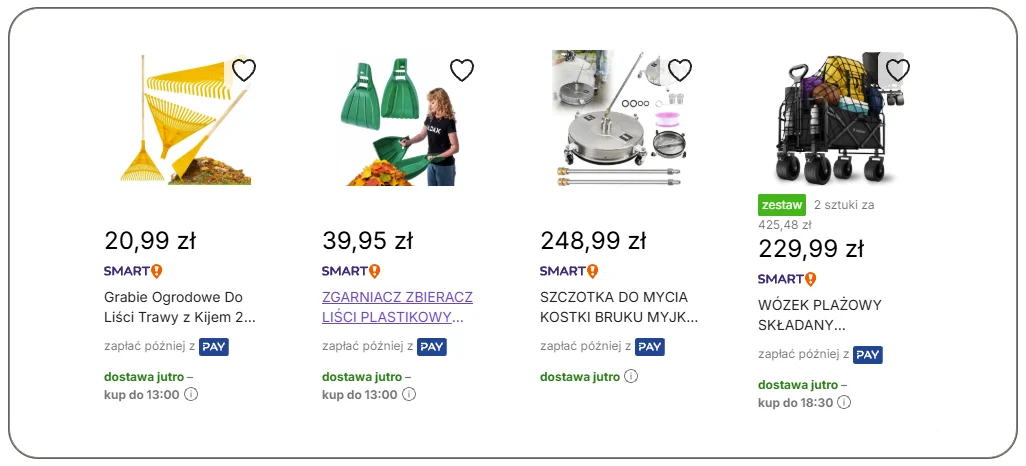
Allegro web scraping for product data provides a way to organize publicly accessible listing information into a consistent format for competitive research. For sellers and manufacturers, the value comes from comparing like-for-like products over time rather than relying on occasional manual searches.
The scale of Allegro's marketplace provides useful business context. In its annual reporting, Allegro.eu reported that group gross merchandise value (GMV), representing the gross value of goods sold through its marketplaces, increased from approximately PLN 35.11 billion in 2020 to PLN 69.74 billion in 2025. GMV measures marketplace transaction value, not company revenue and not the value of products tracked by a competitor-monitoring system.
What do Allegro's reported GMV figures show?
| Year | Group GMV, approximately | Annual change |
|---|---|---|
| 2020 | PLN 35.11 billion | 54.0% |
| 2021 | PLN 42.60 billion | 21.3% |
| 2022 | PLN 52.50 billion | 23.2% |
| 2023 | PLN 58.37 billion | 11.2% |
| 2024 | PLN 63.97 billion | 9.6% |
| 2025 | PLN 69.74 billion | 9.0% |
| 2026 | Full-year result not yet available as of October 21, 2026 | — |
Figures are rounded. Historical GMV and annual changes are based on Allegro's published reporting; reported percentages may vary slightly because of rounding and reporting presentation.
Sources: Allegro's 2020 ESG report, 2022 financial results, and Allegro's financial results and annual reports.
These figures show the scale and growth of Allegro's overall marketplace activity. They do not prove that any particular category experienced the same growth or that a specific competitor changed its pricing.
For an actual monitoring project, businesses should define the product categories, competitor sellers, and reference SKUs before collecting data. Each observation should preserve the product identifier, displayed price, seller or offer identifier where accessible, URL, and timestamp. Researchers can then compare changes across matched records.
The essential distinction is between an observed price difference and a meaningful competitive signal. A lower price may reflect a different package size, shipping arrangement, product condition, or temporary promotion. Valid comparisons require those factors to be recorded or excluded.
Allegro scraper for competitor price monitoring supports this process by helping teams organize comparable observations and identify which changes merit further investigation.
Which Product Price Fields Are Essential for Accurate Analysis?
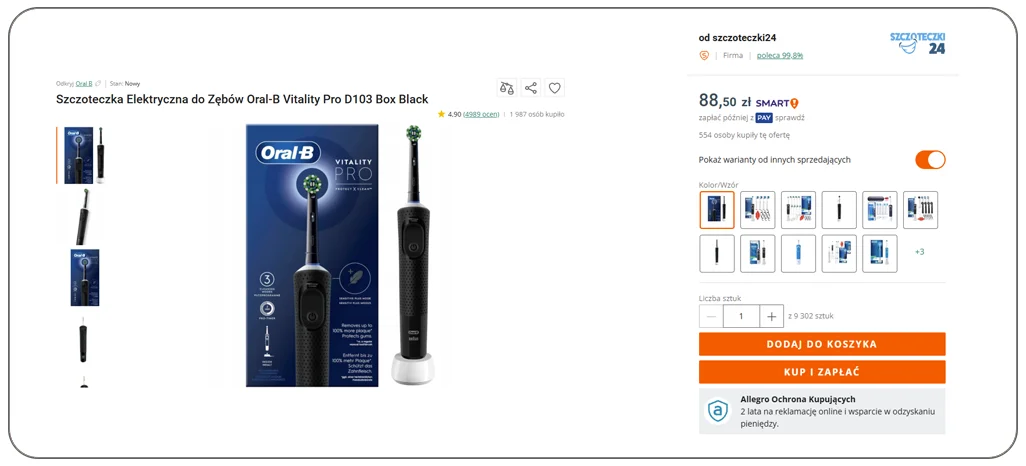
Allegro price data extraction should capture more than a single displayed price. A useful dataset preserves enough information to identify the exact product, understand the offer conditions, and compare observations collected at different times.
The first requirement is product matching. Allegro's Product Catalog links offers to common product information, but sellers can still use different offer prices and sales policies. Brands should use stable product identifiers, such as GTIN/EAN or catalog product IDs where available, alongside model numbers and variant attributes.
Source: Allegro's official guide to linking offers to the Product Catalog.
Which fields should a price dataset contain?
| Field | Why it matters |
|---|---|
| Product ID or GTIN/EAN | Helps identify the exact item |
| Product title and variant | Prevents incorrect product comparisons |
| Displayed price | Establishes the observed selling price |
| Currency | Prevents mixing values from different currencies |
| Seller or offer identifier | Helps distinguish competing listings |
| Shipping information, where available | Provides context for the total purchase cost |
| Promotion details, where visible | Helps explain temporary price differences |
| Listing URL | Supports verification and investigation |
| Timestamp | Establishes when the information was observed |
| Availability status, where available | Adds context to price and assortment changes |
For example, a price comparison between a single-item package and a multipack is not meaningful unless the package quantity is taken into account. Similarly, a headline price that excludes delivery may not represent the same buyer cost as an offer with delivery included.
Analysts can calculate price movement with a simple formula:
Price change (%) = ((Current price − Previous price) ÷ Previous price) × 100
A negative result means that the observed price has decreased. It does not establish why the price changed or whether the change is commercially significant.
A reliable workflow should distinguish missing observations from zero prices, retain the original source reference, and flag records that fail product-matching checks. If an offer disappears, the system should record its observed status rather than silently reuse an old price.
For pricing managers, these controls reduce false alerts and improve the quality of competitive reports. They also make it easier to explain why a particular listing was included in a benchmark.
How Can Businesses Benchmark Competing Offers More Effectively?
To scrape Allegro marketplace data for benchmarking, businesses should define a comparable product set, identify relevant competitors, and apply consistent rules to price and offer comparisons. The objective is to understand relative positioning rather than simply identify the lowest displayed price.
A retailer might compare its own listings with competing offers for the same products, while a manufacturer may want to understand differences across authorized sellers and other visible marketplace offers. These use cases require different comparison rules. A retailer may care about total purchase cost, while a manufacturer may need to investigate distribution patterns against its own agreements.
Which benchmarks help explain competitive position?
| Benchmark | Business question |
|---|---|
| Lowest comparable offer | What is the lowest observed price for the exact product? |
| Median comparable price | What price represents the middle of the observed offer set? |
| Price spread | How far apart are the observed offers? |
| Seller-level price history | Does a particular seller change prices frequently? |
| Promotion frequency | How often do visible discounts appear in the sample? |
| Product availability | Are comparable offers visible and available? |
| Price position over time | Is the product becoming more or less competitive relative to the sample? |
The median can be useful when a few unusually high or low offers distort the average. However, neither the median nor the lowest price automatically represents the correct market price. The result depends on the sellers included, product matching, shipping conditions, and observation time.
A sound benchmark should document its sample. For instance, the report should state whether it covers a specific category, a set of known competitors, or all matching offers available through the chosen source. If some listings cannot be retrieved, that limitation should be visible.
Historical snapshots help distinguish short-lived promotional changes from longer-term pricing patterns. A one-day discount may have a different commercial implication from a sustained price reduction across several sellers. Similarly, changes in product availability can affect which offers appear in a comparison.
The output should lead to a decision, not merely describe the data. A pricing manager may review a product whose relative position has shifted, a sales team may investigate a competitor's new offer, or a category manager may reassess the breadth of the product assortment.
For every finding, retain the source and timestamp so the team can verify the evidence before adjusting its own prices or contacting a commercial partner! Get Insights Now!
Get Insights Now!How Can API Integration Support Automated Pricing Workflows?
An API integration can help businesses transfer product and offer information between an authorized data source and their internal pricing systems. For marketplace research, the available endpoints, authentication requirements, and permitted fields must be confirmed before implementation.
Allegro publishes official REST API documentation covering product and offer resources. Its documentation includes endpoints for retrieving information about a particular offer, including selected price and stock information. Certain resources require authorization, and access depends on the endpoint and account permissions.
Sources: Official Allegro REST API documentation and Allegro's guide to API-based sales management.
What does an automated data pipeline look like?
| Stage | Function | Output |
|---|---|---|
| Source connection | Accesses an approved data source | Retrieved records |
| Product matching | Maps offers to the target catalog | Matched product identifiers |
| Data normalization | Standardizes fields, currencies, and formats | Consistent records |
| Validation | Checks missing values and duplicate entries | Quality-controlled dataset |
| Historical storage | Preserves dated observations | Price history |
| Analysis | Calculates changes and comparisons | Pricing indicators |
| Reporting | Shares results with the relevant team | Dashboard or report |
The main benefit is repeatability. Once the product mapping and data definitions are established, a scheduled process can reduce repetitive manual work and make it easier to compare observations across reporting periods.
However, API access should not be confused with unrestricted access to every competitor listing. Some endpoints are designed for managing a seller's own offers, while other resources have their own access requirements. A project should confirm that its chosen source actually provides the competitor information required.
For operational reliability, the workflow should record failed requests, stale observations, and unavailable fields. It should not present a previously collected price as current when a refresh has failed. Appropriate authentication, rate-limit handling, and secure credential storage are also necessary.
API integration is most useful when the business has a defined destination for the data, such as a pricing dashboard, product information system, analytics warehouse, or internal reporting tool. The final design should reflect the available API capabilities and the organization's actual monitoring requirements.
What Should Businesses Evaluate Before Choosing a Scraping Solution?
An Allegro Scraper should be evaluated by its data quality, product-matching accuracy, source coverage, and suitability for the intended research task. The best solution is not necessarily the one that collects the most fields; it is the one that consistently supplies the information needed for a business decision.
Before selecting a collection approach, companies should define their requirements. A brand tracking competitor prices may prioritize offer prices, product identifiers, seller details, and historical snapshots. A marketplace seller studying assortment opportunities may need category attributes, product descriptions, and availability information instead.
How can teams assess collection quality?
| Evaluation criterion | What to verify |
|---|---|
| Product coverage | Can the required categories and SKUs be matched? |
| Price accuracy | Can displayed prices be checked against source records? |
| Seller identification | Are seller or offer identifiers available where required? |
| Refresh reliability | Is the observation timestamp recorded and freshness measurable? |
| Historical retention | Can earlier observations be compared with current records? |
| Duplicate handling | Are repeated listings and variants treated consistently? |
| Data provenance | Does each record retain a source reference? |
| Compliance | Does the collection method comply with applicable access rules and terms? |
Data collection should also account for product variants, currency, shipping, and promotion conditions. Otherwise, apparently significant price differences may result from comparing unlike offers.
A useful validation process samples records and compares them against their source pages. Teams can track the proportion of records that match the intended product, the number of missing fields, and the frequency of stale observations. These are internal quality measures, not published Allegro platform statistics.
Historical snapshots are valuable because they allow the analyst to distinguish a temporary change from a persistent pattern. They also make investigations easier to reproduce when another team member needs to review a finding.
Allegro scraper for competitor price monitoring should support evidence-based investigation rather than automatically treating every price difference as an error or commercial violation.
The collection method also matters. Businesses should review the platform's current terms, technical restrictions, and API permissions before deployment. If a field is not available through an authorized source, the project should document the limitation rather than imply that the data can always be retrieved.
How Can a Structured Dataset Improve E-Commerce Decisions?
An Allegro E-Commerce Dataset brings product and offer observations into a consistent structure so analysts can compare pricing, assortment, and seller activity across time. Its usefulness depends on clear field definitions, reliable identifiers, source references, and an appropriate refresh strategy.
A dataset should preserve both the observation and its context. A price without a product identifier may be impossible to match confidently. A price without a timestamp cannot reliably establish when the offer was observed. A seller name without a listing reference may be insufficient for verifying a particular discrepancy.
What should a research-ready dataset contain?
| Dataset component | Recommended information |
|---|---|
| Product master | Product ID, GTIN/EAN where available, title, brand, model |
| Offer records | Offer identifier, seller reference, listing URL |
| Pricing records | Displayed price, currency, visible discount information |
| Product attributes | Category, variant, pack size, relevant specifications |
| Observation history | Collection timestamp and previous observations |
| Availability data | Visible stock or listing status when accessible |
| Quality metadata | Validation status, missing fields, matching confidence |
| Source metadata | Source reference and collection method |
The dataset can then support several practical workflows. Pricing teams can identify products with significant price movements. Category managers can compare offer coverage. Sales teams can investigate unusual changes among relevant sellers. Market researchers can examine price distributions and assortment patterns within a documented sample.
For example, an analyst could group comparable offers by product identifier and calculate the minimum, median, and maximum observed price for each product. The resulting spread highlights variation within the collected sample. It does not establish the complete market price range unless the dataset demonstrably covers the full relevant market.
How should businesses interpret historical data from 2020 to 2026?
The correct approach is to distinguish company-level marketplace statistics from product-level price observations. Allegro's annual reports provide historical GMV figures for the wider marketplace, while a competitor-monitoring dataset should contain actual collected offer records for the products being analyzed.
| Period | Appropriate evidence | How to use it |
|---|---|---|
| 2020–2022 | Published annual marketplace reports and any verified archived offer records | Establish historical business context where available |
| 2023–2024 | Annual reports and dated product observations | Compare documented marketplace trends and observed listings |
| 2025 | Published annual results and verified product snapshots | Examine the latest complete historical period |
| 2026 | Dated observations collected to the reporting cutoff | Analyze current changes without treating partial-year data as a full-year result |
Source for marketplace-level history: Allegro investor financial results.
Historical marketplace growth cannot be used as a substitute for missing SKU-level prices. If archived offers are unavailable, the report should state that limitation rather than manufacture a continuous price history.
For better decision-making, teams should combine transparent collection methods with a clearly defined product scope, comparable observations, and documented limitations. This produces a more dependable basis for pricing reviews and competitor analysis.
Why Choose Real Data API?
Real Data API can support businesses that need structured marketplace information for competitive research and data analysis. The appropriate scope depends on the required products, available sources, permitted access methods, and the destination where the data will be used.
What should businesses expect from a data partner?
- Structured information: Consistent fields make product and offer records easier to analyze.
- Product-level comparison: Reliable identifiers help align matching products across listings.
- Historical analysis: Timestamped observations support comparisons between reporting periods when historical records are available.
- Data validation: Quality checks help identify duplicate, incomplete, or incorrectly matched records.
- Business-focused outputs: Organized datasets can support reporting, dashboards, and internal analytics.
Businesses that need to Extract Seller Information from Allegro Marketplace should first define which seller attributes are necessary and confirm that those attributes are available through an appropriate, authorized source. Publicly visible seller details and account-restricted information should not be treated as interchangeable.
A well-scoped project begins with the intended decision, not with an assumption that every possible field can be collected. Product matching, source validation, data freshness, and reporting requirements should be agreed upon before implementation.
Real Data API can help businesses plan a data workflow around these requirements, with coverage and delivery arrangements confirmed during project scoping.
Conclusion
Competitive pricing decisions are stronger when they are based on comparable product records, verified observations, and consistent historical analysis. Allegro's official documentation provides resources for working with product catalogs and offer data, while its annual reports supply marketplace-level context. These sources serve different purposes and should not be confused with one another.
An Allegro scraper for competitor price monitoring can help businesses organize relevant listing observations, compare offers, investigate price movements, and build repeatable reporting workflows. Accurate product matching and transparent source records are essential to ensure that apparent price differences represent meaningful comparisons.
For businesses seeking structured marketplace intelligence, the next step is to define the required product categories, seller information, price fields, refresh frequency, and data delivery format. The collection method should then be selected according to available sources, access permissions, and technical requirements.
Ready to improve your marketplace pricing intelligence? Contact Real Data API to discuss a tailored product data collection workflow for competitor benchmarking, price analysis, and informed e-commerce decisions.
FAQs
1. What is an Allegro scraper for competitor price monitoring?
It organizes accessible Allegro listing data to compare competitor prices, track changes, and support pricing decisions. Results depend on source availability, product matching, and permitted access.
2. How does Allegro Product Data Scraping help online sellers?
It structures product attributes, listing prices, and available offer details, helping sellers compare equivalent products, identify price differences, and improve marketplace research with consistent records.
3. What is Allegro web scraping for product data used for?
It helps businesses organize product titles, identifiers, attributes, and accessible offer information for catalog research, product matching, competitor comparisons, and marketplace reporting.
4. How does Allegro price data extraction support benchmarking?
It captures comparable price observations with timestamps and product identifiers, allowing analysts to measure price differences, examine changes over time, and identify offers requiring further review.
5. Can Real Data API provide an Allegro competitor dataset?
Real Data API can discuss a structured data workflow based on project requirements. Available fields, source permissions, historical coverage, and delivery frequency must be confirmed before implementation.
Latest posts
Allegro scraper for competitor price monitoring – How to Track Product Prices and Stay Ahead of Competitors
Ocado API data collection services for retailers - Track Competitor Prices and Deals
Using Flipkart API for e-commerce competitor benchmarking to Monitor Competitors Across Online Marketplaces

How Myntra scraper for online fashion retail analytics Helps Track Trends, Prices, and Product Demand



.png)


