Quick Summary
- build a structured Nike product dataset by organizing authorized product information into consistent records covering names, categories, styles, sizes, colors, prices, and availability.
- Nike Fashion Data Scraping can support product intelligence when access is authorized and collected information is validated, standardized, and traceable.
- Discover how product catalog management, footwear price benchmarking, API integration research, and historical observations help e-commerce managers and retail analysts improve product comparisons and reporting.
Introduction
To build a structured Nike product dataset, e-commerce managers and retail analysts should organize authorized product information into consistent, validated records that support product matching, price comparisons, assortment analysis, and historical reporting. A useful dataset connects each product to its attributes, source, market context, and observation date instead of storing disconnected product descriptions.
Nike sells athletic footwear, apparel, equipment, and accessories through Nike Direct, including its retail stores and digital platforms, as well as wholesale partners. Its product range and distribution model make structured product information relevant to brands, retailers, manufacturers, and market researchers. Nike's business model and product categories are documented in its official fiscal 2026 annual report.
A carefully governed Nike Fashion Data Scraping workflow can help businesses organize product details from approved sources, subject to applicable terms and access permissions. Typical fields may include product names, style identifiers, categories, colors, sizes, displayed prices, product URLs, and availability observations. These fields should only be included when they are available and permitted for the intended use.
The main challenge is not collecting the largest possible volume of information. It is ensuring that records are accurate, comparable, current, and traceable. This guide explains how to design a structured product schema, validate catalog records, investigate integration options, benchmark comparable footwear prices, and turn verified observations into actionable retail intelligence.
How should the product information architecture be designed?
Nike fashion data API integration should begin with an assessment of the authorized data source, the available fields, and the intended business use. Do not assume that Nike provides an unrestricted public product API. Before building an integration, confirm whether an approved API, licensed feed, partner interface, or other permitted method is available. Nike's Terms of Use and applicable platform restrictions should be reviewed before automated collection begins. Nike also states that it does not condone bots or automation methods that provide an unfair advantage in purchases.
To build a structured Nike product dataset, separate product identity, product attributes, and time-sensitive offer information. A product's name, style code, and colorway describe its identity; size availability, displayed price, and promotional status may change over time. Keeping these elements in separate but connected records prevents every price or stock change from becoming a duplicate product.
| Data entity | Suggested fields | Purpose |
|---|---|---|
| Product | Product ID, product name, category, product URL | Identify the product |
| Variant | Style code, colorway, size, variant ID | Distinguish product variations |
| Offer observation | Displayed price, currency, promotion, timestamp | Track observed offer changes |
| Availability observation | Size, status, market, observation date | Analyze availability over time |
| Source record | Authorized source, retrieval time, validation status | Maintain traceability |
This is a recommended schema, not a representation of Nike's internal database or a claim that every field is publicly available. Preserve original source values alongside normalized fields so that analysts can investigate discrepancies. Where an identifier is unavailable, use carefully validated matching rules and mark uncertain matches for review.
The architecture should also define required fields, accepted formats, missing-value policies, and record-retention rules. These controls make the resulting dataset easier to maintain and more useful for dashboards, product intelligence, and retail analytics.
Which attributes should be collected from clothing catalogs?
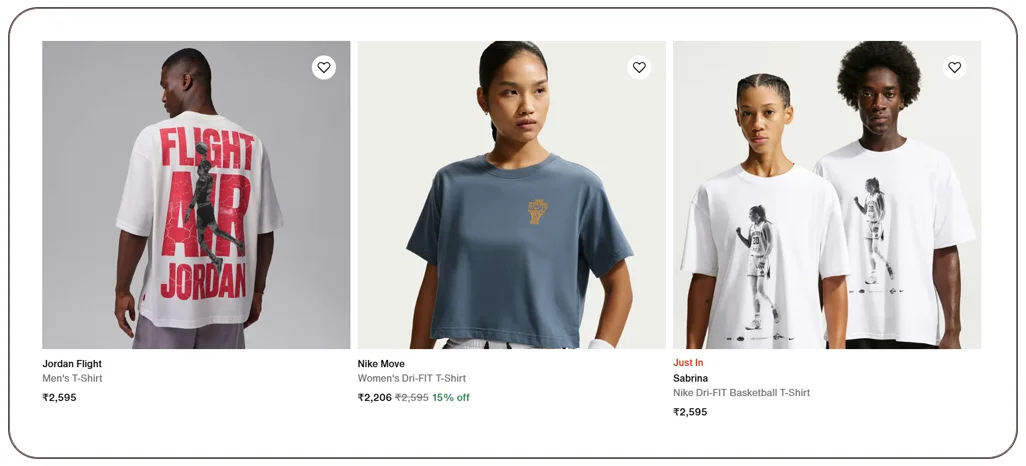
Nike clothing catalog data collection should capture the attributes needed to distinguish similar garments and support reliable comparisons. Depending on the authorized source, these may include product title, apparel category, style identifier, color, size, material description, displayed price, product URL, and availability status.
A product title alone is not sufficient for accurate matching. Two shirts may share a similar name but differ in fit, fabric, collection, intended activity, or style code. Likewise, a single garment can appear in several colorways and sizes. A structured schema must preserve these distinctions rather than combining all variants into one undifferentiated row.
| Attribute | Standardization rule | Analytical benefit |
|---|---|---|
| Product title | Preserve original title and normalized text | Search and product matching |
| Category | Use a consistent category hierarchy | Assortment analysis |
| Style identifier | Retain the source identifier exactly | Product identity |
| Colorway | Preserve source wording and normalize cautiously | Color assortment comparisons |
| Size | Store the original label and applicable size system | Size-level analysis |
| Material | Retain source description and normalize only verified values | Product attribute filtering |
| Price | Store numeric value and currency separately | Comparable price reporting |
| Availability | Record status and observation time | Availability trend analysis |
The collection process should validate data types and field relationships. For example, a price must not be stored as a size, and an unavailable size should not automatically be treated as a discontinued product. Where a source changes its product page structure, schema checks should flag unexpected missing fields rather than silently accepting incomplete records.
Nike's official product catalog provides a reference for the types of product categories and attributes customers encounter. Actual fields and availability vary by product and market, so the source should be checked for each project rather than assumed to provide a uniform record for every item.
For brands and marketplace sellers, the resulting catalog can support assortment planning, product matching, and category-level reporting. The key is to keep the raw description, standardized value, and validation status distinguishable.
How can footwear prices be compared fairly across products?
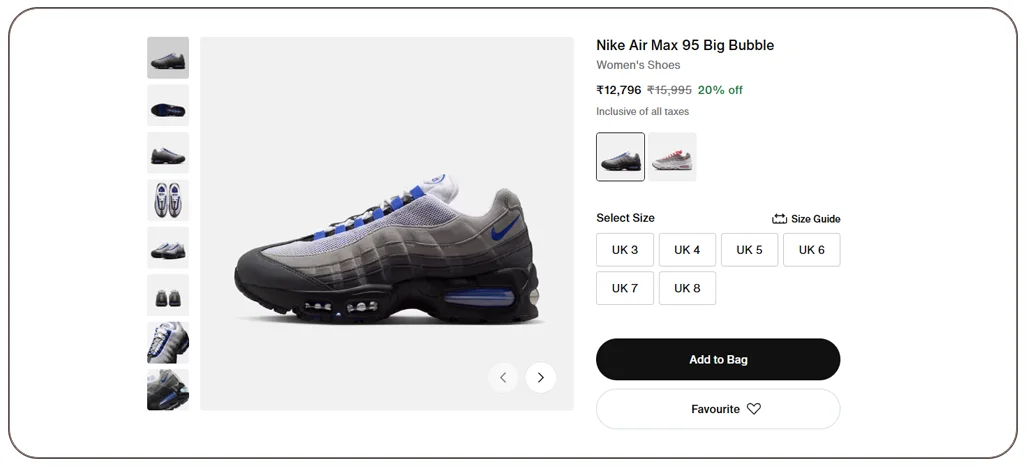
Nike footwear price benchmarking data collection should compare like with like. Analysts need to identify the same shoe model and relevant variant, preserve the currency and market, and distinguish a standard displayed price from a verified promotional price. Comparing two shoes based only on broad labels such as “running shoe” or “basketball shoe” can produce misleading results.
To build a structured Nike product dataset, maintain dated offer observations rather than overwriting the previous price. This makes it possible to calculate the absolute difference between two observed prices, the percentage difference relative to a defined reference price, and the change between observations for the same product.
Nike's annual financial disclosures show why product-level pricing and business-level revenue must be treated as different measures. In fiscal 2025, NIKE, Inc. reported total revenue of $46.3 billion, down from $51.4 billion in fiscal 2024. These company-wide figures do not reveal the price of a specific shoe or the prices offered by individual retailers.
| Fiscal year | NIKE, Inc. reported revenue | What the figure represents |
|---|---|---|
| 2020 | $37.4 billion | Company-wide annual revenue |
| 2021 | $44.5 billion | Company-wide annual revenue |
| 2022 | $46.7 billion | Company-wide annual revenue |
| 2023 | $51.2 billion | Company-wide annual revenue |
| 2024 | $51.4 billion | Company-wide annual revenue |
| 2025 | $46.3 billion | Company-wide annual revenue |
| 2026 | See the FY2026 annual report for reported results | Company-wide annual revenue |
Source: NIKE, Inc. annual reports and financial disclosures. Figures are rounded; fiscal years end on May 31. Revenue is included as business context, not as product-level price data.
For useful benchmarking, analysts should retain product identity, package or unit context where relevant, currency, market, observation timestamp, and promotion conditions. Taxes, delivery charges, and membership-specific discounts should be handled consistently if included in the comparison.
A valid report should also distinguish an observed price from a suggested retail price and avoid claiming that a price change reflects a strategy without supporting evidence. Product-level comparisons can inform further investigation, but they should not be confused with Nike's reported revenue or profitability.
Plan a structured, permission-based product data workflow for retail analytics. Get Insights Now!
Get Insights Now!How can shoe pricing information become decision-ready?
To extract Nike shoe pricing information, analysts need more than a product title and a number. Each observation should include the product or variant identity, currency, displayed price, market context, source reference, and observation timestamp whenever those fields are available through an authorized source.
The first step is to separate a product's identity from its current offer. A shoe may be listed in several sizes and colors, and the displayed availability or price may vary across markets or retailers. If the source does not confirm whether the price applies to every variant, the dataset should preserve that uncertainty instead of assigning the value to all sizes.
Price normalization should retain the original amount and currency. If a business converts prices between currencies, it should record the conversion date and exchange-rate source. If a product has a promotion, the standard price and promotional price should be stored separately only when both are explicitly available and their meaning is clear.
| Analytical measure | Method | Important limitation |
|---|---|---|
| Observed price difference | Reference price minus comparison price | Products must be comparable |
| Percentage difference | Difference divided by the reference price, multiplied by 100 | Define the reference consistently |
| Price change | Current observation minus previous observation | Both observations need reliable identity |
| Promotion change | Compare verified offer fields over time | Promotional terms may vary |
| Price coverage | Count of valid price records against eligible records | Missing records must be reported |
| Price freshness | Time elapsed since the latest valid observation | A recent observation does not guarantee current availability |
These measures help e-commerce managers identify price movements that warrant investigation. For example, an unexpected difference may be caused by a different colorway, size, market, or promotion rather than a genuine price change for the same item.
A useful dashboard should show the underlying observation date, product match confidence, and any known exclusions. It should avoid presenting a single price as universally applicable when the source only supports a specific market or variant.
How can a reusable dataset support product intelligence?
A Nike Fashion Dataset should be designed for repeated analysis rather than a one-time export. A well-maintained dataset lets analysts examine catalog changes, compare product attributes, identify duplicate records, and connect verified observations to product and market dimensions.
To build a structured Nike product dataset, establish a refresh process that is consistent with the source's authorization conditions. The refresh process should detect newly observed products, changed attributes, missing records, and price updates. A missing product record should be classified as an unconfirmed change until the team has sufficient evidence to determine whether the product was removed, temporarily unavailable, or simply not retrieved.
A practical data pipeline has five stages:
- Authorized ingestion: Retrieve only approved data from documented sources.
- Raw data retention: Keep the original permitted fields for traceability.
- Standardization: Normalize categories, sizes, colors, currencies, and identifiers without discarding original values.
- Quality assurance: Detect duplicates, missing fields, invalid prices, and ambiguous product matches.
- Analytics and reporting: Publish validated records and disclose the date and scope of the latest observations.
The pipeline should include a change log that identifies which attributes changed and when. It should also track failed runs, schema changes, and stale observations. If a source becomes inaccessible or a field disappears, the system should report the issue rather than fabricate a value or repeatedly retry beyond the approved limits.
| Quality indicator | How to measure it | Why it matters |
|---|---|---|
| Completeness | Populated required fields divided by required field opportunities | Shows missing information |
| Duplicate rate | Duplicate records divided by total records | Identifies catalog redundancy |
| Match confidence | Share of matched records meeting documented rules | Indicates comparison reliability |
| Freshness | Age of the most recent valid observation | Shows whether reporting may be outdated |
| Validation failure rate | Records failing defined checks divided by records tested | Highlights ingestion problems |
These indicators should be calculated from the actual dataset. A target completeness rate or acceptable refresh interval is a project-specific service level, not a universal benchmark. Reporting actual measurements alongside agreed targets helps stakeholders distinguish verified performance from planned performance.
What safeguards should govern automated price tracking?
Scrape Nike API Data to Track Product Pricing should be treated as a technical project that begins with authorization, not as permission to access any endpoint or automate any website. The team should verify that the chosen source and collection method are permitted, confirm the fields available, and document usage limits before building a scheduled workflow.
Nike's official help content links users to its Terms of Use and explains that the company does not condone bots or automation methods that create an unfair purchasing advantage. This is especially important when a project concerns limited-release products. Product research and competitive analytics must not be used to evade purchase restrictions or access controls.
A compliant tracking workflow should document the following:
- Permission scope: Which source, fields, markets, and purposes are approved?
- Request limits: What frequency and volume are allowed?
- Data minimization: Which fields are genuinely necessary for the stated analysis?
- Access security: How are approved credentials stored and protected?
- Error handling: How are access denials, rate limits, and schema changes recorded?
- Retention: How long may collected information be retained and used?
- Auditability: Can analysts trace a reported price to its source and observation time?
API integrations should use documented authentication and error-handling procedures when an approved interface is available. A successful technical connection alone does not prove that every intended use is authorized. Likewise, publicly viewable information should not automatically be treated as freely reusable for commercial purposes.
For business users, the strongest outcome is a dataset whose origin, collection conditions, quality checks, and limitations are documented. That makes the resulting analysis easier to maintain, review, and defend when commercial decisions depend on it.
Why Choose Real Data API?
Real Data API can help businesses plan data workflows around their specific product intelligence requirements. The right approach begins with the business question, the approved data source, and the level of accuracy needed for reporting.
For teams seeking to Scrape Nike store locations data in the USA, Nike's official U.S. store directory provides a reference for finding retail locations by state. The directory includes location listings and store addresses, while individual store pages may provide additional information. These details can change, so businesses should verify them against the official source before using them in operational reports.
A structured data project can deliver several practical benefits:
- Consistent product records: Standardized fields make it easier to compare products and maintain catalog quality.
- Reliable price analysis: Dated observations help distinguish current values from historical prices.
- Catalog intelligence: Product attributes support assortment analysis and product matching.
- Quality monitoring: Validation rules identify missing values, duplicates, and inconsistencies.
- Integration planning: Documented schemas and access requirements help teams design maintainable data pipelines.
- Transparent reporting: Source references and observation timestamps help stakeholders assess the reliability of reported findings.
The implementation should be tailored to the data actually available through approved sources. Store locations, product catalogs, and prices are separate datasets with different update patterns and validation needs. A store directory, for instance, cannot establish product-level availability at every location.
A responsible project also avoids promising access to restricted APIs or claiming that all product attributes can be obtained automatically. Confirming permissions and data coverage before implementation helps businesses establish realistic expectations and build a more dependable analytics process.
Conclusion
A well-designed product dataset gives e-commerce managers, brands, manufacturers, and retail analysts a consistent foundation for understanding product assortments, price movements, and catalog changes. The key is to combine accurate product identifiers with normalized attributes, dated observations, validation rules, and transparent source documentation.
When businesses build a structured Nike product dataset, they should prioritize reliable product matching, comparable prices, clearly defined availability states, and historical records. These practices make it easier to identify meaningful changes without confusing different product variants or treating incomplete observations as confirmed market trends.
Before launching automated collection, verify the permitted access method, establish the required fields, and define measurable data quality standards. Use official sources where available, preserve the context of each observation, and ensure that the resulting dataset is suitable for its intended commercial use.
Ready to improve your product intelligence strategy? Contact Real Data API to discuss your structured product data requirements, authorized integration options, and retail analytics objectives.
FAQs
1. How do you create a structured product dataset?
To build a structured Nike product dataset, define product identifiers, categories, variants, prices, and timestamps. Validate the fields and preserve source references for traceability.
2. What is the purpose of fashion data collection?
Nike Fashion Data Scraping can organize permitted catalog information for assortment analysis, product matching, and price research, provided collection follows applicable terms and access permissions.
3. How does catalog data collection improve product intelligence?
Nike clothing catalog data collection standardizes product names, categories, colors, sizes, and descriptions, helping businesses compare assortments and identify inconsistencies in their product records.
4. Why is footwear price benchmarking important?
Nike footwear price benchmarking data collection supports comparisons between equivalent products across authorized sources, helping analysts investigate price differences while accounting for currency, market, and promotional conditions.
5. Can Real Data API support product pricing analytics?
Real Data API can help teams plan structured data pipelines and validation workflows. Scrape Nike API Data to Track Product Pricing requires a verified, authorized access method and reliable historical observations.
Latest posts

Allegro scraper for competitor price monitoring – How to Track Product Prices and Stay Ahead of Competitors
Ocado API data collection services for retailers - Track Competitor Prices and Deals
Using Flipkart API for e-commerce competitor benchmarking to Monitor Competitors Across Online Marketplaces

How Myntra scraper for online fashion retail analytics Helps Track Trends, Prices, and Product Demand




.png)


