Quick Summary
- MakeMyTrip API integration for travel data analytics can help travel businesses organize permitted travel information, connect data sources, and improve reporting, pricing analysis, and business intelligence.
- MakeMyTrip Travel Data Scraping should be undertaken only through authorized sources and compliant collection methods, with consistent timestamps, validation, and documented data coverage.
- Historical MakeMyTrip performance data demonstrates the importance of reliable travel analytics, while API access, available fields, and refresh frequency must be verified before implementation.
Introduction
MakeMyTrip API integration for travel data analytics can help travel agencies, hospitality businesses, online travel companies, and market researchers turn fragmented travel information into structured, decision-ready insights. By connecting authorized data sources with analytics systems, organizations can improve reporting on flight bookings, hotel listings, travel prices, destination trends, and business performance.
MakeMyTrip Limited operates digital travel platforms offering flights, hotels, holiday packages, bus tickets, rail bookings, and other travel services. Its official investor website provides company information and financial disclosures that can support research into travel demand and business performance. See the MakeMyTrip investor overview.
MakeMyTrip Travel Data Scraping refers to collecting relevant travel information from an authorized source and organizing it for analysis. It is important to distinguish this activity from official API integration: an API provides access through a documented interface when access has been granted, whereas automated extraction from a website or app may be restricted by applicable terms.
For businesses, the objective is not simply to collect large volumes of data. It is to create a reliable process that connects permitted information with internal systems, validates records, and produces insights that support better commercial decisions.
How can structured travel information improve reporting?
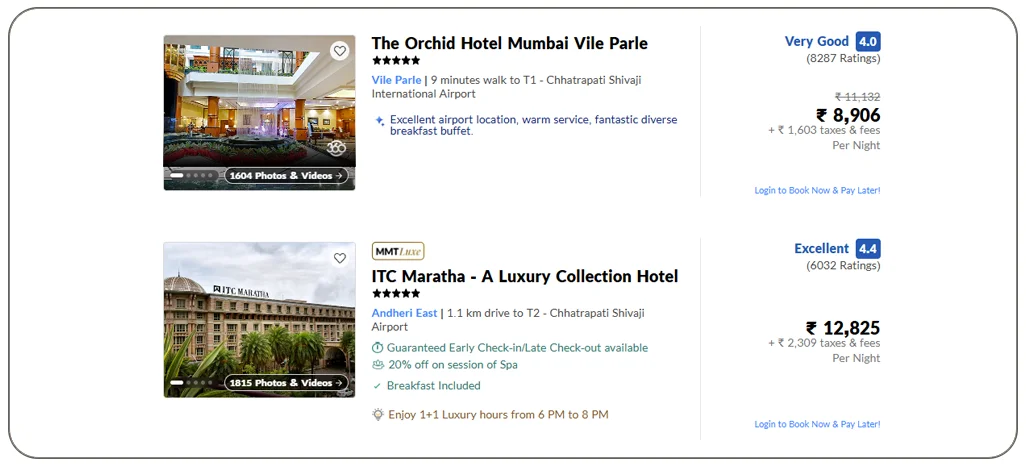
MakeMyTrip API data extraction can support reporting when authorized data is delivered in a consistent format and integrated into a business's existing data environment. Travel companies often need to combine information from booking systems, customer relationship management platforms, finance tools, hotel suppliers, and analytics applications. A structured pipeline can help reduce manual reconciliation and improve reporting consistency.
Before implementation, teams should identify the required fields, the source of each field, the permitted usage, and the refresh schedule. Depending on the authorized source, relevant fields may include destination, travel date, accommodation category, displayed price, booking status, currency, and observation timestamp. Not every source will provide every field.
MakeMyTrip API integration for travel data analytics should also include validation rules. For example, the analytics system should distinguish missing prices from zero-valued prices, preserve currency information, and flag unexpected changes rather than silently treating them as valid.
What does MakeMyTrip's historical performance show?
MakeMyTrip's official financial disclosures provide a useful view of how travel activity changed during the pandemic and subsequent recovery.
| Fiscal year | Reported gross bookings (USD) | Business context |
|---|---|---|
| FY2020 | $6.1 billion | Pre-pandemic comparison period |
| FY2021 | $1.6 billion | Travel demand was severely affected by COVID-19 |
| FY2022 | $3.2 billion | Bookings recovered as travel activity improved |
| FY2023 | $6.6 billion | Strong recovery in travel demand |
| FY2024 | $7.95 billion | Gross bookings reached a new high |
| FY2025 | $9.80 billion | Record annual gross bookings |
| Calendar 2026 | Full-year result not yet available as of October 22, 2026 | Use reported quarterly results rather than estimating a full-year total |
Sources: MakeMyTrip FY2022 annual report, FY2023 results, FY2024 results, and FY2025 results.
The figures are company-wide gross bookings, not API usage metrics or measures of the data available to third parties. They illustrate why travel analysts benefit from distinguishing long-term trends from short-term changes and why consistent historical records matter.
How can integration support travel businesses?
MakeMyTrip API integration for travel businesses requires a clear understanding of the business problem, the authorized data source, and the systems that will consume the information. A travel agency may need operational reporting, a hotel group may want to study market positioning, and a research company may require structured historical observations. These needs should not automatically be treated as the same integration project.
A sound implementation begins with a source inventory. Teams should document which fields come from internal booking records, which come from suppliers, and which are provided through licensed external data services. This prevents a dashboard from mixing incompatible measures or presenting third-party observations as verified transaction data.
Which integration components matter most?
| Component | Purpose | Recommended control |
|---|---|---|
| Source connection | Retrieves permitted information | Document authorization and access requirements |
| Data mapping | Aligns fields across systems | Maintain a data dictionary |
| Validation | Detects missing or inconsistent values | Apply quality checks |
| Storage | Retains records for reporting | Define retention and access policies |
| Analytics layer | Calculates business metrics | Document formulas and assumptions |
| Monitoring | Identifies failures or stale records | Track update times and pipeline errors |
Travel data also changes at different speeds. Flight availability can change quickly, while historical destination analysis may use monthly or quarterly observations. The refresh schedule should match the decision being supported instead of assuming every dataset needs continuous updates.
MakeMyTrip's official investor overview describes its broad travel-service portfolio and digital distribution model. However, the existence of these services does not establish that an unrestricted public API is available for every product or field. Businesses should confirm current API access, documentation, and commercial permissions directly with the relevant provider.
How can accommodation research reveal market patterns?
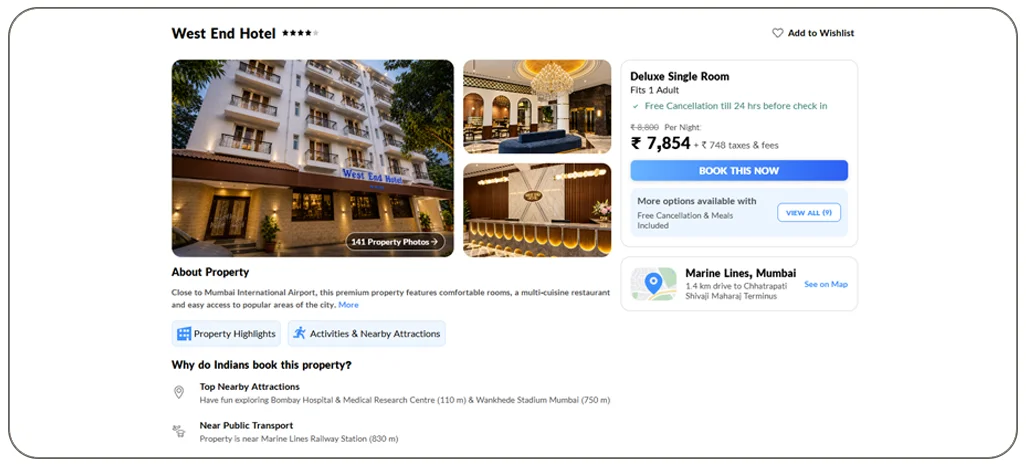
Businesses that scrape MakeMyTrip hotel listings for market research should first establish that the source and collection method are authorized. The research goal should be defined before data is gathered, particularly when the intended use involves commercial benchmarking or republishing information.
Accommodation research can involve comparing hotel categories, displayed rates, destination coverage, amenities, ratings, and availability indicators where those fields are lawfully accessible. The resulting dataset can help analysts understand how listings differ across destinations and travel periods.
What should a hotel research dataset contain?
| Field | Analytical value | Important limitation |
|---|---|---|
| Property identifier | Helps distinguish hotels | Names alone may not be unique |
| Destination | Supports geographic comparisons | Destination boundaries must be consistent |
| Accommodation category | Groups comparable properties | Categories may differ across sources |
| Displayed rate | Enables price comparisons | Taxes, fees, room types, and dates can differ |
| Stay dates | Defines the search context | Rates may change with the requested dates |
| Amenities | Supports property-feature comparisons | Missing fields do not prove an amenity is absent |
| Rating and review count | Provides visible feedback indicators | Does not establish verified quality or profitability |
| Timestamp | Shows when a record was observed | A snapshot may become outdated |
A meaningful hotel comparison must account for room type, occupancy, check-in date, check-out date, cancellation conditions, meal inclusions, and taxes where those details are available. Comparing two displayed rates without these controls can lead to incorrect conclusions.
For historical analysis, teams should preserve dated observations and explain the coverage of the sample. A dataset collected from selected destinations cannot automatically represent the entire hotel market. Analysts should also avoid interpreting a missing listing as proof that a hotel has closed or is permanently unavailable.
The best output is a transparent research report that explains the source, observation period, comparison rules, and known gaps. This makes findings easier to audit and more useful to pricing, marketing, and destination-planning teams. Get Insights Now!
Get Insights Now!How should businesses monitor changing flight prices?
MakeMyTrip real-time flight fare monitoring should be treated as a data requirement whose feasibility depends on the authorized provider, access method, and refresh frequency. A dataset refreshed periodically should not be described as real-time unless its update interval and coverage justify that claim.
Flight fares can vary with route, departure date, booking conditions, airline, baggage allowance, fare class, and availability. A reliable comparison therefore needs more context than an origin, destination, and price. It should record the search date, travel date, currency, fare conditions, and source whenever those details are available.
What should a fare-monitoring workflow track?
- Route and dates: Keep origin, destination, departure date, and return date consistent across comparisons.
- Fare conditions: Separate comparable fare types and identify included baggage or other conditions when available.
- Observation time: Record when the price was returned by the authorized source.
- Currency: Preserve the original currency and document any conversion rate used in reporting.
- Availability: Distinguish a quoted fare from a confirmed booking or ticket issuance.
- Data quality: Flag incomplete records, failed requests, and suspicious price movements.
MakeMyTrip reported gross bookings of approximately $2.85 billion for the quarter ended June 30, 2026, representing 19.9% year-over-year growth in constant currency. Its official Q1 FY2027 results also discussed performance across its air ticketing, hotels and packages, bus ticketing, and other businesses.
This is a verified company performance figure, not evidence of any particular flight fare or a measure of third-party API access. It shows why travel analytics should distinguish company-level booking activity from individual fare observations.
For travel businesses, the practical benefit of a properly sourced fare dataset is the ability to compare like with like, observe changes over time, and build more consistent reports. It should not be used to promise that a fare will remain available or that an observed price is the final amount payable.
What should buyers verify before selecting an API?
A MakeMyTrip API integration should be evaluated on documented access, field coverage, usage conditions, reliability, and compatibility with the buyer's technical environment. Businesses should not assume that an API described by a third party is official or that it grants permission to collect, store, or redistribute MakeMyTrip content.
Before selecting a provider, confirm whether the source is MakeMyTrip itself, a licensed supplier, an authorized distribution partner, or another permitted data service. Review the available documentation and ensure that the contract covers the intended commercial use.
MakeMyTrip API integration for travel data analytics also requires clarity about data freshness and historical depth. A provider may offer current availability without historical prices, or property information without booking-level metrics. These distinctions affect whether the data is suitable for trend analysis, forecasting, or operational reporting.
What questions should procurement teams ask?
| Evaluation area | Questions to ask |
|---|---|
| Access rights | Is the source authorized, and what uses are permitted? |
| Data coverage | Which travel products, destinations, and fields are included? |
| Refresh schedule | Is the data live, near-real-time, hourly, daily, or otherwise scheduled? |
| Historical depth | Are historical observations available, and from what date? |
| Technical interface | Are authentication, schemas, limits, and error responses documented? |
| Reliability | Are update failures and incomplete records reported? |
| Commercial terms | Are storage, display, redistribution, and derived analytics covered? |
| Compliance | Are privacy, security, intellectual-property, and contractual obligations addressed? |
A successful integration should also include monitoring. If a source stops returning data, a dashboard should show that the information is stale rather than quietly presenting yesterday's observations as current. Data lineage and timestamps help analysts trace an output back to its source.
These checks are more important than selecting a provider solely because it advertises a large number of records. A smaller, documented, authorized dataset can be more useful than a large collection with unclear origins or inconsistent definitions.
How can a reusable travel dataset support analytics?
A MakeMyTrip Scraper is a label sometimes used for automated collection workflows, but the label alone does not establish official status, technical capability, or permission to access a platform. Before using such a tool, businesses should verify the source, the authorized method, and any restrictions on collection or reuse.
A travel dataset becomes useful when it is structured for a specific analytical purpose. For example, a destination research project may need location, accommodation category, observation date, and comparable prices. A flight research project may require routes, travel dates, fare conditions, and currency. Combining both without a clear schema can make the data difficult to validate.
How should teams prepare data for analysis?
| Preparation step | Action | Result |
|---|---|---|
| Standardization | Normalize dates, currencies, names, and identifiers | More consistent comparisons |
| Deduplication | Identify repeated records using stable fields | Reduced double counting |
| Validation | Check required fields and acceptable values | Better quality control |
| Historical storage | Preserve dated snapshots where permitted | Trend analysis |
| Documentation | Record source, definitions, and limitations | Easier auditing |
| Governance | Apply access controls and retention policies | Better data management |
MakeMyTrip's public results provide a useful example of why definitions matter. In FY2025, the company reported 58.7 million flight segments, 37.0 million hotel and package room nights, and 106.5 million bus tickets travelled. These are different operating measures and should not be added together as if they represented the same unit.
The figures appear in the company's FY2025 financial and operating disclosures. They illustrate the importance of documenting what each field measures before calculating totals, comparing business lines, or creating a dashboard.
A well-governed travel dataset can support repeatable analysis, but conclusions should stay within the dataset's actual coverage. Observed listings do not necessarily reveal total market demand, private booking volumes, profit margins, or customer identities.
Why Choose Real Data API?
Real Data API can be evaluated as a potential partner for businesses that need structured data collection, integration, and analytics-ready outputs. Before starting a project, buyers should verify the available sources, authorization, field coverage, refresh commitments, delivery formats, and technical support.
makemytrip Travel Dataset requirements should begin with the intended business outcome rather than an assumption that all travel information is publicly accessible. A pricing study, hotel-market report, and route-level trend analysis each require different fields and validation rules.
A practical project plan should include:
- Defined scope: Specify travel products, destinations, dates, and fields.
- Source verification: Document where the information originates and whether commercial use is permitted.
- Data quality: Establish checks for missing fields, duplicate records, and inconsistent values.
- Refresh expectations: Agree on an update schedule that matches the research objective.
- Integration design: Choose an output format compatible with the client's warehouse, dashboard, or reporting tools.
- Transparent reporting: Document methodology, limitations, and any fields that are unavailable.
Real Data API should be assessed on verifiable capabilities rather than assumed access to MakeMyTrip's internal systems. Clear documentation and permission-based data sourcing help buyers reduce implementation risk and create a more reliable foundation for business intelligence.
Conclusion
Travel businesses need more than large datasets to make informed decisions. They need reliable sources, consistent field definitions, documented timestamps, and an integration process that connects relevant information with operational and analytical systems.
MakeMyTrip API integration for travel data analytics can support smarter reporting when data access is authorized, the information is fit for purpose, and the resulting metrics are interpreted correctly. Historical MakeMyTrip results demonstrate the scale and changing patterns of online travel activity, but company-level figures should never be confused with live fare data or unrestricted API availability.
For travel agencies, hospitality groups, online travel companies, and market researchers, the priority is a dependable data workflow that supports useful comparisons and transparent decision-making.
Ready to turn travel data into actionable insights? Contact Real Data API to discuss your data requirements, authorized sources, integration needs, and analytics-ready dataset options!
FAQs
1. What is the purpose of MakeMyTrip API integration for travel data analytics?
It connects authorized travel information with reporting and analytics systems, helping businesses organize data, compare trends, monitor performance, and make decisions using documented, validated information.
2. Is MakeMyTrip Travel Data Scraping the same as API integration?
No. API integration uses a documented interface with granted access, while scraping extracts information from a source. Both require appropriate authorization and compliance checks.
3. Can MakeMyTrip API data extraction provide historical travel prices?
Historical prices depend on the provider and dataset. Confirm retention periods, observation timestamps, route or property coverage, and licensing before planning historical comparisons.
4. Can I use Real Data API for travel research?
Real Data API can be evaluated against your requirements. Verify source permissions, available fields, update frequency, delivery formats, documentation, and suitability for your intended commercial use.
5. How can MakeMyTrip hotel research improve business decisions?
Structured hotel observations can help compare listed rates, categories, amenities, and locations. Reliable conclusions require comparable dates, room conditions, source documentation, and clearly stated data limitations.
Latest posts
Keeta scraper for monitoring food marketplace trends - Identify Discount Changes and Emerging Customer Demand

How to build a structured Nike product dataset for Product Intelligence and Retail Analytics

Allegro scraper for competitor price monitoring – How to Track Product Prices and Stay Ahead of Competitors

Ocado API data collection services for retailers - Track Competitor Prices and Deals



.png)


