

Introduction
Brands can track rapidly changing audience sentiment by collecting public Truth Social posts, timestamps, engagement signals, account information, and related metadata into structured datasets for ongoing analysis. TruthSocial data scraping for real-time social media insights helps businesses turn fast-moving conversations into usable signals for sentiment monitoring, trend detection, reputation management, and market research.
Truth Social is particularly relevant for organizations monitoring influential public conversations. In July 2026, Trump Media announced Truth API, a licensed institutional feed providing real-time access to posts from its highest-ranking accounts. It is positioned as a specialized service rather than a general self-serve developer API.
For brands, researchers, and intelligence teams that need broader or customized coverage, structured web data collection can provide an alternative approach, subject to platform terms, applicable law, and responsible-use requirements. The objective is not simply to collect posts. It is to create a reliable data layer that helps answer business questions quickly.
A Truth Social API can also be part of a broader architecture where available API or licensed feeds are combined with other approved data sources.
How can businesses turn social conversations into real-time insights?

The first challenge is speed. Social conversations can evolve faster than traditional market research cycles. A brand that waits for weekly or monthly reports may miss the early stages of a developing topic, reputation issue, or consumer trend.
social media data scraping for real-time insights can help businesses collect public posts and relevant metadata at defined intervals, normalize the information, and feed it into analytical workflows. Useful fields may include post text, author, timestamp, engagement counts, links, media references, and topic classifications where technically and legally appropriate.
The key is to focus collection around business questions. A consumer brand might monitor conversations about its products. A research organization could track emerging topics. A communications team could identify unusual increases in discussion volume.
| Year | Monitoring Focus | Business Use |
|---|---|---|
| 2020 | Basic social monitoring | Brand awareness |
| 2021 | Topic tracking | Trend discovery |
| 2022 | Engagement analysis | Content intelligence |
| 2023 | Sentiment classification | Reputation monitoring |
| 2024 | Automated monitoring | Faster response |
| 2025 | Multi-signal analysis | Market intelligence |
| 2026 | Real-time intelligence | Proactive decision-making |
A useful workflow separates collection from interpretation. Raw posts should first be timestamped, deduplicated, normalized, and associated with source information. Analytics can then classify topics, sentiment, entities, or engagement patterns.
This separation makes the system more reliable. If the sentiment model changes, businesses do not need to recollect the underlying data. They can simply reprocess the stored dataset.
For marketing and intelligence teams, this creates a practical advantage: social listening becomes an ongoing information system rather than a manual research exercise.
How does an API improve social data extraction?

APIs can make recurring data workflows more predictable by providing structured responses instead of requiring teams to repeatedly process webpages. However, Truth Social's API landscape requires careful distinction between internal/publicly accessible endpoints, third-party services, and the newly announced licensed Truth API.
Trump Media announced its Truth API in July 2026 as a licensed business-to-business feed for real-time access to posts from high-ranking Truth Social accounts. The company positioned it toward institutional customers, particularly financial-services organizations.
For broader data requirements, businesses may use appropriately authorized extraction services or their own compliant collection infrastructure. The right architecture depends on coverage, latency, budget, data fields, and permitted access.
A social media API for real-time data extraction can simplify ingestion by returning consistent fields that downstream systems can process automatically.
| Year | API/Data Workflow Priority | Operational Benefit |
|---|---|---|
| 2020 | Manual collection | Basic monitoring |
| 2021 | Structured extraction | Better organization |
| 2022 | Automated requests | Lower manual effort |
| 2023 | API-based pipelines | Faster ingestion |
| 2024 | Recurring workflows | Continuous monitoring |
| 2025 | Event-driven processing | Faster alerts |
| 2026 | Real-time feeds | Low-latency intelligence |
An API-oriented architecture also makes integration easier. Data can flow into a warehouse, dashboard, sentiment engine, alerting system, or machine-learning pipeline without requiring analysts to manually download and reorganize files.
For organizations that need high-frequency monitoring, this can reduce operational complexity. It also makes it easier to define service-level expectations around collection frequency, schema consistency, error handling, and data delivery.
What role does a web scraper play in Truth Social data collection?
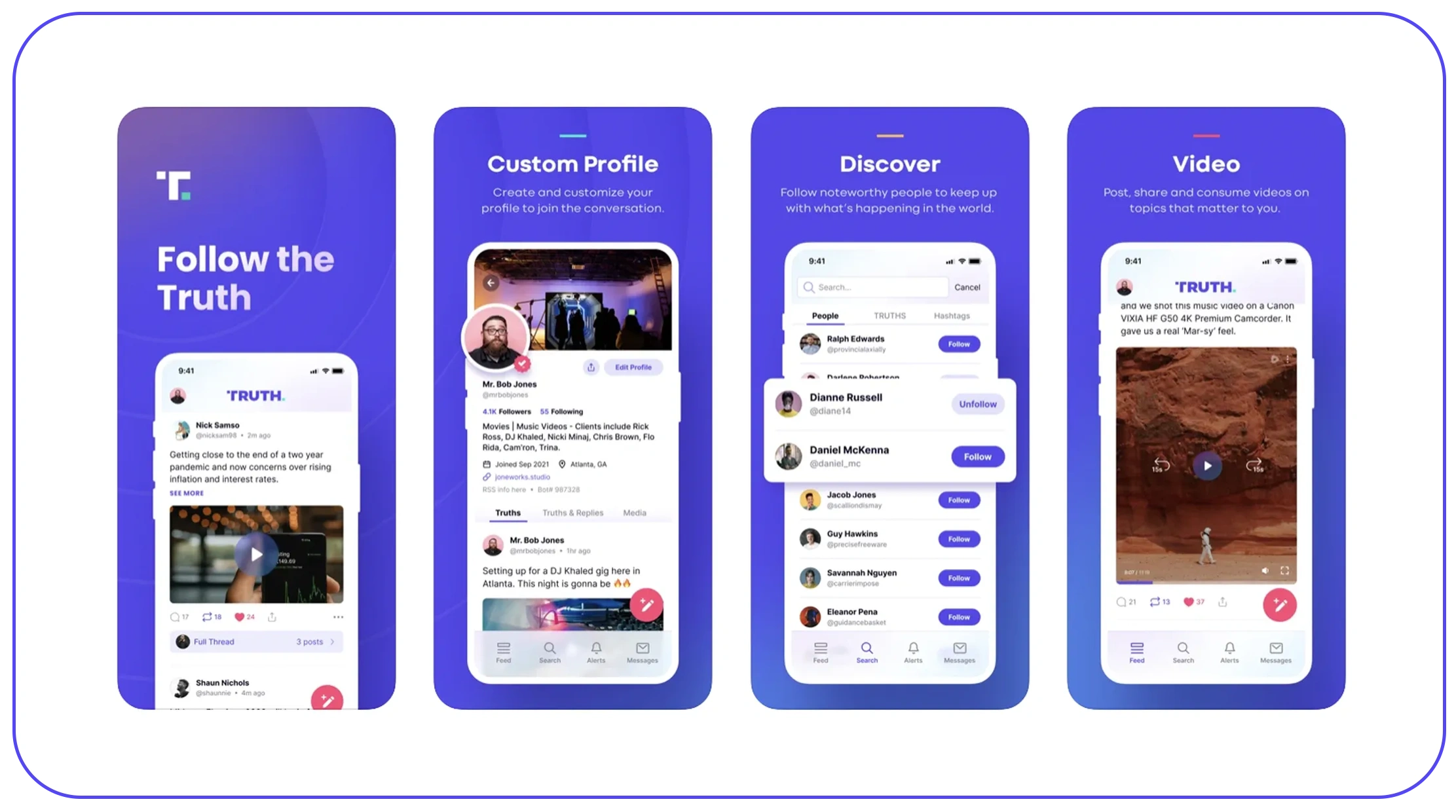
A web scraper can collect publicly accessible information when an appropriate API or licensed feed does not provide the required coverage. Historically, researchers have used custom web-scraping methods because Truth Social did not offer a public API suitable for general research. An academic Truth Social dataset, for example, documented a custom web-scraping approach for collecting posts and account activity.
A web data scraper for TruthSocial data collection can be designed around specific public information and business requirements. Depending on permitted access, collection may include post content, timestamps, account identifiers, engagement signals, and other publicly displayed fields.
The critical consideration is responsible implementation. Collection systems should respect applicable terms, access restrictions, privacy requirements, and technical controls. Businesses should also avoid collecting sensitive personal information that is unnecessary for the stated analytical purpose.
| Year | Collection Challenge | Recommended Capability |
|---|---|---|
| 2020 | Limited structured access | Targeted collection |
| 2021 | Data normalization | Standard schemas |
| 2022 | Larger volumes | Scalable processing |
| 2023 | Page structure changes | Adaptive extraction |
| 2024 | Data freshness | Recurring collection |
| 2025 | Multi-source analysis | Unified pipelines |
| 2026 | Low-latency requirements | Real-time architecture |
A resilient collection system should also include monitoring. If a page structure changes, the pipeline should identify abnormal extraction results rather than silently producing incomplete records.
This is especially important for social intelligence. Missing a large portion of posts can create a misleading picture of conversation volume or sentiment.
The best approach therefore combines technical resilience with data-quality controls. Collection should be measured through completeness checks, duplicate rates, timestamp validation, field coverage, and error monitoring.
How can businesses convert Truth Social conversations into actionable intelligence?
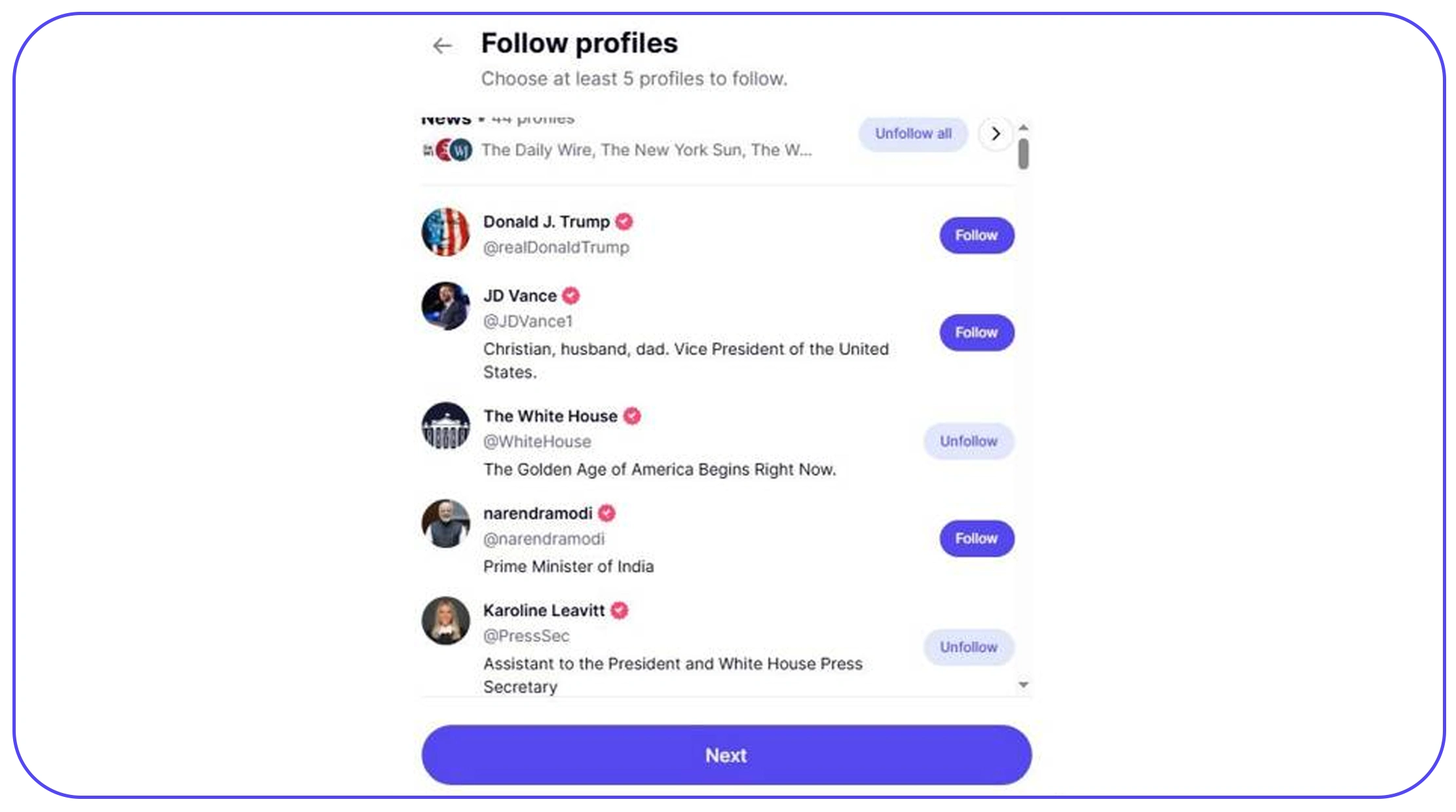
Collecting social posts is useful only when the information answers a business question. scrape social media data from TruthSocial for business insights can help organizations analyze conversations around products, brands, topics, events, competitors, or market themes where the relevant information is publicly available and collection is permitted.
For example, a communications team could track the volume of conversation around a brand before and after a campaign. A market research team could identify recurring themes in discussions about a product category. A competitive intelligence team could compare how frequently different brands appear in relevant conversations.
| Year | Business Intelligence Use Case | Potential Decision |
|---|---|---|
| 2020 | Brand monitoring | Reputation awareness |
| 2021 | Topic analysis | Content planning |
| 2022 | Engagement analysis | Campaign optimization |
| 2023 | Sentiment analysis | Customer experience |
| 2024 | Competitor monitoring | Market positioning |
| 2025 | Trend detection | Product strategy |
| 2026 | Real-time alerts | Rapid response |
Sentiment should be treated as a signal rather than an unquestionable fact. Social posts can contain sarcasm, irony, political language, quotations, or ambiguous context. A robust system should therefore combine automated classification with confidence scores and, for high-impact decisions, human review.
Topic clustering can provide another useful layer. Instead of simply labeling posts positive or negative, businesses can identify what people are actually discussing. Themes might include price, quality, availability, customer service, product features, or brand reputation.
Entity recognition can further connect conversations to products, brands, people, organizations, or locations.
This layered approach produces more actionable intelligence than a basic sentiment percentage. Decision-makers can see what changed, when it changed, what drove the change, and whether the signal is sustained.
Why is a dedicated data pipeline important for social intelligence?
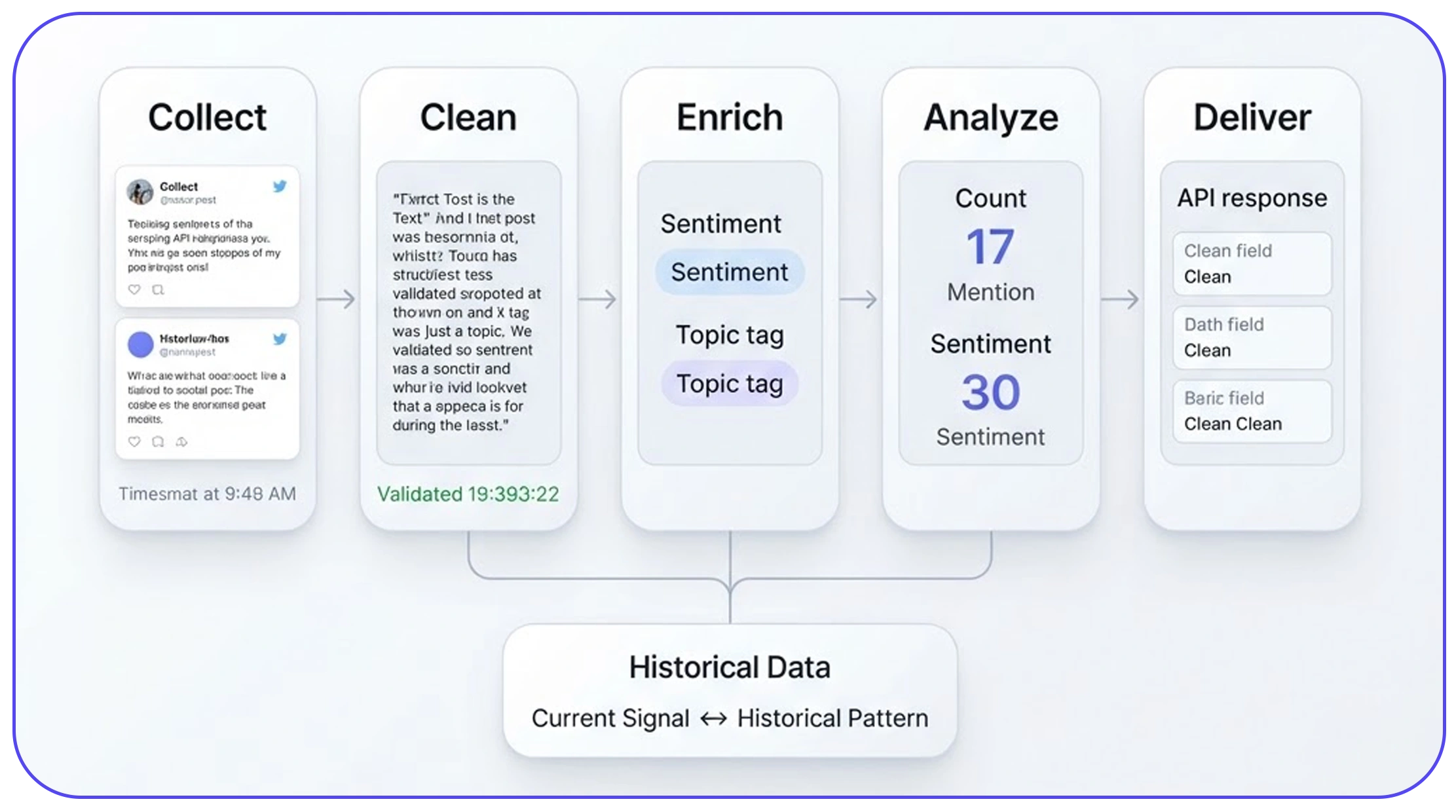
Real-time social monitoring generates data continuously. Without a reliable pipeline, teams can quickly become overwhelmed by duplicates, inconsistent fields, missing timestamps, and unstructured text.
A Social Media Data Scraping API can provide a standardized layer between collection systems and business applications. The API can expose structured records that analytics systems can process consistently.
A useful architecture generally includes collection, validation, normalization, storage, enrichment, analytics, and delivery. Each layer serves a different purpose.
| Year | Data Pipeline Maturity | Intelligence Capability |
|---|---|---|
| 2020 | Basic collection | Historical research |
| 2021 | Structured storage | Searchable archives |
| 2022 | Data validation | Higher reliability |
| 2023 | Automated enrichment | Sentiment and topics |
| 2024 | Dashboard integration | Operational monitoring |
| 2025 | Automated alerts | Faster response |
| 2026 | AI-ready pipelines | Advanced intelligence |
This is a conceptual maturity model, not a dataset of Truth Social results.
For example, a raw post might first be stored with its source URL and timestamp. A processing layer can then clean the text and identify entities. A sentiment model can assign a classification and confidence score. Finally, a dashboard can display conversation volume and emerging themes.
Historical storage is equally important. Real-time data tells businesses what is happening now, while historical data explains whether the current signal is unusual.
This makes trend analysis more reliable. A sudden increase in mentions may look important until it is compared with normal historical patterns.
For enterprise teams, a well-designed pipeline also supports governance. Data retention rules, access controls, audit trails, and quality checks can be built into the workflow from the beginning.
How can an API and scraper work together for faster intelligence?
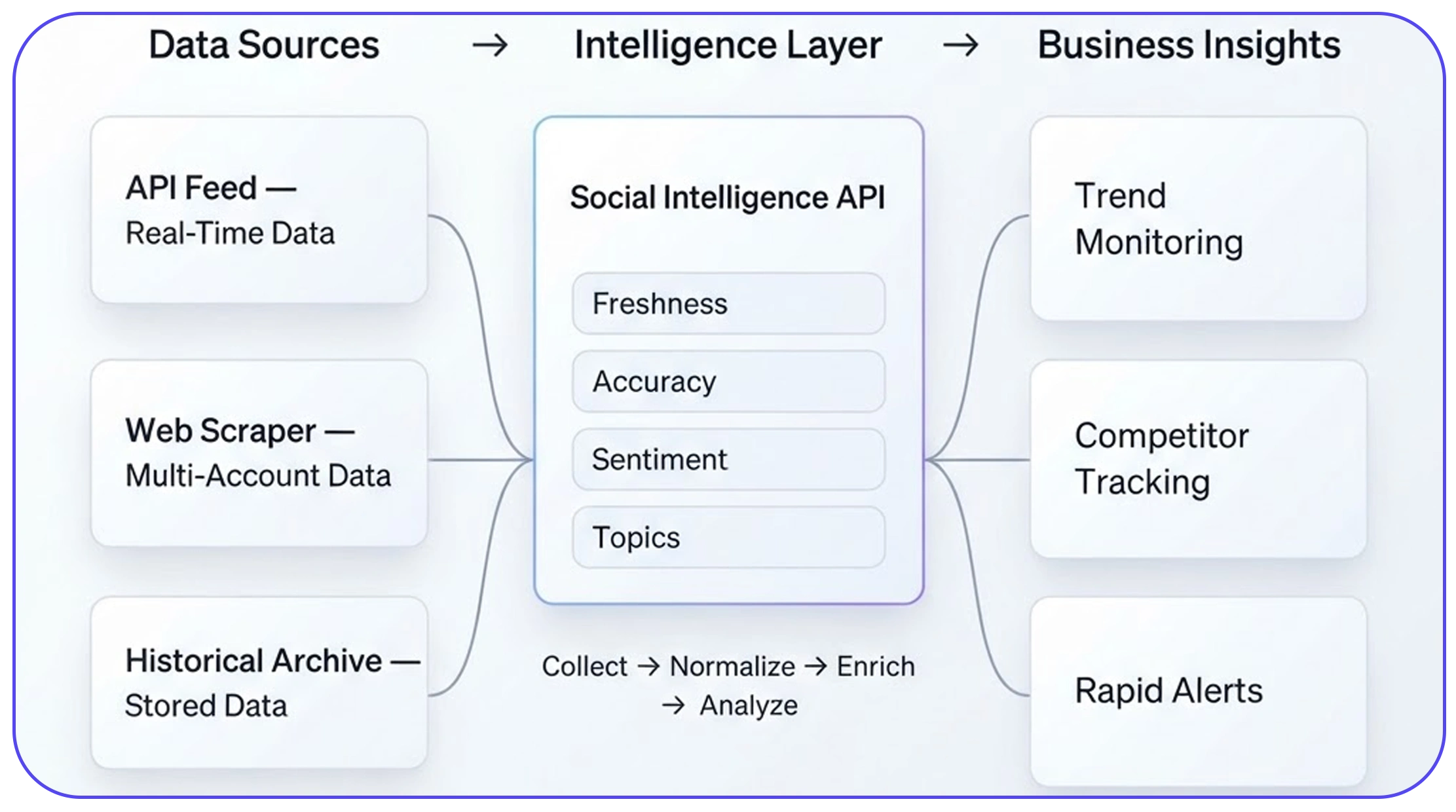
The most effective social intelligence architecture does not necessarily depend on one collection method. Web Scraping API, TruthSocial data scraping for real-time social media insights can form part of a broader system that combines authorized data sources, structured extraction, historical storage, and analytical processing.
This approach is particularly useful when business requirements differ from the coverage of a specific licensed feed. The newly announced Truth API is designed around high-ranking accounts and institutional customers, while businesses may have different needs for account coverage, historical analysis, or research scope.
The architecture should therefore begin with the required output rather than the technology.
| Requirement | Suitable Data Layer | Business Goal |
|---|---|---|
| Historical analysis | Structured archive | Trend research |
| Frequent monitoring | Automated collection | Conversation tracking |
| Low-latency alerts | Authorized real-time feed | Rapid response |
| Sentiment analysis | Enriched dataset | Audience intelligence |
| Competitor monitoring | Multi-account collection | Market research |
| AI applications | Normalized API data | Automated analysis |
The table is an architectural guide, not a claim about available Truth Social coverage.
Real Data API can help businesses design the data layer around their intended use case. A marketing team may need daily monitoring, while an intelligence operation may require much shorter collection intervals. A research organization may prioritize historical completeness instead.
The most important KPI should therefore be business usefulness rather than raw record count.
Teams should measure freshness, completeness, accuracy, duplicate rates, processing latency, and analytical relevance. These metrics provide a better understanding of whether the pipeline is actually solving the original problem.
For brands, the ultimate outcome is faster awareness. The system should help answer questions such as: What are people discussing? Is conversation volume changing? Which topics are emerging? Is sentiment shifting? Which entities are driving the discussion? And does the signal require action?
Why Choose Real Data API?
Real Data API helps businesses build scalable web data collection and structured intelligence workflows around specific business requirements. For organizations interested in social listening, market research, competitive intelligence, and trend analysis, the focus is on creating useful data pipelines rather than simply collecting large volumes of records.
Businesses can Scrape Truth Social Data for Market Research, TruthSocial data scraping for real-time social media insights to support research into publicly available conversations, topic trends, brand mentions, and other permitted signals.
The platform approach can be customized around collection frequency, required fields, output structure, historical requirements, and downstream analytical systems. Data can be prepared for dashboards, research databases, analytics workflows, or AI applications.
Real Data API can also help organizations separate raw collection from enrichment. This makes it possible to add sentiment analysis, topic classification, entity extraction, or other analytical layers without redesigning the entire collection process.
For buyer personas such as market researchers, social intelligence teams, communications professionals, competitive analysts, and data-driven marketers, this flexibility can reduce manual monitoring and improve the speed at which information becomes actionable.
The most important benefit is a business-focused data workflow: collect the right information, validate it, structure it, analyze it, and deliver it where decision-makers can use it.
Conclusion
Rapidly changing social conversations create a difficult challenge for brands: important signals can emerge faster than traditional research teams can identify them. TruthSocial data scraping for real-time social media insights provides a framework for collecting permitted public information and turning it into structured data for trend detection, sentiment analysis, reputation monitoring, and market research.
The strongest solution combines reliable collection, data-quality controls, historical storage, analytical enrichment, and timely delivery. Businesses should also distinguish between licensed feeds, available APIs, and web-based collection methods rather than assuming that every Truth Social data source provides the same coverage.
Real Data API can help organizations design customized data workflows aligned with their specific intelligence requirements.
Contact Real Data API to build a customized social media data solution for your market research and monitoring needs!
Latest posts

Zara Web Data Scraper For Fashion Trend Analysis - How Retailers Overcome Fast-Changing Fashion Demand & Inventory Challenges
How Real Estate Web Scraping Using Bayut API Solves Rental Pricing and Property Tracking Problems?

How Trendyol Data Collection for Ecommerce Market Research Solves Assortment, Pricing, and Market Intelligence Challenges?

How Gemini Scraper For Real-Time Data Extraction Enables Faster Market Intelligence, Monitoring, and Competitive Analysis







.png)



