.gif)
.jpg)

Quick Summary
- IKEA API for retail market intelligence helps retailers organize product information, monitor pricing changes, and improve catalog consistency through structured data.
- Ikea Product Data Scraping can support product-level research, provided collection is authorized and complies with IKEA's applicable terms.
- Retailers can use product, price, and availability insights to improve assortment planning, competitive research, and inventory decisions.
Introduction
Retailers, marketplace operators, furniture distributors, and e-commerce businesses need accurate product information to make informed commercial decisions. Inconsistent product titles, changing prices, incomplete specifications, and location-dependent stock information can make retail analysis difficult. IKEA API for retail market intelligence offers a useful framework for organizing product information and understanding changes across IKEA's digital retail environment.
IKEA operates across physical and digital shopping channels, making product information relevant to several retail activities. Businesses interested in Ikea Product Data Scraping must consider product identification, data accuracy, market-specific information, and collection permissions before developing an integration.
The challenge is not simply collecting product listings. Retailers must connect product identifiers with descriptions, dimensions, prices, availability, and category information. They also need to maintain historical records so that changes can be evaluated accurately.
This article explains how authorized API integrations and structured retail data workflows can address these challenges, what information businesses should prioritize, and how Real Data API can support retail intelligence initiatives.
Why Does Standardized Product Information Matter for Retailers?
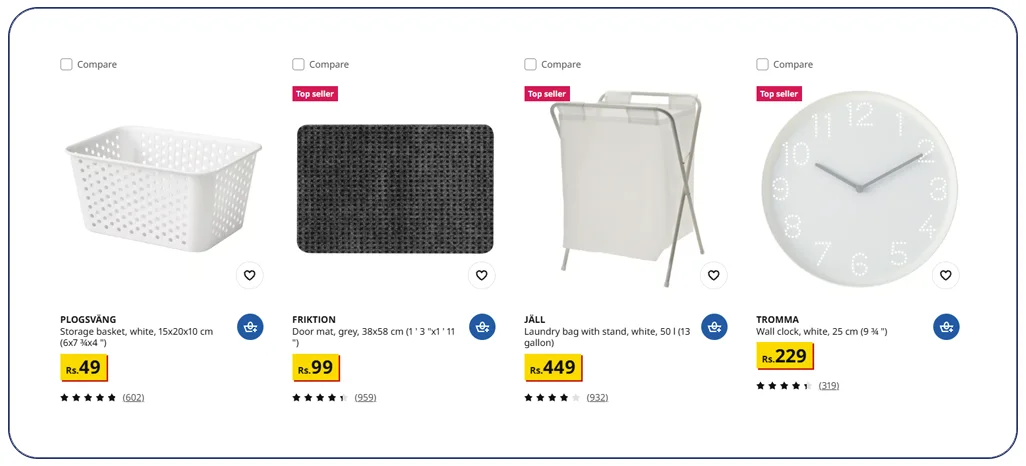
Product catalog inconsistencies create problems for businesses that compare furniture, home accessories, storage solutions, lighting, and household products. A product may appear with different descriptions across regional websites, internal databases, and marketplace listings. Differences in dimensions, colors, article numbers, and packaging information can result in incorrect product matching.
An IKEA API for product catalog data integration can help retailers organize available product attributes into a consistent structure. The exact fields depend on the authorized data source and market coverage. A standardized product record should ideally include the article number, product name, category, description, dimensions, color, material, and product URL.
IKEA uses eight-digit product or article numbers in its shopping and stock-checking processes. This identifier is particularly useful when connecting product information with availability records. Retailers should prioritize exact identifier matching over title-based matching wherever possible.
What do IKEA's retail figures reveal about digital information requirements?
Ingka Group's published results demonstrate the importance of digital retail channels.
| Financial year | Online share of retail sales | Verified business context |
|---|---|---|
| FY2020 | 18% | Online sales grew 60% |
| FY2021 | 30% | Online sales grew 75% |
| FY2022 | 25% | Online sales declined 13% |
| FY2023 | 26% | Online sales grew 9% |
| FY2024 | 28% | Online sales share increased |
| FY2025 | 30% | Online sales share increased |
| FY2026 | Not published in sources reviewed | No verified figure included |
Sources: Ingka Group FY20 reporting, FY21 reporting, FY23 reporting, FY24 reporting, and FY25 reporting.
These figures refer to Ingka Group's IKEA retail operations, not every IKEA franchisee globally. They show why retailers need dependable product information across digital channels.
For data teams, the practical priority is to create a standardized product schema, validate identifiers, retain source information, and document market-specific differences. This reduces the risk of comparing different products as though they were identical.
How Can Retailers Improve Visibility Into Product Availability?
Product availability is a significant consideration for furniture retailers because customers may see a product online but encounter different fulfilment options depending on their location.
IKEA India explains that customers can check product availability by opening the product information page, selecting a store, and reviewing the stock information. Its website also provides information about the relevant store location and, for certain products, the aisle or shelf location.
IKEA product availability data collection should therefore distinguish between different availability conditions instead of storing everything in one generic in-stock or out-of-stock field.
A useful availability record can contain:
- Product article number.
- Product page URL.
- Selected country or market.
- Store or fulfilment location.
- Online delivery availability.
- Click-and-collect availability, where provided.
- In-store stock status.
- Restock information, where displayed.
- Collection timestamp.
- Source and validation status.
Why does location-specific information matter?
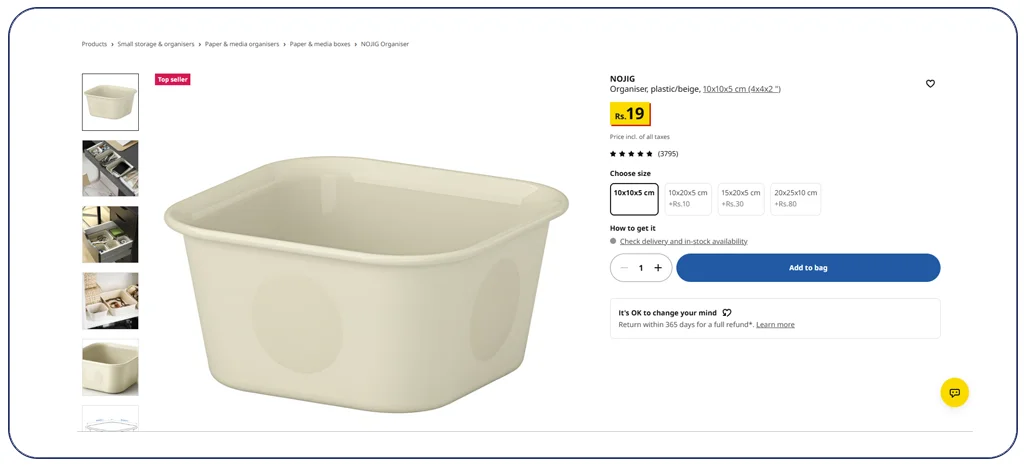
A product can be available at one store but unavailable at another. Similarly, in-store availability does not necessarily mean that home delivery is possible.
IKEA India's customer guidance specifically explains that some products may be available in-store but not eligible for online delivery. It also notes that availability information is connected to the selected store and product page.
Source: IKEA India – Stock Availability and IKEA India – Product Stock FAQ.
For retailers, the solution is to maintain separate fields for online fulfilment, store inventory, and collection options. This makes availability reports more meaningful and helps avoid incorrect assumptions.
A historical availability table can also help analysts identify repeated stock changes, regional assortment differences, and products that require closer inventory attention. However, any automated collection must use an authorized source and respect its permitted update frequency.
How Can Businesses Monitor IKEA Product Price Changes?
Product prices are not necessarily identical across every IKEA market. Currency, taxes, market conditions, promotions, and local assortment decisions can influence displayed prices. Comparing product prices without accounting for these factors can produce misleading results.
A real-time IKEA product price monitoring API workflow should capture the price displayed for a specific product, market, and observation time. It should also preserve the currency and distinguish regular prices from promotional prices.
The most useful pricing attributes include:
- Article number and product title.
- Current displayed price.
- Original or reference price, where available.
- Currency.
- Discount information, where displayed.
- Market or country.
- Product URL.
- Observation timestamp.
- Price-change history.
- Source validation status.
What should a historical pricing record contain?
| Field | Purpose |
|---|---|
| Article number | Identifies the product |
| Market | Identifies the country or region |
| Current price | Records the observed price |
| Previous price | Supports historical comparison |
| Currency | Prevents incorrect cross-market comparisons |
| Discount | Captures displayed promotional information |
| Timestamp | Establishes when the price was observed |
Retailers should avoid comparing products using titles alone. The same product name may refer to different sizes, finishes, or configurations.
A reliable workflow should first match article numbers, then validate product specifications and market information. Currency conversion should be performed separately and should not overwrite the original displayed price.
For historical analysis, businesses can calculate percentage changes using consecutive verified observations:
Price change (%) = [(Current price − Previous price) / Previous price] × 100
This makes it easier to identify price increases, reductions, and promotional changes without inventing historical values.
Want to improve your retail pricing visibility? Explore an authorized product data integration with Real Data API.
Get Insights Now!How Can Businesses Organize Product Information for Retail Analysis?
A large product catalog becomes difficult to analyze when information is spread across different pages, databases, and market-specific records. Businesses need a consistent structure that allows analysts to filter, compare, and validate product information.
The ability to extract IKEA catalog data for retail analysis depends on having permission to use the relevant source and a clearly defined collection scope.
A practical catalog workflow should begin with product identification. Article numbers can act as primary matching attributes, while product names, dimensions, colors, materials, and category labels provide additional validation.
Which product attributes should retailers prioritize?
| Data category | Important attributes | Business application |
|---|---|---|
| Product identity | Article number, name, URL | Product matching |
| Product specifications | Dimensions, material, color | Catalog comparison |
| Categorization | Department, category, product type | Assortment analysis |
| Pricing | Price, currency, displayed discount | Price intelligence |
| Availability | Store, delivery, collection status | Inventory visibility |
| Content | Description, images, product features | Catalog enrichment |
| Geography | Market, country, store | Regional comparison |
How does standardization prevent errors?
Consider a retailer maintaining several versions of a furniture product record. One database may contain the product's full title, while another stores a shortened description. A third record may omit the dimensions.
Without a standardized schema, these records may be treated as separate products or incorrectly merged.
A practical validation process should check:
- Whether the article number matches.
- Whether dimensions and product configurations are consistent.
- Whether the country and currency are correctly assigned.
- Whether required attributes are missing.
- Whether the source record is current and authorized.
- Whether historical changes are preserved rather than overwritten.
Businesses should also maintain field-level provenance. This means recording where each attribute originated and when it was last verified.
Such a structure supports more accurate catalog enrichment, reduces duplicate records, and makes product information easier to integrate into product information management systems, enterprise resource planning platforms, and business intelligence tools.
What Should an API Integration Include?
An IKEA API integration should be designed around the business requirements rather than simply the number of product records collected.
Retailers first need to identify whether they require product descriptions, dimensions, prices, availability, images, or historical observations. They should then identify an authorized data source that provides the required fields and permitted access.
One important distinction is that an API integration does not automatically mean IKEA has provided a public developer API. Businesses should verify the source, ownership, documentation, access permissions, and usage rights before implementing an integration.
IKEA India's online terms restrict commercial collection and use of product listings, descriptions, and prices, as well as data mining and automated extraction, without express written consent. Therefore, a third-party integration should not be treated as permission to collect or reuse IKEA website content.
Source: IKEA India Online Terms and Conditions.
What are the main integration components?
- 1. Data source connection
Connect to an approved API, authorized feed, or other permitted data source. Confirm the available markets, fields, access limits, and usage rights.
- 2. Data extraction
Retrieve the agreed product attributes, such as article numbers, product titles, dimensions, and prices.
- 3. Data transformation
Convert source records into standardized formats. Normalize dates, currencies, product categories, and measurement units without changing the original source values.
- 4. Validation
Check missing fields, duplicate records, invalid identifiers, and inconsistent product attributes.
- 5. Storage
Maintain structured product records and historical snapshots in an appropriate database or data warehouse.
- 6. Delivery
Make validated records available through dashboards, reports, scheduled feeds, or approved API endpoints.
A well-designed integration also needs monitoring for failed requests, schema changes, missing records, and expired credentials. This makes the solution more maintainable and reduces the likelihood of inaccurate reports.
How Can Automated Data Collection Support Long-Term Retail Intelligence?
Retail intelligence becomes more useful when product information can be evaluated over time. A single catalog snapshot provides a view of the current assortment, but historical records help businesses understand changes in prices, availability, and product specifications.
An IKEA Scraper should not be treated as an unrestricted tool for collecting website content. Any automated collection must be explicitly authorized, technically controlled, and consistent with applicable website terms.
Which processes can be automated?
Product record validation: Automated checks can identify missing article numbers, incomplete specifications, and duplicate product records.
Price history management: Approved price observations can be stored with timestamps to support historical comparisons.
Availability change detection: Authorized inventory information can be compared across observation periods to identify changes in stock status.
Catalog update monitoring: Changes in product titles, dimensions, descriptions, and category assignments can be flagged for review.
Reporting workflows: Validated records can be delivered to business intelligence dashboards and internal reporting systems.
What should retailers measure between 2020 and 2026?
The following table distinguishes verified historical business figures from operational metrics that retailers should measure themselves.
| Period | Verified IKEA digital retail indicator | Retail intelligence application |
|---|---|---|
| FY2020 | Online sales represented 18% of Ingka retail sales | Establish digital catalog foundations |
| FY2021 | Online sales represented 30% | Expand digital product monitoring |
| FY2022 | Online share was 25% | Review changes in channel demand |
| FY2023 | Online share was 26% | Improve product information consistency |
| FY2024 | Online share was 28% | Strengthen digital assortment analysis |
| FY2025 | Online share was 30% | Support integrated retail reporting |
| FY2026 | Full-year figure not verified in the reviewed sources | Continue measurement without assuming results |
Sources: Ingka Group's official FY20–FY25 reporting linked in the first section.
Retailers should separately measure their own catalog completeness, product matching accuracy, data freshness, availability coverage, and successful integration rates. These operational metrics must come from their actual systems rather than being inferred from IKEA's corporate reporting.
The result is a repeatable retail intelligence process that helps teams maintain consistent information and identify meaningful product changes over time.
Why Choose Real Data API?
Real Data API can support businesses that need structured retail information for product research, catalog management, and market intelligence. The right solution should be based on the client's required data fields, authorized source access, geographical coverage, and delivery format.
What can businesses gain?
- Structured product information: Organize product identifiers, titles, descriptions, and specifications into consistent records.
- Pricing intelligence: Maintain authorized price observations for historical comparisons.
- Availability visibility: Organize location-specific inventory information where the approved source provides it.
- Catalog enrichment: Improve the completeness of product information for internal retail databases.
- Flexible integration: Deliver validated data through agreed feeds, reports, or API formats.
- Data quality controls: Identify missing values, duplicates, and inconsistencies before downstream analysis.
A structured Ikea E-Commerce Dataset can help retailers connect product attributes with pricing, availability, and category information for more organized analysis.
Real Data API focuses on building data workflows around business requirements rather than treating raw product collection as the final objective.
Conclusion
Product data inconsistencies and changing prices can make retail intelligence difficult, particularly when businesses manage large catalogs across different markets. Standardized product identifiers, validated specifications, historical price records, and location-specific availability information provide a stronger foundation for analysis.
IKEA API for retail market intelligence can help retailers approach these challenges through structured data integration, provided the information is obtained from authorized sources and used within the applicable permissions.
From catalog standardization to product availability analysis and historical price monitoring, businesses should prioritize accuracy, traceability, and consistent data structures.
Real Data API can help businesses plan structured retail data workflows based on their integration requirements.
Looking to improve your retail data accuracy and market visibility? Contact Real Data API to discuss an authorized, scalable product intelligence solution!
FAQs
1. How does IKEA API for retail market intelligence improve catalog accuracy?
It standardizes attributes, validates identifiers, and preserves timestamps, helping retailers compare records and investigate changes without confusing different products.
2. What can Ikea Product Data Scraping capture?
With authorization, workflows may organize product names, article numbers, dimensions, descriptions, prices, and market-specific fields when supplied by an approved source for analysis.
3. Why use IKEA API for product catalog data?
It can standardize identifiers, descriptions, categories, and specifications, subject to available fields and documented access permissions for downstream retail systems and reporting.
4. What does IKEA product availability data collection need?
It should separate store stock, online delivery, and collection status by location, while recording timestamps and the source of each observation clearly.
5. Can Real Data API provide real-time IKEA product price monitoring API services?
Availability depends on authorized access, market coverage, permitted update frequency, and whether the source supplies current price fields reliably.
Latest posts

How to Use Amazon API integration for e-commerce analytics to Track Competitor Prices and Improve Product Performance
How IKEA API for retail market intelligence Helps Retailers Solve Product Data Inconsistency and Pricing Challenges

How Instagram API integration for business analytics Helps Brands Track Engagement and Measure Social Media Performance

How OTT Dataset Updates for Entertainment Analytics Help Streaming Platforms Fix Outdated Content Insights




.png)


