.gif)
.jpg)


Quick Summary
- Amazon API integration for e-commerce analytics helps retailers monitor competitor prices, product availability, sales performance, and marketplace trends using structured data.
- Businesses can use product information, pricing insights, and inventory signals to identify pricing gaps, improve product positioning, and make informed merchandising decisions.
- A reliable analytics workflow combines authorized API access, data validation, historical tracking, and actionable reporting.
Introduction
E-commerce businesses operate in a competitive marketplace where product prices, availability, customer demand, and competitor activity can influence purchasing decisions. Retailers need accurate marketplace information to understand product performance, identify pricing gaps, and respond to changing market conditions. Amazon API integration for e-commerce analytics provides a structured approach to collecting and analyzing marketplace information, helping businesses make informed decisions using reliable product and seller data.
Amazon provides different API capabilities for accessing selling-partner information and product-related information. The Selling Partner API (SP-API), for example, supports programmatic access to authorized seller data, including orders, shipments, and payments. Product discovery and catalog information require the appropriate product-data access route and permissions.
A well-designed Amazon Product Data Scraper can complement authorized API integrations when additional publicly accessible product information is required and collection is permitted. Retailers can combine structured datasets, historical observations, and analytics dashboards to examine competitor pricing, monitor product availability, and identify changes in product positioning.
The objective is not simply to collect more information. It is to turn accurate, consistently structured data into decisions that improve product performance, pricing strategies, and inventory planning.
How Can Retailers Build a Reliable Competitor Pricing Strategy?

Retailers need a consistent view of competitor pricing to understand their market position. Product prices can change because of promotions, seller competition, stock availability, and marketplace events. Tracking these changes helps businesses evaluate whether their products remain competitively positioned.
Amazon API for web scraping alternatives should be evaluated according to the type of information required, access permissions, data coverage, and update frequency. Amazon's Selling Partner API is designed for authorized selling-partner workflows, while its Catalog Items API provides access to catalog information such as product identifiers, attributes, images, sales rankings, and variations. These capabilities serve different purposes and should not be treated as interchangeable.
For retailers, Amazon API integration for e-commerce analytics creates a structured way to combine authorized seller information with permitted marketplace observations. A unified dataset can include:
- ASIN and product identifiers.
- Product titles, brands, and categories.
- Current observed prices and currency.
- Seller and fulfillment information where available.
- Product availability observations.
- Historical price changes.
- Product variations and identifiers.
The most important step is product matching. Retailers should compare identical ASINs or verified equivalent products rather than matching listings based only on similar titles. Differences in size, color, quantity, model numbers, and bundles can otherwise create misleading price comparisons.
Practical recommendation: Maintain a product-matching table that connects internal SKUs, ASINs, manufacturer part numbers, and other verified identifiers. This provides a dependable foundation for competitor monitoring.
How Can Businesses Monitor Orders and Market Demand?
Pricing information becomes more useful when retailers understand how their own products perform. Order information can help businesses identify products with consistent demand, changing sales patterns, and potential inventory concerns.
A real-time Amazon order data API workflow should be designed around authorized order access, synchronization frequency, and the reporting requirements of the business. Amazon's Orders API supports retrieving order information using time-based filters. Its documentation also describes order-status filtering and pagination for retrieving additional results.
With Amazon API integration for e-commerce analytics, businesses can connect authorized order records with product-level performance reports. This allows analysts to examine sales trends alongside competitor pricing and product availability.
For example, a retailer can investigate whether a product's sales decline coincides with a competitor's lower observed price, a stock availability change, or a change in its own listing performance. This is a useful investigation method, not proof that one factor caused the decline.
Useful analytical indicators include:
- Units ordered over a defined period.
- Revenue by SKU and product category.
- Order cancellations and fulfillment status.
- Product-level sales trends.
- Inventory availability and replenishment requirements.
- Changes in competitor prices during the same period.
Important distinction: Order data describes transactions associated with the authorized seller account. It does not automatically reveal competitors' private order volumes or customer purchasing histories.
Businesses should also account for API rate limits, pagination, time zones, and synchronization delays. Amazon documents operation-specific usage plans, so integration schedules should be designed around the applicable limits rather than assuming unlimited requests.
How Can Product Information Improve Catalog Analytics?
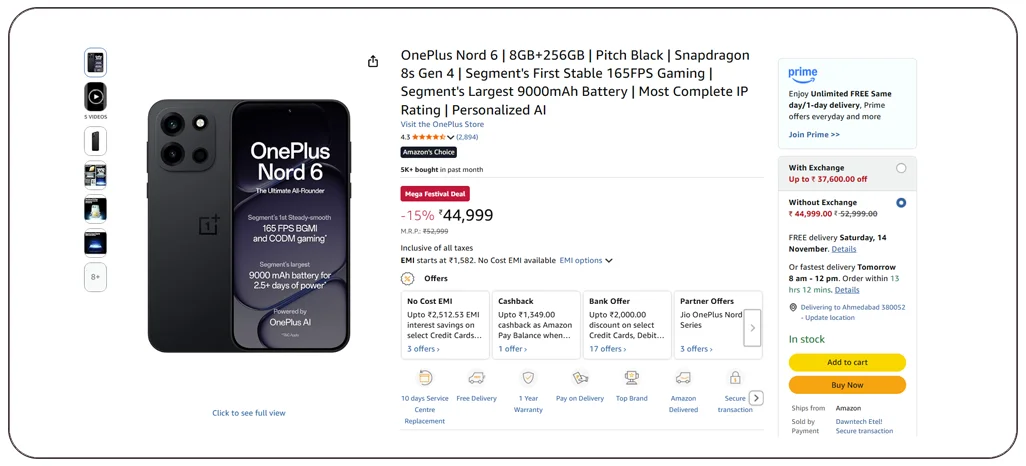
Product information is central to accurate e-commerce analytics. Retailers need standardized catalog records to identify competing products, compare specifications, organize categories, and evaluate product positioning.
The Amazon product catalog API for e-commerce analytics provides a useful framework for accessing catalog information through Amazon's Catalog Items API. According to Amazon's documentation, the API supports searching catalog items and retrieving information such as attributes, identifiers, images, dimensions, sales rankings, relationships, and product summaries.
A structured catalog dataset helps businesses answer practical questions:
- Which products have similar specifications?
- Are competitors offering different product variations?
- Which attributes distinguish competing products?
- Are product identifiers consistent across channels?
- Which categories contain gaps in the retailer's assortment?
- Are existing product listings missing important information?
Retailers should standardize product attributes before conducting comparisons. For example, electronics products should be compared using relevant specifications such as model number, storage capacity, connectivity, and included accessories.
Product variation mapping is equally important. A 128 GB product should not be directly compared with a 256 GB version simply because both listings share a similar title.
Catalog analytics can also support content improvement. Missing attributes, inconsistent descriptions, and incorrect identifiers can be flagged for review before they affect product matching or merchandising decisions.
Recommended approach: Maintain a master product catalog containing verified identifiers, normalized attributes, category information, and source timestamps. Refresh records according to business requirements and validate changes before updating internal systems.
Want to organize marketplace product information into actionable datasets? Explore data collection and analytics solutions from Real Data API.
Get Insights Now!How Can Retailers Improve Data Collection and Reporting?
Collecting marketplace information from multiple products and categories requires a clearly defined data management process. Retailers should decide which product attributes matter, how frequently information needs updating, and how collected records will be used in reporting.
Amazon API data collection services for retailers can help businesses establish structured workflows for gathering, validating, organizing, and delivering marketplace information. The objective is to reduce fragmented records and make information easier to analyze across product categories.
A practical collection workflow includes:
- Define product coverage: Select target categories, ASINs, brands, and competitor listings.
- Identify authorized sources: Determine which fields are accessible through approved APIs and which require other permitted collection methods.
- Configure data extraction: Set the required fields, marketplace, update frequency, and collection schedule.
- Standardize records: Normalize product titles, identifiers, currencies, timestamps, and category attributes.
- Validate information: Check missing fields, duplicate products, inconsistent identifiers, and unexpected price changes.
- Deliver structured datasets: Connect validated records with dashboards, databases, or business intelligence platforms.
Retailers should also establish data-quality checks. A sudden price difference might represent a genuine promotion, a change in product variation, or an incorrect product match. Analysts should verify the underlying listing before treating the difference as a competitive pricing opportunity.
For better reporting, businesses can organize information into daily, weekly, and monthly datasets. Daily observations support operational monitoring, while longer reporting periods help identify recurring pricing patterns and category-level changes.
The collection system should also maintain source information and timestamps. This allows analysts to identify when a record was collected and distinguish current observations from historical information.
How Does Automated Marketplace Monitoring Support Product Performance?
Manual marketplace research can become difficult when retailers manage large product catalogs. Checking individual listings repeatedly consumes time and makes it harder to identify important changes across multiple categories.
An Amazon Web Scraping Service can support permitted collection of publicly accessible marketplace information when the required information is not available through an authorized API. Businesses should assess Amazon's applicable terms, access restrictions, privacy requirements, and collection permissions before implementing any scraping workflow.
Automation can help retailers monitor:
- Competitor product prices.
- Product listing changes.
- Available product variations.
- Publicly displayed availability information.
- Brand and category information.
- Product specifications and descriptions.
- Changes in observed marketplace listings.
The collected information can then be connected with internal product records to create competitor comparison reports.
For example, a retailer can use a price monitoring dashboard to identify products where its current selling price differs significantly from the observed competitor price. Analysts can then investigate product specifications, shipping conditions, seller information, and promotions before recommending an adjustment.
Automation also supports historical analysis. Instead of looking at one isolated price observation, businesses can compare multiple timestamped observations to identify price movements and recurring promotional patterns.
However, an automated collection system should not assume that every displayed price represents the final customer purchase price. Taxes, shipping charges, coupons, delivery conditions, and seller-specific offers may affect the actual amount paid.
Best practice: Combine automated monitoring with validation rules and human review. This creates more dependable pricing intelligence and reduces the risk of making decisions based on incomplete marketplace information.
How Can Businesses Convert Collected Data into Actionable Insights?
Data collection creates business value when retailers connect marketplace observations with measurable performance indicators. A dashboard should help decision-makers understand what changed, which products require attention, and what action should be considered.
Amazon API data can be organized into analytical categories such as product performance, price positioning, catalog quality, inventory status, and sales trends. Each category should have clearly defined metrics and reporting periods.
For example, a competitor pricing dashboard can include the following indicators:
| Metric | What it measures | Business application |
|---|---|---|
| Observed competitor price | Recorded marketplace price | Price comparison |
| Price difference | Difference between retailer and competitor price | Competitive positioning |
| Price change frequency | Number of observed price changes | Monitoring priorities |
| Product availability | Recorded availability status | Stock opportunity analysis |
| Sales trend | Change in authorized seller sales | Performance evaluation |
| Catalog completeness | Availability of required product attributes | Listing improvement |
| Product match accuracy | Reliability of product identification | Comparison quality |
The next step is to create decision rules. A product with a higher observed competitor price does not automatically need a price increase. Businesses should also consider product demand, margins, fulfillment expenses, advertising costs, and customer value.
For instance, if a product experiences declining sales while its competitor price remains stable, the retailer should investigate other possible factors, including listing quality, advertising performance, stock levels, and product reviews where lawfully available.
Amazon API integration for e-commerce analytics can bring these indicators together in a unified reporting environment. Retailers can use historical datasets to compare performance across periods and evaluate whether pricing or catalog changes coincide with improvements in their internal business metrics.
The best dashboards do more than display numbers. They prioritize exceptions, identify unreliable records, and provide enough context for managers to make informed decisions.
What Do E-commerce Market Trends Reveal About the Need for Better Analytics?
The growth of Amazon's business provides useful context for understanding the scale of marketplace operations and the importance of structured business intelligence. Amazon's reported net sales increased from $386.064 billion in 2020 to $716.924 billion in 2025. Its third-quarter 2026 results reported $201.944 billion in quarterly net sales.
The following figures are reported company-wide financial results, not estimates of third-party marketplace sales or competitor pricing activity.
| Year | Amazon net sales (USD billions) |
|---|---|
| 2020 | 386.064 |
| 2021 | 469.822 |
| 2022 | 513.983 |
| 2023 | 574.785 |
| 2024 | 637.959 |
| 2025 | 716.924 |
| 2026 (first nine months) | 584.069 |
Sources: Amazon annual financial statements and Q3 2026 results. The 2026 figure covers January–September only and is not a full-year comparison.
These figures highlight the importance of scalable reporting and reliable data management for businesses operating in large online marketplaces. They do not establish that API integration causes sales growth. Instead, they provide business context for investing in accurate product information, performance tracking, and operational analytics.
For additional context, Amazon reported that third-party seller services generated $172.162 billion in 2025, compared with $156.146 billion in 2024. This category includes third-party seller fees and related fulfillment and shipping fees. It should not be confused with the total value of merchandise sold by third-party sellers.
Why Choose Real Data API?
Real Data API helps businesses approach e-commerce data collection with a focus on structured information, data quality, and practical business applications. Retailers need more than disconnected product records; they need datasets that support competitor research, catalog analysis, price monitoring, and informed merchandising decisions.
A dependable data workflow should prioritize relevant product fields, consistent identifiers, validation, and delivery formats that fit existing analytics systems.
Businesses can use an Amazon E-Commerce Dataset to support product comparisons, marketplace research, and category-level analysis. Combining structured data with internal sales and inventory information helps teams identify opportunities and evaluate product performance more effectively.
Real Data API can support businesses looking to turn marketplace information into organized, actionable business intelligence.
Conclusion
Competitor pricing and product performance are closely connected to the quality of marketplace information available to retailers. Businesses need reliable product identifiers, accurate price observations, consistent catalog records, and historical information to understand market changes.
Amazon API integration for e-commerce analytics provides a structured foundation for combining authorized seller information, product catalog data, and permitted marketplace observations. When supported by data validation, historical tracking, and business intelligence dashboards, these insights can help retailers improve pricing decisions, identify catalog gaps, and strengthen product management.
The key is to focus on relevant data rather than collecting information without a clear business objective. Retailers should choose appropriate data sources, respect access permissions, and connect their analytics workflows with measurable business goals.
Ready to improve your marketplace intelligence? Contact Real Data API to explore structured Amazon product data collection, competitor price monitoring, and e-commerce analytics solutions for your business!
FAQs
1. How does API integration help retailers analyze Amazon data?
Amazon API integration for e-commerce analytics helps retailers organize product, pricing, and authorized seller information to identify market trends and make informed business decisions.
2. Why do businesses use automated product data collection?
An Amazon Product Data Scraper helps collect permitted product information, organize catalog records, and support competitor research, product comparisons, and marketplace monitoring.
3. Are APIs suitable alternatives to manual marketplace research?
Amazon API for web scraping alternatives can provide structured, authorized data access and reduce repetitive research, depending on the information available through each API.
4. Can order information support better inventory decisions?
A real-time Amazon order data API workflow helps authorized sellers synchronize order information, examine sales patterns, and support inventory planning through timely reporting.
5. What product information can businesses retrieve?
The Amazon product catalog API for e-commerce analytics supports access to catalog attributes, identifiers, images, dimensions, and product relationships, subject to API permissions.
Latest posts

How to Use Amazon API integration for e-commerce analytics to Track Competitor Prices and Improve Product Performance

How IKEA API for retail market intelligence Helps Retailers Solve Product Data Inconsistency and Pricing Challenges

How Instagram API integration for business analytics Helps Brands Track Engagement and Measure Social Media Performance

How OTT Dataset Updates for Entertainment Analytics Help Streaming Platforms Fix Outdated Content Insights




.png)


