.gif)
.jpg)
Quick Summary
- Restaurants can improve profit margins by monitoring menu prices, comparing competitors, tracking food costs, and analyzing product availability through structured market data.
- Food Hub API for food industry market intelligence can support better pricing and menu decisions when relevant, authorized data is available.
- Reliable Food Data Scraping workflows help transform public food marketplace information into structured insights for operational planning and competitive analysis.
Introduction
Restaurants can improve profit margins by combining food-cost monitoring, menu engineering, competitor analysis, and demand insights to make better commercial decisions. A Food Hub API for food industry market intelligence can help organize accessible marketplace information into structured records, enabling restaurant operators to evaluate menu prices, product availability, and competitive positioning more efficiently. These insights support decision-making, but actual margin improvements depend on ingredient costs, labor, rent, order commissions, and customer demand.
For restaurant owners, multi-location operators, food-service groups, and delivery-first brands, timely data can make it easier to identify menu items that may need repricing, investigate differences between nearby competitors, and spot changes in marketplace offerings. Food Hub web scraping for food marketplace research can be part of this process when collection is permitted by the source platform and complies with applicable terms, privacy rules, and technical restrictions.
The goal is not simply to collect more information. It is to connect useful external market signals with internal point-of-sale (POS), inventory, purchasing, and accounting data. This combination helps businesses evaluate gross profit, contribution margin, promotional performance, and menu consistency instead of relying on competitor prices alone.
How can competitor price monitoring support better menu decisions?
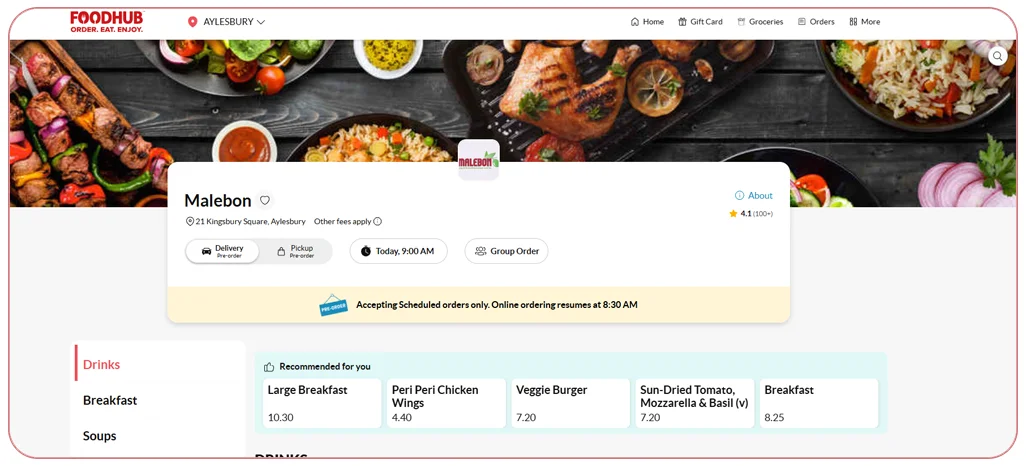
Competitor pricing helps restaurants understand how their menus compare with similar businesses serving the same audience. Operators can review prices for comparable meals, portion sizes, add-ons, meal combinations, and delivery options before deciding whether a menu price needs adjustment. The key is to compare equivalent products rather than treating every listing as directly interchangeable.
A structured workflow to scrape Food Hub menu items for pricing intelligence can organize available menu listings by item name, category, displayed price, location, and observation date. Restaurants can then compare price movements across competitors and identify items that may be positioned unusually high or low. Data collection should respect the marketplace's terms and authorized access conditions.
The financial context makes this analysis important. The U.S. Department of Agriculture reported that restaurant food prices rose 7.7% in 2022, 7.1% in 2023, 4.1% in 2024, and 3.8% in 2025. These figures describe consumer prices for food away from home, not an individual restaurant's ingredient costs.
| Year | U.S. food-away-from-home price change |
|---|---|
| 2020 | 3.4% |
| 2021 | 4.5% |
| 2022 | 7.7% |
| 2023 | 7.1% |
| 2024 | 4.1% |
| 2025 | 3.8% |
| 2026 | 3.5% forecast |
Source: USDA Economic Research Service. The 2026 figure is a forecast, not a completed full-year result.
Restaurants should combine these market signals with recipe costs, actual sales, and customer response. A competitor's higher price does not automatically justify an increase; the decision should account for value, portion size, local demand, and profitability.
How can menu-level information reveal delivery opportunities?
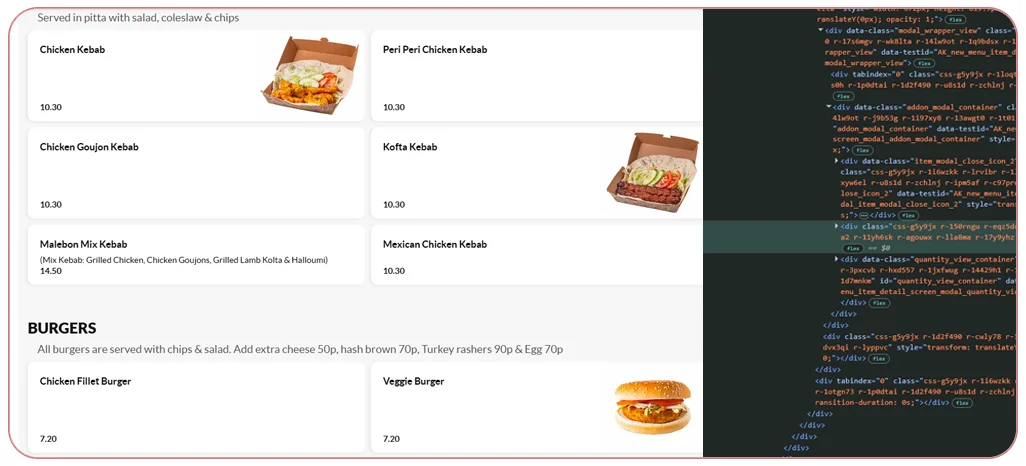
Delivery platforms introduce additional variables into menu performance, including availability, discounts, meal bundles, add-ons, and differences between dine-in and delivery prices. A restaurant that reviews only its own printed menu may miss how customers encounter its products on third-party ordering channels.
With extract Food Hub menu information for food delivery analytics, businesses can structure available listing data to assess how product descriptions, displayed prices, promotions, and availability differ across locations or observation dates. Where permitted data supports it, the analysis can also flag unavailable items, inconsistent listings, and promotional changes that merit investigation.
For example, a restaurant might find that an item is regularly displayed with a discount on a delivery marketplace. That observation does not establish how many orders the promotion generates or whether the restaurant earns a profit on those orders. Those questions require internal order data, platform fees, discounts funded by the restaurant, packaging expenses, and recipe-level costs.
A practical analysis should distinguish the following measures:
- Menu price: The amount displayed to the customer before applicable charges.
- Net revenue: The amount retained after relevant discounts, refunds, and marketplace deductions.
- Food cost ratio: Ingredient and food costs as a share of the chosen revenue measure.
- Contribution margin: Revenue remaining after the variable costs included in the restaurant's calculation.
The U.S. National Restaurant Association's 2025 operations research, based on more than 900 restaurant operators, found that food and non-alcoholic beverage costs represented a median 32.4% of sales for limited-service respondents in 2024. This is a sector benchmark, not a target that every restaurant should adopt.
The practical next step is to connect marketplace observations to POS and delivery-order records. This reveals whether an offer is commercially worthwhile instead of merely visible or popular.
What role does a structured data connection play in restaurant research?
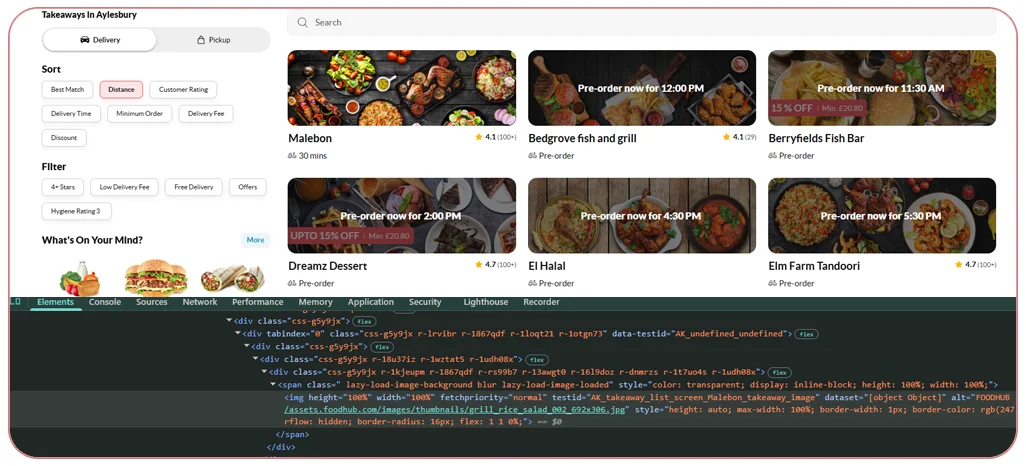
An API-led workflow can help businesses retrieve and organize data in a repeatable format, provided the provider and source platform support the required fields and access. Rather than manually compiling menu observations from separate pages, analysts can build consistent records for comparison and downstream reporting.
A Food Hub API for restaurant data extraction can support this type of workflow when an authorized endpoint or integration is available. Before implementation, restaurants should verify the actual API documentation, available fields, refresh frequency, usage limits, geographic coverage, and licensing conditions. An API should not be assumed to expose every marketplace attribute or guarantee real-time updates.
A useful record structure may include:
| Data field | Business purpose |
|---|---|
| Restaurant or outlet identifier | Distinguishes locations |
| Menu item and category | Enables product-level grouping |
| Listed price and currency | Supports price comparisons |
| Promotion details, when available | Separates standard and promotional prices |
| Availability status, when available | Flags listings that may require review |
| Collection timestamp | Shows when the observation was captured |
| Source reference | Supports traceability and validation |
Restaurants can use these records to compare prices over time, find duplicate or inconsistent product listings, and prioritize menu reviews. Matching requires care: similar names do not guarantee identical ingredients, portion sizes, or meal contents.
The implementation should also include validation checks for missing prices, currency differences, unexpected format changes, duplicate records, and stale observations. Sensitive internal sales and customer records should be handled separately with appropriate access controls.
The strongest setup connects external menu information with internal operational data while preserving source attribution and clear definitions for every metric. This makes the resulting analysis easier for finance, marketing, procurement, and operations teams to interpret consistently.
Explore how structured data solutions can support your restaurant's pricing and market research requirements.
Get Insights Now!How can automation reduce manual research effort?
Manually reviewing menus across multiple locations and competitors can create inconsistent records, particularly when prices, product descriptions, or availability change. Automated collection can standardize repeatable tasks, reduce repetitive data entry, and make it easier to identify changes that deserve attention.
A Food Scraping API can support structured data collection when the source permits access and the required fields are available. For restaurant operators, the value lies in producing consistent records that can be reviewed alongside purchasing data, recipe costs, and sales performance. Automation itself does not guarantee accurate data; validation and monitoring remain necessary.
A useful workflow includes four steps:
- Collect: Retrieve permitted menu and listing information at a suitable frequency.
- Validate: Check for missing prices, duplicated records, unusual changes, and inconsistent formats.
- Compare: Match equivalent items across locations, competitors, and observation dates.
- Act: Send exceptions to the relevant pricing, procurement, or operations team for review.
Industry evidence highlights why cost control matters. In its 2025 industry report, the National Restaurant Association found that 82% of surveyed restaurant operators said their average food costs were higher in 2024 than in 2023. The report also described menu removals, supplier negotiations, and other adjustments that operators used in response to rising costs.
For restaurant groups, automated monitoring can help prioritize which outlets or menu items need attention first. A sudden listed-price change, for example, can trigger a review, but it should not automatically trigger a price change in the restaurant's own system.
The recommended approach is to automate collection and exception detection while keeping pricing decisions under human control. This protects against reacting to temporary promotions, incorrect listings, or unmatched products.
How can structured records improve cost and purchasing decisions?
Restaurant profitability depends on more than the selling price. Ingredient quantities, supplier rates, waste, portion consistency, packaging, and labor all affect the economics of an individual menu item. Market data becomes more useful when it is combined with these internal cost components.
Well-organized Food Datasets can bring together permitted marketplace observations, supplier price records, product details, and internal sales measures. These sources should retain separate definitions and timestamps so analysts can distinguish external market prices from the restaurant's actual purchase costs.
Consider the following framework for evaluating menu profitability:
| Measure | Calculation or comparison | Why it matters |
|---|---|---|
| Food cost ratio | Food cost ÷ relevant food sales × 100 | Tracks ingredient cost relative to revenue |
| Gross profit per item | Selling price minus food cost | Shows the amount left after food cost |
| Contribution per order | Net revenue minus included variable costs | Supports channel and promotion decisions |
| Price gap | Restaurant price minus comparable competitor price | Shows relative positioning |
| Waste rate | Recorded food waste ÷ a consistently defined food-use measure | Helps identify avoidable losses |
These measures should use consistent accounting definitions. For example, marketplace prices may exclude taxes, delivery fees, or service charges, so comparing them directly with net restaurant revenue can produce misleading conclusions.
The National Restaurant Association's analysis of 2024 operating results reported that full-service restaurants with annual sales of at least $2 million had a median food and non-alcoholic beverage cost ratio of 31.0%. For full-service respondents with sales below $2 million, the median was 33.7%. These are reported group medians, not proof that higher sales alone cause lower food costs.
Restaurants can use this kind of benchmark to ask better questions about purchasing scale, menu complexity, and waste. They should then validate the findings against their own financial records before changing suppliers, portions, or prices.
How can market signals become practical operating insights?
Raw records have limited value unless they help teams make decisions. Restaurant managers need clear answers to operational questions: Which items may be underpriced? Where have competitors changed their offers? Which products are frequently unavailable? Which promotions deserve a profitability review?
Food Insights can be developed by combining validated market observations with internal sales, inventory, and cost information. A useful dashboard should show the observation date, comparison group, data coverage, and limitations of each measure. It should also distinguish observed facts from recommendations generated from those facts.
For example, a restaurant might monitor these indicators weekly:
- Changes in comparable competitor menu prices.
- Items with a sustained increase in ingredient cost.
- Menu products with low contribution despite strong sales.
- Promotions whose net contribution requires further investigation.
- Listings with missing, inconsistent, or outdated information.
- Location-level differences that may justify a separate menu review.
The evidence supports treating this as an ongoing management process. The USDA's food-price reporting documents sustained increases in restaurant prices across recent years, while the National Restaurant Association's operating research shows that food and labor costs remain important components of restaurant expenses. These sources describe broad U.S. trends; they cannot establish the financial outcome for a particular restaurant.
A sensible decision cycle is to identify an exception, check the source data, calculate the effect using internal records, approve an action, and measure the result afterward. This creates a feedback loop rather than treating a dashboard as the final answer.
Restaurants should also review access permissions, source terms, retention policies, and data quality as part of the process. The result is a more disciplined way to connect market observations with pricing, procurement, and menu planning.
Why choose Real Data API?
Real Data API can be considered by businesses seeking structured data collection to support market research and operational analysis. Before selecting any provider, restaurant teams should verify the specific source coverage, available fields, access method, refresh schedule, documentation, and permitted use of collected information.
A useful solution should fit the restaurant's existing workflow rather than simply maximize the volume of records collected. Evaluate potential providers against these practical requirements:
- Relevant coverage: Can the solution access the permitted marketplaces, locations, and menu fields the business actually needs?
- Consistent structure: Can records be matched and compared across collection periods?
- Data quality: Are missing fields, duplicates, and unexpected changes detectable?
- Integration readiness: Can the output be connected to reporting tools or internal systems?
- Transparent limitations: Are access restrictions, update frequency, and unavailable fields documented?
- Responsible collection: Does the implementation comply with applicable source terms, laws, and privacy requirements?
For restaurants, the strongest use case is a repeatable process that turns reliable external observations into better-informed commercial decisions. Provider capabilities should be confirmed against current technical documentation before implementation; availability of a particular Food Hub endpoint or field should not be assumed.
Conclusion
Restaurants can use marketplace data to compare menu prices, review competitor positioning, monitor listings, and identify issues for further analysis. However, sustainable margin improvement requires connecting those observations with ingredient costs, sales volumes, labor, packaging, platform fees, and other operating expenses.
A Food Hub API for food industry market intelligence can support this process when the required data is available through an authorized and suitable integration. The best results come from accurate records, consistent metrics, sensible review thresholds, and measured follow-up—not from price monitoring alone.
Ready to improve your restaurant's pricing and market research workflow? Contact Real Data API to discuss your data collection requirements, explore suitable integration options, and build a more informed approach to restaurant market intelligence.
FAQs
1. How does a Food Hub API for food industry market intelligence help restaurants?
It can organize permitted marketplace information about menu prices, product availability, and competitor offerings, helping restaurants investigate pricing opportunities and make better-informed commercial decisions.
2. What is Food Data Scraping used for in restaurants?
Food Data Scraping collects permitted food-related information into structured records. Restaurants can use these records for menu comparisons, marketplace monitoring, product research, and operational analysis.
3. Why use Food Hub web scraping for food marketplace research?
Food Hub web scraping for food marketplace research can help teams track observable menu changes across locations and dates, provided access is permitted and the source supports the required information.
4. Can restaurants scrape Food Hub menu items for pricing intelligence?
Yes, where collection is authorized and technically supported. Scrape Food Hub menu items for pricing intelligence to compare equivalent listings, track displayed prices, and flag changes for human review.
5. Does Real Data API guarantee higher restaurant profit margins?
No provider can guarantee improved margins from data collection alone. Results depend on data quality, restaurant costs, pricing decisions, customer demand, and how effectively insights are applied.
Latest posts
Can a McDonald’s Scraper for Menu Price Monitoring Solve the Challenge of Tracking Frequent Menu Price Changes Across Multiple Locations
How Blinkit API for authorized product data access Helps Retailers Track Product Prices and Improve Competitive Intelligence
How Nykaa API Integration for Beauty E-commerce Analytics Helps Fix Inaccurate Product and Pricing Data
How Zepto Grocery Data Scraping by Pincode Helps Retailers Identify Local Price Differences & Pricing Gaps?



.png)


