.gif)
.jpg)
Quick Summary
- Understand how location-based grocery price monitoring helps retailers identify pricing differences, regional promotions, and competitive gaps across delivery locations.
- Explore how authorized data feeds and structured product information support accurate market comparisons and better pricing decisions.
- Learn how businesses can use pincode-level insights to improve assortment planning, pricing strategies, and competitive intelligence.
Introduction
Grocery prices are not always consistent across delivery locations. Retailers, FMCG brands, and consumer goods companies need to understand how product prices, discounts, and availability differ between local markets to make competitive decisions. Zepto grocery data scraping price comparison by pincode helps businesses organize location-specific grocery information, identify pricing variations, and understand how regional market conditions influence product positioning.
Quick commerce has made location-based retail intelligence increasingly important in India. Consumers expect convenient grocery delivery, while brands and retailers need better visibility into product availability, promotions, and competitive pricing. Zepto is one of the platforms operating in this rapidly expanding market. Its grocery service confirms that delivery availability depends on the stores serving a customer's location. This makes location an important dimension when evaluating marketplace data. Zepto's grocery service information.
A structured Zepto API integration, where officially provided or contractually authorized, can help businesses collect permitted product information and organize it for comparison. Rather than relying on occasional manual checks, companies can build repeatable datasets containing product identifiers, prices, promotional information, stock status, and collection timestamps.
For grocery retailers and FMCG manufacturers, the objective is not simply to find the cheapest product. It is to understand where pricing differences occur, which products are competitively positioned, and how local availability affects pricing decisions.
Why Do Grocery Prices Require Location-Level Competitive Analysis?
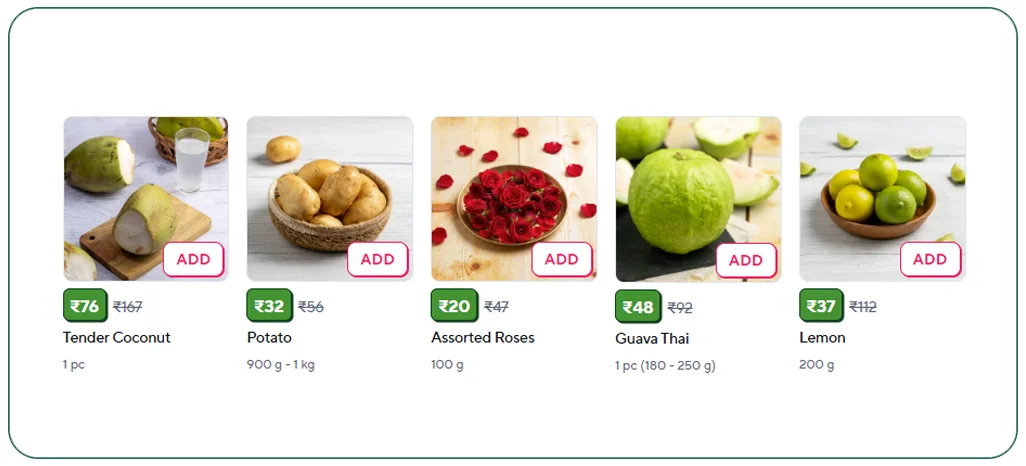
Grocery retailers frequently operate in markets where consumer demand, product availability, and promotional activity differ by location. A price that appears competitive in one delivery area may not be equally competitive in another. National-level price comparisons can overlook these local differences.
A location-based comparison framework helps retailers evaluate products at a more granular level. For example, businesses can compare the same packaged food, beverage, personal care product, or household essential across different pincodes, provided the relevant information is available through authorized sources.
Zepto grocery data API for competitor analytics can support structured comparisons when the business has permission to access the relevant data. The dataset can help analysts examine product-level pricing, promotional activity, and availability across selected delivery areas.
How does this help retailers?
- Regional price benchmarking: Compare the same product across different serviceable locations.
- Promotion analysis: Identify differences in listed discounts and promotional prices.
- Competitive positioning: Understand whether products are priced above, below, or in line with observed market prices.
- Availability comparison: Separate price differences from situations where a product is unavailable.
- Pricing decisions: Use location-level evidence to review pricing policies instead of relying exclusively on national averages.
India's quick commerce market growth
The expansion of quick commerce makes this information increasingly relevant. RedSeer's March 2026 report on India's quick commerce market provides the following published market estimates.
| Calendar year | India quick commerce GMV (USD billion) | Data status |
|---|---|---|
| 2020 | 0.1 | Published estimate |
| 2021 | 0.2 | Published estimate |
| 2022 | 1.5 | Published estimate |
| 2023 | 2.6 | Published estimate |
| 2024 | 5.0 | Published estimate |
| 2025 | 11.5 | Estimate |
| 2026 | 25.0 | Projection |
This growth highlights why retailers need better visibility into local competition. As quick commerce expands, pricing intelligence can help businesses evaluate market conditions at the level where products are offered to customers.
How Does Product-Level Data Help Businesses Understand Local Grocery Markets?
Product-level information helps retailers understand how individual grocery items perform across different locations. Comparing broad grocery categories alone may hide important differences between brands, pack sizes, product variants, and promotional offers. A standardized product dataset makes these comparisons more reliable.
A Zepto grocery product dataset for market research can organize relevant information into consistent fields for analysis, subject to authorized access and permitted data use. Retailers can use these records to understand how products are positioned in different local markets.
Important product attributes include:
- Product name and brand.
- Product category and subcategory.
- Pack size and quantity.
- Listed selling price.
- Maximum retail price (MRP), where published.
- Discount amount and percentage.
- Product availability status.
- Delivery location or pincode.
- Seller information, where available.
- Collection date and timestamp.
Product matching is particularly important. A 500 ml beverage should not be compared directly with a 1-litre variant simply because both share the same brand name. Similarly, different pack configurations and product bundles should be separated from standard single-unit products.
Retailers should use standardized identifiers, brand names, product descriptions, pack sizes, and unit measurements to establish comparable product groups.
How can businesses use this information?
First, they can identify products with significant price differences across selected delivery areas. Second, they can evaluate whether discounts are influencing the final selling price. Third, they can identify categories where availability differences make direct price comparisons misleading. A Zepto Grocery Dataset can help organize these observations into structured records for analyzing product prices, discounts, and regional availability.
For example, a retailer analyzing packaged snacks could compare identical pack sizes across locations and separate regular selling prices from promotional prices. This makes the resulting analysis more useful for category managers and pricing teams.
A well-maintained dataset also supports historical analysis. Businesses can compare observations collected over different periods to understand whether pricing differences are temporary promotional changes or recurring regional patterns.
The most useful output is not simply a spreadsheet of grocery prices. It is a structured product intelligence resource that helps businesses understand local market conditions and make informed decisions.
What Is the Right Way to Access and Organize Marketplace Information?
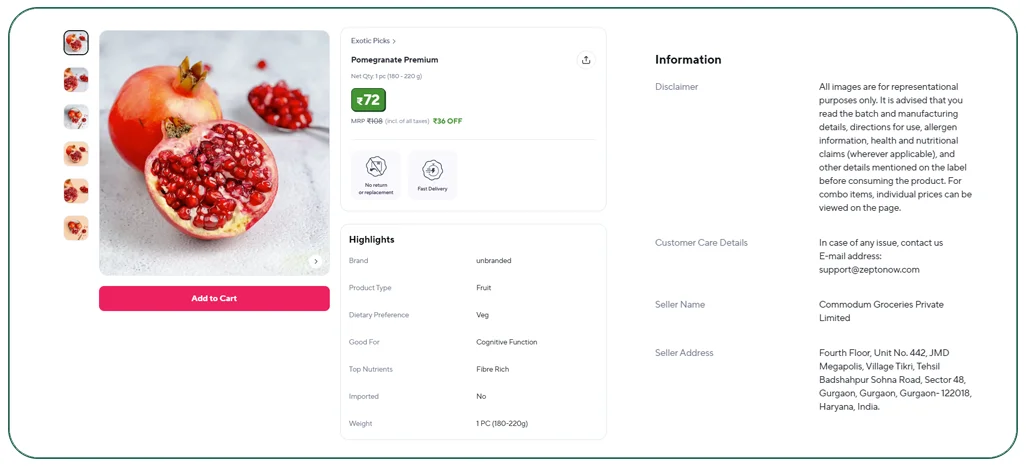
Reliable competitive intelligence begins with an appropriate data access method. Businesses should identify which information is available through officially provided APIs, licensed feeds, commercial agreements, or other expressly authorized sources before planning an extraction workflow.
The phrase Extract Zepto grocery product data from authorized feeds describes an important operational principle: data collection should follow the platform's permissions, contractual requirements, and applicable laws.
Zepto's published Terms of Use are particularly relevant. Its current terms, updated August 20, 2026, restrict automated access through robots, spiders, and similar devices, as well as unauthorized commercial reproduction or exploitation of platform content. Therefore, businesses should not assume that publicly visible product information can automatically be collected for commercial monitoring. Written permission or an appropriate authorized data arrangement should be established first. Zepto Terms of Use.
A structured data collection workflow can include the following stages:
- Source authorization: Confirm permitted access methods, data fields, commercial usage rights, and applicable restrictions.
- Location selection: Define the target pincodes and confirm which locations are supported by the authorized source.
- Product identification: Establish consistent product identifiers to distinguish brands, pack sizes, and variants.
- Data collection: Retrieve the permitted product, price, promotion, and availability fields.
- Data validation: Check missing values, inconsistent formats, duplicate products, and incorrect unit comparisons.
- Dataset storage: Maintain historical records with collection timestamps and source references.
- Reporting: Deliver organized datasets and comparison reports to business teams.
How does historical tracking improve accuracy?
A single observation provides only a snapshot of a product's displayed price. Repeated authorized observations can help analysts distinguish between regular pricing, promotional changes, and temporary availability conditions.
For instance, a product that appears at a lower price during a short promotional period should not automatically be treated as having a permanently lower local price.
Historical records also help identify missing observations. If a product was unavailable during one collection period, the analyst should avoid interpreting its missing price as a price increase or decrease.
This disciplined process creates more dependable information for retail research, pricing decisions, and competitive analysis.
Build a more reliable grocery intelligence workflow with structured, permission-based data collection and location-level reporting.
Get Insights Now!How Can Location-Based Monitoring Improve Grocery Analytics?
Location-based monitoring helps retailers understand how product information differs between serviceable delivery areas. Instead of combining every observation into one national dataset, analysts can organize records according to individual pincodes and collection periods.
Zepto quick commerce data collection for analytics can be planned around specific business questions, such as which products show different listed prices, where promotional activity is visible, and how availability changes across locations. The actual coverage depends on the authorized source and the locations it supports.
A useful location-based analytics framework should include three important dimensions.
Geographic comparison: Each product observation should be associated with the relevant delivery location. This allows analysts to compare the same product across different areas without mixing records from unrelated service zones.
Time-based comparison: Collection timestamps help distinguish between observations taken at different times. This is essential when a promotion changes or a product becomes unavailable between checks.
Product-level comparison: Matching identical products and pack sizes ensures that analysts are comparing equivalent items rather than unrelated variants.
What should a location-level report contain?
| Analytics dimension | Information to examine | Business application |
|---|---|---|
| Pincode | Selected delivery area | Local market comparison |
| Product | Brand, SKU and pack size | Product matching |
| Price | Listed selling price | Price benchmarking |
| Promotion | Displayed discount | Promotional analysis |
| Availability | In-stock or unavailable status | Inventory visibility |
| Timestamp | Date and time of observation | Historical comparison |
These dimensions can be used to create dashboards for category managers, pricing analysts, and regional sales teams.
For example, a consumer goods manufacturer may want to understand whether a particular packaged food product is listed at different prices across selected serviceable locations. The analyst can compare matched product records, identify price variations, and examine whether discounts or availability conditions explain the differences.
Importantly, location-level price differences should not automatically be attributed to different pricing policies. Promotional campaigns, seller differences, product substitutions, delivery conditions, and observation timing may also influence the results.
The purpose of analytics is to identify these differences and provide enough context for business teams to investigate them.
How Can Automated Monitoring Reduce Competitive Pricing Gaps?
Manual grocery price comparisons become difficult when businesses need to monitor multiple products across numerous delivery locations. Analysts must repeatedly verify product names, prices, discounts, and availability. This creates operational challenges and makes historical comparisons harder to maintain.
Zepto Quick Commerce Data Scraping is a commonly used description for this category of marketplace intelligence work. For commercial projects, however, the implementation must rely on expressly authorized data access rather than automated collection prohibited by the platform's terms.
A properly designed monitoring framework can help retailers organize relevant information and identify changes that deserve attention.
Key monitoring capabilities
- Price change identification: Compare current authorized observations with previous records.
- Discount tracking: Separate promotional prices from regular listed prices wherever the source provides both.
- Product availability monitoring: Identify changes between available and unavailable states.
- New product identification: Flag newly observed product identifiers for verification.
- Location comparisons: Examine the same product across selected delivery areas.
- Historical reporting: Maintain time-stamped records for trend analysis.
What should retailers measure?
| Metric | Calculation or method | Purpose |
|---|---|---|
| Price difference | Local price minus reference price | Identify pricing gaps |
| Price difference % | Difference ÷ reference price × 100 | Measure relative variation |
| Discount % | (MRP − selling price) ÷ MRP × 100 | Evaluate displayed discounts |
| Availability rate | Available observations ÷ total valid observations × 100 | Measure observed availability |
| Price change | Current price − previous price | Identify price movement |
These metrics provide a practical foundation for competitive pricing analysis.
For example, if an identical product has different listed prices across two locations, the analyst can calculate the absolute and percentage differences. The team can then investigate whether the variation reflects a promotion, seller configuration, or another marketplace condition.
Historical monitoring also helps retailers avoid reacting to isolated observations. A single price difference may not represent a persistent market pattern. Repeated observations provide stronger evidence for pricing reviews.
The final objective is to give pricing teams a consistent method for understanding local competition rather than encouraging automatic price matching without considering costs, margins, and market conditions.
Which Technical Capabilities Make a Location-Level Dataset More Reliable?
A useful competitive intelligence system needs more than data collection. It requires consistent product matching, accurate location mapping, data validation, historical storage, and reporting capabilities.
A Zepto Scraper should not be presented as permission to bypass platform restrictions. Any technical implementation involving Zepto information must use an approved integration, licensed feed, or other explicitly authorized access method.
The following capabilities are important when designing a compliant monitoring architecture.
- Product normalization
Product names, brand attributes, pack sizes, and quantities should follow standardized formats. This reduces mismatches caused by spelling differences, abbreviations, and inconsistent product descriptions.
- Pincode mapping
Each record should retain its relevant delivery location. Analysts should also record the source's coverage limitations because a pincode alone does not establish that every address within it is serviceable.
- Price validation
Prices should be stored with currency, observation time, product identifier, and applicable promotional context. Where available, regular prices and discounted prices should be maintained separately.
- Historical data storage
Previous observations should be retained so analysts can examine changes over time. Records should not simply overwrite earlier prices because doing so removes important historical context.
- Duplicate management
Product identifiers and matching rules can help identify repeated records. Duplicate observations should be distinguished from genuine product variants.
- Reporting and visualization
Dashboards can present location-level price comparisons, discount movements, product availability, and category-level trends. Filters should allow users to examine specific products, brands, dates, and locations.
A reliable system should also include quality checks for missing prices, inconsistent units, unsupported locations, and stale observations.
These capabilities make the resulting dataset more useful for commercial decisions. They also help analysts understand the limitations of their findings instead of treating every collected record as equally reliable.
Why Choose Real Data API?
Retailers need dependable data infrastructure to understand marketplace activity, compare grocery prices, and identify competitive opportunities. Real Data API focuses on transforming authorized data sources into structured datasets that businesses can use for market research and retail intelligence.
A well-planned Zepto Grocery Dataset can support several business requirements:
- 1. Structured Grocery Product Information
Businesses need consistent product attributes to compare identical grocery items across different locations. Standardized product names, brands, pack sizes, prices, and categories make analysis easier and reduce product-matching errors.
- 2. Location-Level Price Intelligence
Pincode-based organization helps businesses understand local pricing conditions. Retailers can evaluate regional differences, compare selected delivery areas, and identify products requiring further competitive investigation.
- 3. Historical Price Comparisons
Maintaining historical observations helps analysts identify price movements and distinguish temporary promotional changes from recurring patterns. Timestamped records also improve the transparency of competitive reports.
- 4. Flexible Dataset Delivery
Structured outputs can be prepared for business intelligence platforms, spreadsheets, databases, and reporting environments. This makes the information accessible to pricing teams, category managers, and market researchers.
- 5. Data Quality and Consistency
Product normalization, duplicate checks, missing-value identification, and validation rules help maintain reliable datasets. These processes are particularly important when comparing products across multiple locations.
- 6. Scalable Retail Intelligence
Businesses can organize their monitoring requirements around selected product categories, geographic areas, and reporting schedules. This creates a flexible foundation for expanding research as business requirements evolve.
With Zepto grocery data scraping price comparison by pincode, Real Data API can help businesses plan a structured approach to location-level grocery intelligence using approved data access arrangements.
Conclusion
Local grocery pricing is an important consideration for retailers, FMCG brands, distributors, and consumer goods manufacturers. As quick commerce expands across India, businesses need better ways to understand product prices, promotional activity, and availability across different delivery locations.
Zepto grocery data scraping price comparison by pincode provides a framework for examining these differences through organized product-level and location-level information. By comparing identical products, recording historical observations, and separating promotional prices from regular prices, businesses can develop a clearer understanding of competitive market conditions.
However, reliable analysis depends on appropriate data access, accurate product matching, and consistent collection practices. Businesses should use officially authorized feeds, licensed integrations, or expressly permitted sources rather than assuming that publicly visible marketplace information is available for unrestricted commercial extraction.
A well-structured dataset can help pricing teams identify regional differences, investigate competitive gaps, evaluate assortment opportunities, and make more informed decisions. Historical records and analytical dashboards further improve the usefulness of the collected information.
Looking to improve your grocery pricing intelligence? Contact Real Data API to discuss authorized data access, structured grocery datasets, and location-based competitive pricing solutions!
FAQs
1. Why do retailers compare grocery prices by pincode?
Location-based comparisons help retailers understand regional pricing differences, evaluate promotions, and identify competitive opportunities. Zepto grocery data scraping price comparison by pincode supports structured analysis across selected delivery locations.
2. What information can businesses obtain through authorized integrations?
Depending on permissions, Zepto API integrations may provide product names, prices, categories, availability, and timestamps for structured grocery intelligence and business reporting.
3. How does competitive grocery analysis help retailers?
Zepto grocery data API for competitor analytics helps businesses organize product-level observations, compare prices, identify promotional differences, and evaluate local competitive positioning.
4. Why is product matching important in grocery research?
A Zepto grocery product dataset for market research helps analysts compare identical brands, quantities, and product variants, preventing misleading conclusions caused by mismatched products.
5. Can businesses collect grocery information for commercial research?
Businesses should Extract Zepto grocery product data from authorized feeds and follow applicable platform terms, contractual permissions, and data protection requirements before commercial use.
Latest posts
How Can a Web Scraper for Large-Scale Data Collection Help Businesses Reduce Manual Research Costs
Used & Rental Car Price Scraping: Turo, Kayak, Priceline & mobile.de Vehicle Listings
Marketplace Seller Data Scraping: Walmart, TikTok Shop, Etsy & Amazon Category Data
BookMyShow Data Scraping: Movie-Wise & City-Wise Ticket Availability and Pricing



.png)


