.gif)
.jpg)
Quick Summary
- Understand how authorized product data access helps retailers monitor grocery prices, product availability, discounts, and assortment changes across quick-commerce markets.
- Explore how structured product datasets support competitive benchmarking, historical comparisons, and more informed pricing decisions.
- Learn how automated analytics can help FMCG brands, retailers, and market researchers identify pricing gaps and improve retail intelligence.
Introduction
Retailers and FMCG brands need accurate product information to understand changing grocery prices, promotional activity, and competitive positioning. Blinkit API for authorized product data access provides a framework for businesses to work with permitted marketplace information and organize it into structured datasets for pricing intelligence, product research, and retail analytics.
India's quick-commerce industry has changed how consumers purchase groceries and everyday essentials. Platforms such as Blinkit have made rapid delivery an important part of the online retail experience. For businesses, this creates a need to understand product visibility, local pricing, availability, and promotional activity across different markets.
An authorized Blinkit Product Data Scraper workflow can help organize permitted product information into consistent records for business analysis. Depending on the source permissions, these records may include product names, categories, pack sizes, listed prices, discounts, availability, and collection timestamps.
The objective is not simply to collect product listings. Retailers need reliable information that helps them compare equivalent products, understand price movements, identify assortment changes, and evaluate competitive gaps. With appropriate access permissions and data validation, structured product intelligence can support better decisions across pricing, category management, and market research.
How Can Retailers Monitor Grocery Prices More Effectively?
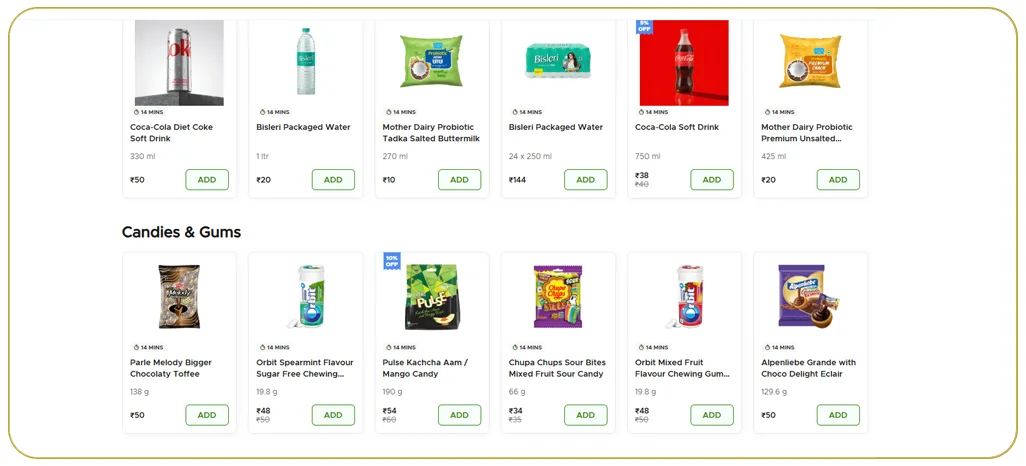
Price monitoring is an important part of retail competitive intelligence. Grocery retailers need to understand how competitors position similar products, which categories receive frequent discounts, and where price differences may influence customer purchasing decisions.
A Blinkit real-time grocery price monitoring API can be a useful business requirement when an approved data provider or authorized integration makes the relevant product information available. It allows businesses to plan structured price observations and organize them for analysis. Blinkit Quick Commerce Data Scraping helps businesses structure relevant grocery product information, monitor pricing trends, and support competitor price analysis for better business decisions.
The main areas retailers should evaluate include:
- Product price tracking: Record permitted listed prices for comparable grocery products.
- Discount monitoring: Identify published promotional prices and discount percentages.
- Product availability: Understand whether products are available or unavailable at the observation time.
- Category comparison: Evaluate price differences across groceries, beverages, personal care, and household essentials.
- Historical price analysis: Compare time-stamped observations to understand price movements.
- Competitive benchmarking: Review equivalent products across selected marketplaces and locations.
How has the quick-commerce business expanded?
Eternal Limited's FY2024–25 annual report provides company-reported operating metrics for Blinkit. These figures demonstrate the scale of its business expansion.
| Financial year | Blinkit orders (million) | Net order value (₹ crore) | Stores at year-end |
|---|---|---|---|
| FY2023 | 119 | 5,690 | Not shown in this comparison |
| FY2024 | 203 | 10,503 | 526 |
| FY2025 | 424 | 22,371 | 1,301 |
Source: Eternal Limited Annual Report 2024–25. Blinkit FY2023 figures are reported on an unaudited, management-information basis. Read the annual report.
The reported order volume increased from 119 million in FY2023 to 424 million in FY2025. This illustrates why structured grocery intelligence is relevant to retailers and FMCG brands operating in a growing quick-commerce environment.
Price monitoring should nevertheless distinguish between a listed selling price, an effective price after eligible offers, and the final amount paid by a customer. These values are not necessarily identical.
How Does Product-Level Analysis Improve Retail Decisions?
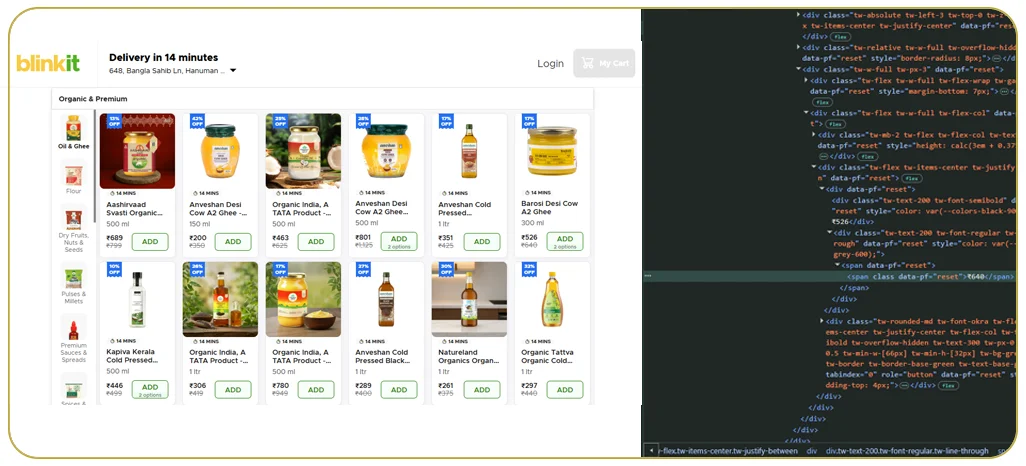
Retailers cannot make reliable pricing decisions using category names alone. They need to compare products with matching brands, quantities, variants, and packaging configurations. Without product-level standardization, market comparisons can produce misleading conclusions.
Blinkit API data extraction for products analytics can describe a permitted data workflow in which product information is organized for business intelligence and competitive research.
For example, a grocery category manager may need to evaluate packaged beverages. Comparing a 250 ml product with a 1-litre pack would create an inaccurate price comparison. Unit-level normalization helps resolve this issue.
Which product attributes should businesses examine?
| Data attribute | Analytical purpose |
|---|---|
| Product name | Identifies the listed item |
| Brand | Groups products by manufacturer |
| Product category | Supports category-level analysis |
| Pack size | Enables equivalent product matching |
| Product identifier | Helps distinguish product variants |
| Listed price | Supports price benchmarking |
| MRP | Provides a reference where published |
| Discount | Helps evaluate promotions |
| Availability | Adds inventory context |
| Observation timestamp | Supports historical comparisons |
Product matching should be completed before calculating competitive price differences. Retailers should normalize quantities into comparable units wherever possible. For example, price per kilogram or price per litre can help compare different package sizes of an equivalent product.
Which business teams benefit?
- Category managers: Evaluate assortment coverage and product positioning.
- Pricing analysts: Examine price movements and competitive differences.
- FMCG manufacturers: Understand the visibility and positioning of their products.
- Market researchers: Organize category-level information for market studies.
- Regional business teams: Compare market observations across serviceable areas.
The value of product-level information comes from consistency. Businesses should preserve original product descriptions alongside standardized fields so analysts can trace how a product was matched.
Historical product records also make it possible to distinguish a newly listed product from an existing item with an updated title or packaging description.
This approach helps retailers build stronger product intelligence without relying on unstructured marketplace observations.
How Can Businesses Turn Product Information into Usable Datasets?
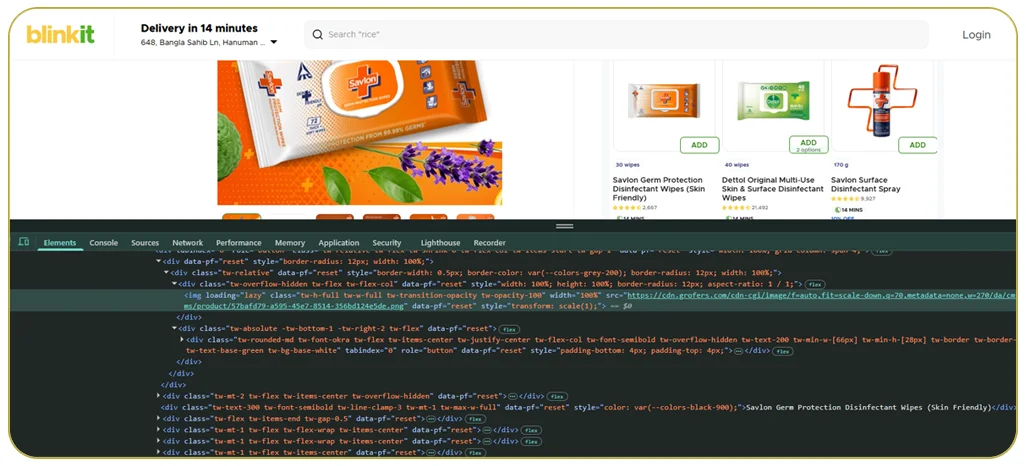
Collecting product information is only the first step. Businesses also need to organize it into a consistent structure that supports comparison, reporting, and historical analysis.
The process to extract Blinkit product information into structured datasets must begin with an authorized source. Blinkit's Terms of Use, last updated in February 2026, restrict commercial use, product-listing collection, data mining, robots, and similar automated extraction without express prior written consent. Businesses should therefore obtain appropriate written permission or use a licensed integration before planning commercial data collection. A Blinkit Grocery Dataset can help organize authorized product information into structured records for grocery product analysis, pricing research, and inventory insights. Review Blinkit's Terms of Use.
What does a structured dataset look like?
A suitable dataset can contain the following fields, where permitted by the data source:
| Field | Description |
|---|---|
| Product ID | Unique product reference |
| Product name | Published product title |
| Brand | Manufacturer or brand name |
| Category | Grocery product classification |
| Pack size | Product quantity or volume |
| MRP | Published maximum retail price |
| Selling price | Displayed selling price |
| Discount | Published promotional reduction |
| Availability | Observed availability status |
| Location | Permitted service-area identifier |
| Timestamp | Date and time of observation |
| Source reference | Authorized source record |
What are the main stages of dataset preparation?
Source validation: Confirm the source's permissions, data coverage, commercial usage rights, and available product attributes.
Product standardization: Normalize product names, brands, quantities, and category labels to improve comparison accuracy.
Duplicate identification: Use product identifiers and matching rules to avoid counting repeated observations as separate products.
Price validation: Check currency, numerical formats, missing values, and the distinction between regular and promotional prices.
Historical storage: Retain previous observations instead of overwriting them, allowing analysts to evaluate changes over time.
Data delivery: Prepare approved records in formats suitable for spreadsheets, databases, and business intelligence dashboards.
Why does historical information matter?
A single price observation cannot establish a long-term pricing pattern. Repeated, time-stamped records help businesses understand whether a difference is temporary or recurring.
For example, a product may show a promotional discount during one observation period and return to its regular listed price later. Keeping both records helps analysts understand the movement instead of treating the promotional price as permanent.
Build a structured grocery intelligence workflow with authorized product information, standardized datasets, and historical reporting.
Get Insights Now!How Can Quick-Commerce Data Support Market Research?
Quick commerce provides businesses with a different retail environment to study. Product visibility, delivery-area coverage, assortment, and pricing can vary according to the operational market being served.
A Blinkit quick commerce data scraper may be a search term used by businesses exploring product intelligence solutions. However, commercial implementations should use authorized feeds, approved integrations, or written permission rather than automated extraction that conflicts with platform terms.
What can retailers learn from quick-commerce information?
Category performance: Businesses can organize permitted product observations by category to understand which types of grocery items are represented in the marketplace.
Price positioning: Comparing equivalent products can help identify differences between listed prices and promotional prices.
Assortment coverage: Product records can help analysts examine which brands, pack sizes, and product variants appear in a selected assortment.
Availability patterns: Historical availability observations provide context when evaluating price comparisons.
Regional intelligence: Where location-level data is authorized, businesses can examine differences between selected service areas.
Industry growth and reported operating metrics
Bain & Company's How India Shops Online 2025 report provides important context for the expansion of quick commerce in India.
| Year | India quick-commerce GMV |
|---|---|
| 2022 | US$1.5 billion |
| 2024 | US$6–7 billion |
| 2025 | No directly comparable final figure in this report |
| 2026 | No directly comparable final figure in this report |
Source: Bain & Company, How India Shops Online 2025. The report also estimates that quick commerce accounted for approximately 70–75% of India's e-grocery GMV in 2024. Read the Bain report.
These industry estimates indicate the growing importance of quick commerce in India's online retail ecosystem. They are market-wide figures, not Blinkit-specific revenue or product-price statistics.
For retailers, the practical opportunity is to combine industry context with product-level observations. This allows market research teams to study assortment, promotions, and competitive positioning using clearly defined datasets rather than relying on broad market assumptions.
What Role Does an Authorized Integration Play in Product Intelligence?
An approved integration can help businesses access permitted product information in a consistent format. Instead of maintaining disconnected product records, retailers can use a centralized data pipeline to organize information for pricing analysis, assortment research, and reporting.
A Blinkit API integration should be evaluated according to the actual access agreement, available endpoints, permitted fields, usage limits, and commercial rights. The availability of an API should never be assumed simply because a platform displays product information publicly.
What should businesses verify before integration?
- Access authorization: Confirm that the provider or platform has granted permission for the intended use.
- Available fields: Establish whether product names, prices, discounts, identifiers, and availability information are included.
- Update frequency: Confirm how frequently the authorized source refreshes its records.
- Location coverage: Check which delivery areas and geographic identifiers are supported.
- Data delivery: Identify whether the integration supports structured files, API responses, or database transfers.
- Usage restrictions: Review retention, redistribution, commercial-use, and permitted processing conditions.
How does integration improve reporting?
Once authorized information enters a centralized system, businesses can standardize it and connect it to analytical dashboards.
For example, a pricing analyst may need to examine the listed prices of equivalent household products over several reporting periods. A structured integration can provide the approved records needed to calculate price differences, review promotional changes, and identify missing observations.
The reporting system can also separate different analytical dimensions:
- Product-level price comparisons.
- Brand-level assortment comparisons.
- Category-level promotional analysis.
- Historical price movements.
- Location-specific observations, where available.
- Availability changes across observation periods.
An important consideration is data freshness. A record collected several hours earlier should not automatically be described as a real-time price. Dashboards should display the actual collection timestamp and the source's update frequency.
Businesses should also maintain source references and validation logs so that analysts can trace important findings back to their original authorized records.
Which Technical Features Make a Product Monitoring System Scalable?
A scalable product intelligence system needs reliable data management, consistent validation, and reporting capabilities. Simply collecting more records does not guarantee better market insights. The quality of product matching, observation timing, and source permissions determines whether the information is useful.
Blinkit API for authorized product data access should be approached as a permission-based data integration requirement, supported by an architecture that can manage product information throughout its lifecycle.
Essential technical capabilities
- Product identification and normalization
The system should standardize product names, brands, pack sizes, and categories. This helps prevent incorrect comparisons between different product variants.
- Historical record management
Previous observations should be retained with their collection timestamps. This enables analysts to review changes without losing earlier information.
- Data quality validation
Automated checks should identify missing product attributes, invalid prices, duplicate records, and inconsistent quantities.
- Location-level organization
Where the source permits geographic data access, records can be organized by service area. This helps analysts distinguish between location-specific observations.
- Dashboard integration
Business intelligence tools can display price movements, product availability, assortment changes, and category comparisons.
- Automated reporting
Scheduled reports can distribute validated information to pricing teams, category managers, and research departments.
Which performance indicators should businesses monitor?
| KPI | Measurement | Business value |
|---|---|---|
| Product coverage | Valid products recorded | Measures dataset completeness |
| Price difference | Current price minus reference price | Identifies pricing gaps |
| Discount percentage | Discount divided by MRP × 100 | Evaluates promotions |
| Availability rate | Available observations divided by valid observations | Measures observed availability |
| Data freshness | Time since last collection | Evaluates reporting timeliness |
| Matching accuracy | Correctly matched records divided by reviewed records | Measures comparison reliability |
These indicators help businesses assess both the quality of their datasets and the usefulness of their analytical workflows.
A well-designed architecture should also distinguish between unavailable products, missing data, and products that are outside the authorized source's coverage. These conditions have different meanings and should not be combined into a single status.
The result is a more dependable monitoring framework that can support additional product categories, reporting periods, and approved data sources as business requirements evolve.
Why Choose Real Data API?
Businesses need dependable product information to understand marketplace activity and make better pricing decisions. Real Data API focuses on helping companies organize authorized data sources into structured datasets that support retail intelligence, market research, and competitive analysis.
Here are some important capabilities to consider when selecting a product data partner.
- 1. Structured Product Datasets
Retailers need consistent product attributes for comparing brands, categories, quantities, and prices. Standardized datasets make it easier to analyze product information and reduce inconsistencies.
- 2. Competitive Pricing Intelligence
Organized price observations help businesses evaluate competitive positioning, understand promotional activity, and identify products that require further pricing investigation.
- 3. Historical Data Management
Maintaining historical records allows analysts to examine price movements, product availability changes, and assortment developments over selected reporting periods.
- 4. Flexible Data Integration
Structured data can be prepared for business intelligence dashboards, spreadsheets, databases, and other analytical environments, subject to the relevant integration requirements.
- 5. Data Quality Management
Validation processes, duplicate identification, product normalization, and timestamp management help businesses maintain consistent analytical records.
- 6. Scalable Research Support
Businesses can organize their requirements around selected product categories, geographic coverage, data fields, and reporting schedules.
With Blinkit API for authorized product data access, businesses can plan permission-based data workflows that support better product intelligence and competitive research.
Conclusion
Quick commerce has become an important part of India's online retail landscape. Retailers and FMCG manufacturers need reliable information to understand product prices, promotional activity, assortment changes, and marketplace positioning.
Blinkit API for authorized product data access offers a relevant framework for businesses seeking permitted product information for competitive intelligence and retail analytics.
By organizing product names, brands, categories, pack sizes, prices, discounts, and availability into structured datasets, businesses can improve their understanding of marketplace activity. Historical observations further help analysts identify pricing movements, evaluate promotional changes, and compare equivalent products over time.
However, successful implementation depends on appropriate access permissions, accurate product matching, consistent data validation, and transparent reporting. Businesses must confirm that their chosen integration or data provider has the necessary authorization for commercial data access and processing.
A well-organized product intelligence workflow can help pricing teams investigate competitive gaps, support assortment decisions, and develop more informed retail strategies. It also creates a foundation for expanding research across additional categories and approved data sources.
Looking to strengthen your grocery market intelligence? Contact Real Data API to discuss authorized product data access, structured datasets, and customized retail analytics solutions for your business!
FAQs
1. What is an authorized product data integration?
It is a permission-based method of accessing approved marketplace information. Blinkit API for authorized product data access can support structured product intelligence and business research.
2. What information can a product data scraper organize?
A Blinkit Product Data Scraper workflow can organize permitted product names, brands, categories, prices, discounts, and availability information from authorized sources.
3. Why is grocery price monitoring important?
A Blinkit real-time grocery price monitoring API can support price benchmarking, promotional analysis, and historical comparisons when the authorized source provides sufficiently fresh information.
4. How does product analytics support retailers?
Blinkit API data extraction for products analytics helps businesses organize product attributes, compare equivalent items, and evaluate assortment and pricing trends.
5. Can businesses build structured grocery datasets?
Yes. Real Data API can help businesses plan structured data workflows using appropriately authorized sources and organize permitted product information for market research.
Latest posts
Can a McDonald’s Scraper for Menu Price Monitoring Solve the Challenge of Tracking Frequent Menu Price Changes Across Multiple Locations
How Blinkit API for authorized product data access Helps Retailers Track Product Prices and Improve Competitive Intelligence
How Nykaa API Integration for Beauty E-commerce Analytics Helps Fix Inaccurate Product and Pricing Data
How Zepto Grocery Data Scraping by Pincode Helps Retailers Identify Local Price Differences & Pricing Gaps?



.png)


