
Introduction
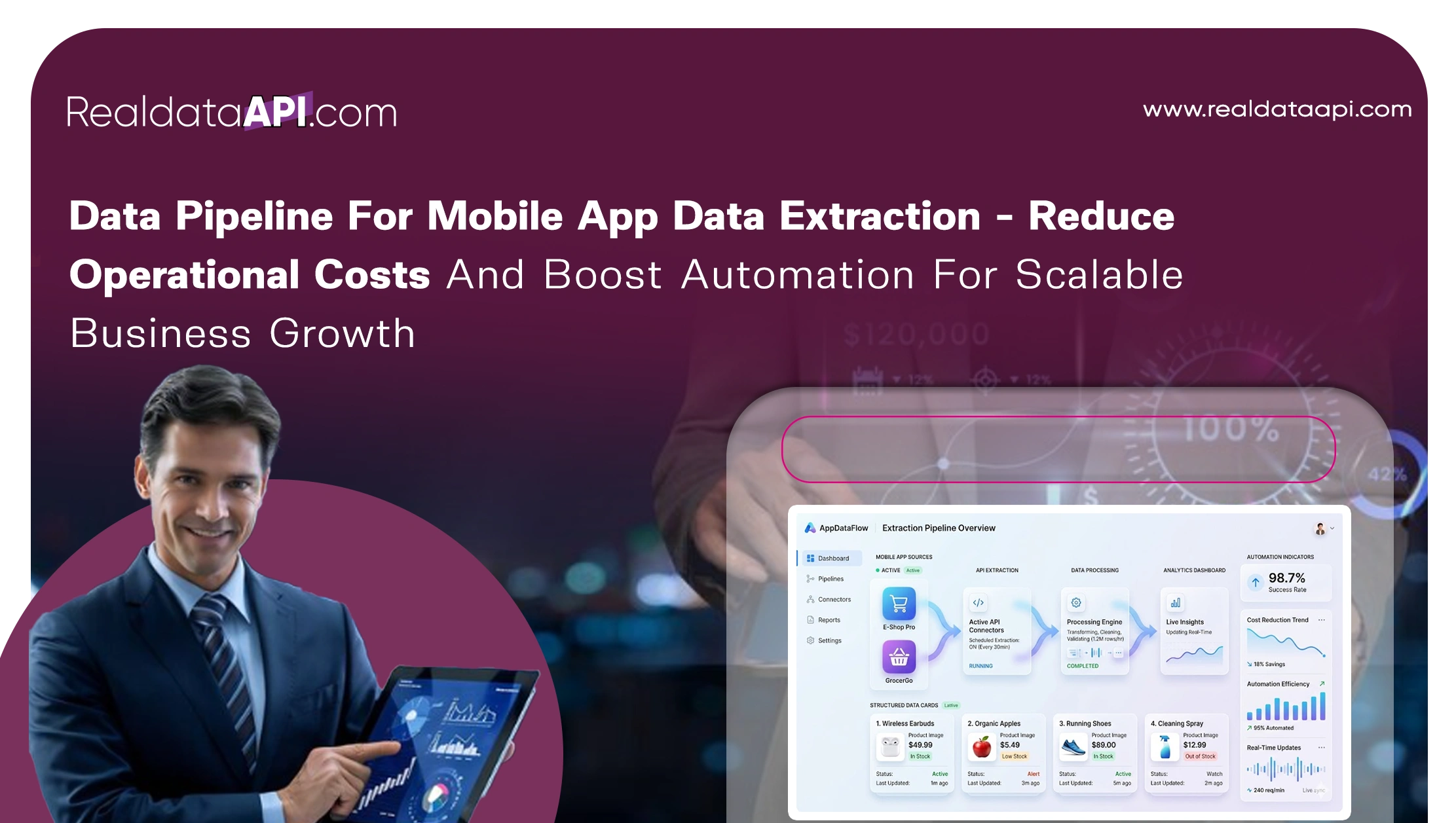
In today's digital-first economy, businesses depend heavily on structured and real-time data to drive decisions. However, collecting and processing mobile data at scale is complex without a structured system in place. This is where a data pipeline for mobile app data extraction becomes essential, enabling seamless data flow from mobile applications into analytics and business intelligence systems.
Modern mobile apps generate massive volumes of dynamic data, including pricing, user activity, and transactional updates. Managing this manually is inefficient and costly. A well-designed pipeline automates ingestion, transformation, and storage processes, significantly reducing operational overhead.
Solutions like a Mobile App Scraping API further simplify this process by handling authentication, data extraction, and formatting automatically. This ensures businesses can focus on insights rather than infrastructure.
As organizations scale, the need for real-time, accurate, and reliable mobile data becomes even more critical. In this blog, we explore how structured pipelines improve efficiency, reduce costs, and enable scalable business growth through automation and advanced data engineering practices.
Building Robust Systems for Scalable Data Flow
Designing efficient systems is the foundation of successful data operations. Understanding how to build scalable pipelines for mobile app data extraction helps organizations manage increasing data volumes without performance degradation.
Between 2020 and 2026, data consumption from mobile apps has increased by over 75%, driven by eCommerce, fintech, and on-demand services. This surge has made scalability a top priority for businesses.
| Year | Mobile Data Growth | Pipeline Adoption Rate |
|---|---|---|
| 2020 | 30% | 40% |
| 2022 | 45% | 55% |
| 2024 | 60% | 70% |
| 2026 | 75% | 85% |
Scalable pipelines typically use modular architectures that separate ingestion, processing, and storage layers. This allows systems to handle failures independently without disrupting the entire workflow.
Additionally, load balancing and distributed processing ensure that large-scale requests are handled efficiently. Businesses also implement retry mechanisms and queue systems to maintain data integrity.
By building scalable pipelines, organizations can ensure consistent performance even as data demands grow exponentially, enabling long-term operational stability.
Leveraging Cloud Infrastructure for Data Expansion
Cloud computing plays a vital role in modern data engineering. Adopting scaling data extraction systems using cloud architecture allows businesses to expand their capabilities without investing heavily in physical infrastructure.
From 2020 to 2026, cloud adoption in data pipelines has grown by 80%, driven by flexibility, cost efficiency, and scalability. Cloud platforms enable dynamic resource allocation, ensuring optimal performance during peak loads.
| Feature | On-Premise Systems | Cloud Systems |
|---|---|---|
| Scalability | Limited | High |
| Maintenance Cost | High | Low |
| Deployment Speed | Slow | Fast |
| Flexibility | Low | High |
Cloud-based pipelines support auto-scaling, meaning resources adjust automatically based on workload. This ensures uninterrupted data flow even during high-demand periods.
Additionally, cloud environments provide built-in security features, backup systems, and monitoring tools that enhance reliability. Businesses can also integrate multiple data sources seamlessly, improving overall data quality.
By leveraging cloud infrastructure, organizations can build resilient and cost-effective pipelines that support continuous mobile app data extraction at scale.
Enabling Instant Insights Through Continuous Data Flow
Real-time processing is critical in fast-moving industries. Implementing real-time data pipeline mobile apps ensures that businesses receive up-to-date information without delays.
Between 2020 and 2026, real-time data processing adoption has increased by 68%, especially in sectors like retail, logistics, and fintech.
| Industry | Real-Time Adoption |
|---|---|
| Retail | 70% |
| Logistics | 65% |
| Fintech | 80% |
| Travel | 60% |
Real-time pipelines use event-driven architectures where data is processed immediately after generation. This reduces latency and improves decision-making speed.
Streaming technologies and message queues help manage continuous data flow efficiently. These systems ensure that even large-scale data updates are processed without delays.
With real-time pipelines, businesses can monitor pricing changes, user behavior, and inventory updates instantly. This enables proactive decision-making and improves customer experience.
Ultimately, real-time processing transforms raw mobile data into actionable insights within seconds, giving businesses a significant competitive advantage.
Choosing the Right Tools for Pipeline Efficiency
Selecting the right tools is crucial for building effective systems. Leveraging tools for building scalable scraping pipelines helps businesses optimize performance, reduce complexity, and improve reliability.
From 2020 to 2026, automation tools in data engineering have seen a 62% increase in adoption due to their ability to streamline workflows.
| Tool Type | Functionality |
|---|---|
| ETL Platforms | Data transformation |
| Message Queues | Data streaming |
| API Gateways | Secure access management |
| Monitoring Tools | Performance tracking |
These tools help automate repetitive tasks such as data cleaning, transformation, and validation. They also improve fault tolerance by handling errors and retries automatically.
Integration tools allow seamless connection between mobile apps, databases, and analytics platforms. This ensures smooth data movement across the pipeline.
By using the right combination of tools, businesses can significantly improve efficiency and reduce development time, making their data pipelines more robust and scalable.
Enhancing Data Extraction with Advanced APIs
APIs are central to modern data extraction systems. Using a Web Scraping API allows businesses to automate complex data collection tasks while ensuring accuracy and scalability.
From 2020 to 2026, API-based scraping adoption has grown by 58%, reflecting its effectiveness in handling dynamic mobile environments.
| Feature | Benefit |
|---|---|
| Automation | Reduced manual effort |
| Scalability | High-volume support |
| Accuracy | Structured data output |
| Integration | Easy system connectivity |
APIs simplify authentication, request handling, and data formatting, making them ideal for large-scale operations. They also support real-time updates, ensuring businesses always have access to the latest information.
With built-in support for proxies, retries, and error handling, APIs significantly reduce operational complexity. This allows teams to focus on analysis rather than data collection.
By integrating scraping APIs into pipelines, organizations can achieve faster, more reliable, and scalable data extraction processes.
Scaling Enterprise-Level Data Operations
Enterprise systems require advanced architectures to manage large-scale operations. Implementing Enterprise Web Crawling solutions ensures that businesses can handle massive data workloads efficiently.
Between 2020 and 2026, enterprise-level data extraction has grown by 72%, driven by global digital transformation initiatives.
| Capability | Impact |
|---|---|
| Distributed Crawling | High scalability |
| Centralized Control | Simplified management |
| Multi-Source Support | Broader data coverage |
| Real-Time Processing | Faster insights |
Enterprise systems use distributed nodes to handle multiple extraction tasks simultaneously. This improves speed and reduces system bottlenecks.
Advanced monitoring and AI-based optimization further enhance efficiency by dynamically adjusting resource allocation.
These systems are essential for organizations managing global datasets and high-frequency data updates, ensuring consistent performance at scale.
Why Choose Real Data API?
Real Data API provides industry-leading Web Scraping Services designed to support scalable and efficient data pipeline for mobile app data extraction solutions. It simplifies complex data workflows by offering automated extraction, transformation, and delivery systems tailored for modern businesses.
With a focus on reliability, scalability, and compliance, Real Data API ensures that organizations can build robust pipelines without worrying about infrastructure challenges. Its advanced architecture supports real-time processing, large-scale extraction, and seamless integration with analytics platforms.
By leveraging Real Data API, businesses can significantly reduce operational costs while improving data accuracy and automation efficiency.
Conclusion
A well-designed data pipeline for mobile app data extraction is essential for reducing operational costs, improving automation, and enabling scalable business growth. By adopting modern tools, cloud infrastructure, and real-time processing systems, businesses can transform raw mobile data into actionable insights efficiently.
As data continues to grow in volume and complexity, structured pipelines will remain a key driver of digital transformation and competitive advantage.
Ready to build smarter, faster, and more scalable data systems? Partner with Real Data API today and unlock the full potential of automated mobile data extraction!
Latest posts
How Scrape Xiaohongshu Product Trends in Real Time Solves Product Discovery and Competitor Monitoring Challenges?
How to Scrape Taobao Product Data to Solve Pricing, Inventory, and Competitor Monitoring Challenges?
How to Extract grocery product listings Data from SPAR to Build Accurate Grocery Intelligence and Competitive Market Insights?
Scrape Douyin follower growth and engagement data to track influencer performance and trends







.png)