Introduction
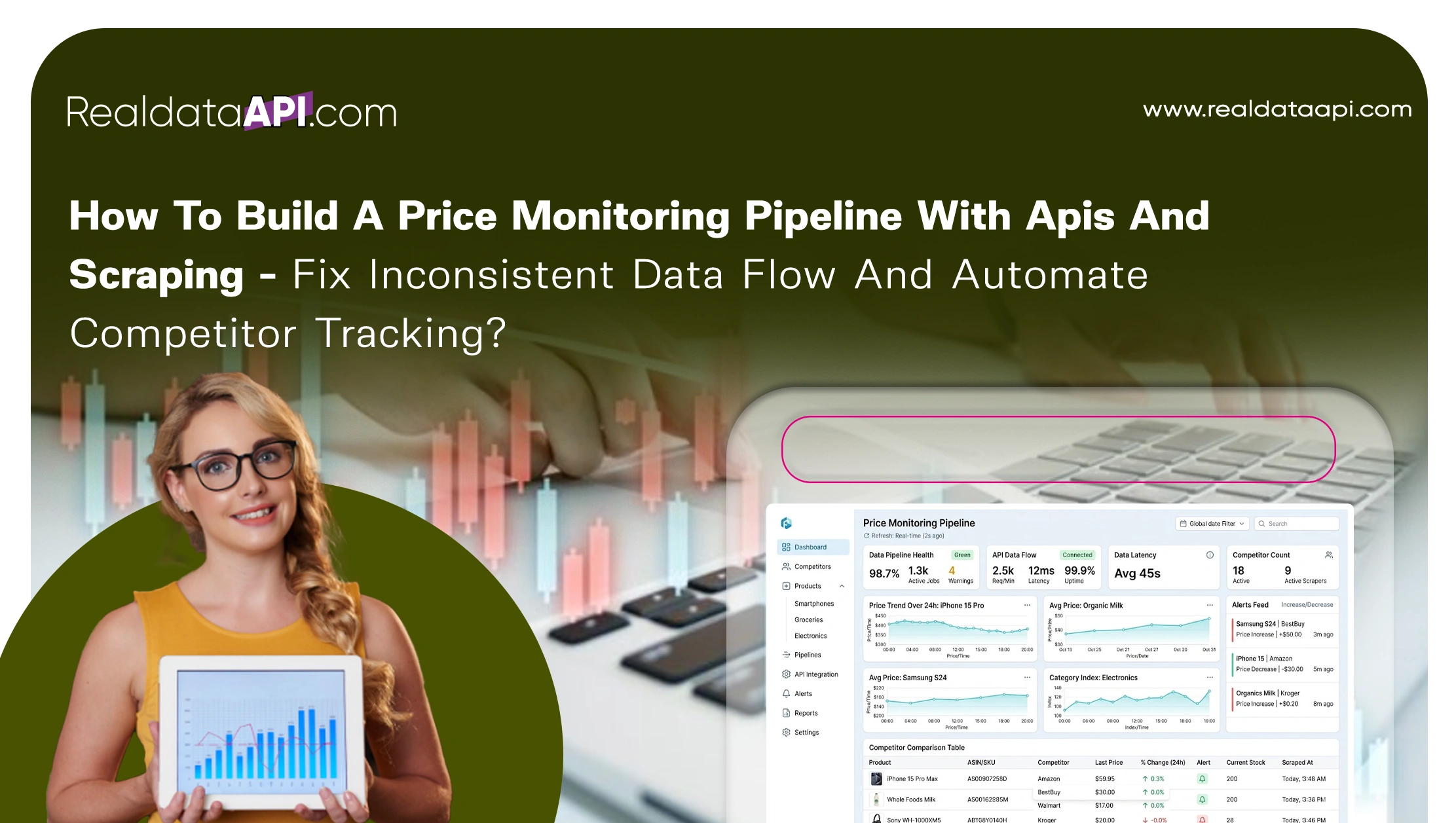
In today's fast-changing digital marketplace, businesses need accurate and real-time pricing intelligence to stay competitive. However, inconsistent data sources and manual tracking often lead to gaps in insights and delayed decisions. This is why understanding how to build a price monitoring pipeline with APIs and scraping has become essential for modern data-driven organizations.
A structured pipeline enables continuous collection, processing, and analysis of competitor pricing data across multiple platforms. With tools like Price Monitoring, businesses can automate the entire workflow from data extraction to visualization, ensuring real-time accuracy.
Modern systems combine APIs for structured data access and scraping techniques for dynamic content extraction. Platforms like Real Data API help unify these processes into a scalable pipeline that eliminates inconsistencies and improves efficiency.
In this blog, we will explore how to design, build, and scale a reliable price monitoring pipeline that automates competitor tracking and ensures consistent data flow for smarter business decisions.
Turning Raw Data into Real-Time Competitive Intelligence
Accurate pricing insights depend on real-time analytics. Implementing real-time competitor pricing analytics using scraped data allows businesses to track market changes instantly and respond faster than competitors.
Between 2020 and 2026, real-time analytics adoption in pricing intelligence systems has increased by over 78%, driven by eCommerce and quick commerce growth.
| Year | Adoption Rate | Data Refresh Frequency |
|---|---|---|
| 2020 | 35% | Daily |
| 2022 | 50% | Hourly |
| 2024 | 68% | Every 15 minutes |
| 2026 | 78% | Real-time |
Real-time competitor analytics systems collect pricing data continuously and update dashboards instantly. This enables businesses to identify pricing gaps, monitor promotions, and adjust strategies dynamically.
Scraped data plays a key role in filling gaps where APIs may not provide complete coverage. By combining multiple sources, businesses achieve a more accurate and holistic view of the market.
This real-time intelligence helps organizations react quickly to competitor actions and maintain optimal pricing strategies.
Expanding Market Coverage with Multi-Source Data Extraction
Comprehensive data coverage is essential for effective price monitoring. The ability to Scrape competitor prices across ecommerce platforms ensures businesses capture pricing variations across different channels.
From 2020 to 2026, the number of ecommerce platforms has increased by over 65%, making multi-source scraping more important than ever.
| Data Source | Coverage Level | Update Frequency |
|---|---|---|
| Marketplaces | High | Real-time |
| Brand Websites | Medium | Hourly |
| Aggregators | High | Frequent |
| Mobile Apps | Very High | Real-time |
Scraping across multiple platforms ensures that businesses do not miss critical pricing changes. Each platform may have different pricing strategies, discounts, or regional variations.
By aggregating this data, companies can build a unified pricing intelligence system that provides a complete market view.
This approach eliminates blind spots and ensures that pricing strategies are based on comprehensive, real-world data rather than partial insights.
Automating End-to-End Competitor Tracking Systems
Automation is the backbone of modern pricing intelligence. Implementing automated competitor price tracking using data pipelines allows businesses to eliminate manual processes and improve efficiency.
Between 2020 and 2026, automation in data pipelines has increased by 72%, reducing operational costs and improving data accuracy.
| Pipeline Stage | Function | Benefit |
|---|---|---|
| Data Ingestion | Collect pricing data | Real-time access |
| Processing Layer | Clean & normalize data | Accuracy |
| Storage Layer | Save historical data | Trend analysis |
| Visualization | Display insights | Decision support |
Automated pipelines continuously collect and process pricing data from multiple competitors. This ensures that dashboards always reflect the latest market conditions.
Additionally, automation reduces human error and ensures consistent data formatting across all sources.
Businesses can also set alerts for price drops or competitor changes, enabling proactive decision-making.
This makes automated pipelines a critical component of any modern pricing intelligence system.
Strengthening Market Position with Competitive Analysis
Understanding market positioning is key to pricing strategy. Using Competitive Benchmarking, businesses can compare their prices against competitors and identify opportunities for optimization.
From 2020 to 2026, competitive benchmarking adoption has increased by 70%, especially in retail and eCommerce sectors.
| Metric | Importance Level |
|---|---|
| Price Positioning | High |
| Discount Strategy | Medium |
| Market Share | High |
| Competitor Gaps | High |
Benchmarking helps businesses identify whether they are overpriced or underpriced in the market. It also highlights gaps where competitors are gaining an advantage.
Advanced systems use historical data to track pricing trends and forecast future movements. This allows businesses to plan long-term pricing strategies more effectively.
By integrating benchmarking into pricing pipelines, companies can maintain a strong competitive position and improve profitability.
Enhancing Data Collection with Managed Services
Reliable data collection is essential for any pricing system. Using Web Scraping Services ensures consistent, scalable, and accurate data extraction from multiple sources.
Between 2020 and 2026, demand for managed scraping services has grown by 60%, driven by increasing data complexity.
| Feature | Benefit |
|---|---|
| Automation | Reduced manual effort |
| Scalability | Large-scale extraction |
| Accuracy | Clean structured data |
| Maintenance | Low operational overhead |
Managed scraping services handle challenges such as anti-bot systems, dynamic content, and rate limits. This ensures uninterrupted data flow into pipelines.
These services also support multi-platform extraction, making it easier to gather competitor pricing data from diverse sources.
By outsourcing or integrating scraping services, businesses can focus on analysis rather than infrastructure management.
Powering Pipelines with Advanced API Infrastructure
APIs are essential for structured and reliable data collection. A Web Scraping API enables businesses to automate data extraction while maintaining high accuracy and scalability.
From 2020 to 2026, API-based scraping adoption has increased by 58%, making it a standard for modern data pipelines.
| Feature | Advantage |
|---|---|
| Automation | Faster data collection |
| Scalability | High-volume support |
| Integration | Easy system connectivity |
| Reliability | Stable data flow |
APIs simplify authentication, request handling, and data formatting. They ensure that pipelines receive structured and consistent data across all sources.
Advanced APIs also include proxy management, retry mechanisms, and geo-targeting features, improving reliability and coverage.
By integrating APIs into price monitoring pipelines, businesses can achieve real-time, scalable, and efficient competitor tracking systems.
Why Choose Real Data API?
Real Data API provides powerful Web Scraping Services designed to help businesses effectively implement how to build a price monitoring pipeline with APIs and scraping. It ensures seamless data extraction, processing, and delivery for real-time pricing intelligence systems.
With advanced infrastructure, Real Data API supports scalable pipelines that eliminate inconsistencies and improve data accuracy. It enables businesses to automate competitor tracking, reduce operational costs, and enhance decision-making speed.
Its robust architecture ensures uninterrupted data flow, making it ideal for building high-performance pricing intelligence systems across industries.
Conclusion
Understanding how to build a price monitoring pipeline with APIs and scraping is essential for eliminating data inconsistencies and enabling automated competitor tracking. With structured pipelines, businesses can achieve real-time pricing visibility, improve efficiency, and make smarter strategic decisions.
As competition intensifies, automated pricing intelligence becomes a critical advantage for growth and profitability.
Ready to build a powerful price monitoring system? Partner with Real Data API today and turn real-time data into actionable business intelligence!
Latest posts

How Louis Vuitton Fashion Dataset Enables Better Analysis of Luxury Products, Prices, Brands, and Fashion Trends?
How Blinkit Grocery Dataset Enables Smarter Analysis of Products, Prices, Availability, and Quick-Commerce Trends?

How Chanel Fashion Dataset Enables Smarter Analysis of Luxury Products, Prices, Categories, and Fashion Trends?
How Foodpanda Food Dataset Helps Businesses Track Restaurants, Menus, Prices, Ratings, and Food Delivery Trends?






.png)



