TL;DR
- Chanel fashion dataset can help fashion businesses structure product, category, price, collection, material, color, and availability information for market and assortment analysis.
- Chanel fashion data Scraping supports recurring observation of publicly displayed fashion information, making historical comparisons easier across collections, categories, and markets.
- From 2020–2026, luxury fashion has experienced major shifts in pricing, consumer behavior, digital discovery, resale, and AI. Structured product intelligence can help businesses respond to these changes with evidence-based analysis.
Introduction
Luxury fashion businesses need timely product intelligence to understand how assortments, pricing, categories, collections, and consumer-facing trends change over time. A structured Chanel fashion dataset can organize publicly available product information into a consistent format for competitive research, assortment benchmarking, pricing analysis, and trend intelligence.
CHANEL's current digital fashion presence spans ready-to-wear, handbags, small leather goods, eyewear, seasonal collections, haute couture, and other fashion-related categories. Its official website currently features Fall-Winter 2026 collections, while its fashion FAQ describes recurring Spring-Summer, Métiers d'Art, Autumn-Winter, Cruise, and capsule collections. (CHANEL)
Businesses can use Chanel fashion data Scraping to systematically capture selected publicly available attributes such as product names, reference numbers, categories, collection names, materials, colors, sizes, prices where displayed, and availability.
This becomes particularly valuable in a luxury market where price increases, changing consumer preferences, resale, digital discovery, and AI are reshaping fashion intelligence requirements. McKinsey reports that the luxury sector experienced a 5% compound annual growth rate from 2019 to 2023, while price increases accounted for more than 80% of that growth. The same research identifies a subsequent slowdown and changing value expectations. (McKinsey & Company)
The objective is therefore not simply to collect more product records. It is to build consistent, timestamped, comparable product intelligence that helps analysts understand what is changing and where.
How can structured collection improve luxury assortment intelligence?
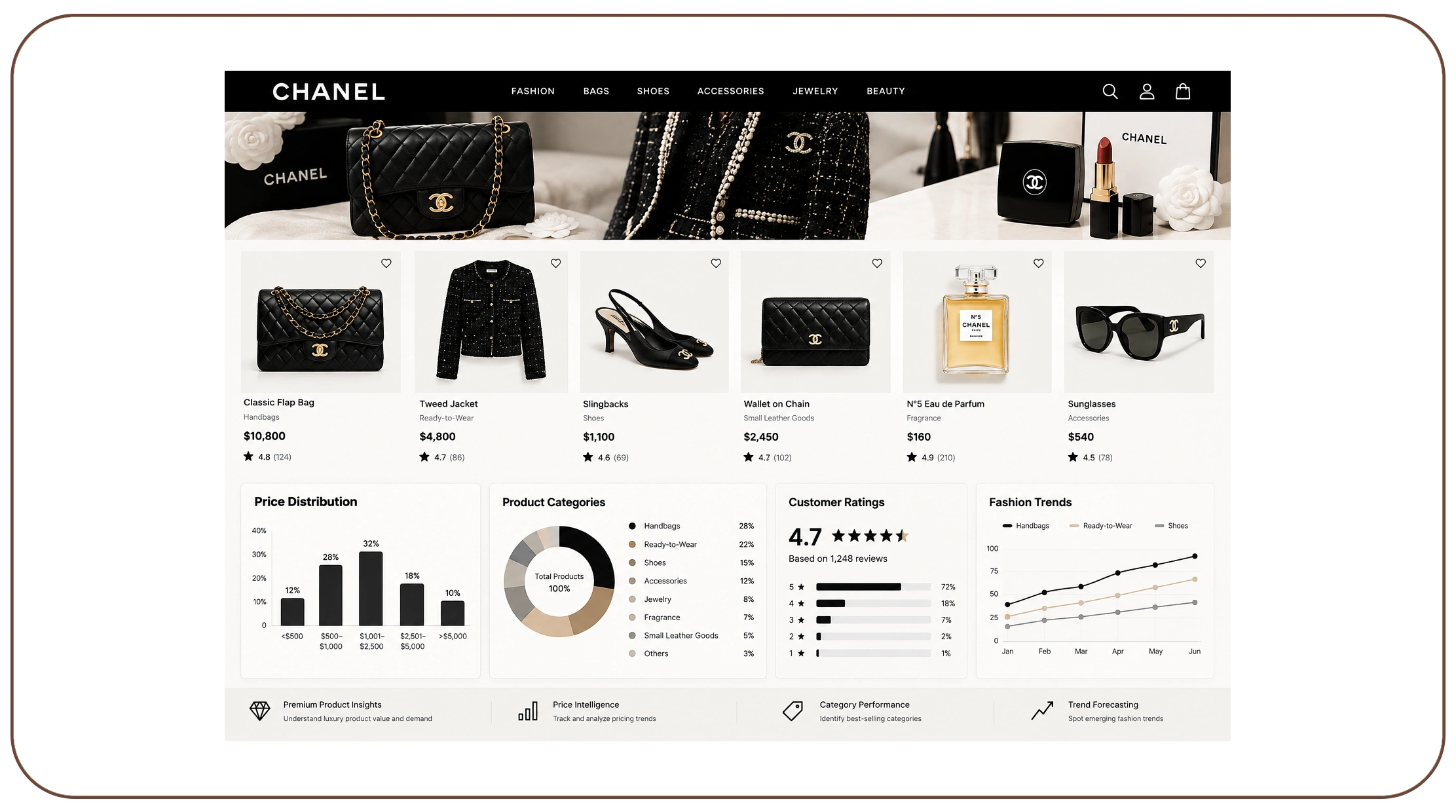
Chanel fashion data collection services can help businesses convert publicly available product information into structured records that are easier to compare across categories, collections, regions, and time periods.
For luxury analysts, the important information may include:
- Product name
- Product reference
- Collection
- Product category
- Subcategory
- Material
- Color
- Size
- Product description
- Listed price where available
- Availability
- Product URL
- Collection date
- Market or country
CHANEL's official product pages demonstrate why structured categorization matters. Its handbag pages provide filters including collection, shape, size, material, color, and hardware, creating multiple dimensions through which an assortment can be analyzed. (CHANEL)
What Changed From 2020 to 2026?
The luxury market moved through several distinct phases during this period. The pandemic accelerated digital shopping and disrupted physical retail. The following recovery produced strong luxury demand, followed by increasing pressure on consumers and brands.
McKinsey estimates that the luxury industry achieved approximately 5% CAGR between 2019 and 2023, supported by strong demand and significant pricing activity. By 2025, the sector was experiencing a slowdown, with macroeconomic conditions and a deteriorating value proposition affecting demand. (McKinsey & Company)
| Period | Market Development | Data Requirement |
|---|---|---|
| 2020 | Digital shopping accelerated | Digital assortment visibility |
| 2021 | Luxury demand recovered in many markets | Product and price tracking |
| 2022 | Inflation and pricing became more significant | Historical price comparisons |
| 2023 | Strong luxury growth period continued | Assortment and pricing benchmarks |
| 2024 | Consumer value sensitivity increased | Product-value analysis |
| 2025 | Luxury slowdown became more visible | Competitive and category intelligence |
| 2026 | Strategic renewal and AI adoption | Structured, machine-readable product data |
For analysts, historical snapshots make it possible to distinguish a temporary listing change from a longer-term assortment or pricing trend.
Why does frequently refreshed product information matter for luxury analysis?
Real-time Chanel fashion product data can support businesses that need frequently refreshed information about publicly visible product availability, assortment changes, new collections, and other product attributes.
Luxury fashion moves through seasonal and capsule collections rather than a completely static assortment. CHANEL's official FAQ identifies multiple annual fashion releases, including Spring-Summer, Métiers d'Art, Autumn-Winter, Cruise, and capsule collections. (CHANEL)
This creates an important analytical requirement: a product record should ideally retain its collection context and observation date.
A business monitoring an assortment over several months could identify:
- Newly introduced products
- Products no longer displayed
- Category expansion
- New colors
- New materials
- Collection transitions
- Product-reference changes
- Price changes where prices are publicly displayed
- Availability changes
How Did the Market Evolve Between 2020 and 2026?
In 2025, McKinsey described the fashion industry as facing a long-anticipated cyclical slowdown, with consumers becoming more price sensitive following inflation. (McKinsey & Company)
In 2026, the same research points to a luxury recalibration, with brands attempting to reduce dependence on price-led growth and place greater emphasis on creativity and craftsmanship. (McKinsey & Company)
That transition increases the importance of product-level evidence. Instead of analyzing luxury performance only through broad market reports, businesses can study the observable product assortment itself.
| Signal | What It Can Reveal |
|---|---|
| New collection | Assortment expansion |
| Product disappearance | Assortment turnover |
| New color | Seasonal direction |
| Material change | Product positioning |
| Category growth | Assortment strategy |
| Price movement | Pricing strategy |
| Availability change | Demand or supply signal |
| Reference number | Product-level tracking |
For data teams, frequent refreshes should be combined with historical storage. Real-time or near-real-time collection without historical retention provides limited trend visibility.
How can product-level collection strengthen pricing and category analysis?
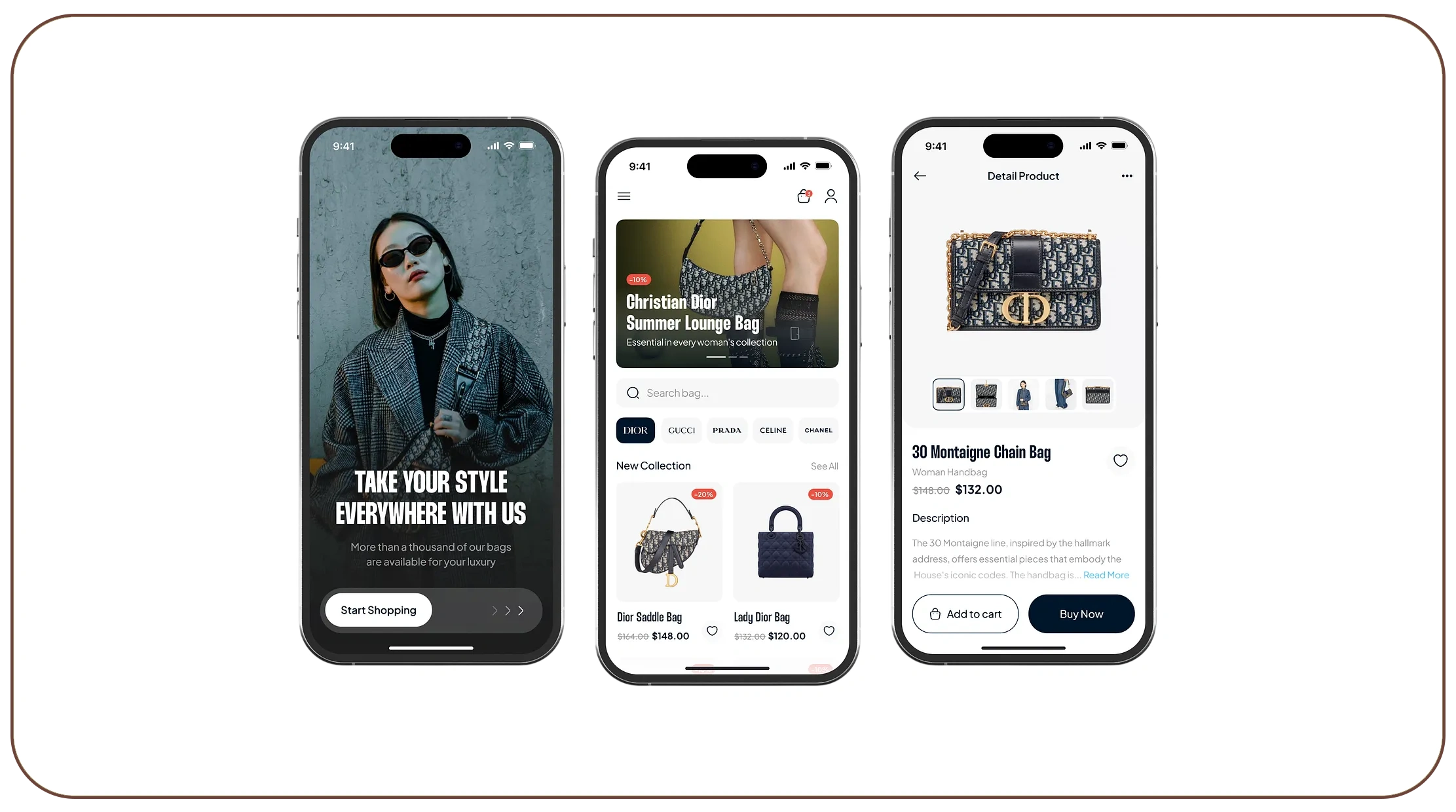
Businesses looking to scrape Chanel fashion product data can structure product records around attributes that support pricing, category, assortment, and trend analysis.
Luxury pricing analysis requires careful normalization. A price should not be compared blindly across products because differences in material, size, collection, market, currency, and product category can materially affect the result.
A more useful analytical model groups products into comparable segments.
Example Analytical Framework
| Dimension | Example Segmentation |
|---|---|
| Category | Handbags, ready-to-wear, eyewear |
| Product type | Tote, bowling bag, jacket, dress |
| Material | Leather, tweed, fabric |
| Color | Black, white, pink, beige |
| Collection | Spring-Summer, Fall-Winter, Cruise |
| Market | Country or regional storefront |
| Price | Local displayed price |
| Availability | Available or unavailable |
| Time | Collection timestamp |
CHANEL's current handbag catalog, for example, provides product filtering across collection, shape, size, material, color, and hardware. (CHANEL) This illustrates how multidimensional product metadata can be transformed into a more useful analytical structure.
2020–2026 Pricing Context
Luxury pricing became especially important during the 2019–2023 growth period. McKinsey estimates that more than 80% of luxury industry's growth during that period came from price increases rather than volume. (McKinsey & Company)
By 2025 and 2026, the environment changed. McKinsey reported that price increases had reached a ceiling for parts of the luxury market and that higher prices were affecting aspirational consumers. (McKinsey & Company)
| Analytical Question | Useful Dataset Fields |
|---|---|
| Which categories carry higher prices? | Category + price |
| Are prices changing? | Product + historical price |
| Are new products entering the assortment? | Product ID + timestamp |
| Which materials are expanding? | Material + category |
| Which colors appear frequently? | Color + collection |
| How does assortment differ by market? | Market + product |
Build structured luxury product intelligence that makes assortment and pricing changes easier to measure!
Get Insights Now!What insights can product-level luxury information reveal?
Businesses that extract Chanel luxury product data can build a detailed view of assortment structure rather than relying solely on broad market statistics.
The process can be designed around the attributes most relevant to the buyer's business objective.
For a fashion retailer, the focus might be category and product attributes. For a market researcher, historical collection changes may matter more. For a pricing intelligence team, price, currency, category, and timestamp become central.
Potential Analytical Use Cases
Assortment analysis: Measure the number of products by category, collection, material, or color.
Pricing intelligence: Compare prices across comparable products and historical snapshots where publicly displayed prices are available.
Collection monitoring: Track when seasonal and capsule collections appear or disappear.
Trend analysis: Identify recurring colors, materials, shapes, and categories.
2020–2026 Trend Environment
Fashion trends have become increasingly influenced by digital discovery. McKinsey's 2026 fashion research notes that consumers are increasingly using large language models to search for products, compare offerings, and receive recommendations. It also emphasizes that semantically rich, API-accessible content is becoming important for brands seeking visibility in AI-driven discovery. (McKinsey & Company)
This creates a direct connection between product data quality and digital discoverability.
| Business Objective | Product Intelligence Contribution |
|---|---|
| Assortment planning | Category and SKU-level visibility |
| Pricing research | Historical price observations |
| Trend research | Color, material, shape, category analysis |
| Market research | Country-level comparison |
| AI readiness | Structured product attributes |
| Competitive intelligence | Comparable product records |
The more consistent the underlying dataset, the easier it becomes to produce reliable dashboards, reports, and machine-readable outputs.
How can historical datasets support fashion trend analysis?
Chanel Fashion Datasets become more valuable when they preserve observations across time instead of representing only the current assortment.
A historical dataset can allow analysts to compare:
- Collection-to-collection changes
- Product introductions
- Product removals
- Category proportions
- Material distribution
- Color distribution
- Price movements
- Availability patterns
This is particularly relevant in fashion because trends are cyclical. A color that appears heavily in one collection may decline in the next, while a material or product silhouette can return after several seasons.
CHANEL's current fashion site already separates products and collections across multiple seasonal and thematic groupings, including Fall-Winter 2026, Métiers d'Art 2026, Spring-Summer 2026, Cruise 2026/27, and other collections. (CHANEL)
What Does 2020–2026 Tell Analysts?
McKinsey's 2025 report described a fashion market affected by economic uncertainty, shifting consumer preferences, price sensitivity, and regional differences. (McKinsey & Company) By 2026, the report identifies resale, AI, luxury recalibration, and category-level shifts as major themes. (McKinsey & Company)
Historical product records provide the underlying evidence needed to study these developments at a more granular level.
| Dataset Capability | Trend-Analysis Benefit |
|---|---|
| Historical timestamps | Detect changes over time |
| Collection labels | Compare seasons |
| Product IDs | Track individual products |
| Category fields | Identify category movement |
| Material fields | Detect material trends |
| Color fields | Analyze palette changes |
| Price fields | Study pricing evolution |
| Availability | Track assortment continuity |
For AI and analytics teams, this historical structure also makes datasets easier to query, summarize, visualize, and integrate into downstream systems.
How does fashion data collection support AI-ready market intelligence?
Fashion Data Scraping can help organizations create structured datasets that feed market research, analytics, competitive intelligence, reporting, and AI applications.
The key is to treat data collection as an information-engineering process rather than a simple extraction task.
A scalable workflow can include:
- Define target markets and product categories.
- Identify publicly available product attributes.
- Capture product-level records.
- Normalize categories and field names.
- Standardize price and market information where appropriate.
- Validate product records.
- Attach collection and timestamp information.
- Remove or identify duplicates.
- Store historical snapshots.
- Deliver data through the required format or API.
Why Does This Matter in 2026?
McKinsey reports that more than 35% of fashion executives surveyed were already using generative AI in areas such as customer service, image creation, copywriting, consumer search, or product discovery. It also highlights the growing importance of semantically rich and API-accessible content as AI changes how shoppers discover products. (McKinsey & Company)
That means product data is increasingly serving two audiences: human analysts and machines.
| Requirement | AI/Data Benefit |
|---|---|
| Consistent field names | Easier machine processing |
| Structured categories | Better classification |
| Product references | Entity resolution |
| Historical timestamps | Temporal analysis |
| Clean descriptions | Semantic search |
| Market identifiers | Regional comparison |
| Normalized attributes | Cross-source analysis |
| API delivery | System integration |
A fashion intelligence system can therefore connect collection data with dashboards, BI platforms, internal research databases, pricing tools, and AI applications.
The goal is not to automate judgment about fashion trends. The goal is to provide clean evidence that analysts and business teams can evaluate themselves.
Why Choose Real Data API?
Real Data API can support requirements around specific fashion intelligence requirements instead of relying on generic datasets.
For fashion and luxury research, a project can be structured around:
- Product-level data
- Category-level data
- Collection monitoring
- Price intelligence
- Material and color attributes
- Availability tracking
- Historical snapshots
- Market-specific datasets
- Structured API outputs
- Data validation and normalization
The appropriate approach depends on the business objective.
A pricing team may require frequent product and price observations. A market research organization may prioritize historical collection data. A trend intelligence team may need detailed color, material, category, and product metadata.
The wider fashion environment makes this flexibility increasingly important. McKinsey's 2026 analysis identifies low industry growth, AI adoption, resale, changing consumer priorities, and luxury recalibration among the major forces affecting fashion businesses. (McKinsey & Company)
A well-designed data pipeline can help businesses respond by turning publicly available product information into structured, reusable intelligence.
Real Data API can support requirements around Fashion Datasets by defining the schema, collection frequency, historical depth, validation requirements, and output structure around the intended use case.
Conclusion
A structured Chanel fashion dataset can give businesses a more consistent foundation for analyzing luxury products, prices, categories, collections, and fashion trends.
The 2020–2026 period demonstrates why this type of product intelligence matters. Luxury experienced substantial growth and price-led value creation through 2023, followed by a more challenging environment characterized by consumer value sensitivity, slower growth, resale expansion, and technological disruption. (McKinsey & Company)
At the same time, CHANEL's digital product environment demonstrates the depth of information available for structured analysis, including collections, categories, materials, colors, sizes, and product references. (CHANEL)
The practical opportunity is to turn these changing product signals into timestamped, normalized datasets that support pricing research, assortment intelligence, trend analysis, competitive research, and AI-ready applications.
Need structured luxury fashion product intelligence? Contact Real Data API to build a scalable, customized data solution for your product, pricing, category, and trend-analysis requirements!
FAQs
What is a Chanel fashion dataset used for?
A Chanel fashion dataset organizes product, category, collection, material, color, pricing, and availability information for assortment research, competitive analysis, and fashion trend monitoring.
How does Chanel fashion data Scraping support research?
Chanel fashion data Scraping can automate collection of publicly available product information, helping analysts build recurring snapshots for product, category, pricing, and collection analysis.
Why use Chanel fashion data collection services?
Chanel fashion data collection services can reduce manual research by providing structured, validated, timestamped records designed around specific business intelligence and analytics requirements.
What can real-time Chanel fashion product data reveal?
Real-time Chanel fashion product data can help analysts observe publicly displayed changes in products, collections, availability, categories, and prices where applicable, supporting faster market monitoring.
Can businesses scrape Chanel fashion product data?
Yes. Businesses can scrape Chanel fashion product data from publicly available sources subject to applicable terms, technical restrictions, and legal requirements. Real Data API can help structure the resulting data for analysis.
Latest posts
How Foodpanda Food Dataset Helps Businesses Track Restaurants, Menus, Prices, Ratings, and Food Delivery Trends?
How IKEA E-commerce Dataset Helps Businesses Solve Product, Pricing, Category, and Retail Trend Challenges?
How Target e-commerce dataset Helps Brands Track Products, Prices, Availability, and Retail Market Trends for Smarter Insights?
How Dior fashion dataset Helps Brands Track Luxury Products, Prices, Collections, and Fashion Trends for Smarter Insights?






.png)