
Introduction
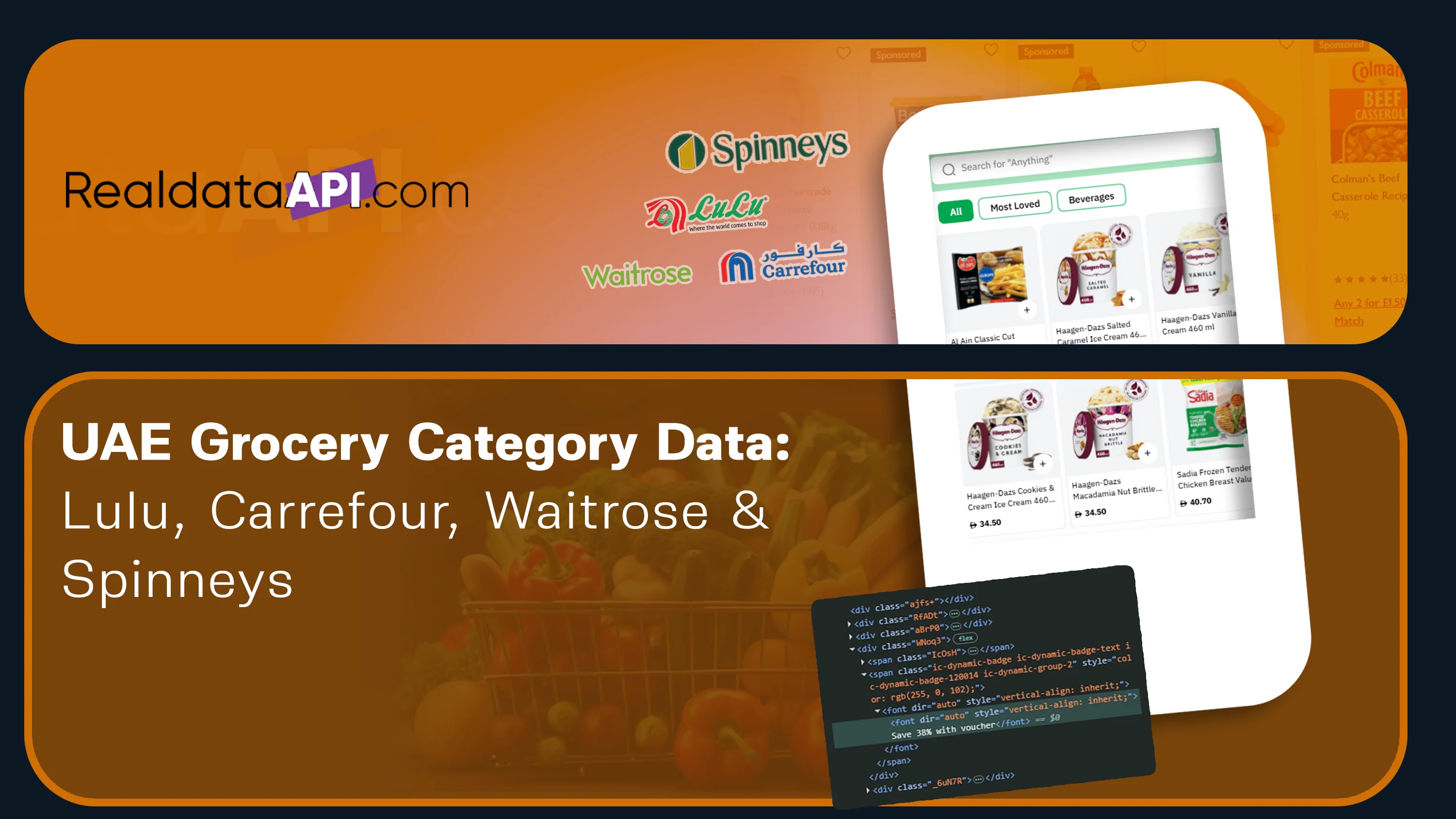
The UAE grocery market blends global brands, premium imports and large hypermarket chains in a small but highly competitive geography. Lulu and Carrefour dominate the mass market with huge assortments and frequent promotions. Spinneys and Waitrose position themselves towards premium shoppers, with strong fresh, organic and imported ranges. For brands, importers and analysts, comparing these four retailers is essential, and the best way to do it is through structured category data. UAE grocery data scraping provides exactly that.
This guide covers what category data you can collect, how the scraping process handles Arabic and English content, what challenges arise and how companies use the results. For teams comparing multiple UAE retailers, a structured UAE grocery price scraping workflow can make price, availability and promotion data easier to benchmark across locations.
Why These Four Retailers
Each retailer represents a different part of the UAE grocery landscape:
- Lulu: a large hypermarket and supermarket chain with a wide range, strong in South Asian and Middle Eastern products and aggressive weekly promotions
- Carrefour: a global hypermarket brand with a large local presence, strong private label and frequent promotional campaigns
- Spinneys: a premium supermarket known for quality fresh produce, butchery and a curated range of international products
- Waitrose: a premium British supermarket brand with a distinct range of British and organic products
Covering all four gives a view from mass market to premium.
What Category Data Includes
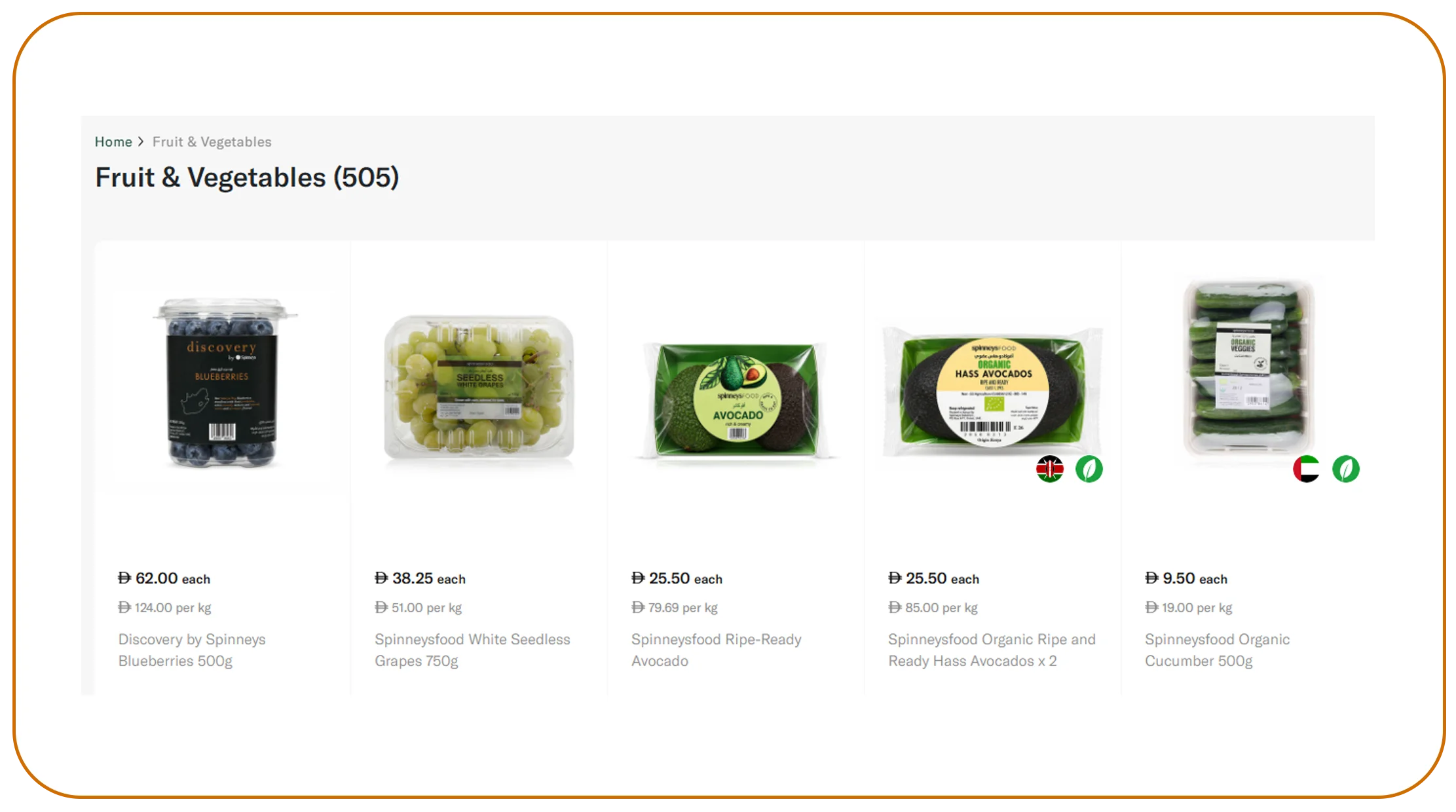
- Product name in English and Arabic where available
- Brand, variant, pack size and unit
- Category, sub-category and breadcrumb path
- Price, discounted price and promotion text, such as buy two for a fixed price
- Unit price per kilogram, litre or piece
- Availability and delivery options
- Country of origin when shown, which matters for imported goods
- Product images and product URLs
- Ratings where displayed
- Barcode or SKU code where shown
- Collection date and time and the area or emirate selected
Category Coverage
Typical categories for a UAE grocery project include:
- Fresh produce: fruit and vegetables
- Meat, poultry and seafood
- Dairy and eggs
- Bakery
- Pantry staples: rice, flour, oil, pulses, spices
- Packaged foods: snacks, confectionery, cereals
- Beverages: water, soft drinks, juices, tea and coffee
- Frozen foods
- Household and personal care
- Baby products
Brands often focus on a few categories, while analysts may collect the full catalogue. For broader category monitoring, a structured grocery data scraping approach can also support assortment, pricing and availability analysis across multiple retailers.
How The Scraping Process Works
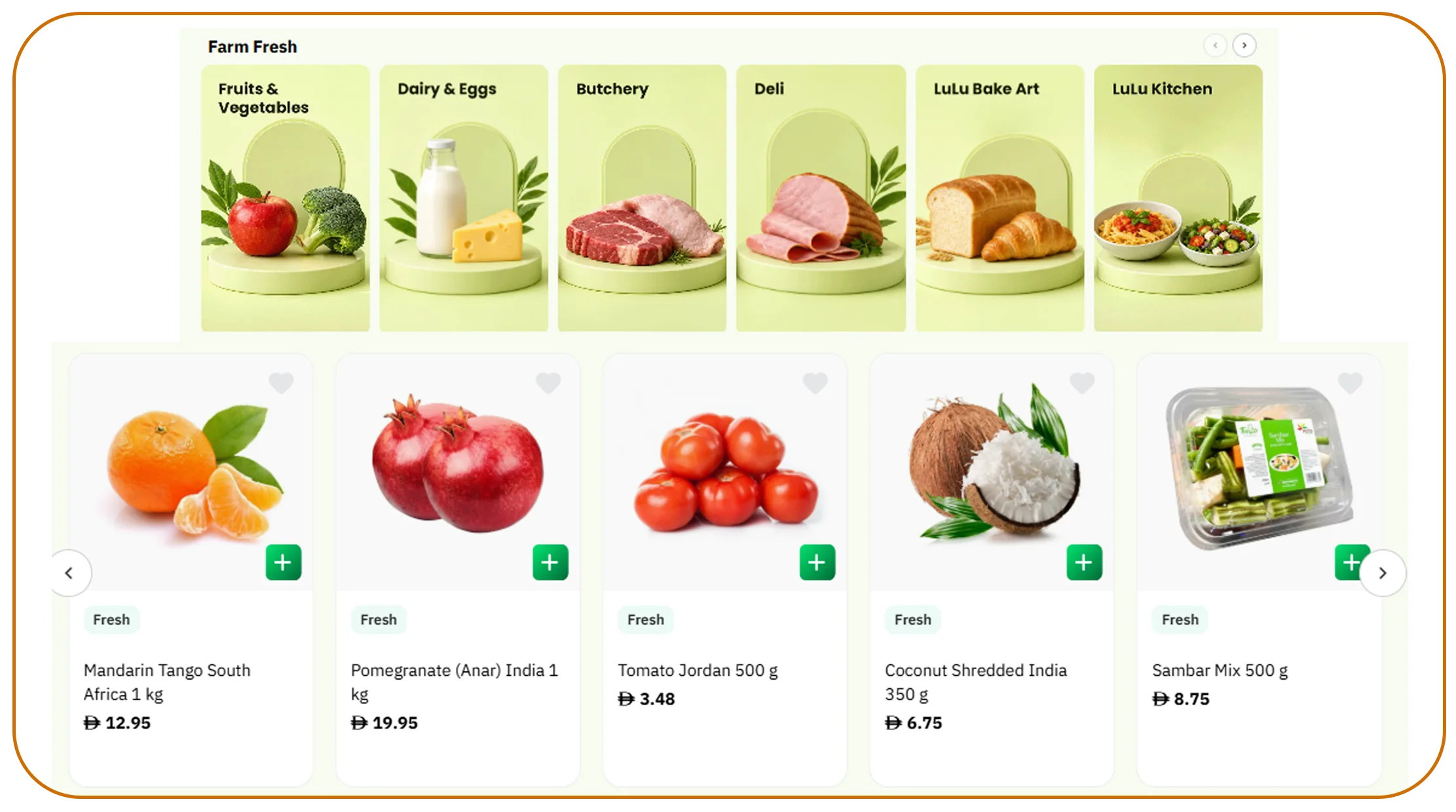
- Define scope. List retailers, categories and the emirates or delivery areas where prices matter.
- Set the delivery location. Online grocery sites may show different stock and delivery options by area. The scraper selects the area before collecting.
- Map the category tree. Each retailer organises its categories differently. The scraper discovers all sub-categories.
- Collect listings and details. Page through each category and open product pages when needed.
- Capture both languages. Where the site offers Arabic and English, collect both names to support multilingual matching.
- Normalise units and sizes. Convert grams, kilograms, millilitres and litres, and calculate unit prices.
- Parse promotions. Convert promotion text into structured fields: type, quantity, price and validity.
- Match products across retailers. Use barcode, brand, size and attributes to link the same product on all four sites.
- Validate and deliver.
Handling Arabic And English Content
Bilingual data is both a challenge and an opportunity. The same product may appear with an English title on one site and an Arabic title on another. Brand names might be transliterated differently. To handle this:
- Store both language versions in separate columns
- Use barcodes as the strongest key for matching
- Normalise brand names through a brand dictionary that includes Arabic and English forms
- Keep text encoded properly so Arabic characters display correctly in files and tools
Technical Challenges
- Dynamic sites and apps: product lists load as users scroll and change frequently.
- Location-specific assortment: stock varies by store or area.
- Frequent promotions: weekly and festival promotions change prices rapidly, with campaigns such as Ramadan and national-day sales creating large swings.
- Different promotion mechanics: one retailer may use price cuts while another uses multi-buy deals, which need standardising.
- Weighted items: fresh produce is often priced per kilogram with variable weights.
- Rate limits and blocking: each retailer limits automated traffic, so careful pacing and monitoring are required.
Use Cases
- FMCG and imported-brand owners: track price positioning across mass and premium retailers.
- Importers and distributors: identify price gaps and opportunities for new products.
- Retail analysts: build price indexes and measure promotion intensity by retailer.
- Price-comparison and shopping apps: show consumers the best place to buy.
- Category managers: monitor competitors' assortment and private-label share.
- Investors and consultants: study the competitive landscape and pricing power. This type of benchmarking is especially useful when teams combine grocery competitive benchmarking with recurring price and promotion observations.
Example: A Snack Brand During Ramadan
A snack brand sells in the UAE and wants to understand promotional pressure during Ramadan. It collects daily category data for snacks across Lulu, Carrefour, Spinneys and Waitrose for six weeks. The analysis shows that Lulu and Carrefour run multi-buy offers on large packs, while the premium retailers keep prices stable but feature the brand in curated displays. The brand adjusts its own pack sizes and promotional offers by retailer.
Sample Output
A row might contain: retailer, emirate or area, category, sub-category, product name in English, product name in Arabic, brand, pack size, unit, price, discounted price, promotion type, promotion text, unit price, availability, barcode, country of origin, image URL, product URL and timestamp.
Quality Checks
- Check that prices fall within expected ranges for each category
- Verify that promotion fields parse correctly
- Compare product counts to the previous run
- Review bilingual fields for encoding problems
- Sample manually against live pages
Delivery Formats
Data can be delivered as CSV or Excel, as JSON via API or into a data warehouse. A weekly cadence suits price indexes, while daily collection is better during promotional events. For teams that need continuously refreshed records, a grocery data API can feed normalized product and price observations directly into dashboards or data warehouses.
Responsible Data Collection
Collect only public product and price information, avoid personal data, keep request rates reasonable and follow retailer terms and applicable laws.
Why Choose Real Data API For UAE Grocery Data Scraping
Real Data API builds retailer-specific scrapers, handles bilingual content, standardises units and parses promotions. A pilot with one or two categories across the four retailers is a practical way to verify quality before scaling to full catalogues.
Conclusion
UAE grocery category data scraping gives brands and analysts a clear, comparable view of Lulu, Carrefour, Spinneys and Waitrose across mass and premium segments. With bilingual handling, unit standardisation and promotion parsing, the data supports pricing, assortment and marketing decisions in one of the region's most dynamic grocery markets.
Need UAE grocery category data? Real Data API can deliver a pilot for your categories and retailers.
FAQs
1. Can you collect data for specific emirates?
Yes, where the retailer's site supports area selection. The area is stored with each record.
2. Do you capture Arabic names?
Yes, where the retailer shows them. Both languages are stored.
3. How often should grocery prices be collected?
Weekly works for most analysis. Daily collection is useful during major promotions.
4. Can you track fresh produce prices?
Yes. Prices per kilogram or per piece are captured, along with the unit.
5. Can I add Saudi Arabia or other GCC countries later?
Yes. The process and schema can extend to other countries and retailers.



.png)


