Introduction
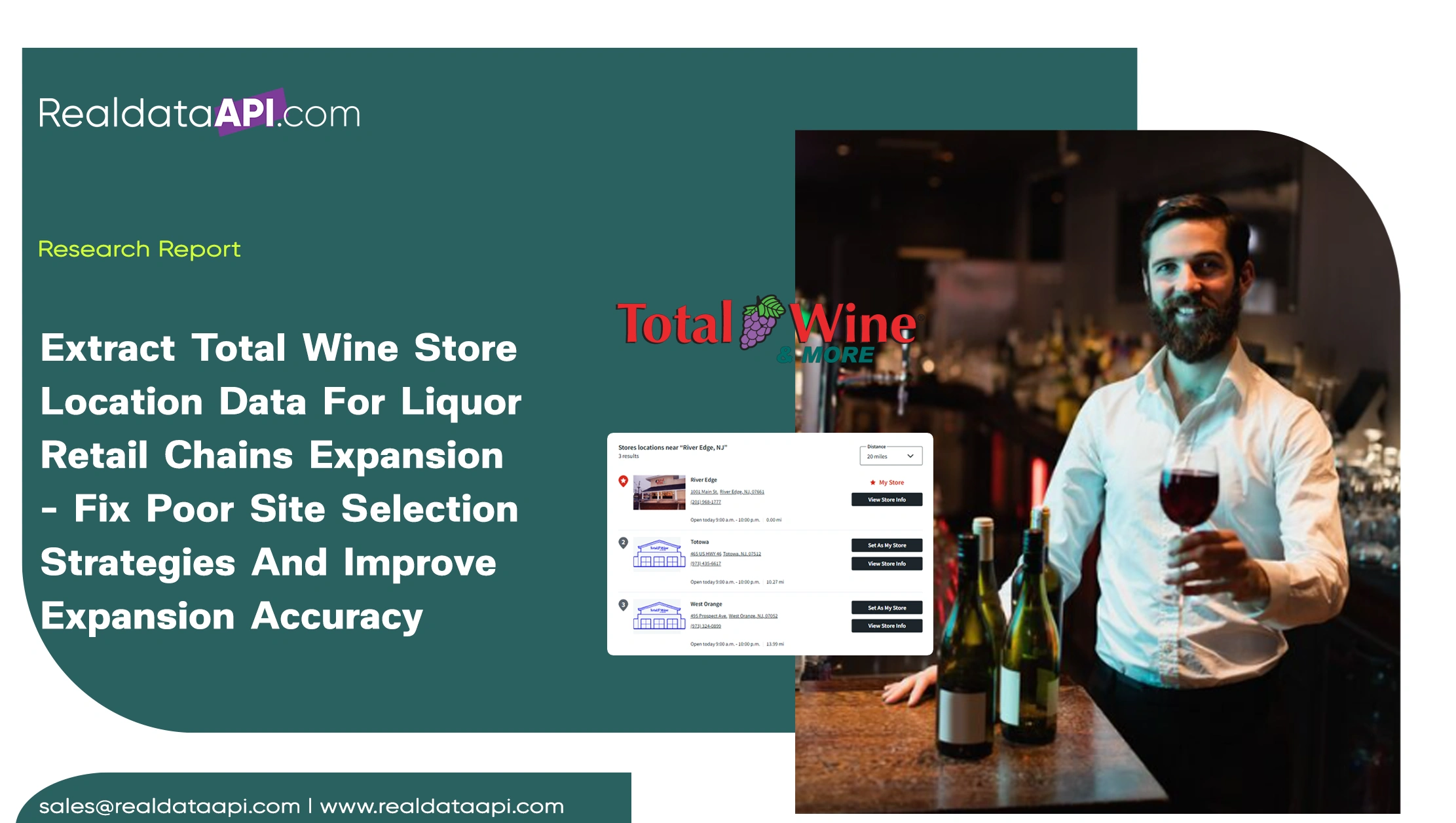
Liquor retail chains are increasingly relying on data intelligence to improve expansion decisions, reduce site selection errors, and maximize store performance. Traditional location planning methods often fail to capture real-world demand patterns, leading to poor-performing outlets and inefficient market coverage. This is where extract Total Wine store location data for liquor retail chains expansion becomes a powerful research-driven approach for modern retail strategy.
By analyzing Scrape Total Wine & More store locations data in the USA, businesses can understand how one of the largest liquor retailers in the country structures its store network, selects high-performing markets, and expands strategically across regions.
With the help of Real Data API, organizations can automate extraction of store-level data, including coordinates, addresses, and regional distribution patterns. This enables accurate mapping of competitive landscapes and supports data-driven expansion decisions.
This research report explores how liquor retail chains can leverage location intelligence, scraping frameworks, and structured datasets to improve site selection accuracy and build scalable expansion strategies.
Understanding National Store Distribution Patterns
A key step in retail intelligence is analyzing how stores are distributed across regions. Using scrape Total Wine store location data in the USA, businesses can identify geographic clustering, market saturation levels, and expansion trends.
Between 2020 and 2026, retail location analytics adoption in the liquor industry has increased significantly due to rising competition and market consolidation.
| Year | Location Data Usage | Expansion Accuracy Improvement |
|---|---|---|
| 2020 | 32% | 20% |
| 2022 | 48% | 38% |
| 2024 | 66% | 55% |
| 2026 | 80% | 72% |
Location scraping helps identify whether stores are concentrated in urban hubs or distributed across suburban regions. It also reveals underserved areas with high expansion potential.
Retailers can use this intelligence to avoid oversaturated markets and focus on high-growth zones. This reduces expansion risk and improves profitability.
By understanding national distribution patterns, liquor chains can build more efficient and scalable expansion strategies based on real-world data rather than assumptions.
Enhancing Geospatial Accuracy in Retail Planning
Precise geolocation data is critical for retail expansion success. Implementing Web scraping Total Wine store addresses and coordinates allows businesses to build accurate geospatial models for analysis.
From 2020 to 2026, the use of geospatial analytics in retail planning has grown by over 70%, driven by improved mapping technologies and data availability.
| Data Type | Importance Level |
|---|---|
| Store Address | High |
| Latitude/Longitude | Very High |
| Regional Zone | High |
| Foot Traffic Area | Medium |
| Insight Type | Business Value |
|---|---|
| Store Clustering | High |
| Market Saturation | High |
| Expansion Gaps | High |
| Regional Density | Medium |
Mapping competitor networks helps identify regions with high competition and areas with untapped potential.
For example, dense clustering in urban areas may indicate high demand but also high competition, while suburban regions may offer expansion opportunities.
This insight allows liquor retail chains to strategically plan store openings and avoid overexposure in saturated markets.
By analyzing competitor footprints, businesses can improve positioning and long-term profitability.
Extracting Structured Store Intelligence at Scale
Large-scale retail analysis requires structured datasets. Using Total Wine store location data extraction, businesses can build comprehensive databases for strategic planning.
From 2020 to 2026, structured data extraction in retail has grown by 75%, driven by automation and API-based systems.
| Extraction Element | Usage Importance |
|---|---|
| Store Name | High |
| Location Coordinates | Very High |
| Store Type | Medium |
| Regional Category | High |
Structured extraction enables businesses to analyze thousands of store locations efficiently. This helps identify performance clusters and expansion opportunities.
Automation ensures consistent data quality and reduces manual effort. It also allows frequent updates, keeping datasets current and reliable.
With structured datasets, retailers can build predictive models for expansion planning and market entry strategies.
Expanding Intelligence into Pricing and Promotions
Beyond locations, pricing intelligence plays a key role in retail strategy. Using Web Scraping Liquor Prices and Promotions from Total Wine, businesses can analyze pricing trends and promotional strategies.
Between 2020 and 2026, pricing analytics adoption in retail has increased by 60%, especially in competitive beverage markets.
| Data Type | Importance Level |
|---|---|
| Product Pricing | High |
| Discounts | High |
| Seasonal Offers | Medium |
| Bundles | Medium |
Scraping pricing data allows businesses to understand how retailers adjust prices across regions and seasons.
This helps in benchmarking pricing strategies and improving competitiveness.
Combining pricing data with location intelligence creates a complete retail strategy framework.
Strengthening Product-Level Retail Intelligence
Product-level insights are essential for understanding consumer demand. Using Total Wine Product Data Scraper, businesses can analyze product availability, categories, and trends.
From 2020 to 2026, product-level analytics adoption has increased by 72%, driven by demand for granular retail insights.
| Product Metric | Importance Level |
|---|---|
| Product Category | High |
| Stock Availability | High |
| Brand Distribution | Medium |
| Regional Demand | High |
Product scraping helps businesses identify best-selling categories and regional preferences.
This supports inventory planning and targeted marketing strategies.
By combining product, pricing, and location data, retailers can build a unified intelligence system for better decision-making.
Why Choose Real Data API?
Real Data API provides advanced Alcohol Accessories Data Extraction from Total Wine solutions designed to support extract Total Wine store location data for liquor retail chains expansion use cases. It enables businesses to collect structured, scalable, and real-time retail datasets.
With powerful automation and high-performance infrastructure, Real Data API simplifies complex data extraction processes and improves accuracy in retail intelligence workflows. It supports location, pricing, and product-level data extraction for comprehensive market analysis.
Conclusion
The ability to extract Total Wine store location data for liquor retail chains expansion is essential for improving site selection strategies and enhancing expansion accuracy. With structured datasets and automated tools, businesses can eliminate inefficiencies and make data-driven decisions with confidence.
As competition intensifies in the liquor retail industry, leveraging location intelligence and scraping technologies will be key to sustainable growth and market success.
Ready to improve your retail expansion strategy? Partner with Real Data API today and unlock powerful location intelligence for smarter, data-driven growth!
Latest posts
How Target API Simplifies Product, Price, Category, Inventory & Retail Data Collection for Retail Intelligence
How Pull & Bear Fashion Dataset Solves Fashion Intelligence Challenges Across Products, Prices, Categories, and Apparel Trends?
How Levi's Fashion Dataset Improves Fashion Intelligence Across Products, Prices, Categories, and Denim Market Trends?
How Myntra Fashion Dataset Solves Fashion Intelligence Challenges Across Products, Prices, Brands, and Fashion Market Trends?
How Hyatt Travel Dataset Helps Businesses Track Hotels, Room Prices, Amenities, Locations, and Travel Trends?

Real Data API stands out as one of the premier global companies specializing in web data Scraping and web extraction.



.png)


Rating 4.7
Rating 4.7
Rating 4.5
Rating 4.7
Rating 4.7


Disclaimer : RealData API functions solely as an independent data infrastructure and technology solutions provider. We build customized automation workflows designed to collect publicly accessible web data based exclusively on client instructions. RealData API neither owns proprietary datasets nor engages in the sale or redistribution of extracted information. Our operations are limited strictly to lawful public web data processing and never involve unauthorized access to restricted systems or private networks. Any company names, trademarks, logos, or brand references displayed on this website are used purely for demonstrative and illustrative purposes to showcase our technical capabilities and do not imply endorsement, partnership, or affiliation. Use of our platform and services remains subject to our Terms of Service.