
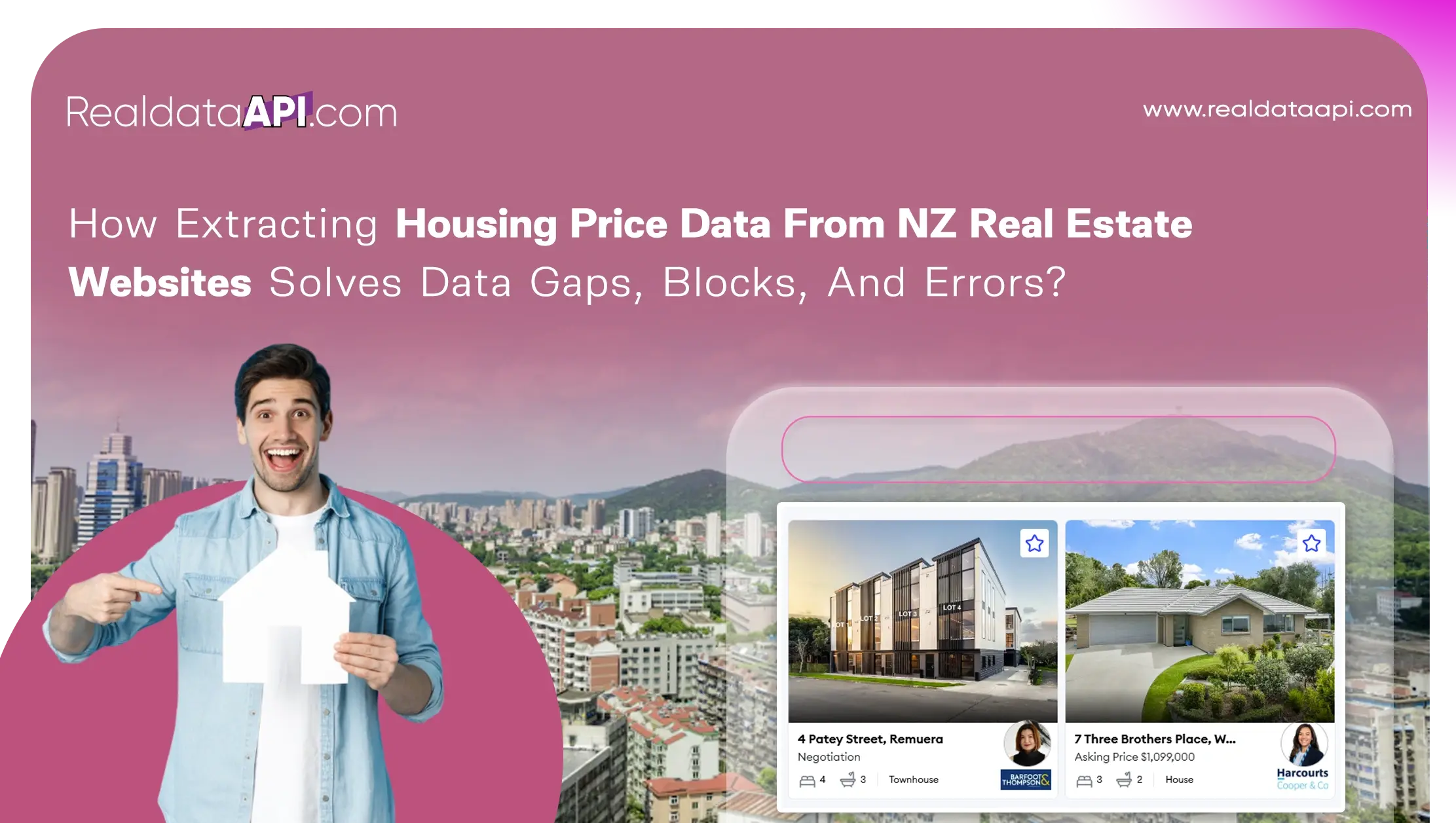
Introduction
In today’s data-driven property market, extracting housing price data from NZ real estate websites has become essential for investors, analysts, and proptech companies. However, the process is far from simple. Data gaps, anti-bot restrictions, inconsistent formats, and frequent website changes create major roadblocks for businesses trying to access reliable property insights.
This is where Web Scraping Real Estate Data API solutions come into play. Instead of relying on manual extraction or unstable scripts, APIs provide structured, scalable, and real-time access to property data. With advanced scraping infrastructure, businesses can bypass common barriers and obtain accurate, complete datasets.
From identifying pricing trends to forecasting market shifts, high-quality real estate data enables smarter decisions. This blog explores how modern scraping techniques and APIs solve key challenges in the New Zealand property market while delivering actionable intelligence for long-term growth.
Unlocking Accurate Market Streams with Smarter Data Pipelines
One of the biggest challenges in property analytics is accessing timely and consistent data. A real-time New Zealand property price Data scraper eliminates delays and ensures that users always work with the latest listings and price movements.
Between 2020 and 2026, New Zealand’s housing market has seen significant fluctuations:
| Year | Avg Property Price (NZD) | Annual Change |
|---|---|---|
| 2020 | 700,000 | +8% |
| 2021 | 820,000 | +17% |
| 2022 | 780,000 | -5% |
| 2023 | 760,000 | -2.5% |
| 2024 | 790,000 | +4% |
| 2025 | 815,000 | +3% |
| 2026* | 835,000 | +2.5% |
These fluctuations highlight the importance of real-time data access. Without it, businesses risk making decisions based on outdated or incomplete information.
Modern scraping APIs address this by:
- Continuously monitoring property listings
- Updating datasets in real time
- Reducing latency in data delivery
- Ensuring high availability even during peak demand
By leveraging automated pipelines, companies can eliminate data gaps and maintain consistent visibility into market trends. This enables more accurate forecasting, pricing strategies, and investment planning.
Overcoming Website Restrictions with Intelligent Automation
Access barriers such as CAPTCHA, IP blocking, and rate limiting often disrupt Web scraping property prices in New Zealand. These restrictions are designed to prevent automated access but can also hinder legitimate data use cases.
Here’s how challenges have evolved:
| Challenge Type | Frequency (2020) | Frequency (2026) |
|---|---|---|
| CAPTCHA | Medium | High |
| IP Blocking | Low | High |
| Dynamic Content | Medium | Very High |
| Data Fragmentation | High | Very High |
Modern solutions tackle these issues using:
- Rotating proxies and IP pools
- Headless browsers for dynamic content
- Smart request throttling
- AI-based CAPTCHA handling
These technologies ensure uninterrupted data extraction while maintaining compliance and efficiency.
By overcoming these barriers, businesses can:
- Access complete datasets without interruptions
- Improve data reliability
- Reduce downtime in analytics workflows
Ultimately, intelligent automation transforms restricted environments into accessible data ecosystems.
Scaling Insights Through Automated Data Collection
Manual data collection is not only inefficient but also prone to errors. With automated property data collection for NZ market analysis, organizations can scale their operations while maintaining accuracy.
Key advantages include:
- Elimination of manual errors
- Faster data processing
- Consistent data formatting
- Scalable infrastructure
Market data growth between 2020 and 2026 demonstrates the need for automation:
| Year | Listings Scraped Monthly | Data Volume (GB) |
|---|---|---|
| 2020 | 50,000 | 10 |
| 2022 | 120,000 | 25 |
| 2024 | 200,000 | 45 |
| 2026 | 320,000 | 70 |
Handling such volumes manually is impossible. Automation ensures seamless data flow and allows businesses to focus on analysis rather than collection.
Additionally, automated systems:
- Normalize data across multiple sources
- Detect anomalies in listings
- Enable predictive analytics
This leads to deeper market insights and better strategic decisions.
Transforming Raw Listings into Actionable Intelligence
Raw data alone is not enough. Businesses need structured insights, which is where the ability to Scrape real estate price intelligence data in New Zealand becomes critical.
Transforming raw listings involves:
- Data cleaning and validation
- Removing duplicates
- Standardizing formats
- Enriching datasets with metadata
Property intelligence trends:
| Insight Type | Usage Growth (2020-2026) |
|---|---|
| Price Trends | +65% |
| Location Analytics | +70% |
| Demand Forecasting | +55% |
| Investment Scoring | +60% |
With structured intelligence, companies can:
- Identify high-growth regions
- Predict price movements
- Optimize investment portfolios
This transformation bridges the gap between raw data and actionable insights, making data extraction far more valuable.
Building Reliable Data Foundations for Analysis
A well-structured Real Estate Dataset is the backbone of any successful property analytics strategy. Without clean and complete datasets, insights can be misleading or inaccurate.
Key dataset components include:
- Property prices
- Location details
- Listing history
- Agent information
- Property features
Dataset quality improvements (2020–2026):
| Metric | 2020 | 2026 |
|---|---|---|
| Data Accuracy | 75% | 95% |
| Completeness | 70% | 92% |
| Update Frequency | Weekly | Real-time |
High-quality datasets enable:
- Better machine learning models
- Accurate valuation tools
- Reliable market predictions
By ensuring data integrity, businesses can confidently rely on their analytics for decision-making.
Adapting to Market Changes with Pricing Intelligence
The property market is constantly evolving, making Dynamic Pricing strategies essential. Access to real-time data allows businesses to adjust pricing models based on market conditions.
Pricing trend highlights:
| Year | Price Volatility Index |
|---|---|
| 2020 | Low |
| 2021 | High |
| 2023 | Medium |
| 2026 | Medium-High |
Dynamic pricing benefits:
- Responds to demand fluctuations
- Optimizes property valuations
- Enhances competitiveness
- Supports real-time decision-making
By integrating live data feeds, businesses can:
- Adjust prices instantly
- Identify undervalued properties
- Maximize returns on investment
This adaptability is crucial in a market as dynamic as New Zealand’s.
Strengthening Competitive Advantage with Predictive Analytics
As the property market becomes increasingly data-centric, predictive analytics is emerging as a powerful tool alongside extracting housing price data from NZ real estate websites. By combining historical datasets with real-time inputs, businesses can forecast trends, identify opportunities, and mitigate risks more effectively.
Market adoption of predictive analytics in real estate has grown rapidly:
| Year | Adoption Rate (%) | Forecast Accuracy (%) |
|---|---|---|
| 2020 | 35% | 68% |
| 2022 | 50% | 74% |
| 2024 | 65% | 81% |
| 2026 | 78% | 87% |
This growth reflects the increasing reliance on data-driven decision-making. Advanced analytics models use property price history, location demand, and economic indicators to generate reliable forecasts.
Key benefits include:
- Early identification of price trends
- Risk reduction in investments
- Improved portfolio diversification
- Data-backed decision-making
By integrating predictive models with scraping APIs, businesses can move beyond reactive strategies and adopt a proactive approach. This not only enhances competitiveness but also ensures long-term sustainability in the New Zealand real estate market.
Enhancing Data Accuracy with Continuous Monitoring Systems
Maintaining data accuracy is a constant challenge in real estate analytics. Continuous monitoring systems, combined with Web Scraping Real Estate Data API, help ensure that datasets remain fresh, consistent, and error-free.
Data quality improvements through monitoring systems:
| Metric | Without Monitoring | With Monitoring (2026) |
|---|---|---|
| Data Freshness | 60% | 95% |
| Error Detection Rate | 45% | 90% |
| Update Frequency | Weekly | Real-time |
| Duplicate Reduction | 50% | 92% |
These systems work by:
- Automatically detecting outdated listings
- Flagging inconsistencies in pricing
- Updating datasets in real time
- Removing duplicate or invalid entries
The result is a highly reliable data environment that supports accurate analysis and reporting. Businesses can confidently rely on their datasets without worrying about gaps or inaccuracies.
In a fast-moving property market, continuous monitoring ensures that insights remain relevant and actionable. This level of precision is essential for making informed decisions and maintaining a competitive edge.
Why Choose Real Data API?
When it comes to Enterprise Web Crawling, extracting housing price data from NZ real estate websites, Real Data API stands out as a reliable and scalable solution.
Key benefits include:
- High success rate with minimal blocks
- Real-time data delivery
- Advanced anti-bot bypass mechanisms
- Structured and clean datasets
- Scalable infrastructure for large volumes
Real Data API empowers businesses to:
- Eliminate data gaps
- Overcome scraping challenges
- Access accurate and timely property insights
With enterprise-grade technology, it ensures consistent performance even in complex scraping environments.
Conclusion
In an increasingly competitive property market, extracting housing price data from NZ real estate websites is no longer optional—it’s essential. From overcoming blocks to eliminating data gaps and ensuring accuracy, modern scraping solutions provide the foundation for smarter decisions.
By leveraging advanced APIs and automation, businesses can unlock the full potential of real estate data and stay ahead of market trends.
Get started with Real Data API today and transform your property data into powerful insights!
Latest posts
Why Brands Use Competitive Data Intelligence to Increase Market Share in Highly Competitive Markets?

How To Scrape Competitor Data To Support Market Entry Strategy And Expansion Planning For Data-Driven Business Growth?
How Hotel Occupancy Intelligence Through Public Data Sources Is Reshaping Revenue Management
The ZIP Code Advantage: How Hyper-Local Amazon Product Data Collection Is Redefining Retail Intelligence

Real Data API stands out as one of the premier global companies specializing in web data Scraping and web extraction.





.png)


Rating 4.7
Rating 4.7
Rating 4.5
Rating 4.7
Rating 4.7


Disclaimer : RealData API functions solely as an independent data infrastructure and technology solutions provider. We build customized automation workflows designed to collect publicly accessible web data based exclusively on client instructions. RealData API neither owns proprietary datasets nor engages in the sale or redistribution of extracted information. Our operations are limited strictly to lawful public web data processing and never involve unauthorized access to restricted systems or private networks. Any company names, trademarks, logos, or brand references displayed on this website are used purely for demonstrative and illustrative purposes to showcase our technical capabilities and do not imply endorsement, partnership, or affiliation. Use of our platform and services remains subject to our Terms of Service.