Introduction
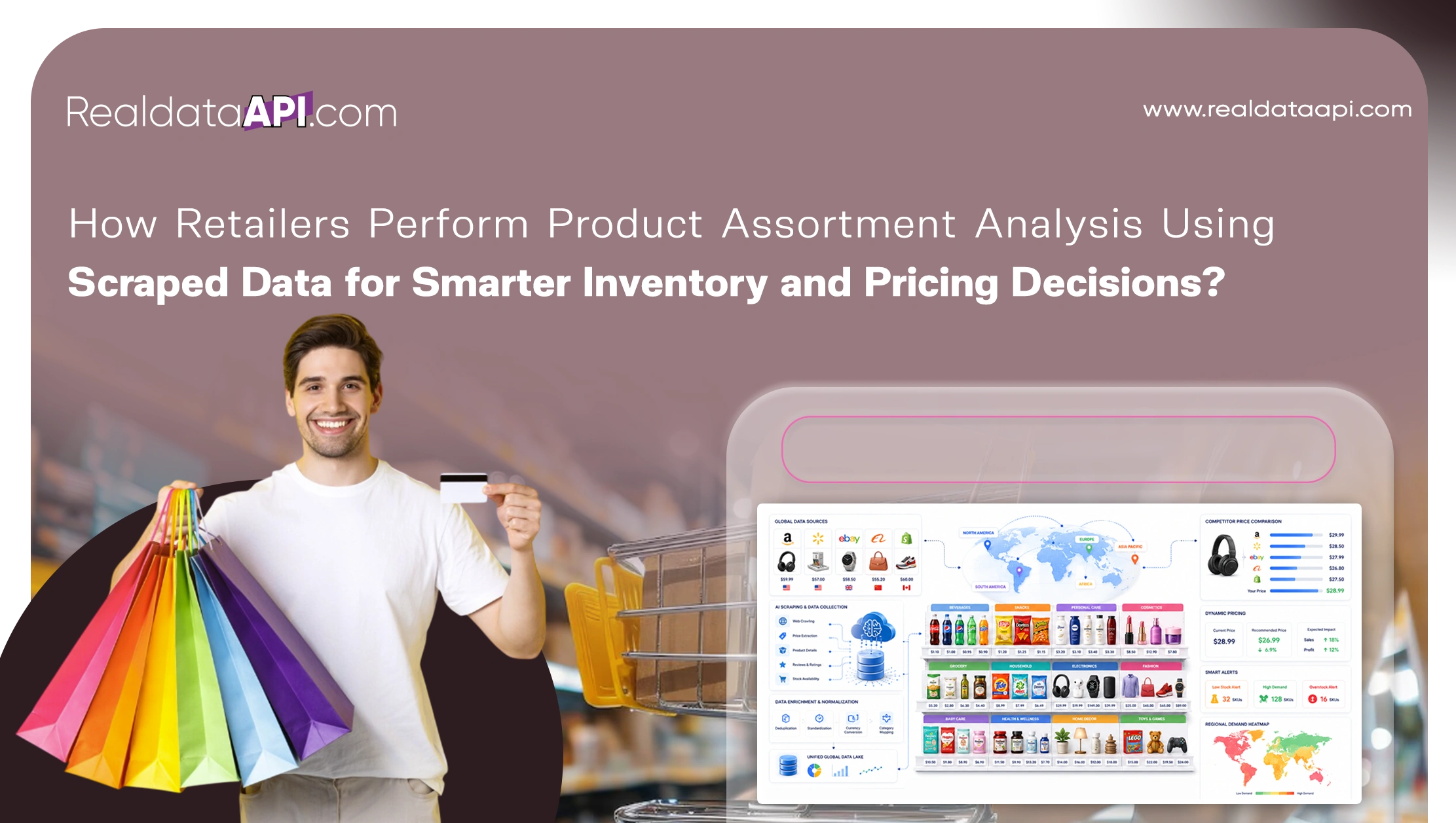
Modern retailers operate in highly competitive digital marketplaces where customer preferences, pricing trends, and inventory dynamics change rapidly. To remain competitive, businesses increasingly rely on advanced analytics and automation to perform product assortment analysis using scraped data and gain real-time visibility into market conditions. Assortment intelligence helps retailers identify high-performing SKUs, detect assortment gaps, optimize pricing strategies, and improve category planning across online channels.
As online marketplaces continue expanding, businesses are leveraging Top Ecommerce Scraping API Use Cases to monitor product listings, stock availability, pricing fluctuations, promotional campaigns, and customer demand trends at scale. Data-driven assortment analysis enables companies to improve merchandising decisions while reducing operational inefficiencies associated with manual tracking.
Retailers now use automated scraping frameworks to analyze thousands of products across multiple platforms in real time. This allows businesses to improve inventory allocation, enhance digital shelf visibility, and respond faster to changing market trends. Assortment analytics has become essential for maximizing profitability and strengthening long-term eCommerce competitiveness.
The Evolution of Data-Driven Retail Assortment Strategies
Retail assortment management has evolved significantly over the past decade as eCommerce platforms continue introducing millions of new products annually. Businesses now require scalable analytics systems capable of monitoring competitor assortments and customer demand patterns continuously.
Retailers increasingly depend on Product assortment benchmarking using web scraping to compare product catalogs, pricing structures, category depth, and promotional activity across multiple online marketplaces.
| Year | Global eCommerce SKU Growth | Retailers Using Automated Assortment Analytics |
|---|---|---|
| 2020 | 12% | 28% |
| 2021 | 15% | 34% |
| 2022 | 18% | 41% |
| 2023 | 22% | 49% |
| 2024 | 26% | 57% |
| 2025 | 30% | 64% |
| 2026 | 35% | 72% |
Benchmarking enables retailers to evaluate assortment breadth, identify missing categories, and optimize product selection based on competitor performance. Businesses can compare SKU diversity, bundle offers, and seasonal product availability more effectively through automated analytics systems.
Data-driven assortment strategies also improve category planning by identifying underperforming products and highlighting opportunities for assortment expansion. Retailers gain better visibility into market demand patterns while reducing the risks associated with overstocking or understocking inventory.
As digital retail competition intensifies, assortment benchmarking continues becoming a critical component of strategic retail planning.
Identifying Untapped Product Opportunities Through Marketplace Insights
One of the biggest challenges retailers face is identifying missing products that customers actively search for but competitors already offer. Assortment gaps often result in lost sales opportunities and weaker customer retention.
Businesses increasingly Identify assortment gaps using scraped ecommerce data to monitor product availability, trending categories, and customer purchasing behavior across online marketplaces.
| Year | Retailers Experiencing Assortment Gaps | Revenue Impact from Missing SKUs |
|---|---|---|
| 2020 | 38% | 9% |
| 2021 | 42% | 11% |
| 2022 | 47% | 13% |
| 2023 | 53% | 16% |
| 2024 | 58% | 19% |
| 2025 | 63% | 22% |
| 2026 | 69% | 26% |
Scraped marketplace data allows businesses to compare their product assortments with competitors and identify categories where customer demand remains underserved. Retailers can detect missing brands, packaging sizes, product variations, and trending SKUs that competitors successfully promote.
Assortment gap analysis also helps businesses improve customer satisfaction by ensuring product availability aligns with market demand. Retailers can optimize inventory investments by focusing on categories with higher conversion potential and lower competitive saturation.
Automated assortment tracking significantly improves decision-making speed while reducing the reliance on manual market research and fragmented reporting systems.
Transforming Retail Analytics with Centralized Intelligence Systems
Retailers increasingly require centralized reporting frameworks capable of converting raw marketplace data into actionable business insights. Traditional spreadsheet-based analysis methods are no longer sufficient for managing complex product assortments across multiple platforms.
Companies now build assortment intelligence dashboards via data extraction to monitor category performance, pricing trends, inventory levels, and promotional activity in real time.
| Year | Retailers Using Real-Time Dashboards | Data Processing Efficiency Improvement |
|---|---|---|
| 2020 | 24% | 18% |
| 2021 | 31% | 24% |
| 2022 | 39% | 31% |
| 2023 | 48% | 39% |
| 2024 | 57% | 47% |
| 2025 | 65% | 54% |
| 2026 | 73% | 62% |
Centralized dashboards provide retailers with a unified view of assortment health across categories and marketplaces. Businesses can track SKU-level performance, monitor price fluctuations, and analyze customer engagement metrics more efficiently.
These intelligence systems also improve collaboration between merchandising, marketing, inventory management, and pricing teams. Retailers can automate reporting workflows while ensuring faster access to strategic insights.
Advanced dashboard analytics additionally support predictive forecasting by identifying emerging demand trends and competitor assortment changes before they impact profitability.
As assortment complexity grows, centralized intelligence systems continue becoming essential for scalable retail operations.
Monitoring SKU Movements Across Competitive Marketplaces
Product assortments within eCommerce platforms constantly evolve as retailers introduce new SKUs, discontinue products, and adjust promotional strategies. Continuous monitoring is necessary to maintain competitive visibility and assortment relevance.
Businesses increasingly Scrape SKU assortment changes across ecommerce platforms to track category expansion, pricing adjustments, inventory shifts, and promotional campaigns across multiple online retailers.
| Year | Monthly SKU Changes Across eCommerce Platforms | New Product Introductions Growth |
|---|---|---|
| 2020 | 15% | 10% |
| 2021 | 19% | 13% |
| 2022 | 23% | 17% |
| 2023 | 28% | 22% |
| 2024 | 33% | 27% |
| 2025 | 38% | 32% |
| 2026 | 44% | 38% |
Continuous assortment monitoring helps retailers identify fast-growing product categories and respond quickly to competitor activity. Businesses can evaluate which SKUs gain visibility through promotions and seasonal campaigns while improving inventory allocation strategies.
Tracking SKU changes also enables retailers to identify assortment volatility across marketplaces. This visibility supports better forecasting accuracy and faster merchandising adjustments.
Automated monitoring frameworks reduce operational workload while ensuring businesses maintain real-time awareness of evolving marketplace conditions and competitive assortment movements.
APIs Driving Scalable Retail Intelligence Operations
Retailers managing large-scale product catalogs increasingly depend on automated APIs to streamline data collection and assortment analytics processes. APIs enable faster, more reliable access to marketplace intelligence without manual intervention.
Businesses now rely heavily on E-Commerce Data Scraping API solutions to automate extraction of pricing data, product descriptions, reviews, ratings, inventory status, and category structures from multiple marketplaces.
| Year | API-Driven Retail Analytics Adoption | Retail Data Automation Growth |
|---|---|---|
| 2020 | 21% | 16% |
| 2021 | 28% | 22% |
| 2022 | 36% | 29% |
| 2023 | 45% | 37% |
| 2024 | 54% | 45% |
| 2025 | 63% | 53% |
| 2026 | 71% | 61% |
API-driven systems significantly improve scalability and operational efficiency for retailers managing dynamic assortments. Businesses can automate high-frequency monitoring while reducing data inconsistencies and manual processing delays.
Retailers also use APIs to integrate assortment intelligence directly into inventory management systems, pricing platforms, and analytics dashboards. This enables faster strategic decision-making and more responsive merchandising operations.
As digital retail ecosystems expand globally, API-based analytics continue becoming foundational for modern assortment intelligence strategies.
Leveraging Structured Marketplace Data for Smarter Decisions
The effectiveness of assortment analysis depends heavily on access to clean, structured, and high-volume marketplace data. Retailers require reliable datasets capable of supporting forecasting, benchmarking, and inventory optimization initiatives.
Businesses increasingly use structured E-Commerce Dataset solutions to analyze customer demand patterns, product trends, pricing movements, and category performance across multiple retail platforms.
| Year | Structured Retail Data Usage Growth | Forecasting Accuracy Improvement |
|---|---|---|
| 2020 | 18% | 14% |
| 2021 | 24% | 19% |
| 2022 | 31% | 25% |
| 2023 | 39% | 32% |
| 2024 | 48% | 39% |
| 2025 | 57% | 46% |
| 2026 | 67% | 54% |
Structured datasets help retailers improve category planning by providing standardized visibility into assortment depth, pricing variations, stock availability, and promotional activity. Businesses can identify patterns more accurately and optimize assortment strategies with greater confidence.
Comprehensive retail datasets also support predictive analytics initiatives that forecast customer demand and category expansion opportunities. Retailers gain the ability to react proactively rather than reactively to changing market conditions.
As data complexity continues increasing, structured marketplace intelligence remains essential for long-term retail scalability and profitability.
Why Choose Real Data API?
Retailers require scalable analytics solutions capable of supporting high-frequency assortment monitoring and competitive intelligence across rapidly evolving marketplaces. Real Data API delivers advanced automation frameworks that help businesses optimize assortment planning, pricing strategies, and inventory management operations efficiently.
Our Web Scraping API solutions enable companies to collect real-time product data, monitor competitor assortments, analyze pricing trends, and benchmark category performance with exceptional accuracy. Businesses can also perform product assortment analysis using scraped data more effectively through automated extraction pipelines, centralized dashboards, and predictive analytics frameworks.
Real Data API combines automation, structured datasets, API integrations, and advanced analytics into a scalable retail intelligence ecosystem designed for modern eCommerce operations. Our solutions help retailers improve decision-making speed, reduce manual workload, and strengthen long-term marketplace competitiveness.
Conclusion
Modern retail success increasingly depends on the ability to monitor changing market conditions, optimize assortments, and react quickly to customer demand shifts. Businesses that perform product assortment analysis using scraped data gain a significant competitive advantage through improved forecasting accuracy, better inventory planning, and stronger pricing strategies.
Automated assortment intelligence enables retailers to identify product gaps, benchmark competitor assortments, monitor SKU changes, and improve category performance across digital marketplaces. As eCommerce ecosystems continue growing, scalable analytics solutions will remain critical for operational efficiency and sustainable growth.
Real Data API empowers retailers with advanced assortment intelligence frameworks designed to support smarter merchandising decisions, faster analytics, and scalable marketplace competitiveness.
Contact Real Data API today to perform product assortment analysis using scraped data and unlock real-time retail intelligence for smarter inventory and pricing decisions!
Latest posts

How WhatsApp Scraper Helps Businesses Extract Public Business Profiles and Contact Data

How Businesses Use Instagram profile scraper to Track Profiles, Followers, Engagement, and Social Media Data
How Ixigo API Helps Businesses Solve Flight, Train, Hotel, Travel, and Pricing Data Challenges

How to Extract Restaurants, Menus, Prices, Ratings, and Business Data for Market Insights






.png)