Introduction
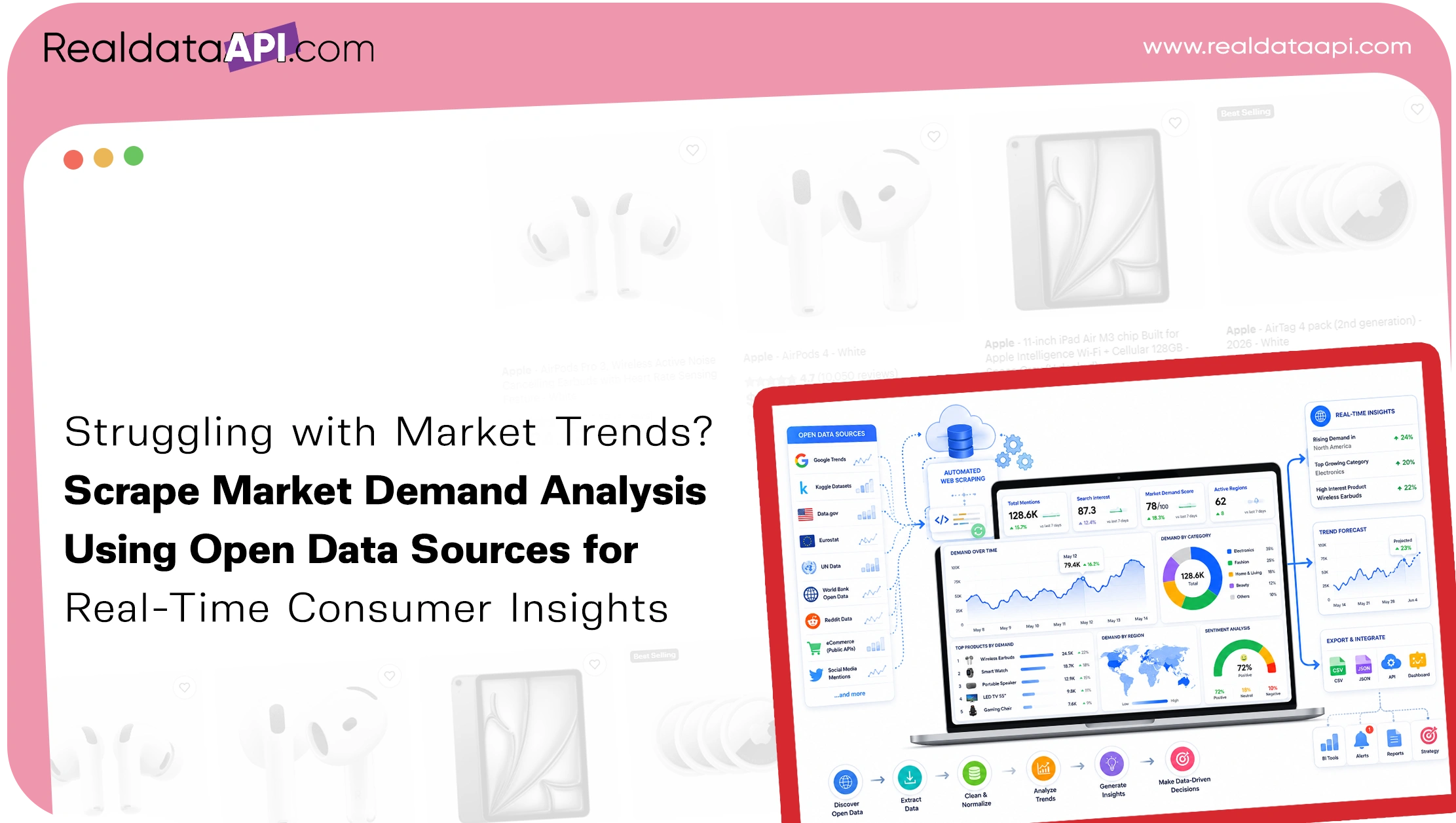
Businesses that scrape Market demand analysis using open data sources gain faster access to consumer preferences, emerging trends, and competitive insights. By leveraging public datasets, organizations can make informed decisions, improve forecasting accuracy, and respond to market changes before competitors.
According to industry estimates, organizations using data-driven decision-making are significantly more likely to achieve revenue growth than those relying solely on traditional research methods. Between 2020 and 2026, the volume of publicly accessible digital data has continued to expand, creating unprecedented opportunities for businesses to analyze demand patterns and customer behavior in real time.
Modern Web Scraping Services help companies collect structured information from marketplaces, review platforms, social channels, forums, government databases, and industry portals. This data enables businesses to identify demand fluctuations, optimize pricing strategies, forecast inventory requirements, and launch products that align with market expectations.
For retail brands, manufacturers, eCommerce businesses, and market intelligence teams, access to accurate and timely demand insights has become essential. Open data sources provide a cost-effective alternative to expensive surveys and manual research while delivering broader market visibility.
Industry Insight: Analysts estimate that global data creation will exceed 180 zettabytes by 2026, making automated data collection and analysis critical for competitive success.
How Can Public Consumer Data Reveal Hidden Market Opportunities?
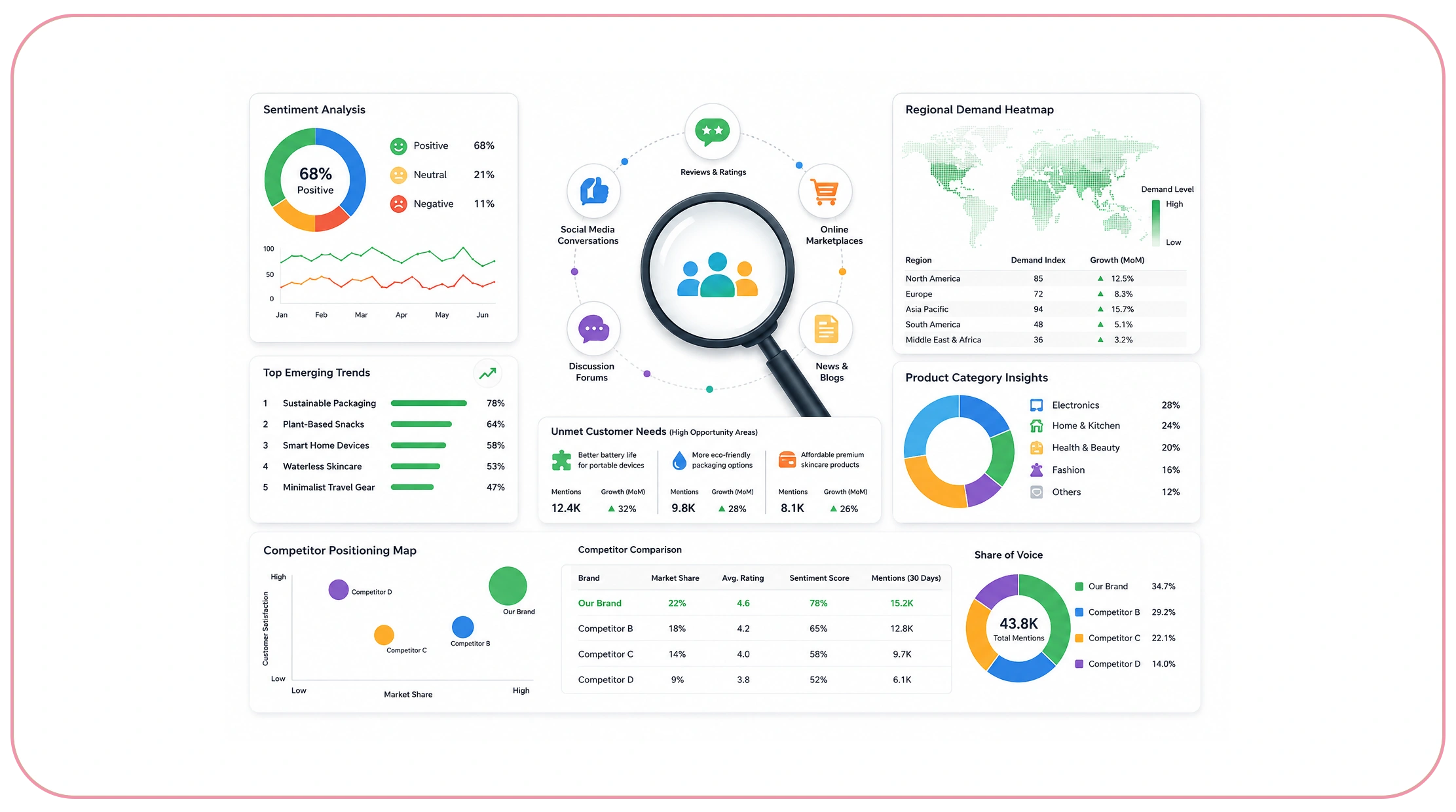
Businesses often struggle to understand why demand rises or falls in specific regions or product categories. Publicly available datasets offer valuable clues that help organizations identify opportunities before they become obvious to competitors.
Using tools to extract Public data sources for consumer behavior analysis, companies can evaluate reviews, ratings, discussion forums, social media conversations, and online marketplace activity. These sources provide direct visibility into customer sentiment and buying preferences.
Key Benefits
- Detect emerging product trends early
- Identify unmet customer needs
- Understand regional buying patterns
- Monitor competitor positioning
- Improve product development decisions
Consumer Data Growth Trends (2020–2026)
| Year | Public Consumer Data Availability Index |
|---|---|
| 2020 | 100 |
| 2021 | 118 |
| 2022 | 137 |
| 2023 | 158 |
| 2024 | 179 |
| 2025 | 201 |
| 2026 | 226 |
Businesses can use these expanding datasets to:
- Track changes in customer expectations.
- Compare product performance across regions.
- Measure sentiment around new launches.
- Identify high-growth customer segments.
A retailer launching a new product line can analyze thousands of public reviews to understand which features customers value most. This reduces risk and increases the likelihood of market success.
As more consumers interact online, public behavioral data continues to become one of the most reliable indicators of future demand patterns. Companies that effectively collect and analyze this information gain a significant competitive advantage.
How Can Businesses Forecast Demand More Accurately?
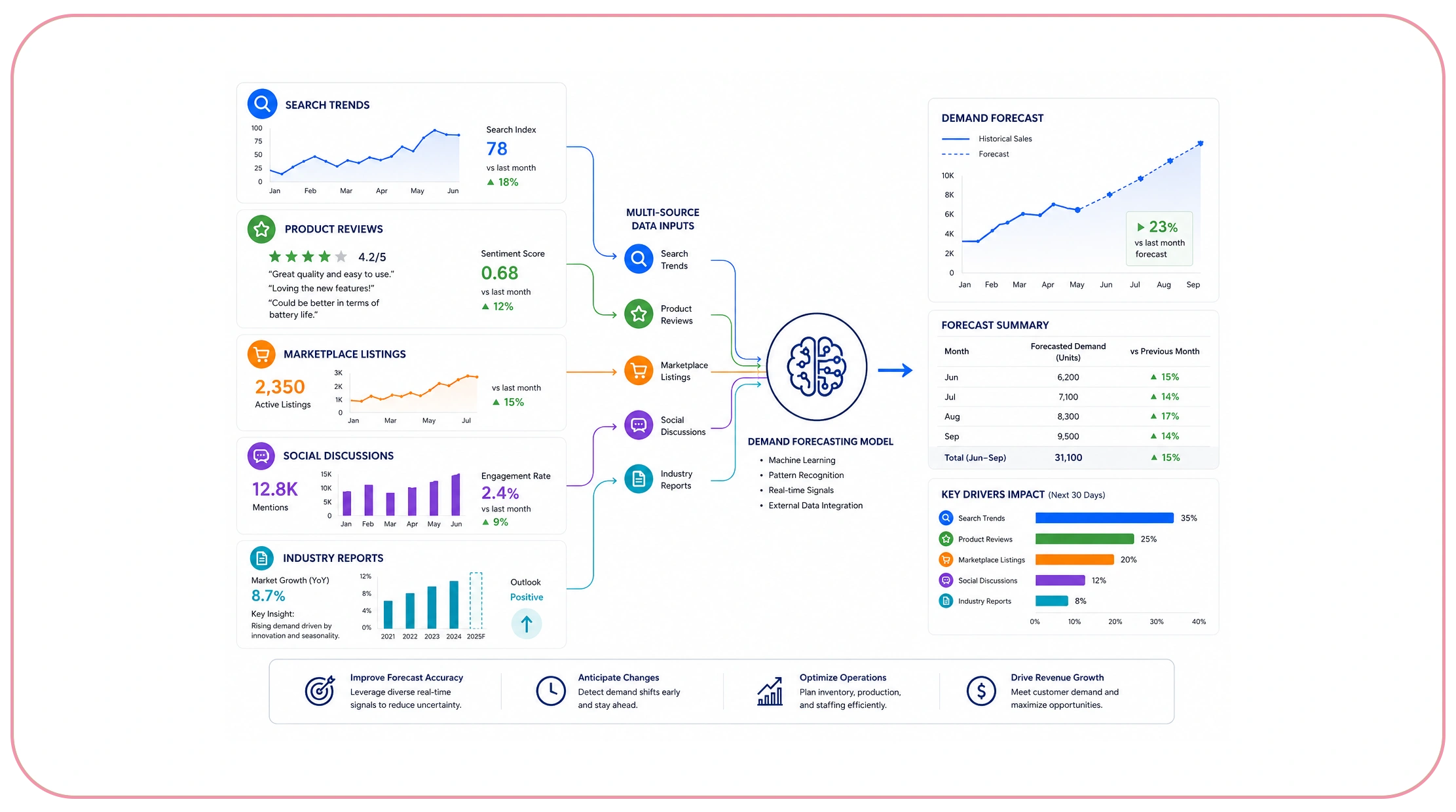
Demand forecasting remains one of the most difficult challenges for businesses. Traditional forecasting methods often depend on historical sales data, which may not capture rapidly changing market conditions.
Organizations can analyze consumer demand using public datasets to complement internal sales records with real-time market signals. This approach improves forecast accuracy and helps businesses anticipate changes before they affect revenue.
Demand Forecasting Drivers
- Search trends
- Product reviews
- Marketplace listings
- Social discussions
- Industry reports
Demand Forecast Accuracy Improvements
| Year | Traditional Methods | Data-Driven Methods |
|---|---|---|
| 2020 | 65% | 72% |
| 2021 | 66% | 75% |
| 2022 | 67% | 78% |
| 2023 | 68% | 81% |
| 2024 | 69% | 84% |
| 2025 | 70% | 87% |
| 2026 | 71% | 90% |
Companies that integrate public datasets into forecasting models can:
- Reduce inventory shortages
- Minimize excess stock
- Improve supply chain planning
- Optimize pricing strategies
For example, a consumer electronics brand may detect rising online discussions around a specific product feature. This trend can signal increased future demand, allowing the company to adjust production accordingly.
Accurate forecasting is no longer about looking backward. It requires analyzing current market signals and emerging consumer interests to predict future demand.
How Do Companies Identify Emerging Consumer Trends Faster?
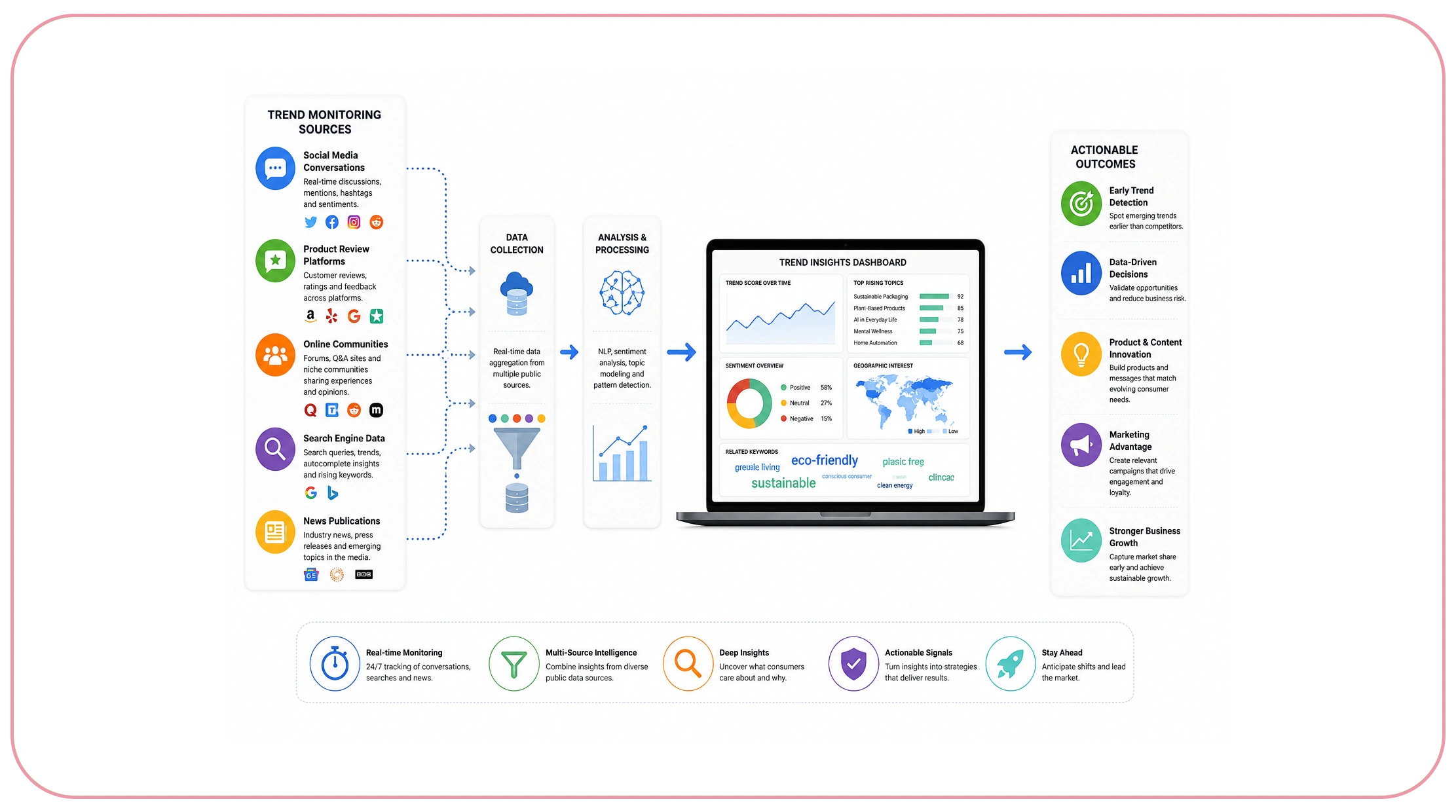
Consumer preferences change rapidly. Businesses that recognize trends early often capture larger market share and achieve stronger growth.
One effective strategy is learning how to Track consumer trends through public information gathered from multiple digital channels. Publicly accessible online content provides immediate insight into evolving customer interests.
Trend Monitoring Sources
- Social media conversations
- Product review platforms
- Online communities
- Search engine data
- News publications
Trend Discovery Impact
| Year | Businesses Monitoring Trends (%) |
|---|---|
| 2020 | 42 |
| 2021 | 48 |
| 2022 | 55 |
| 2023 | 63 |
| 2024 | 71 |
| 2025 | 78 |
| 2026 | 85 |
Organizations can use trend monitoring to:
- Identify rising product categories
- Predict seasonal demand shifts
- Improve marketing campaigns
- Launch products earlier
A beauty brand may discover growing conversations around sustainable packaging months before competitors react. Acting early allows the company to develop products that align with emerging consumer expectations.
Trend analysis helps organizations move from reactive decision-making to proactive strategy development. Businesses that monitor trends consistently gain stronger visibility into future market demand.
What Makes Open Data Collection Essential for Modern Analytics?
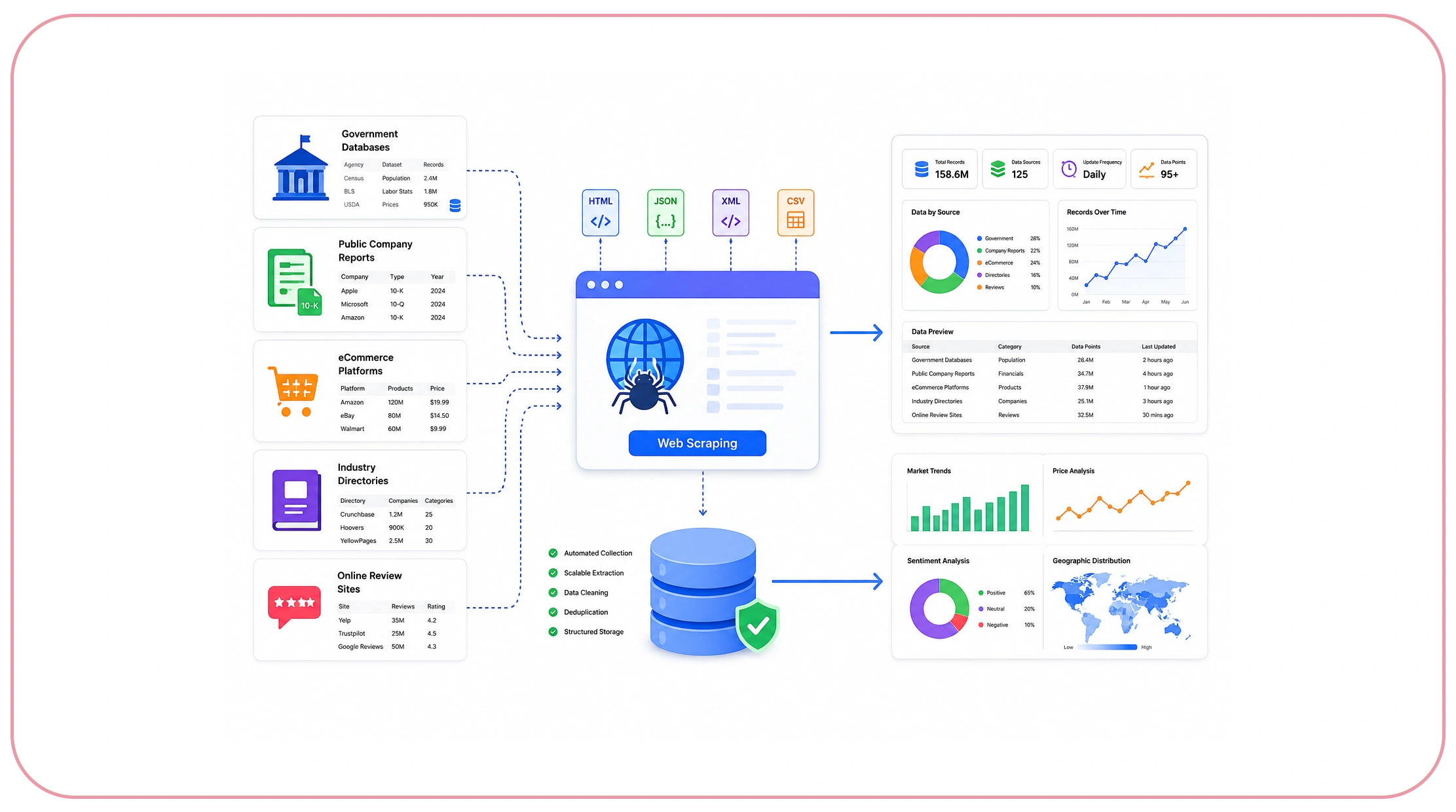
Businesses generate enormous amounts of information daily, but much of the most valuable market intelligence exists outside internal systems.
By utilizing Web Scraping Open Data Sources, organizations can collect information from publicly available websites and databases at scale. This data provides deeper market visibility and supports strategic planning.
Common Open Data Sources
- Government databases
- Public company reports
- eCommerce platforms
- Industry directories
- Online review sites
Open Data Utilization Growth
| Year | Adoption Rate (%) |
|---|---|
| 2020 | 35 |
| 2021 | 41 |
| 2022 | 49 |
| 2023 | 58 |
| 2024 | 67 |
| 2025 | 75 |
| 2026 | 82 |
Benefits include:
- Faster decision-making
- Improved competitive intelligence
- Better market visibility
- Enhanced forecasting accuracy
Organizations collecting open-source data can identify pricing changes, demand fluctuations, and competitor activities in near real time.
The increasing availability of public data has transformed business intelligence. Companies that systematically gather and analyze this information can respond faster to market opportunities and challenges.
Why Is Data-Driven Research Replacing Traditional Surveys?
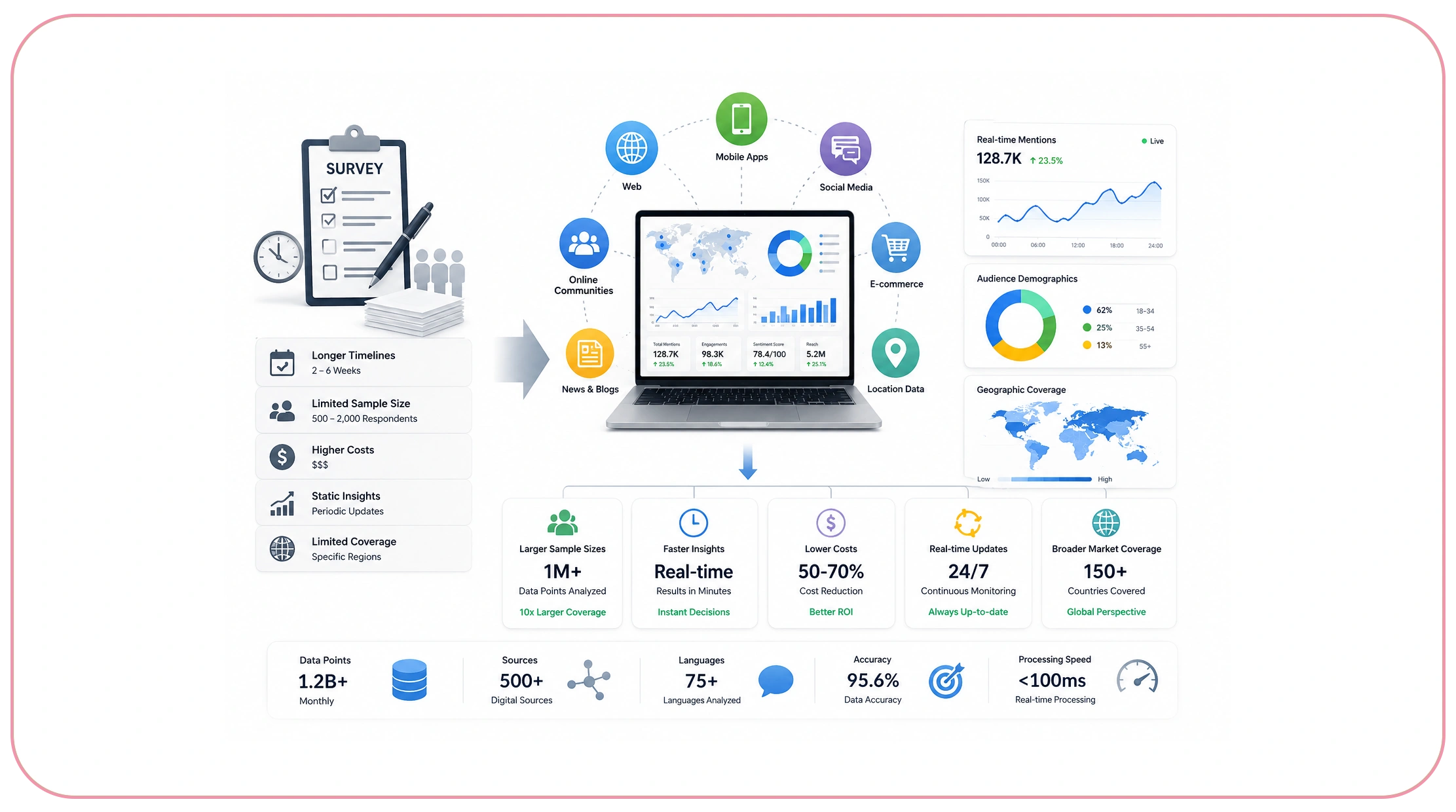
Traditional research methods often require substantial budgets and lengthy timelines. Businesses increasingly seek faster and more scalable alternatives.
Modern Market Research combines automated data collection with advanced analytics to deliver real-time insights. Instead of relying solely on surveys, organizations can analyze actual consumer behavior across digital platforms.
Advantages Over Traditional Research
- Larger sample sizes
- Faster insights
- Lower costs
- Real-time updates
- Broader market coverage
Research Method Comparison
| Year | Traditional Research Usage (%) | Data-Driven Research Usage (%) |
|---|---|---|
| 2020 | 78 | 22 |
| 2021 | 73 | 27 |
| 2022 | 67 | 33 |
| 2023 | 60 | 40 |
| 2024 | 53 | 47 |
| 2025 | 46 | 54 |
| 2026 | 39 | 61 |
Businesses can leverage data-driven research to:
- Validate product concepts.
- Monitor competitor activity.
- Measure customer sentiment.
- Assess market demand.
A food manufacturer evaluating a new product launch can analyze online reviews and search behavior instead of waiting months for survey results.
This shift enables organizations to make faster decisions while maintaining confidence in the quality of their insights.
How Can Large Enterprises Scale Demand Intelligence Efficiently?
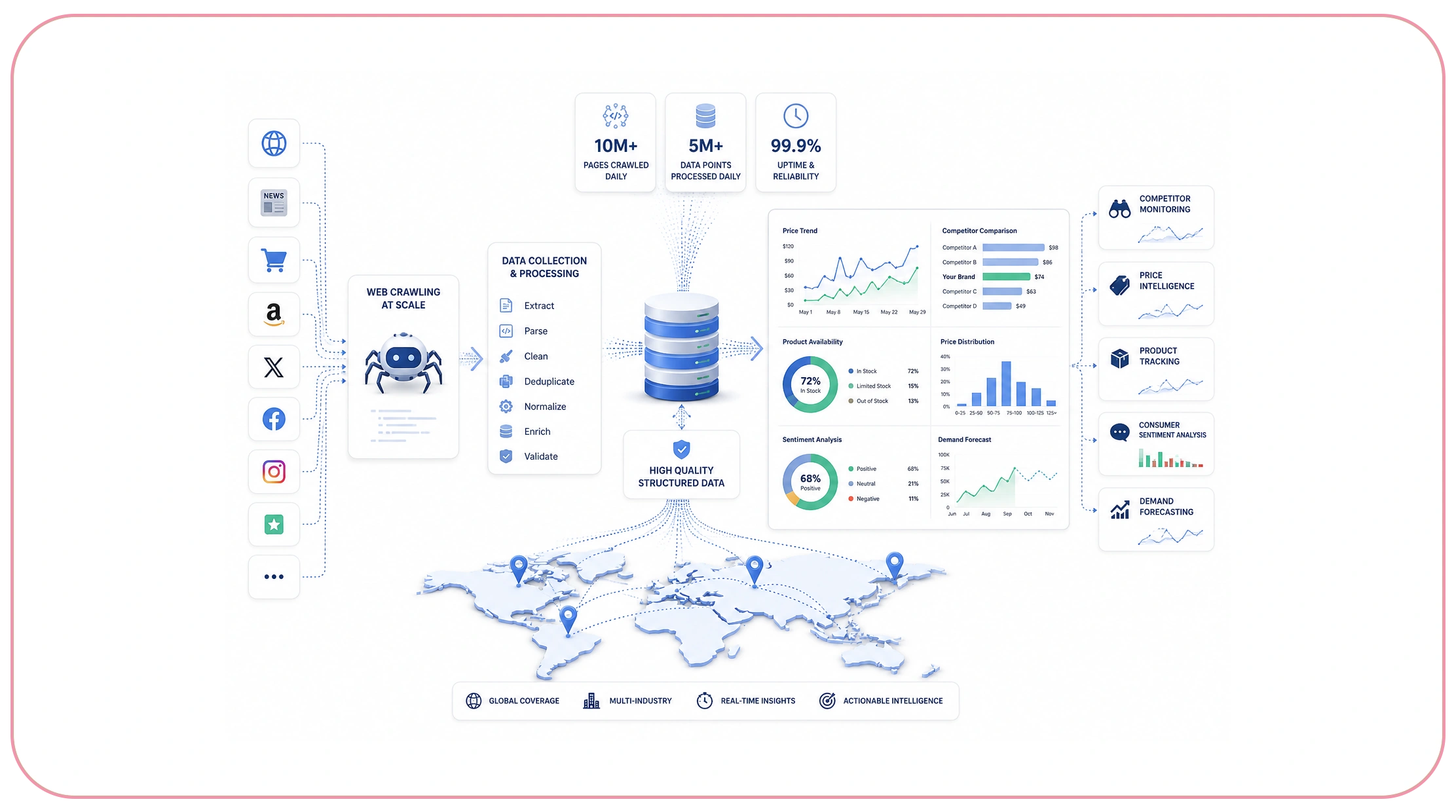
As organizations grow, manual data collection becomes increasingly difficult. Large enterprises require automated solutions capable of processing millions of data points daily.
Enterprise Web Crawling enables businesses to gather information from thousands of sources efficiently and consistently. These systems support large-scale market intelligence initiatives across multiple industries and geographies.
Enterprise Data Collection Applications
- Competitor monitoring
- Price intelligence
- Product tracking
- Consumer sentiment analysis
- Demand forecasting
Enterprise Crawling Adoption
| Year | Enterprise Adoption (%) |
|---|---|
| 2020 | 30 |
| 2021 | 37 |
| 2022 | 45 |
| 2023 | 54 |
| 2024 | 64 |
| 2025 | 73 |
| 2026 | 81 |
Benefits include:
- Automated data collection
- Improved scalability
- Consistent data quality
- Faster market intelligence
A global retailer monitoring thousands of SKUs across multiple regions can use enterprise crawling systems to track inventory availability, pricing changes, and demand indicators in real time.
As digital data volumes continue to expand, scalable crawling infrastructure becomes essential for maintaining a competitive edge.
Why Choose Real Data API?
Businesses need reliable, scalable, and accurate solutions to transform public data into actionable insights. Real Data API provides advanced data collection capabilities that help organizations monitor markets, analyze demand, and uncover growth opportunities.
With a powerful Web Scraping API, businesses can automate data collection from multiple public sources while maintaining data consistency and scalability.
Key advantages include:
- Real-time data acquisition
- High-volume data processing
- Structured and clean datasets
- Scalable enterprise architecture
- Global data coverage
- Custom integration capabilities
Organizations looking to scrape Market demand analysis using open data sources can leverage Real Data API to access valuable consumer and market intelligence without the complexity of building internal infrastructure.
Whether your goal is competitor monitoring, demand forecasting, pricing analysis, or consumer trend tracking, Real Data API delivers the data foundation needed for smarter business decisions.
Conclusion
Market demand is constantly evolving, and businesses that rely solely on traditional research methods risk missing critical opportunities. By leveraging public datasets, organizations can gain deeper visibility into consumer behavior, forecast demand more accurately, identify emerging trends, and make faster strategic decisions.
Modern data collection technologies make it easier than ever to scrape Market demand analysis using open data sources, transforming publicly available information into actionable business intelligence.
Ready to unlock real-time consumer insights and stay ahead of market trends? Contact Real Data API today to discover how scalable data collection solutions can power your next growth strategy!
Latest posts
How Leveraging generative AI for market data intelligence Enables Faster Decision-Making and Competitive Advantage?
Struggling with Market Trends? Scrape Market Demand Analysis Using Open Data Sources for Real-Time Consumer Insights
ROI of Data Scraping for Business Intelligence Teams - How Automated Data Collection Drives Smarter Decisions
Industry-specific data APIs for businesses - Transforming Data Collection, Analytics, and Competitive Monitoring

Real Data API stands out as one of the premier global companies specializing in web data Scraping and web extraction.





.png)


Rating 4.7
Rating 4.7
Rating 4.5
Rating 4.7
Rating 4.7


Disclaimer : RealData API functions solely as an independent data infrastructure and technology solutions provider. We build customized automation workflows designed to collect publicly accessible web data based exclusively on client instructions. RealData API neither owns proprietary datasets nor engages in the sale or redistribution of extracted information. Our operations are limited strictly to lawful public web data processing and never involve unauthorized access to restricted systems or private networks. Any company names, trademarks, logos, or brand references displayed on this website are used purely for demonstrative and illustrative purposes to showcase our technical capabilities and do not imply endorsement, partnership, or affiliation. Use of our platform and services remains subject to our Terms of Service.