Introduction
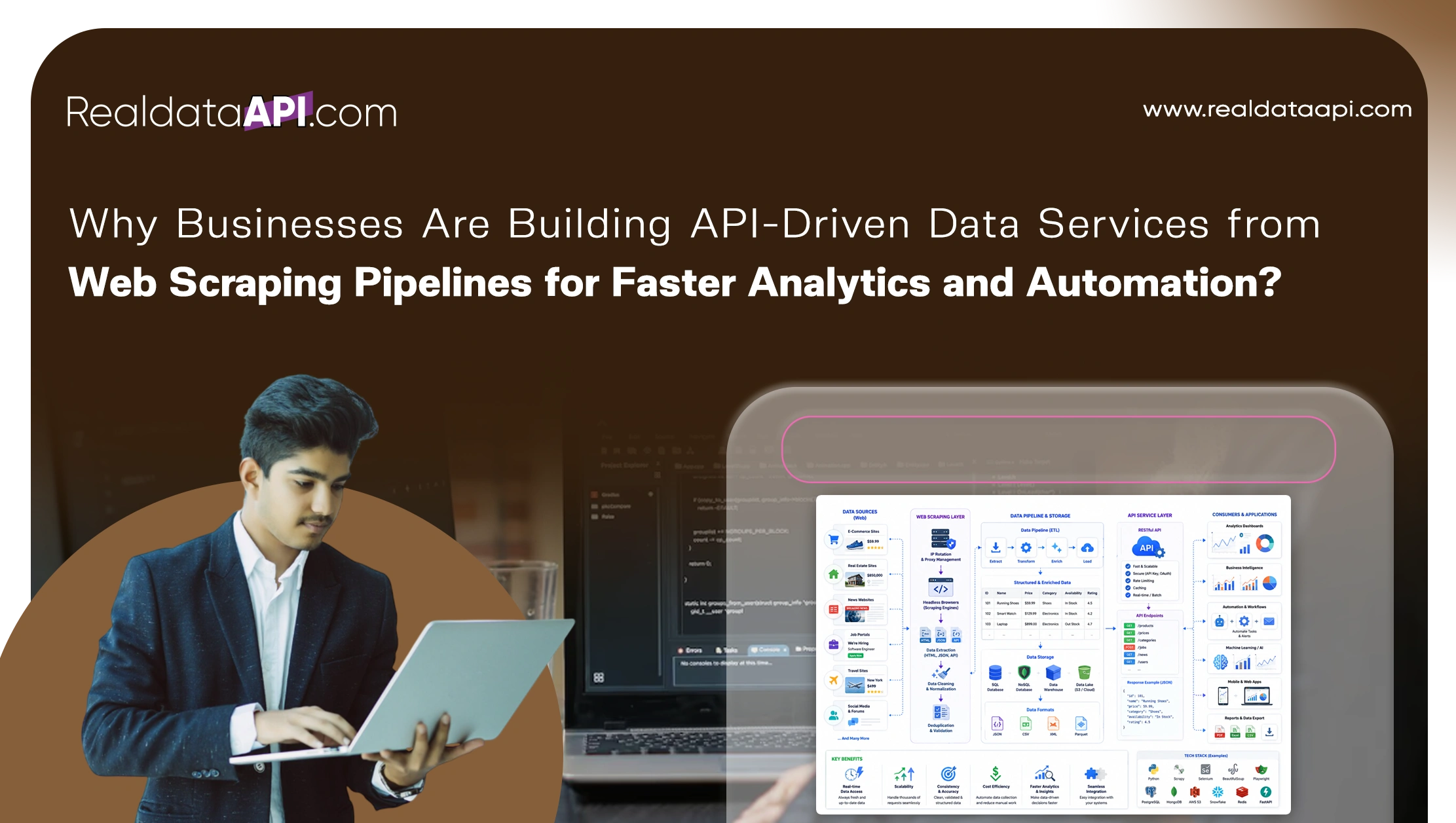
Modern enterprises increasingly depend on automated data ecosystems to gain competitive intelligence, improve forecasting accuracy, and accelerate operational efficiency. Organizations across retail, finance, healthcare, logistics, and eCommerce are now building API-driven data services from web scraping pipelines to transform raw digital information into scalable business intelligence solutions. These systems allow businesses to automate data collection, processing, integration, and analytics while delivering real-time insights through centralized APIs.
A scalable Web Scraping API acts as the foundation of these ecosystems by extracting structured data from websites, marketplaces, social platforms, and digital sources continuously. Once collected, the data is processed through automated pipelines and delivered through APIs that support dashboards, internal applications, reporting systems, and predictive analytics platforms.
Businesses are shifting toward API-driven data services because manual reporting methods can no longer support the speed and complexity of modern digital markets. Automated data pipelines reduce operational overhead, improve analytical consistency, and enable faster decision-making. As organizations increasingly prioritize real-time intelligence, API-driven scraping infrastructures are becoming essential for scalable analytics and automation strategies.
Turning Extracted Data into Revenue Opportunities
Businesses are increasingly recognizing that structured data itself has become a valuable commercial asset. Organizations now monetize analytics, market intelligence, and aggregated insights by packaging extracted information into scalable digital services.
Companies increasingly monetize scraped data through DaaS platforms that provide real-time access to pricing intelligence, inventory trends, customer sentiment, competitor monitoring, and market research data.
| Year | Global DaaS Market Growth | Companies Monetizing Data Assets |
|---|---|---|
| 2020 | 14% | 21% |
| 2021 | 18% | 27% |
| 2022 | 23% | 34% |
| 2023 | 29% | 42% |
| 2024 | 36% | 51% |
| 2025 | 44% | 60% |
| 2026 | 53% | 69% |
DaaS platforms allow businesses to generate recurring revenue streams by delivering structured analytics directly to customers through APIs and cloud-based dashboards. Retailers can sell pricing intelligence, financial institutions can provide market monitoring data, and logistics firms can distribute operational insights at scale.
These platforms also improve scalability by automating collection, processing, and delivery workflows. Businesses no longer rely on static reports but instead provide continuously updated intelligence that customers can integrate directly into their own systems.
As demand for real-time analytics continues growing, data monetization strategies are rapidly becoming a key component of digital transformation initiatives.
The Rise of Subscription-Based Intelligence Models
Subscription-based business models have become increasingly popular because they provide predictable recurring revenue while delivering continuous value to customers. Companies are now extending this approach into data analytics and intelligence services.
Organizations increasingly deploy Subscription-based data APIs using web scraping to provide clients with ongoing access to structured datasets, competitor monitoring, pricing trends, and operational analytics.
| Year | Subscription API Market Growth | Businesses Offering Data Subscriptions |
|---|---|---|
| 2020 | 16% | 19% |
| 2021 | 21% | 25% |
| 2022 | 27% | 33% |
| 2023 | 34% | 41% |
| 2024 | 42% | 50% |
| 2025 | 51% | 59% |
| 2026 | 61% | 69% |
Subscription-based APIs enable businesses to deliver continuously updated intelligence without requiring customers to manage complex scraping infrastructure themselves. Clients gain direct access to reliable data streams while businesses maintain centralized control over extraction and processing systems.
These models also support greater scalability by allowing organizations to package intelligence services into flexible pricing tiers and industry-specific offerings. Businesses can customize datasets, reporting frequency, and API access based on customer requirements.
As digital ecosystems continue evolving, subscription-driven analytics platforms are becoming increasingly attractive for organizations seeking scalable recurring revenue models.
Delivering Real-Time Intelligence at Enterprise Scale
Modern enterprises require immediate access to fresh, actionable information to support decision-making across rapidly changing markets. Businesses increasingly focus on minimizing delays between data extraction and analytical delivery.
Organizations now prioritize understanding how to deliver real-time scraped data as a service by building automated processing, streaming, and API delivery frameworks.
| Year | Real-Time Data Delivery Adoption | Average Analytics Response Time Reduction |
|---|---|---|
| 2020 | 22% | 17% |
| 2021 | 29% | 23% |
| 2022 | 37% | 30% |
| 2023 | 46% | 38% |
| 2024 | 55% | 46% |
| 2025 | 64% | 55% |
| 2026 | 73% | 64% |
Real-time delivery systems allow businesses to stream pricing updates, inventory movements, customer engagement metrics, and competitor changes instantly into dashboards and operational applications. Organizations can respond proactively to market conditions rather than relying on delayed reporting cycles.
Streaming analytics also improve forecasting accuracy by ensuring decision-makers always work with the most current data available. Retailers can react faster to stock shortages, financial firms can monitor market volatility continuously, and logistics providers can optimize operations dynamically.
As businesses continue prioritizing operational agility, real-time data delivery is becoming foundational for enterprise analytics infrastructure.
Advanced Extraction Frameworks Supporting Automation

The efficiency of API-driven data services depends heavily on reliable extraction technologies capable of collecting structured information continuously from complex digital environments. Organizations increasingly invest in scalable automation systems to improve operational reliability.
Businesses now depend on advanced Web Scraping Services to extract pricing data, product catalogs, reviews, financial metrics, competitor intelligence, and operational information across multiple online platforms.
| Year | Enterprise Scraping Adoption Growth | Automated Data Collection Expansion |
|---|---|---|
| 2020 | 18% | 22% |
| 2021 | 24% | 28% |
| 2022 | 31% | 35% |
| 2023 | 39% | 43% |
| 2024 | 48% | 52% |
| 2025 | 57% | 61% |
| 2026 | 67% | 71% |
Modern scraping frameworks support distributed extraction, anti-blocking systems, dynamic rendering, API integrations, and automated scheduling. These capabilities improve scalability while ensuring high-frequency data collection remains accurate and consistent.
Automated extraction also reduces dependency on manual workflows and fragmented reporting systems. Businesses can centralize data operations while improving analytical speed and operational efficiency.
As enterprise analytics requirements continue growing, advanced scraping technologies remain essential for maintaining reliable and scalable data service infrastructures.
Large-Scale Crawling Driving Enterprise Intelligence
Organizations managing extensive digital intelligence operations require scalable crawling infrastructures capable of monitoring millions of webpages continuously. Enterprise-grade crawling systems provide the foundation for large-scale data collection and analytics automation.
Businesses increasingly invest in Enterprise Web Crawling technologies to support market monitoring, competitive intelligence, financial analysis, and industry-wide research initiatives.
| Year | Enterprise Crawling Market Growth | Large-Scale Monitoring Expansion |
|---|---|---|
| 2020 | 15% | 19% |
| 2021 | 21% | 25% |
| 2022 | 28% | 32% |
| 2023 | 36% | 40% |
| 2024 | 45% | 49% |
| 2025 | 55% | 59% |
| 2026 | 66% | 70% |
Enterprise crawling systems allow organizations to automate discovery, extraction, categorization, and indexing processes across massive digital ecosystems. Businesses gain real-time visibility into changing market conditions, emerging trends, competitor activity, and operational metrics.
Distributed crawling architectures also improve scalability by supporting high-frequency monitoring without performance bottlenecks. Organizations can process large data volumes efficiently while maintaining analytical accuracy and operational stability.
As digital information continues expanding globally, enterprise crawling systems are becoming increasingly important for scalable intelligence operations and API-driven analytics services.
Structured Data Assets Fueling Smarter Analytics
The quality of analytics depends heavily on access to clean, structured, and scalable datasets capable of supporting automation and predictive intelligence workflows. Organizations increasingly prioritize centralized data assets for operational consistency and analytical reliability.
Businesses rely on structured Web Scraping Datasets to analyze pricing movements, inventory changes, customer behavior, competitor strategies, and market demand trends across multiple industries.
| Year | Structured Dataset Adoption Growth | Forecasting Accuracy Improvement |
|---|---|---|
| 2020 | 19% | 15% |
| 2021 | 25% | 21% |
| 2022 | 32% | 28% |
| 2023 | 40% | 36% |
| 2024 | 49% | 44% |
| 2025 | 58% | 53% |
| 2026 | 68% | 63% |
Structured datasets improve scalability by enabling organizations to standardize analytics workflows across departments and applications. Businesses can integrate data directly into dashboards, machine learning systems, reporting platforms, and customer-facing APIs.
Centralized datasets also support predictive analytics initiatives by providing historical and real-time intelligence within unified architectures. Organizations gain stronger forecasting capabilities while improving operational responsiveness.
As analytics ecosystems continue evolving, structured data assets remain essential for enterprise automation and scalable intelligence delivery.
Why Choose Real Data API?
Organizations require scalable analytics ecosystems capable of supporting real-time extraction, processing, automation, and API delivery across increasingly complex digital environments. Real Data API provides enterprise-grade infrastructure designed to streamline modern data intelligence operations efficiently.
Our solutions help businesses succeed in building API-driven data services from web scraping pipelines through scalable extraction frameworks, centralized processing systems, distributed crawling technologies, and high-performance API delivery architectures.
Real Data API combines automation, cloud scalability, structured datasets, streaming analytics, and enterprise-grade integrations into a unified intelligence ecosystem. Our platforms enable businesses to accelerate analytics workflows, improve operational efficiency, reduce manual overhead, and deliver real-time intelligence at scale.
Conclusion
Modern enterprises increasingly rely on automated data ecosystems capable of extracting, processing, and delivering intelligence continuously across digital markets. Businesses that focus on building API-driven data services from web scraping pipelines gain significant advantages through faster analytics, scalable automation, and improved decision-making capabilities.
API-driven infrastructures allow organizations to transform raw web information into structured, monetizable intelligence delivered through centralized services and real-time applications. As industries continue adopting automation-first strategies, scalable scraping pipelines and API-based analytics will remain foundational for long-term growth and operational competitiveness.
Real Data API empowers organizations with enterprise-grade solutions designed to support large-scale data extraction, real-time analytics delivery, and intelligent automation workflows.
Contact Real Data API today to start building API-driven data services from web scraping pipelines and unlock scalable real-time analytics for your business.
Latest posts

How Myntra Fashion Dataset Solves Fashion Intelligence Challenges Across Products, Prices, Brands, and Fashion Market Trends?
How Hyatt Travel Dataset Helps Businesses Track Hotels, Room Prices, Amenities, Locations, and Travel Trends?

How Louis Vuitton Fashion Dataset Enables Better Analysis of Luxury Products, Prices, Brands, and Fashion Trends?
How Blinkit Grocery Dataset Enables Smarter Analysis of Products, Prices, Availability, and Quick-Commerce Trends?







.png)



