Introduction: Why Legal Data Is the Most Underexploited B2B Dataset in America
Every major industry vertical has its authoritative data source. Finance has Bloomberg. Real estate has MLS. Healthcare has NPI Registry. For the legal profession in the United States, that authoritative source is Martindale-Hubbell.
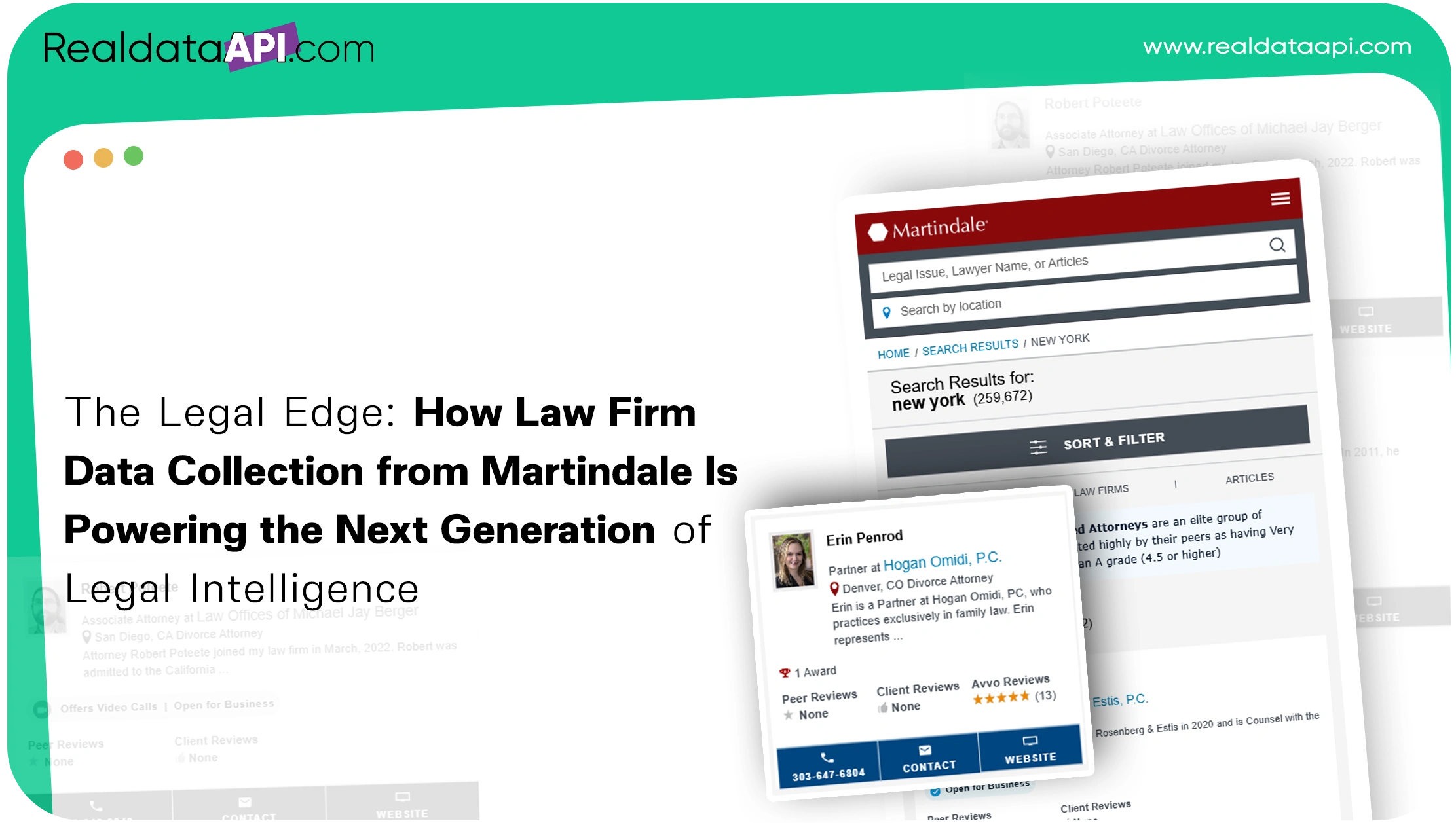
Founded in 1868, Martindale-Hubbell Scraper has spent over a century and a half building the most trusted directory of attorneys, law firms, and legal professionals in the country. Its digital platform — Martindale.com — hosts detailed profiles for hundreds of thousands of attorneys and law firms across every U.S. state, practice area, and firm size category. Profiles include peer review ratings, client reviews, bar admissions, practice specializations, education history, years of experience, firm size, geographic coverage, languages spoken, and direct contact information.
For legal technology companies, B2B data providers, litigation finance firms, corporate legal departments, bar associations, academic researchers, and legal marketing agencies, systematic law firm data collection from Martindale — through structured scraping, extraction, and API-based data pipelines — delivers a competitive intelligence foundation that no other source can match.
This blog covers what Martindale law firm data looks like in practice, the most critical data fields worth extracting, real-world use cases across the legal and adjacent industries, the technical challenges of scraping and extracting Martindale data at scale, and how Real Data API delivers this legal intelligence as a clean, structured, continuously refreshed data feed.
Why Martindale Is the Authoritative Source for Law Firm Data Extraction
Before building a data collection strategy around Martindale, it helps to understand what makes it structurally superior to other legal directories — and why extraction from this platform delivers outsized value compared to alternatives like Avvo, FindLaw, or Justia.
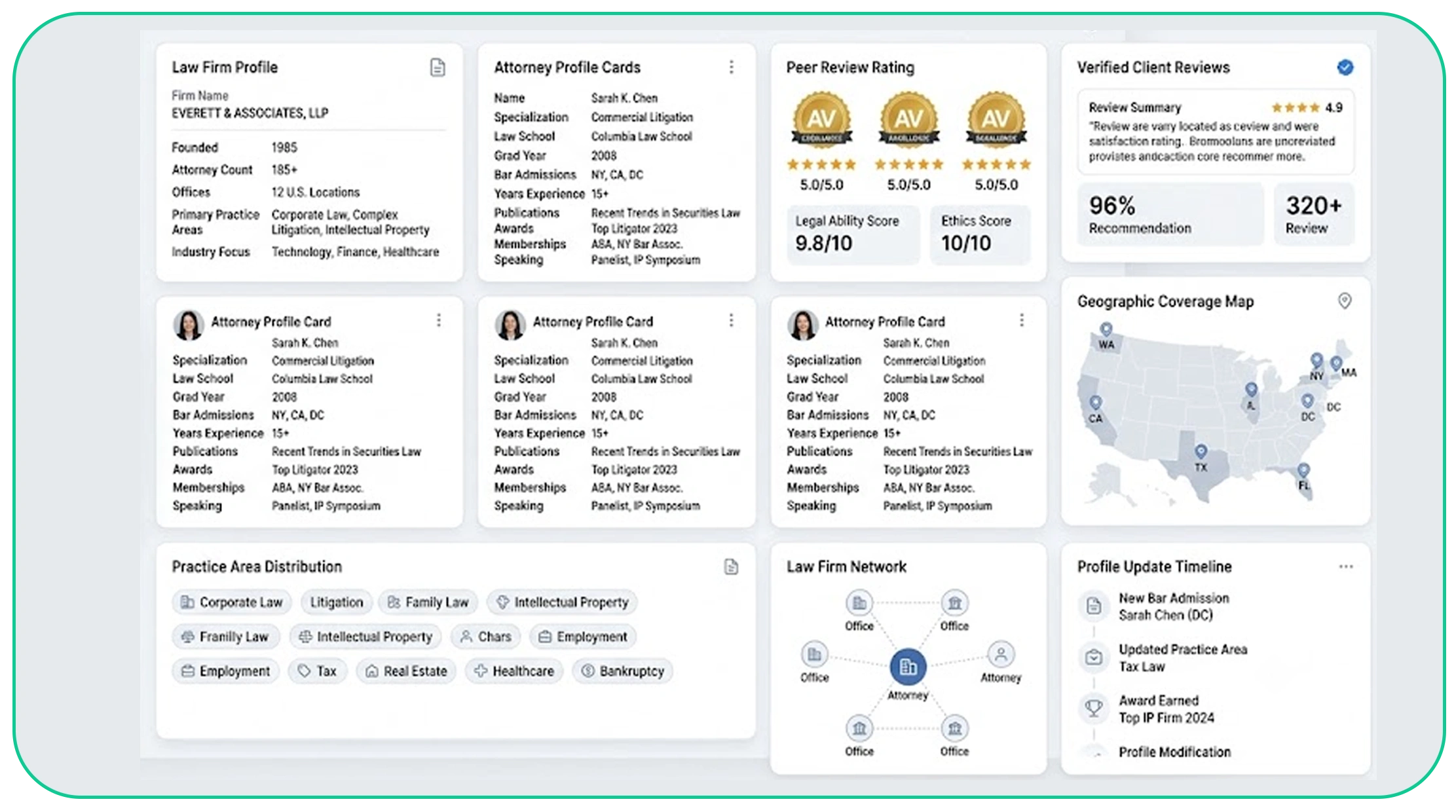
Peer Review Rating System — Martindale's AV Preeminent rating is the legal industry's most recognized peer review designation. Attorneys are rated by other attorneys on legal ability and ethical standards, producing a credibility signal that no self-reported directory can replicate. Extracting peer review ratings alongside attorney profiles creates a quality-differentiated dataset unavailable anywhere else.
Depth of Attorney-Level Profiles — Unlike general business directories, Martindale profiles go deep on individual attorneys: law school attended, graduation year, bar admission dates and jurisdictions, practice area specializations (often listed at the sub-specialty level), honors and awards, publications, speaking engagements, and professional association memberships. This granularity supports attorney-level analysis, not just firm-level analysis.
Firm-Level Structural Data — Martindale publishes firm profiles that aggregate attorney counts, office locations, practice area coverage, firm founding year, and client industry specializations. This firm-level metadata enables market segmentation, competitive mapping, and business development targeting that attorney-level data alone cannot support.
Geographic Coverage Completeness — Martindale covers attorneys across all 50 U.S. states, U.S. territories, and many international jurisdictions. For data collection use cases that require national or multi-jurisdictional coverage, Martindale is the only platform with the geographic completeness to support it.
Client Review Integration — Martindale publishes verified client reviews alongside peer ratings, adding a demand-side quality signal to complement the supply-side peer assessment. Extracting client review data alongside ratings and profiles creates a multidimensional quality dataset.
Regular Profile Updates — Attorneys update their Martindale profiles when they change firms, gain new bar admissions, add practice areas, or earn new ratings. This makes Martindale a dynamic dataset that rewards regular scraping and extraction over static one-time collection.
Core Data Fields Worth Extracting from Martindale
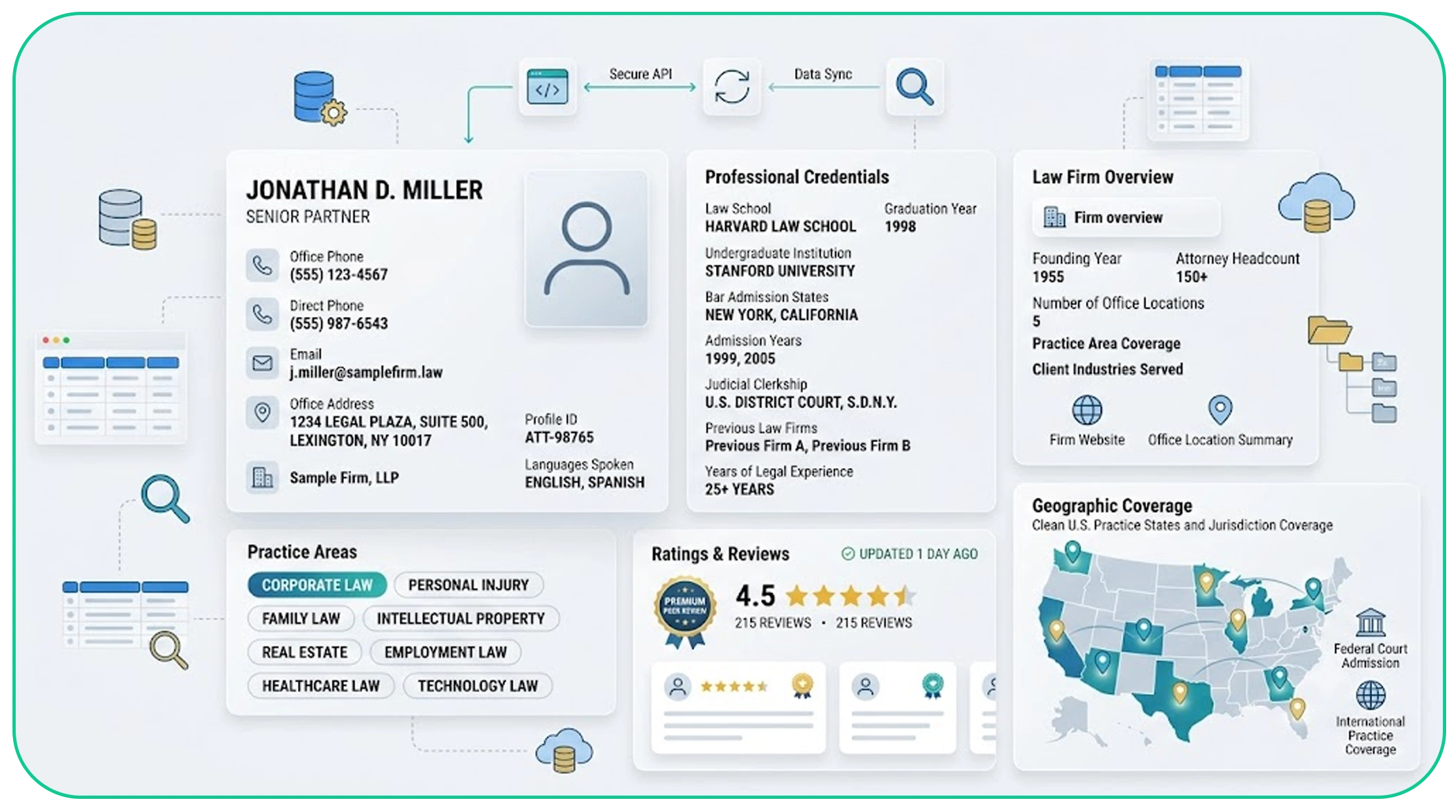
A comprehensive Martindale law firm data collection pipeline targets the following structured data layers:
Attorney Identity and Contact Data
- Full name and professional title
- Direct phone number and office phone
- Email address (where published)
- Office address (street, city, state, ZIP code)
- Law firm name and firm profile URL
- Profile URL and unique attorney identifier
- Profile photo URL
- Languages spoken
Professional Credentials and History
- Law school attended and graduation year
- Undergraduate institution
- Bar admission jurisdictions and admission years
- Judicial clerkship history
- Prior firm affiliations
- Years in practice / year licensed
Practice Area and Specialization Data
- Primary practice areas (e.g., Personal Injury, Corporate Law, Family Law, Intellectual Property)
- Secondary and sub-specialty practice areas
- Industry focus (e.g., Healthcare Law, Real Estate Law, Technology Law)
- Client type focus (individuals, small business, corporate, government)
Rating and Review Data
- Martindale-Hubbell peer review rating (AV Preeminent, BV Distinguished, or unrated)
- Rating year and last verified date
- Client review count and average rating
- Client review text excerpts
- Super Lawyers or other third-party rating integrations where listed
Firm-Level Data
- Firm name and founding year
- Total attorney headcount
- Number of office locations
- Office location addresses
- Practice area coverage at firm level
- Firm website URL
- Firm description and overview text
- Client industries served
Geographic and Jurisdictional Data
- Primary practice state and city
- Multi-state practice coverage
- Federal court admissions
- International jurisdiction coverage
Real-World Use Cases: Who Extracts Martindale Data and Why
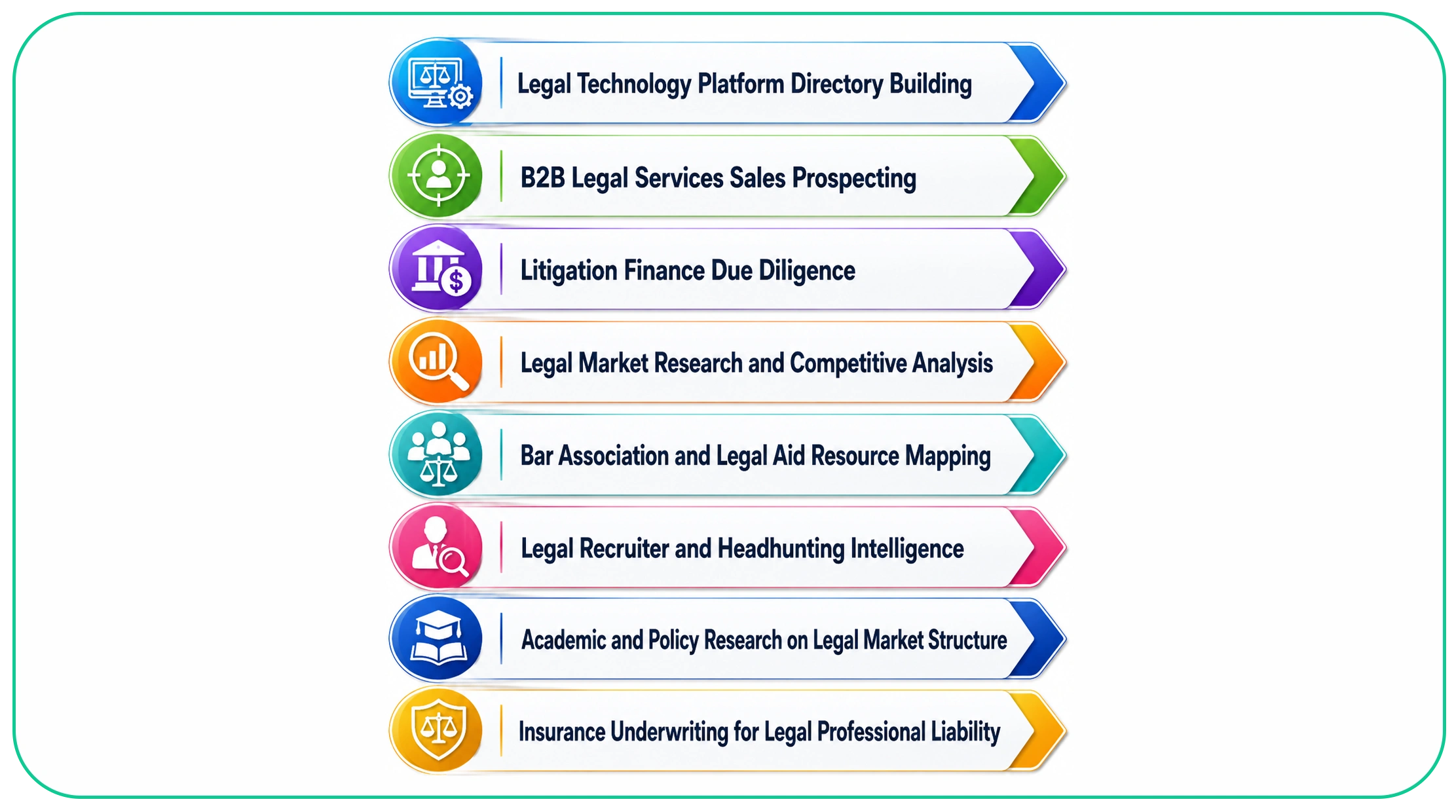
Use Case 1: Legal Technology Platform Directory Building
A legal technology company building a lawyer-matching platform for consumers needs a comprehensive, accurate attorney database as its foundation. Rather than building attorney profiles from scratch — an enormously time-consuming and expensive process — the platform uses Martindale scraping and extraction to populate its core database with verified attorney profiles, credentials, practice areas, and contact information.
Martindale's peer review ratings serve as a built-in quality filter: the platform can immediately surface AV Preeminent-rated attorneys in relevant practice areas for users seeking high-quality representation, without developing its own vetting methodology from zero.
Use Case 2: B2B Legal Services Sales Prospecting
A legal technology SaaS company selling contract management software to law firms uses Martindale data extraction to build a segmented prospect list. By extracting firm-level data — attorney headcount, practice area focus, office locations, and firm founding year — the sales team identifies target firms: mid-size corporate law firms (25–150 attorneys) in major U.S. metros focused on transactional work (M&A, commercial contracts, real estate), where contract management software delivers the highest ROI.
Martindale extraction produces a prospect list that would take a sales development team months to build manually from public sources, and delivers it in days with consistent data quality across thousands of firm records.
Use Case 3: Litigation Finance Due Diligence
A litigation finance firm evaluating investment opportunities in personal injury and mass tort cases needs to assess the quality and track record of plaintiff-side law firms seeking funding. Martindale data — particularly peer review ratings, years of practice, bar admissions, and published case result histories — provides a structured due diligence input alongside court record research.
By systematically extracting Martindale profiles for plaintiff-side personal injury and mass tort attorneys in target jurisdictions, the litigation finance team builds a pre-screened attorney quality database that accelerates deal evaluation and reduces the risk of funding underprepared or under-credentialed firms.
Use Case 4: Legal Market Research and Competitive Analysis
A law firm consulting practice conducting strategic Market Research for a regional Am Law 200 firm uses Martindale data extraction to map the competitive landscape in the firm's primary markets. By scraping all law firm profiles in target cities — capturing attorney headcounts, practice area coverage, firm founding years, and office locations — the consulting team builds a competitive map showing which firms dominate each practice area, where gaps exist, and which competitor firms are growing or contracting based on attorney count trends over time.
This market intelligence would require dozens of hours of manual directory research without automated Martindale extraction — making systematic scraping not just convenient but essential for delivering the depth of analysis clients expect.
Use Case 5: Bar Association and Legal Aid Resource Mapping
A state bar association wants to identify geographic gaps in legal service availability — ZIP codes or counties where residents have limited access to attorneys in key practice areas like family law, immigration, or housing law. By extracting Martindale attorney data filtered by state, practice area, and office ZIP code, the bar association builds a geographic distribution map of legal services that informs legal aid funding decisions, pro bono program targeting, and rural access initiatives.
This use case represents a public interest application of Martindale data extraction — using structured attorney location and specialization data to address the justice gap in underserved communities.
Use Case 6: Legal Recruiter and Headhunting Intelligence
A legal recruitment firm specializing in partner-level lateral placements uses Martindale extraction to identify high-value attorney targets. By filtering extracted profiles on AV Preeminent rating, years of experience (15+ years), specific practice area specializations (e.g., M&A, IP Litigation, Tax), and current firm size (targeting attorneys at firms below 50 attorneys who might be receptive to larger platform opportunities), the recruiting team generates a pre-qualified candidate pipeline without conducting manual directory searches.
Martindale's depth of credential data — law school, prior firm history, bar admissions — means recruiters arrive at outreach conversations already informed, dramatically improving conversion rates from first contact to candidate engagement.
Use Case 7: Academic and Policy Research on Legal Market Structure
A law school research center studying the geographic distribution of legal specialization in the United States uses Martindale data as its primary dataset. By extracting attorney profiles across all 50 states with practice area, bar admission, years of experience, and firm size fields, the research team builds a national dataset capable of answering questions about legal specialization concentration, rural access to specialized legal services, the relationship between law school prestige and career geography, and the evolution of firm size distributions over time.
Martindale is uniquely suited for this research because its consistent profile structure and national coverage make cross-state comparisons methodologically valid in a way that patchwork collection from state bar websites cannot support.
Use Case 8: Insurance Underwriting for Legal Professional Liability
A specialty insurance carrier underwriting legal professional liability (malpractice) policies uses Martindale extraction to enrich its underwriting data. By pulling practice area specialization, years of experience, firm size, and peer rating for applicant attorneys — and comparing them against the carrier's historical claims data — the underwriting team builds risk scoring models that price policies more accurately than the standard questionnaire-based approach.
Martindale's peer review rating, in particular, functions as a proxy for professional standing and ethical track record that standard financial underwriting data cannot provide.
Technical Challenges of Martindale Law Firm Data Scraping and Extraction
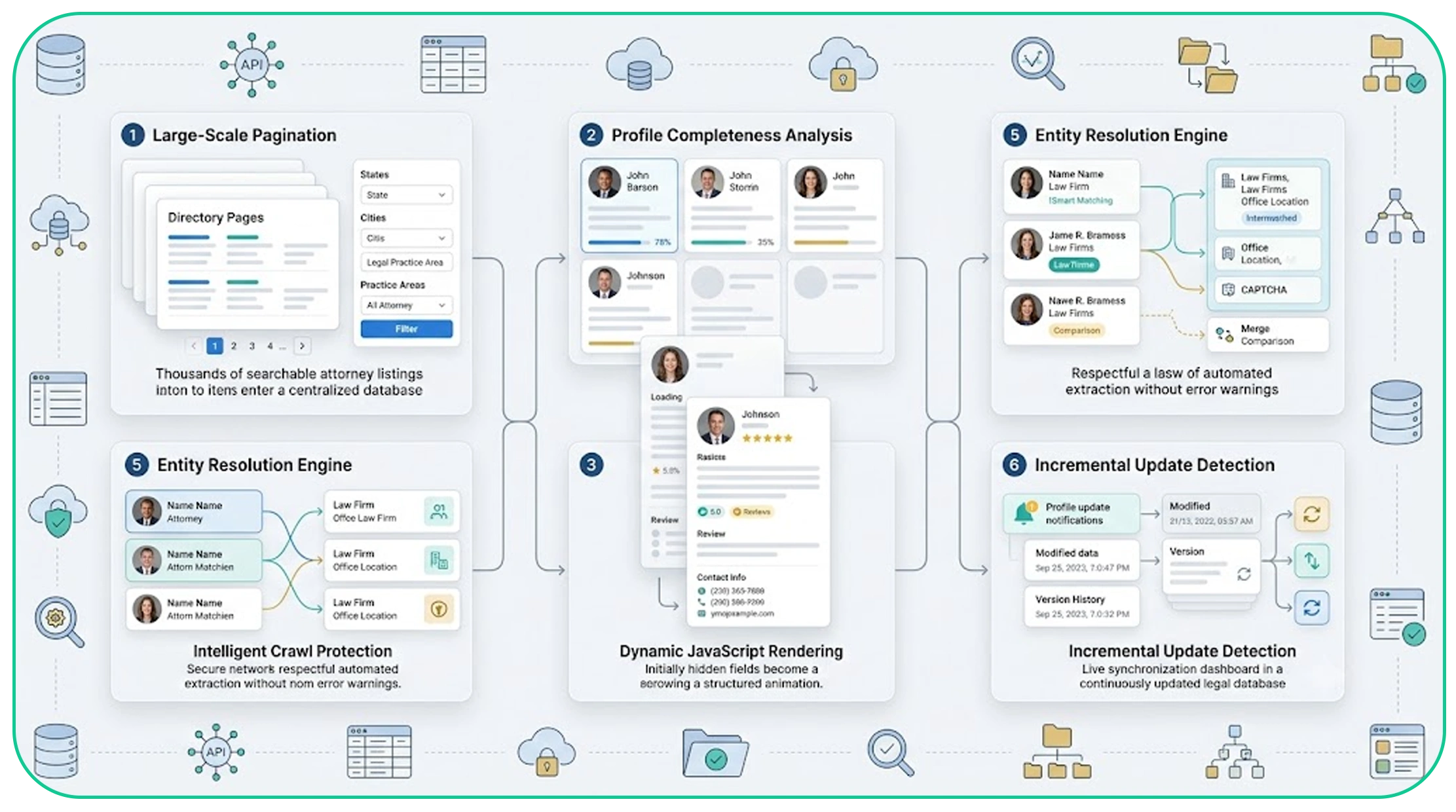
Pagination at Scale — Martindale hosts profiles for hundreds of thousands of attorneys organized across state, city, and practice area category pages, each with paginated result sets. A comprehensive national extraction requires systematic pagination traversal across thousands of category and geography combinations — a significant crawl management challenge.
Profile Completeness Variation — Not all Martindale profiles are equally complete. Some attorneys maintain detailed, regularly updated profiles; others have minimal or outdated entries. A production-grade extraction pipeline must handle missing fields gracefully, flagging incomplete profiles rather than returning null errors that corrupt downstream datasets.
JavaScript-Rendered Content — Martindale's platform uses client-side rendering for certain profile elements, including review content, rating badges, and contact details. Static HTML parsing misses these fields; headless browser execution is required for complete data extraction.
Anti-Scraping Protections — As a high-value B2B data source, Martindale implements rate limiting, bot detection, and CAPTCHA challenges for high-frequency automated access. Compliant, sustainable extraction requires intelligent request throttling, rotation strategies, and respectful crawl rates that do not degrade platform performance.
Name and Firm Disambiguation — Attorney names and firm names scraped from Martindale require disambiguation logic — distinguishing between two attorneys named "James Williams" at different firms in the same city, or tracking firm name changes when a firm rebrands or merges. Entity resolution is a critical post-extraction processing step for any use case that tracks attorneys or firms over time.
Data Freshness and Update Detection — Extracting Attorney Profile Data via Martindale API changes when attorneys move firms, gain new ratings, add practice areas, or retire. A scraping pipeline that only runs once produces a dataset that degrades in accuracy over time. Incremental extraction with change detection — flagging updated profiles for re-extraction rather than re-crawling the full directory — is essential for maintaining a live, accurate legal intelligence database.
Building a Martindale Data Collection Pipeline: Key Design Principles
Taxonomy-first crawl planning — Martindale's category structure (state → city → practice area) provides a natural crawl hierarchy. Map the full taxonomy before writing extraction logic to ensure complete coverage without duplication.
Attorney deduplication — Attorneys often appear in multiple category listings. The pipeline must deduplicate on a canonical attorney identifier (Martindale profile URL or unique ID) to avoid inflating record counts.
Rating verification timestamping — Peer review ratings are periodically re-verified. Store the rating alongside its verification date, not just the rating value, to support temporal analysis of rating trends.
Structured output schema — Define a strict output schema with consistent field names, data types, and handling rules for optional fields before extraction begins. Ad hoc schemas produce messy datasets that require expensive remediation downstream.
Compliance-aware extraction — Martindale data is a commercial asset. Production extraction pipelines should operate within platform terms of service, use appropriate request rates, and integrate data through licensed or API-based channels where available.
Conclusion: Real Data API — Your Structured Gateway to Martindale Law Firm Intelligence
Martindale-Hubbell is the legal industry's most authoritative, most comprehensive, and most credibility-rich directory — and the structured data it publishes represents an intelligence asset that legal technology companies, B2B sales teams, litigation finance firms, recruiters, researchers, and insurers are only beginning to fully leverage.
Scraping and extracting Martindale law firm data at scale — with the completeness, freshness, and structural consistency that production use cases demand — requires solving for JavaScript rendering, pagination at national scale, profile deduplication, change detection, and entity resolution. These are non-trivial engineering challenges that distract most teams from their core product work.
Real Data API handles the entire Martindale data collection pipeline — attorney profiles, firm-level data, peer review ratings, client reviews, practice area taxonomies, bar admissions, geographic coverage, and contact information — and delivers it as a clean, structured, continuously refreshed data feed through a single API endpoint.
Every record delivered by Real Data API is normalized against a canonical schema, deduplicated, timestamped, and enriched with geographic and taxonomic metadata — ready for direct integration into your legal technology platform, CRM, underwriting model, research database, or sales intelligence tool.
Whether you are building a lawyer-matching marketplace, powering a litigation finance due diligence workflow, mapping the competitive landscape for a law firm strategy engagement, or training a legal AI model on attorney credential data — Real Data API delivers the Martindale law firm data intelligence your product demands, at the quality and freshness your use case requires.
The legal industry runs on trust, credentials, and verified reputation. Real Data API gives you the data infrastructure to build on all three.
Latest posts
Industry-specific data APIs for businesses - Transforming Data Collection, Analytics, and Competitive Monitoring
The Legal Edge: How Law Firm Data Collection from Martindale Is Powering the Next Generation of Legal Intelligence

The Complete Guide to Web Scraping Grocery Data from Sobeys

How to Scrape Market and Competitor Data for Startup Growth Strategies and Faster Business Scaling?

Real Data API stands out as one of the premier global companies specializing in web data Scraping and web extraction.





.png)


Rating 4.7
Rating 4.7
Rating 4.5
Rating 4.7
Rating 4.7


Disclaimer : RealData API functions solely as an independent data infrastructure and technology solutions provider. We build customized automation workflows designed to collect publicly accessible web data based exclusively on client instructions. RealData API neither owns proprietary datasets nor engages in the sale or redistribution of extracted information. Our operations are limited strictly to lawful public web data processing and never involve unauthorized access to restricted systems or private networks. Any company names, trademarks, logos, or brand references displayed on this website are used purely for demonstrative and illustrative purposes to showcase our technical capabilities and do not imply endorsement, partnership, or affiliation. Use of our platform and services remains subject to our Terms of Service.