.gif)
.png)
Introduction
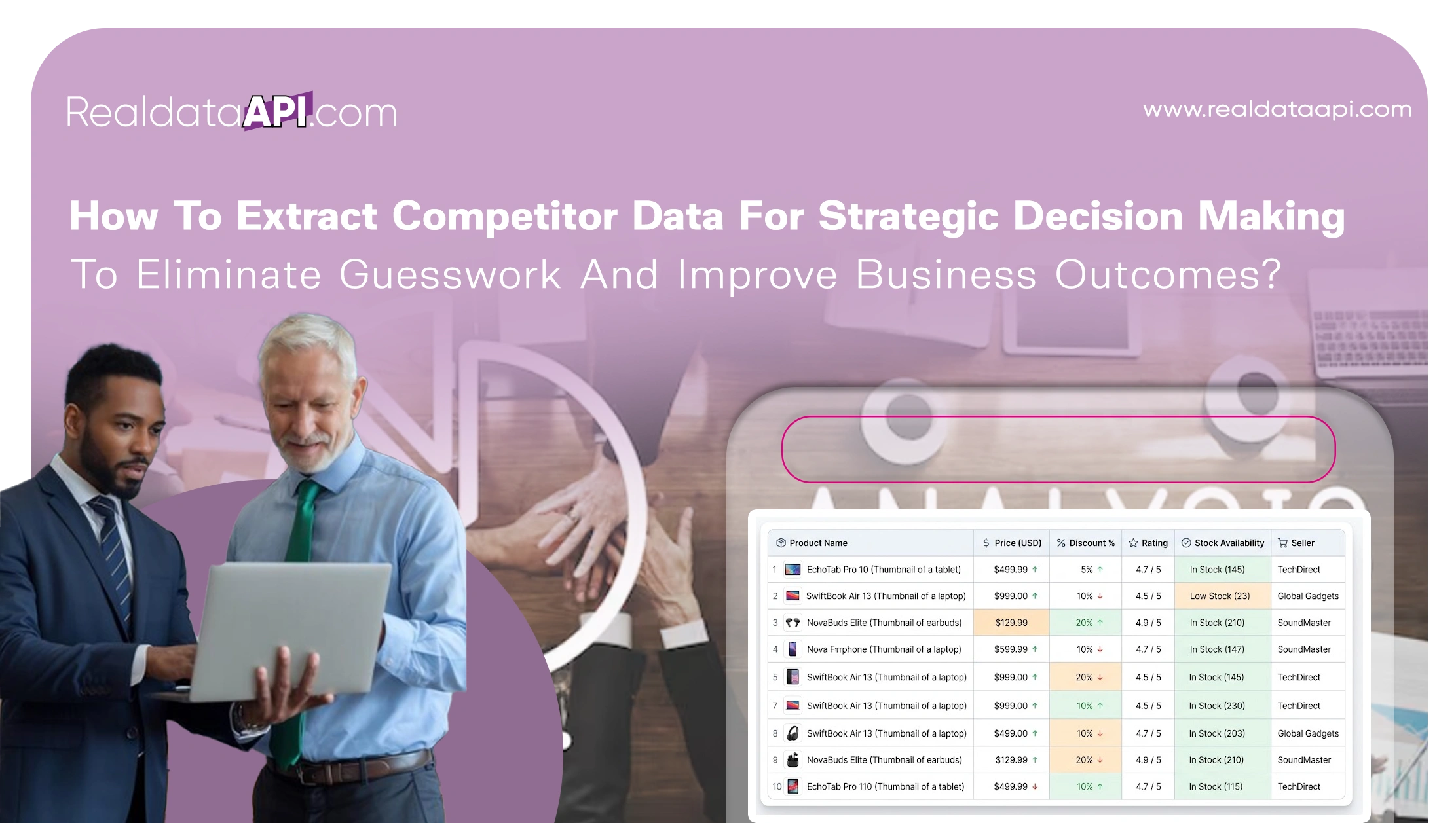
In an increasingly competitive digital landscape, businesses can no longer rely on intuition alone to make strategic decisions. The ability to extract competitor data for strategic decision making has become essential for gaining a clear understanding of market dynamics, pricing strategies, and customer preferences. Companies that leverage structured competitor intelligence are better equipped to identify opportunities, mitigate risks, and outperform rivals.
At the core of this approach lies Competitive Benchmarking, which allows organizations to compare their performance against industry peers. By analyzing competitor pricing, promotions, and product assortments, businesses can uncover hidden trends and optimize their strategies accordingly. From 2020 to 2026, organizations adopting competitor data analytics have seen measurable improvements in operational efficiency, pricing accuracy, and revenue growth.
This blog explores how to systematically extract, analyze, and utilize competitor data to eliminate guesswork and improve business outcomes, supported by real-world statistics and actionable frameworks.
Building a strong foundation for data extraction
To gain meaningful insights, businesses must implement web scraping for competitor intelligence data analysis as a core capability. This involves collecting structured data from competitor websites, marketplaces, and digital platforms to understand pricing, promotions, and product offerings.
Between 2020 and 2026, the adoption of web scraping for competitor analysis has increased significantly:
| Year | Adoption Rate (%) | Data Accuracy (%) |
|---|---|---|
| 2020 | 32% | 75% |
| 2022 | 48% | 82% |
| 2024 | 63% | 89% |
| 2026 | 76% | 94% |
This growth highlights the importance of automated data extraction in modern business strategies. By leveraging web scraping, organizations can monitor competitor activities in real time and identify emerging trends.
A strong data foundation ensures that businesses are working with accurate and up-to-date information. This reduces reliance on assumptions and enables data-driven decision-making across departments.
Turning raw data into actionable insights
Once data is collected, businesses must focus on data-driven competitor analysis using scraped data to derive meaningful insights. This process involves cleaning, organizing, and analyzing data to uncover patterns and trends.
From 2020 to 2026, companies using data-driven analysis have achieved better performance outcomes:
| Metric | 2020 | 2026 |
|---|---|---|
| Pricing Accuracy | 68% | 92% |
| Decision Speed | Slow | Fast |
| Revenue Growth | 7% | 18% |
These improvements demonstrate the value of structured data analysis. Businesses can identify pricing trends, understand customer preferences, and optimize their strategies accordingly.
By integrating analytics tools and dashboards, organizations can visualize data and make informed decisions quickly. This ensures that competitor intelligence is not just collected but effectively utilized.
Capturing pricing and promotional intelligence
A critical aspect of competitor analysis is the ability to Scrape competitor product pricing and promotion data. This enables businesses to track how competitors price their products, run discounts, and execute promotional campaigns.
Between 2020 and 2026, promotional activity has increased significantly across industries:
| Year | Promo Frequency (%) | Avg Discount (%) |
|---|---|---|
| 2020 | 18% | 12% |
| 2022 | 25% | 16% |
| 2024 | 33% | 20% |
| 2026 | 40% | 24% |
These trends highlight the importance of monitoring promotions alongside pricing. Businesses can identify which strategies drive sales and replicate successful campaigns.
By capturing detailed pricing and promotion data, organizations can refine their own strategies, improve customer engagement, and increase conversion rates.
Leveraging advanced tools for efficiency
To scale competitor intelligence efforts, businesses must adopt tools to extract competitor data for decision making. These tools automate data collection, processing, and analysis, ensuring efficiency and accuracy.
From 2020 to 2026, the adoption of advanced tools has improved operational performance:
| Metric | Without Tools | With Tools |
|---|---|---|
| Data Collection Speed | Slow | Fast |
| Data Accuracy | 70% | 93% |
| Cost Efficiency | Low | High |
These tools provide centralized dashboards, enabling businesses to monitor competitor activities in real time. They also support predictive analytics, allowing organizations to anticipate market trends and adjust strategies proactively.
By leveraging advanced tools, businesses can reduce manual effort and focus on strategic decision-making.
Scaling data extraction with reliable solutions
To handle large-scale data requirements, companies rely on Web Scraping Services that offer scalability and reliability. These services enable continuous data collection across multiple platforms, ensuring comprehensive coverage.
Between 2020 and 2026, businesses using web scraping services have achieved higher efficiency:
| Year | Efficiency Improvement (%) | Coverage (%) |
|---|---|---|
| 2020 | 20% | 30% |
| 2022 | 28% | 45% |
| 2024 | 35% | 60% |
| 2026 | 42% | 75% |
| Metric | 2020 | 2026 |
|---|---|---|
| Integration Speed | Moderate | Instant |
| Data Availability | Limited | Real-time |
| Automation Level | Low | High |
APIs allow businesses to integrate competitor data into dashboards, analytics tools, and decision-making systems. This ensures that insights are readily available and actionable.
By leveraging APIs, organizations can streamline operations, improve efficiency, and enhance their overall data strategy.
Why Choose Real Data API?
Real Data API provides advanced solutions for businesses seeking to leverage competitor intelligence effectively. With powerful Enterprise Web Crawling capabilities, organizations can collect large volumes of data with high accuracy and reliability.
By enabling companies to extract competitor data for strategic decision making, Real Data API empowers businesses to gain real-time insights into pricing, promotions, and market trends. This helps organizations optimize strategies, improve decision-making, and stay competitive.
With scalable infrastructure, customizable solutions, and robust support, Real Data API ensures that businesses can unlock the full potential of competitor data and achieve sustainable growth.
Conclusion
In today's fast-paced business environment, relying on guesswork is no longer an option. The ability to extract competitor data for strategic decision making provides businesses with the insights needed to stay ahead of the competition.
From data extraction and analysis to automation and integration, each component plays a crucial role in building an effective competitor intelligence strategy. Organizations that embrace these approaches are better equipped to identify opportunities, optimize pricing, and improve overall performance.
Now is the time to transform your decision-making process. Start leveraging competitor data today and turn insights into a powerful competitive advantage!
Latest posts
Keeta scraper for monitoring food marketplace trends - Identify Discount Changes and Emerging Customer Demand
How to build a structured Nike product dataset for Product Intelligence and Retail Analytics
Allegro scraper for competitor price monitoring – How to Track Product Prices and Stay Ahead of Competitors
Ocado API data collection services for retailers - Track Competitor Prices and Deals
Using Flipkart API for e-commerce competitor benchmarking to Monitor Competitors Across Online Marketplaces

Real Data API stands out as one of the premier global companies specializing in web data Scraping and web extraction.





.png)


Rating 4.7
Rating 4.7
Rating 4.5
Rating 4.7
Rating 4.7


Disclaimer : RealData API functions solely as an independent data infrastructure and technology solutions provider. We build customized automation workflows designed to collect publicly accessible web data based exclusively on client instructions. RealData API neither owns proprietary datasets nor engages in the sale or redistribution of extracted information. Our operations are limited strictly to lawful public web data processing and never involve unauthorized access to restricted systems or private networks. Any company names, trademarks, logos, or brand references displayed on this website are used purely for demonstrative and illustrative purposes to showcase our technical capabilities and do not imply endorsement, partnership, or affiliation. Use of our platform and services remains subject to our Terms of Service.