Introduction
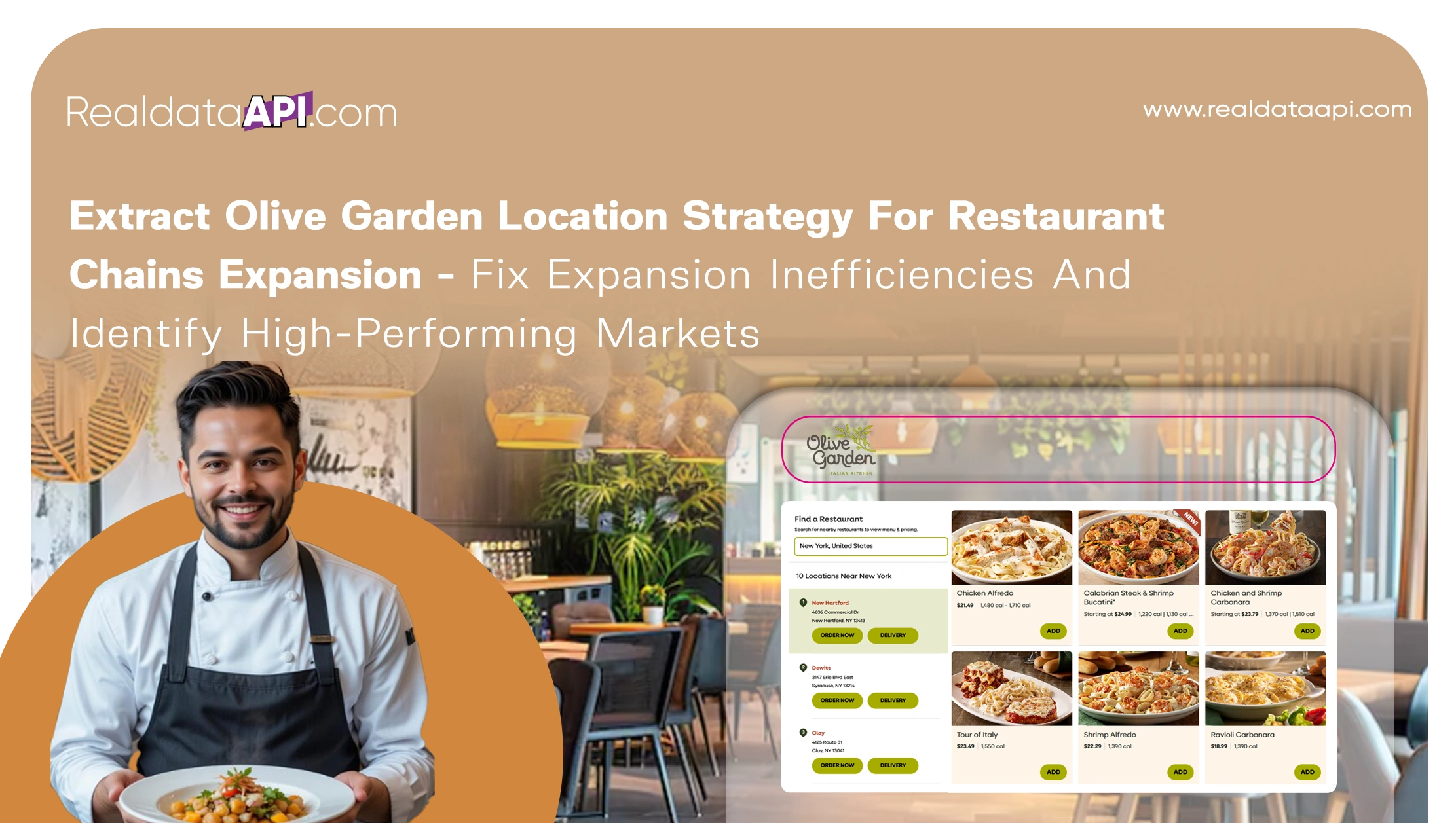
Restaurant chains today rely heavily on data-driven expansion strategies to reduce risks and identify profitable locations. Traditional site selection methods often fail to capture real-world market dynamics such as customer density, competition clusters, and regional demand variations. This is where Extract Olive Garden location strategy for restaurant chains expansion becomes a powerful use case for data intelligence in the food service industry.
By analyzing Olive Garden Location Data USA, businesses can uncover how successful restaurant chains choose their store locations, expand across regions, and maintain consistent performance. With structured datasets, companies can evaluate patterns in urban vs suburban expansion, proximity to competitors, and demographic alignment.
Modern tools like Real Data API enable automated extraction of restaurant location data, helping businesses eliminate manual research and improve accuracy. This approach transforms raw location information into actionable insights for expansion planning.
In this blog, we explore how restaurant chains can leverage location intelligence, scraping techniques, and analytics to identify high-performing markets and optimize expansion strategies effectively.
Building Restaurant Intelligence Through Location Data
Understanding physical presence is critical for restaurant growth strategies. Implementing scrape Olive Garden store location data for Restaurant Data Intelligence helps businesses analyze real-world expansion patterns and operational density.
Between 2020 and 2026, data-driven location intelligence adoption in the restaurant industry has increased by over 70%, driven by competitive expansion and rising market saturation.
| Year | Location Data Usage | Expansion Accuracy Improvement |
|---|---|---|
| 2020 | 35% | 25% |
| 2022 | 50% | 40% |
| 2024 | 68% | 55% |
| 2026 | 78% | 70% |
By extracting store-level data, businesses can identify high-performing regions, density of outlets, and gaps in coverage. This helps in understanding where brands like Olive Garden perform best and why.
Such intelligence enables restaurant chains to replicate successful models while avoiding oversaturated markets. It also improves forecasting accuracy for new store openings.
With structured datasets, companies can transform location data into strategic insights that directly influence expansion success.
Enhancing Market Research with Location Scraping
Accurate market analysis is essential for expansion planning. Using Web scraping Olive Garden store location data for market analysis, businesses can evaluate geographic performance trends and regional demand patterns.
From 2020 to 2026, the use of scraped location data for market research has grown by 65%, especially in the QSR and casual dining segments.
| Market Factor | Influence Level |
|---|---|
| Population Density | High |
| Income Levels | High |
| Competition Density | Medium-High |
| Accessibility | Medium |
Scraping location data allows businesses to analyze clustering patterns, identifying areas with high restaurant concentration or underserved regions.
For example, if Olive Garden stores are heavily concentrated in suburban zones, this may indicate strong performance in family-oriented markets.
This data helps businesses refine their expansion strategy by focusing on high-potential areas and avoiding low-performing regions.
By combining location intelligence with demographic data, companies can make more informed and profitable expansion decisions.
Optimizing Site Selection with Data-Driven Insights
Site selection is one of the most critical decisions in restaurant expansion. Applying Restaurant site selection strategy using Olive Garden location data Scraping helps businesses reduce risk and improve ROI on new locations.
Between 2020 and 2026, data-driven site selection has improved success rates by over 50% in restaurant expansion projects.
| Selection Factor | Importance |
|---|---|
| Foot Traffic | High |
| Nearby Competition | High |
| Demographics | High |
| Accessibility | Medium |
Scraped location data provides insights into where successful restaurant chains operate and why those locations perform well.
Businesses can analyze proximity to highways, shopping centers, and residential zones to identify optimal sites.
This reduces reliance on guesswork and ensures that expansion decisions are backed by real-world performance data.
Data-driven site selection significantly increases the probability of success for new restaurant openings.
Mapping Competitive Restaurant Landscapes
Understanding competition is key to strategic expansion. Using map competitor restaurant locations data via Olive Garden dataset, businesses can visualize competitive density and market saturation.
From 2020 to 2026, competitive mapping tools have increased in adoption by 72%, especially in urban restaurant markets.
| Insight Type | Business Value |
|---|---|
| Competitor Density | High |
| Market Gaps | High |
| Expansion Zones | High |
| Risk Assessment | Medium |
Mapping restaurant locations helps identify clusters where competition is intense and regions where demand is underserved.
This allows businesses to strategically position new outlets in less saturated areas.
By visualizing competitor distribution, companies can avoid market cannibalization and improve long-term profitability.
Expanding Data Intelligence Beyond Locations
Location data is only part of the bigger picture. Using Scrape Olive Garden Menu and Pricing Data Across USA, businesses can combine pricing intelligence with location strategy.
Between 2020 and 2026, menu and pricing data analysis has increased by 60%, helping restaurants refine pricing strategies regionally.
| Data Type | Usage Importance |
|---|---|
| Menu Pricing | High |
| Regional Offers | Medium-High |
| Discounts | High |
| Seasonal Items | Medium |
Combining menu data with location insights allows businesses to understand how pricing varies across regions and customer segments.
This supports better revenue optimization and localized marketing strategies.
It also helps identify high-margin markets where premium pricing strategies are more effective.
Strengthening Location Intelligence Across the USA
Comprehensive location data is essential for nationwide expansion strategies. Using Scrape Olive Garden restaurant locations data in the USA, businesses can analyze national expansion trends and performance clusters.
From 2020 to 2026, nationwide location analytics adoption has grown by 68%, driven by chain expansion and data-driven decision-making.
| Region Type | Expansion Rate |
|---|---|
| Urban Centers | High |
| Suburban Areas | Very High |
| Rural Areas | Low-Medium |
This data helps businesses understand where restaurant chains like Olive Garden perform best across different regions.
It also highlights expansion opportunities in underserved markets, enabling strategic growth planning.
With nationwide datasets, businesses can build scalable expansion models that adapt to regional differences.
Why Choose Real Data API?
Real Data API provides advanced Olive Garden Delivery API solutions designed to support Extract Olive Garden location strategy for restaurant chains expansion use cases. It enables businesses to collect, process, and analyze restaurant location data efficiently at scale.
With powerful automation and structured data pipelines, Real Data API helps eliminate manual research and improve accuracy in expansion planning. It supports real-time extraction, making it easier to identify high-performing markets and optimize site selection strategies.
Conclusion
Understanding Extract Olive Garden location strategy for restaurant chains expansion is essential for improving expansion efficiency and identifying high-performing markets. With data-driven insights, restaurant chains can reduce risks, optimize site selection, and scale more effectively.
As competition increases, leveraging location intelligence and scraping-based analytics will become a key driver of success in restaurant expansion strategies.
Ready to optimize your restaurant expansion strategy? Partner with Real Data API today and unlock powerful location intelligence for smarter growth decisions!
Latest posts
How to Scrape OpenRent property data for UK rental market trends for Better Market Insights?
How to Scrape Land.com data scraping for rural property market intelligence for Smarter Investment Decisions?
How to Scrape food delivery trends in Turkey via Yemeksepeti API to Overcome Market Intelligence Gaps?
Extract Flipkart Product Review Data For Brand Analysis - How To Track Customer Sentiment, Ratings, And Product Performance?
How To Track Prices, Products, And Consumer Demand When Scrape China's Social Commerce Market Using Pinduoduo Data?






.png)



