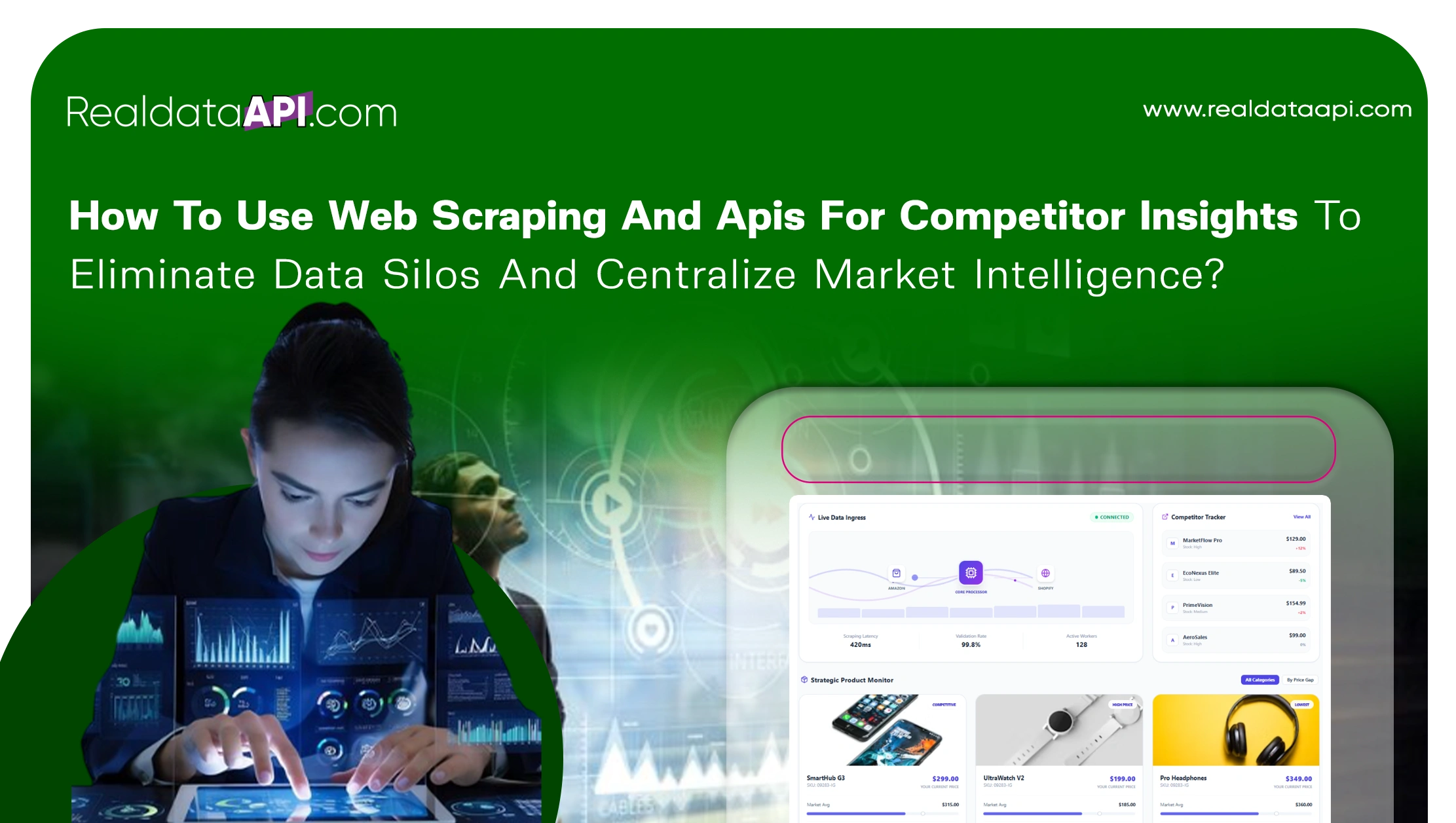
Introduction
In today's data-driven economy, businesses are overwhelmed with fragmented information spread across multiple platforms, tools, and systems. This fragmentation leads to inefficiencies, delayed decisions, and missed opportunities. To overcome this challenge, organizations are increasingly choosing to use web scraping and APIs for competitor insights as a strategic approach to unify and centralize market intelligence.
By leveraging automation and integration, companies can break down silos and build a single source of truth for competitor data. The use of a Web Scraping API allows seamless data extraction and real-time updates, ensuring that decision-makers always have access to the latest insights.
From 2020 to 2026, businesses adopting centralized data strategies have seen significant improvements in operational efficiency, pricing accuracy, and competitive positioning. This blog explores how web scraping and APIs can help eliminate data silos, streamline workflows, and empower organizations with actionable competitor intelligence.
Bringing scattered data into a unified system
A key step in eliminating data silos is implementing multi-source data aggregation for competitor analysis. Businesses often collect data from ecommerce platforms, marketplaces, social channels, and internal systems, but without integration, this data remains fragmented.
Between 2020 and 2026, organizations adopting multi-source aggregation have improved data accessibility and decision-making efficiency:
| Year | Data Sources Integrated | Decision Efficiency (%) |
|---|---|---|
| 2020 | 3–5 | 65% |
| 2022 | 5–8 | 75% |
| 2024 | 8–12 | 85% |
| 2026 | 12+ | 92% |
Aggregating data from multiple sources allows businesses to create a holistic view of competitor activities. This includes pricing trends, product assortments, and promotional strategies.
By consolidating data into a single system, organizations can eliminate inconsistencies, reduce duplication, and improve accuracy. This unified approach ensures that teams across departments are working with the same reliable data.
Leveraging technology for efficient data collection
To support aggregation efforts, businesses must adopt Web Scraping tools to aggregate competitor data. These tools automate the process of collecting large volumes of data from various online sources, ensuring scalability and efficiency.
From 2020 to 2026, the adoption of scraping tools has significantly increased:
| Year | Tool Adoption Rate (%) | Data Collection Speed |
|---|---|---|
| 2020 | 30% | Moderate |
| 2022 | 45% | Fast |
| 2024 | 60% | Faster |
| 2026 | 75% | Real-time |
These tools enable businesses to gather structured data, such as product prices, discounts, and availability, without manual intervention.
By leveraging advanced scraping technologies, organizations can reduce operational costs, improve data accuracy, and ensure continuous data flow. This forms the backbone of a centralized market intelligence system.
Transforming raw data into pricing intelligence
Once data is collected, businesses need a competitive pricing intelligence data scraper to convert raw information into actionable insights. This involves processing and analyzing data to identify trends, patterns, and opportunities.
Between 2020 and 2026, companies using pricing intelligence tools have achieved better outcomes:
| Metric | 2020 | 2026 |
|---|---|---|
| Pricing Accuracy | 68% | 93% |
| Margin Improvement | 6% | 18% |
| Decision Speed | Slow | Fast |
These improvements highlight the importance of transforming data into intelligence. Businesses can identify pricing gaps, optimize promotions, and enhance customer experiences.
A robust pricing intelligence system ensures that data is not just collected but effectively utilized to drive strategic decisions.
Scaling operations with reliable data services
To manage large-scale data requirements, businesses rely on Web Scraping Services that offer scalability and reliability. These services enable continuous data extraction across multiple platforms, ensuring comprehensive coverage.
From 2020 to 2026, organizations using scraping services have seen significant efficiency gains:
| Year | Efficiency Improvement (%) | Data Coverage (%) |
|---|---|---|
| 2020 | 22% | 35% |
| 2022 | 30% | 50% |
| 2024 | 38% | 65% |
| 2026 | 45% | 80% |
These services help businesses monitor thousands of products and competitors simultaneously. They also ensure data consistency, enabling accurate analysis and decision-making.
By adopting scalable solutions, organizations can expand their data capabilities and maintain a competitive edge.
Managing large-scale data extraction effectively
For enterprises dealing with massive datasets, Enterprise Web Crawling is essential. This approach enables businesses to collect data from complex and large-scale sources, ensuring comprehensive coverage.
Between 2020 and 2026, enterprise crawling has significantly improved data collection capabilities:
| Metric | 2020 | 2026 |
|---|---|---|
| Data Volume Handled | Moderate | Very High |
| Crawl Efficiency | 70% | 95% |
| Automation Level | Low | High |
Enterprise crawling allows businesses to monitor competitor activities across multiple regions and platforms. It also supports advanced analytics, enabling organizations to uncover deeper insights.
By implementing enterprise-level solutions, businesses can handle large-scale data requirements and ensure continuous data flow.
Strengthening strategies through benchmarking
A centralized data system enables effective Competitive Benchmarking, allowing businesses to compare their performance against competitors. This involves analyzing pricing, promotions, and product assortments to identify opportunities for improvement.
From 2020 to 2026, benchmarking adoption has significantly improved performance metrics:
| Metric | Without Benchmarking | With Benchmarking |
|---|---|---|
| Pricing Accuracy | 65% | 90% |
| Market Responsiveness | 60% | 88% |
| Revenue Growth | 7% | 20% |
Benchmarking provides a clear understanding of market positioning, helping businesses align their strategies with industry standards. It also enables proactive decision-making, ensuring competitiveness in dynamic markets.
By leveraging benchmarking insights, organizations can refine their strategies and achieve sustainable growth.
Why Choose Real Data API?
Real Data API offers advanced solutions for businesses looking to centralize their data and gain a competitive edge. By enabling organizations to use web scraping and APIs for competitor insights, the platform ensures seamless data collection, integration, and analysis.
With robust infrastructure and scalable capabilities, Real Data API helps businesses eliminate data silos and build a unified market intelligence system. From real-time data extraction to advanced analytics, the platform empowers organizations to make informed decisions and stay ahead of competitors.
Whether you are tracking pricing trends, monitoring competitors, or optimizing strategies, Real Data API provides the tools and expertise needed to unlock the full potential of your data.
Conclusion
In a world where data drives success, eliminating silos and centralizing market intelligence is essential. By choosing to use web scraping and APIs for competitor insights, businesses can transform fragmented data into a unified, actionable resource.
From data aggregation and automation to benchmarking and analytics, each component plays a crucial role in building a powerful intelligence system. Organizations that embrace these strategies are better equipped to respond to market changes, optimize pricing, and improve overall performance.
Now is the time to take control of your data strategy. Start leveraging web scraping and APIs today to centralize your market intelligence and gain a lasting competitive advantage!
Latest posts

How Louis Vuitton Fashion Dataset Enables Better Analysis of Luxury Products, Prices, Brands, and Fashion Trends?
How Blinkit Grocery Dataset Enables Smarter Analysis of Products, Prices, Availability, and Quick-Commerce Trends?

How Chanel Fashion Dataset Enables Smarter Analysis of Luxury Products, Prices, Categories, and Fashion Trends?
How Foodpanda Food Dataset Helps Businesses Track Restaurants, Menus, Prices, Ratings, and Food Delivery Trends?






.png)