
Introduction
The ecommerce industry generates enormous volumes of product information every second across marketplaces, direct-to-consumer platforms, and online retail stores. Businesses increasingly extract product attributes images and descriptions at scale to improve catalog intelligence, optimize digital merchandising, and support AI-driven retail analytics. Product-level insights such as titles, specifications, descriptions, images, pricing, ratings, and availability are essential for competitive ecommerce strategies.
As online retail ecosystems expand globally, companies require scalable automation tools capable of collecting and processing millions of product records in real time. An advanced E-Commerce Data Scraping API enables organizations to automate structured product extraction while ensuring high accuracy and consistency across multiple ecommerce websites.
Modern brands, retailers, analytics firms, and market intelligence platforms use large-scale extraction systems to power recommendation engines, dynamic pricing models, search optimization, assortment planning, and competitor monitoring. According to industry reports, global ecommerce sales are expected to exceed $8 trillion by 2026, increasing the demand for enterprise-grade product intelligence solutions.
Scalable ecommerce data extraction has become a foundational technology for organizations seeking faster decision-making, improved customer experiences, and smarter digital commerce operations.
Advanced Systems Driving Modern Catalog Intelligence
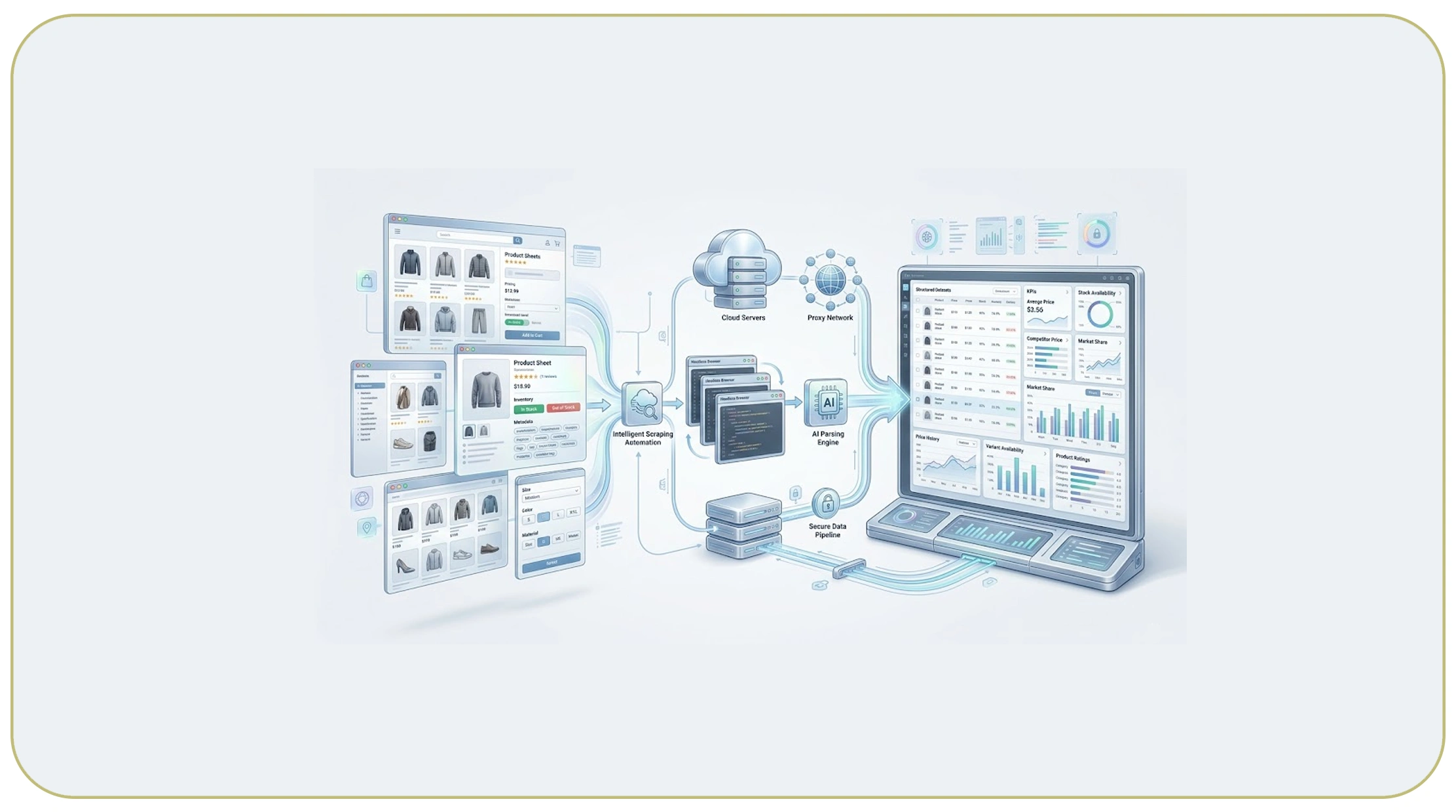
Organizations implementing scalable retail intelligence rely on best techniques for ecommerce product content scraping to capture accurate and structured product information across diverse ecommerce platforms. Ecommerce sites contain highly dynamic page structures, JavaScript-rendered content, variant-based catalogs, and anti-bot protections that require sophisticated extraction systems.
Modern extraction pipelines use headless browsers, AI-driven parsers, rotating proxies, CAPTCHA bypassing, and cloud-based crawling infrastructures to ensure uninterrupted product collection. Intelligent parsers can automatically identify product titles, specifications, metadata, images, and pricing across changing webpage layouts.
| Year | Businesses Using Automated Scraping | Avg. Product Pages Processed Daily |
|---|---|---|
| 2020 | 35% | 150K |
| 2021 | 42% | 240K |
| 2022 | 49% | 360K |
| 2023 | 57% | 520K |
| 2024 | 65% | 730K |
| 2025 | 73% | 980K |
| 2026 | 81% | 1.3 Million |
Key technologies improving scraping efficiency include:
- AI-powered content detection
- Browser automation frameworks
- Dynamic rendering systems
- Distributed cloud scraping
- Proxy rotation infrastructure
- Real-time validation engines
- Automated retry mechanisms
Transforming Raw Retail Data into Structured Intelligence

Businesses focused on ecommerce analytics increasingly prioritize extracting structured product data from ecommerce websites to build accurate and searchable product databases. Raw product information collected from online stores often contains inconsistent formatting, duplicate fields, and unstructured metadata that require normalization before analytics processing.
Structured product datasets help businesses improve catalog organization, search relevance, recommendation engines, and machine learning applications. Standardized attributes also simplify cross-platform product comparisons and marketplace synchronization.
| Year | Retailers Using Structured Product Data | AI-Based Product Analytics Adoption |
|---|---|---|
| 2020 | 31% | 19% |
| 2021 | 39% | 26% |
| 2022 | 47% | 34% |
| 2023 | 56% | 43% |
| 2024 | 64% | 54% |
| 2025 | 73% | 66% |
| 2026 | 82% | 77% |
Structured ecommerce intelligence supports:
- Product matching systems
- Recommendation engines
- Advanced search optimization
- Catalog enrichment
- AI-driven merchandising
- Assortment analysis
- Competitor benchmarking
Scaling Visual and Specification Data Collection

Retail intelligence platforms increasingly invest in large-scale scraping of product images and specifications to support visual commerce, AI training models, and product discovery systems. Product images and technical specifications significantly influence online purchasing decisions and customer engagement metrics.
Modern ecommerce extraction systems capture high-resolution images, variant-specific photos, dimension details, feature lists, and technical attributes from millions of product pages daily. AI-powered image classification further improves catalog organization and automated tagging systems.
| Year | Avg. Images Collected Daily | Businesses Using Visual Commerce Analytics |
|---|---|---|
| 2020 | 5 Million | 22% |
| 2021 | 7.8 Million | 30% |
| 2022 | 11 Million | 39% |
| 2023 | 15 Million | 48% |
| 2024 | 21 Million | 58% |
| 2025 | 28 Million | 69% |
| 2026 | 36 Million | 79% |
Visual and specification datasets support several ecommerce initiatives including:
- AI-powered visual search
- Product recognition systems
- Marketplace synchronization
- Catalog enrichment
- Customer personalization
- Recommendation algorithms
- Automated quality monitoring
Improving Digital Merchandising Through Automation
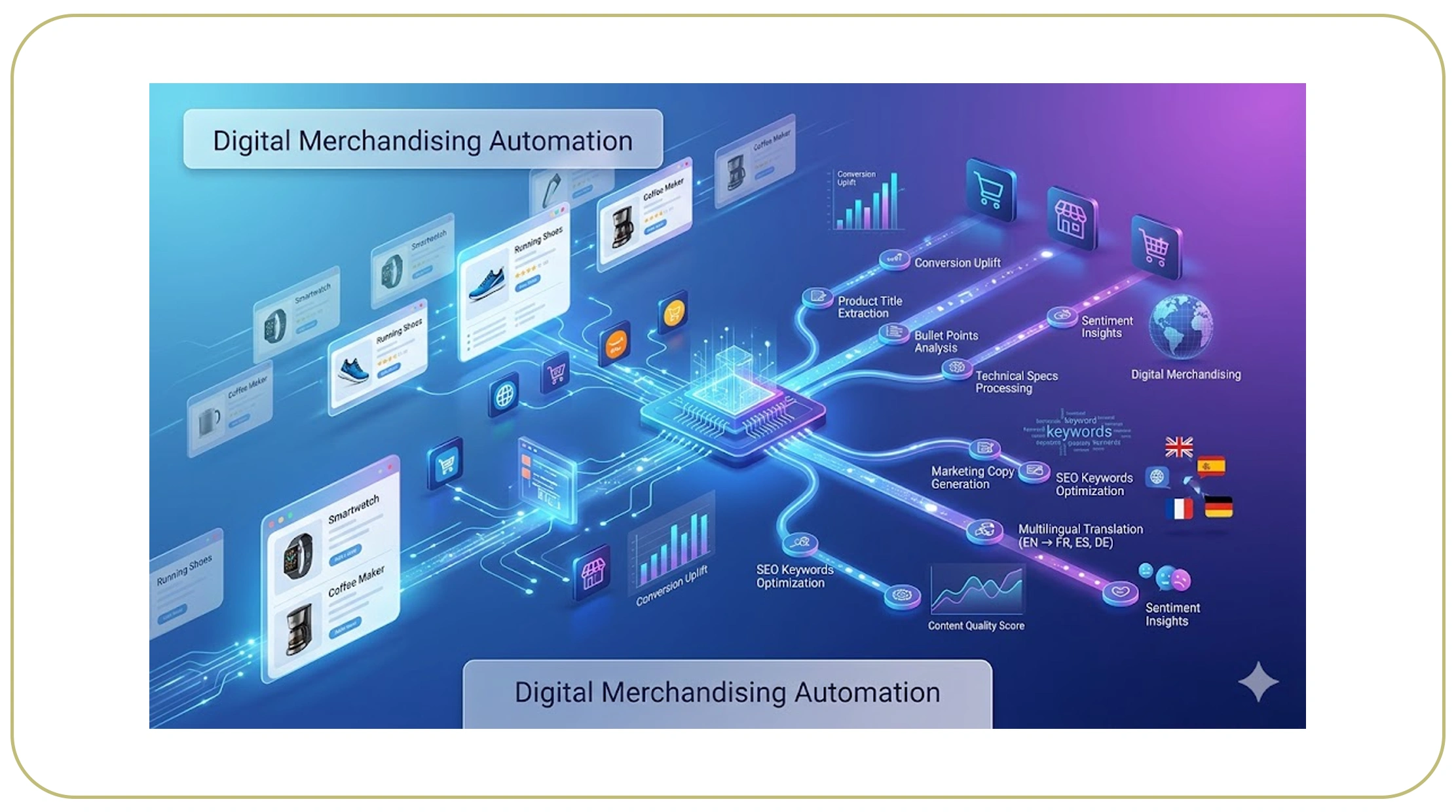
Retailers and brands increasingly automate product description extraction from online stores to improve content quality, marketplace consistency, and digital merchandising performance. Product descriptions play a critical role in SEO optimization, customer engagement, and conversion rates across ecommerce platforms.
Automated extraction systems collect long descriptions, bullet points, technical details, marketing copy, and feature highlights from large ecommerce catalogs in real time. AI-based content processing further enables sentiment analysis, keyword optimization, and multilingual translation for global commerce operations.
| Year | Automated Description Extraction Adoption | Avg. Descriptions Processed Daily |
|---|---|---|
| 2020 | 28% | 850K |
| 2021 | 36% | 1.4 Million |
| 2022 | 45% | 2.2 Million |
| 2023 | 54% | 3.5 Million |
| 2024 | 63% | 5.1 Million |
| 2025 | 72% | 7.3 Million |
| 2026 | 81% | 10 Million |
Automated content extraction enables businesses to:
- Improve SEO visibility
- Enhance catalog consistency
- Monitor competitor messaging
- Optimize product discovery
- Support multilingual expansion
- Improve conversion performance
- Accelerate marketplace onboarding
Data Assets Powering AI-Driven Retail Ecosystems
The growing importance of high-quality E-Commerce Dataset solutions reflects the rapid expansion of AI and predictive analytics across ecommerce ecosystems. Structured datasets provide the foundation for market intelligence, demand forecasting, customer behavior analysis, and pricing optimization.
Large ecommerce datasets include millions of records containing product attributes, images, specifications, reviews, ratings, pricing history, and seller information. Historical retail data further enables long-term trend analysis and predictive commerce modeling.
| Year | Daily Dataset Volume Processed | AI Commerce Platforms Using Datasets |
|---|---|---|
| 2020 | 4 TB | 20% |
| 2021 | 7 TB | 28% |
| 2022 | 11 TB | 37% |
| 2023 | 17 TB | 47% |
| 2024 | 25 TB | 58% |
| 2025 | 34 TB | 69% |
| 2026 | 46 TB | 81% |
Retail datasets help organizations improve:
- Demand forecasting
- Product recommendations
- Assortment optimization
- Dynamic pricing
- Customer segmentation
- Market trend analysis
- Competitor intelligence
API-Driven Infrastructure Transforming Retail Intelligence

Modern commerce intelligence systems increasingly rely on scalable Web Scraping API infrastructure to automate ecommerce product extraction and synchronize real-time catalog data. API-driven architectures simplify integration with BI platforms, analytics dashboards, ERP systems, and pricing engines.
Unlike traditional manual extraction systems, API-based scraping solutions enable centralized control, faster deployment, automated scaling, and continuous monitoring across multiple ecommerce domains. Businesses can process millions of requests daily while maintaining high extraction reliability and low operational overhead.
| Year | API Adoption in Ecommerce Extraction | Avg. API Requests Daily |
|---|---|---|
| 2020 | 25% | 10 Million |
| 2021 | 34% | 16 Million |
| 2022 | 43% | 24 Million |
| 2023 | 52% | 36 Million |
| 2024 | 62% | 51 Million |
| 2025 | 72% | 70 Million |
| 2026 | 83% | 94 Million |
API-first scraping ecosystems provide several advantages including:
- Real-time synchronization
- Enterprise scalability
- Automated maintenance
- Simplified integrations
- High-speed extraction
- Structured data delivery
- Global ecommerce coverage
Why Choose Real Data API?
Real Data API provides enterprise-grade retail intelligence solutions designed to support large-scale ecommerce product extraction and advanced analytics operations. Businesses leveraging professional Web Scraping Services benefit from scalable cloud infrastructure, intelligent extraction pipelines, and real-time ecommerce monitoring systems.
The platform enables enterprises to extract product attributes images and descriptions at scale while maintaining high data accuracy, structured output delivery, and seamless integration capabilities. From visual asset extraction and product specification monitoring to description collection and SKU intelligence, Real Data API supports diverse ecommerce use cases.
Key advantages include:
- High-speed distributed scraping infrastructure
- AI-powered data normalization
- Real-time catalog monitoring
- Automated image extraction
- Structured JSON and CSV delivery
- Global ecommerce coverage
- Historical retail archives
- Advanced anti-bot handling systems
Real Data API empowers retailers, analytics providers, brands, and market intelligence companies to build scalable ecommerce intelligence ecosystems with reliable and actionable product data.
Conclusion
As ecommerce ecosystems continue expanding globally, businesses increasingly depend on scalable data extraction systems to improve digital merchandising, market intelligence, and customer experiences. The ability to extract product attributes images and descriptions at scale enables organizations to build structured product intelligence pipelines that support AI-driven analytics, pricing optimization, catalog enrichment, and competitive benchmarking.
From image extraction and structured specifications to automated content collection and API-driven synchronization, modern ecommerce intelligence technologies are transforming how enterprises manage digital commerce operations.
Partner with Real Data API to unlock scalable ecommerce product extraction, real-time retail intelligence, and enterprise-grade data solutions for smarter commerce growth today!
Latest posts

How Louis Vuitton Fashion Dataset Enables Better Analysis of Luxury Products, Prices, Brands, and Fashion Trends?
How Blinkit Grocery Dataset Enables Smarter Analysis of Products, Prices, Availability, and Quick-Commerce Trends?

How Chanel Fashion Dataset Enables Smarter Analysis of Luxury Products, Prices, Categories, and Fashion Trends?
How Foodpanda Food Dataset Helps Businesses Track Restaurants, Menus, Prices, Ratings, and Food Delivery Trends?






.png)



