Introduction
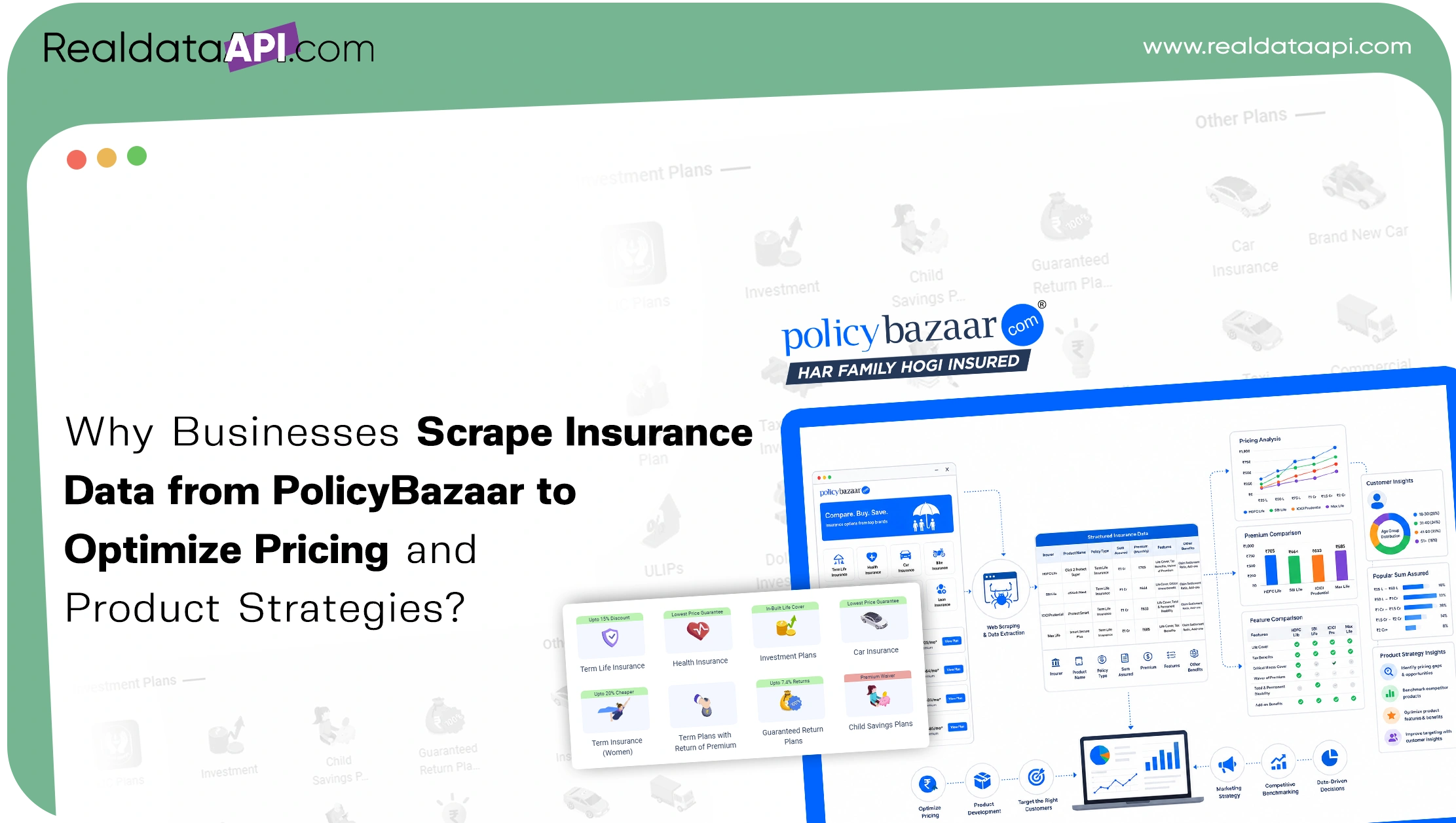
Businesses use insurance marketplace data to compare pricing, monitor competitors, analyze policy features, and respond faster to changing customer demand. By using scrape insurance data from PolicyBazaar through a reliable Web Scraping API, insurers, aggregators, fintech companies, and researchers can automate data collection, improve pricing decisions, and build stronger insurance products backed by real-time market intelligence.
Industry Insight: According to multiple industry reports, India's digital insurance market has experienced double-digit annual growth since 2020, with online policy comparisons becoming one of the primary purchase channels. Between 2020 and 2026, insurers continue investing heavily in pricing intelligence, digital transformation, and competitive analytics to strengthen customer acquisition.
Insurance buyers compare dozens of plans before making purchasing decisions. This constant comparison creates a dynamic pricing environment where insurers must continuously monitor premium changes, coverage options, discounts, claim settlement ratios, and customer benefits. Manual tracking is no longer practical.
For insurance providers, brokers, fintech startups, market researchers, and analytics companies, automated data extraction offers significant advantages. Using a robust Web Scraping API, organizations can gather structured insurance information at scale while reducing operational costs and improving decision-making.
How Can Companies Monitor Competitor Listings More Efficiently?
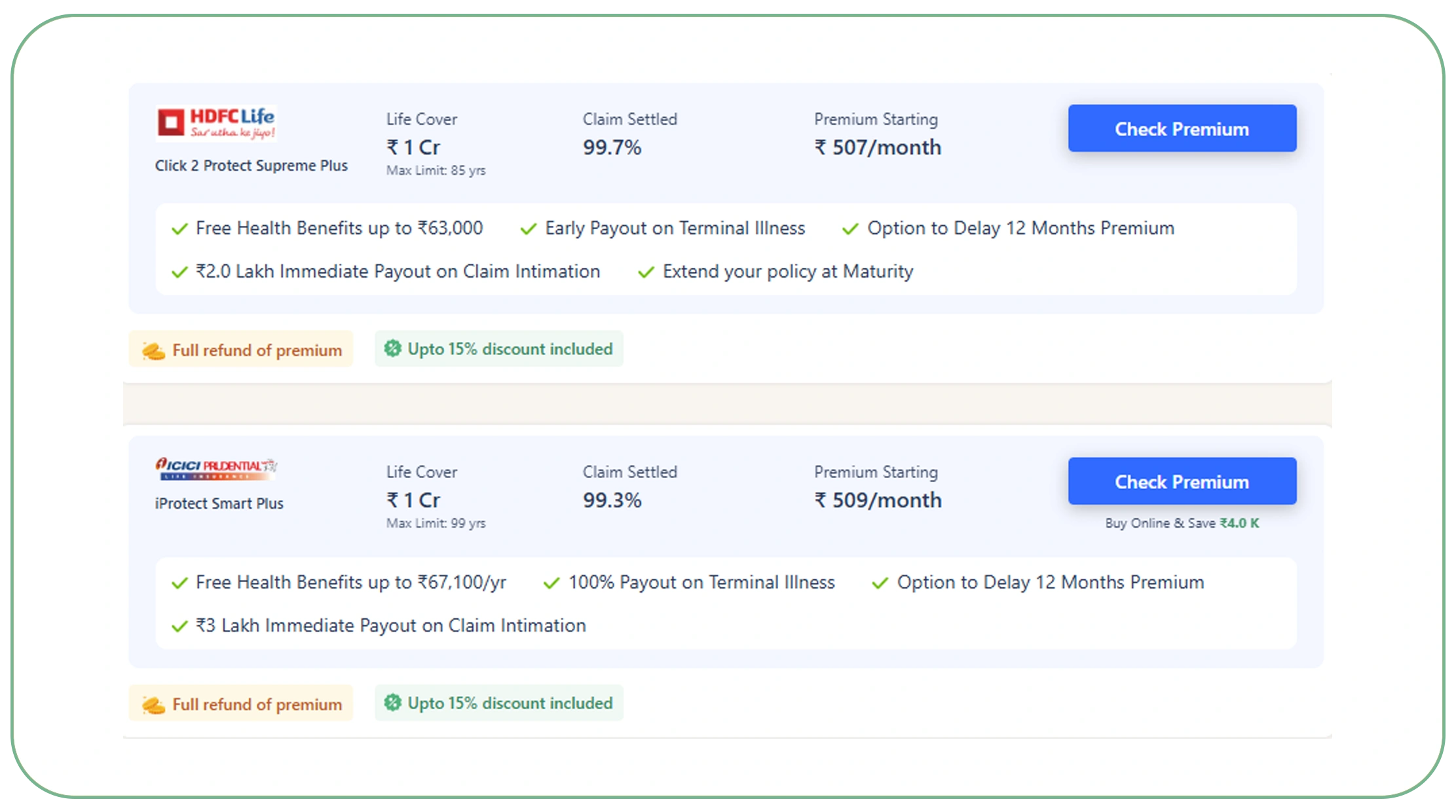
One of the biggest competitive advantages comes from continuously monitoring insurance listings across digital marketplaces. Businesses can use Web scraping PolicyBazaar insurance listings data to analyze product availability, insurer rankings, premium variations, policy benefits, exclusions, and promotional campaigns without manually reviewing hundreds of webpages.
Insurance comparison platforms update their listings frequently as insurers revise premiums, introduce seasonal offers, or launch new products. Automated scraping ensures organizations always work with current information instead of outdated spreadsheets.
Benefits include:
- Continuous monitoring of insurance products
- Faster competitor benchmarking
- Better pricing intelligence
- Improved product positioning
- Easier market expansion analysis
- Automated data standardization
Industry Statistics (2020–2026)
| Year | Online Insurance Comparison Usage | Digital Insurance Growth | Businesses Using Automated Data |
|---|---|---|---|
| 2020 | 42% | 14% | 29% |
| 2021 | 48% | 16% | 35% |
| 2022 | 55% | 18% | 43% |
| 2023 | 61% | 20% | 51% |
| 2024 | 67% | 22% | 59% |
| 2025 | 72% | 24% | 66% |
| 2026* | 78% | 26% | 73% |
Projected industry estimates.
Businesses That Benefit
- Insurance providers
- Price comparison platforms
- Market intelligence firms
- Financial consultants
- InsurTech startups
- Investment analysts
Instead of spending hours gathering information manually, organizations receive structured datasets that support pricing optimization, portfolio analysis, and strategic planning. Decision-makers gain a clearer understanding of competitor movements and customer preferences, allowing them to react faster to changing market conditions.
How Does Vehicle Insurance Intelligence Improve Business Decisions?
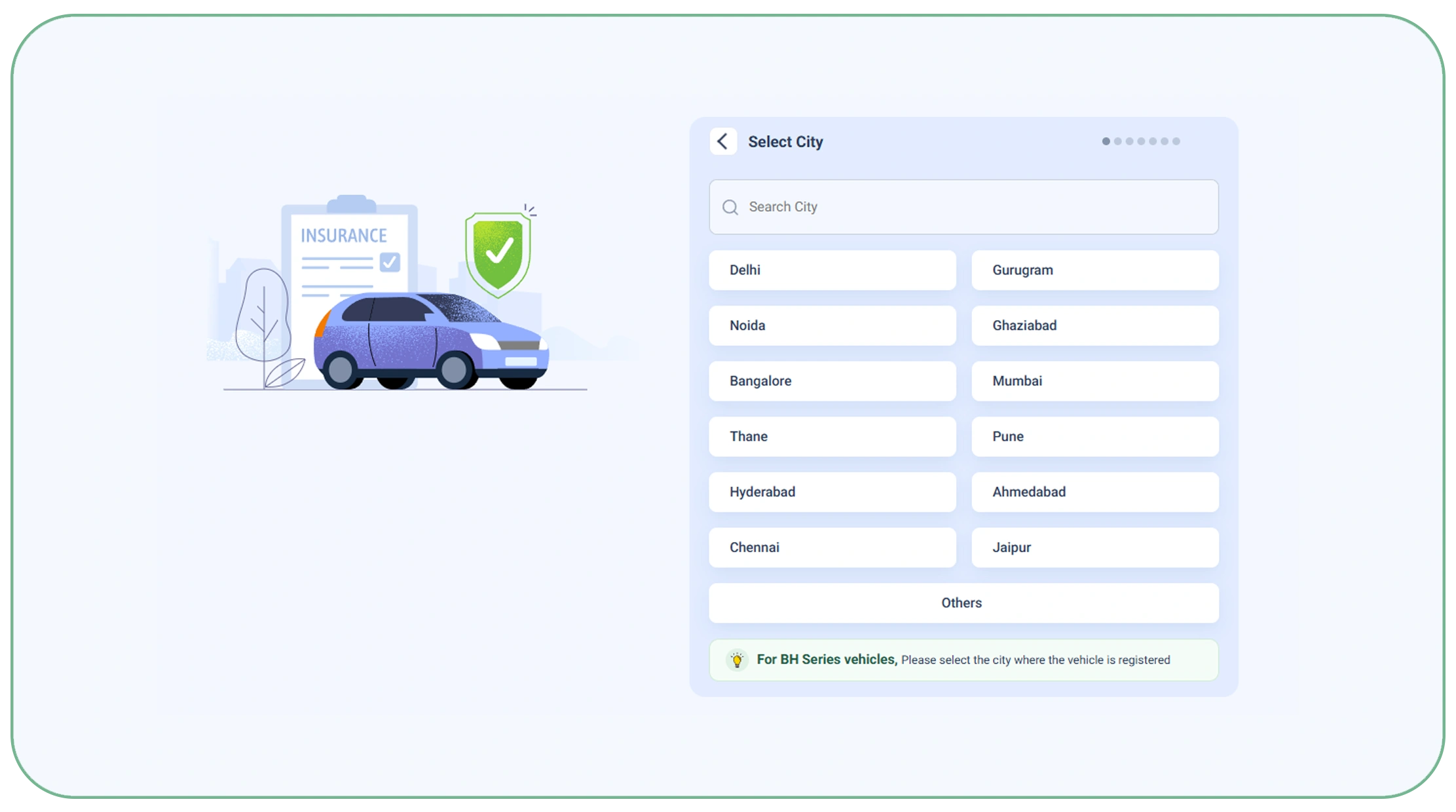
Motor insurance remains one of the largest insurance categories in India. Businesses increasingly rely on PolicyBazaar car insurance data extraction to evaluate pricing models, coverage benefits, insurer participation, vehicle categories, add-on services, and discount strategies.
Car insurance premiums vary based on multiple factors including vehicle type, manufacturing year, geographic location, insurer policies, and optional coverages. Monitoring these variables manually across thousands of listings is highly inefficient.
Automated extraction provides structured datasets that simplify pricing comparisons and competitive analysis.
Key Data Fields Captured
- Premium amounts
- Vehicle categories
- Insurance providers
- Coverage benefits
- Add-on features
- Deductibles
- Claim settlement information
- Policy duration
- No Claim Bonus details
- Discount availability
Market Trends (2020–2026)
| Metric | 2020 | 2022 | 2024 | 2026* |
|---|---|---|---|---|
| Online Car Insurance Purchases | 38% | 49% | 63% | 76% |
| Average Premium Updates Per Year | 7 | 10 | 13 | 16 |
| Insurers Expanding Digital Products | 46% | 59% | 72% | 84% |
| Customers Comparing Multiple Quotes | 57% | 69% | 81% | 89% |
Projected estimates.
Why This Matters
Businesses can use extracted data to:
- Identify pricing gaps
- Benchmark competitor premiums
- Analyze regional pricing trends
- Improve underwriting strategies
- Forecast demand
- Develop competitive insurance products
For insurers and aggregators, vehicle insurance data also supports machine learning models that predict customer purchasing behavior, optimize renewal campaigns, and personalize product recommendations.
As India's online insurance ecosystem continues expanding through 2026, automated car insurance intelligence helps organizations maintain accurate competitive visibility while improving operational efficiency and customer satisfaction.
How Can Automated Quote Intelligence Improve Pricing Accuracy?
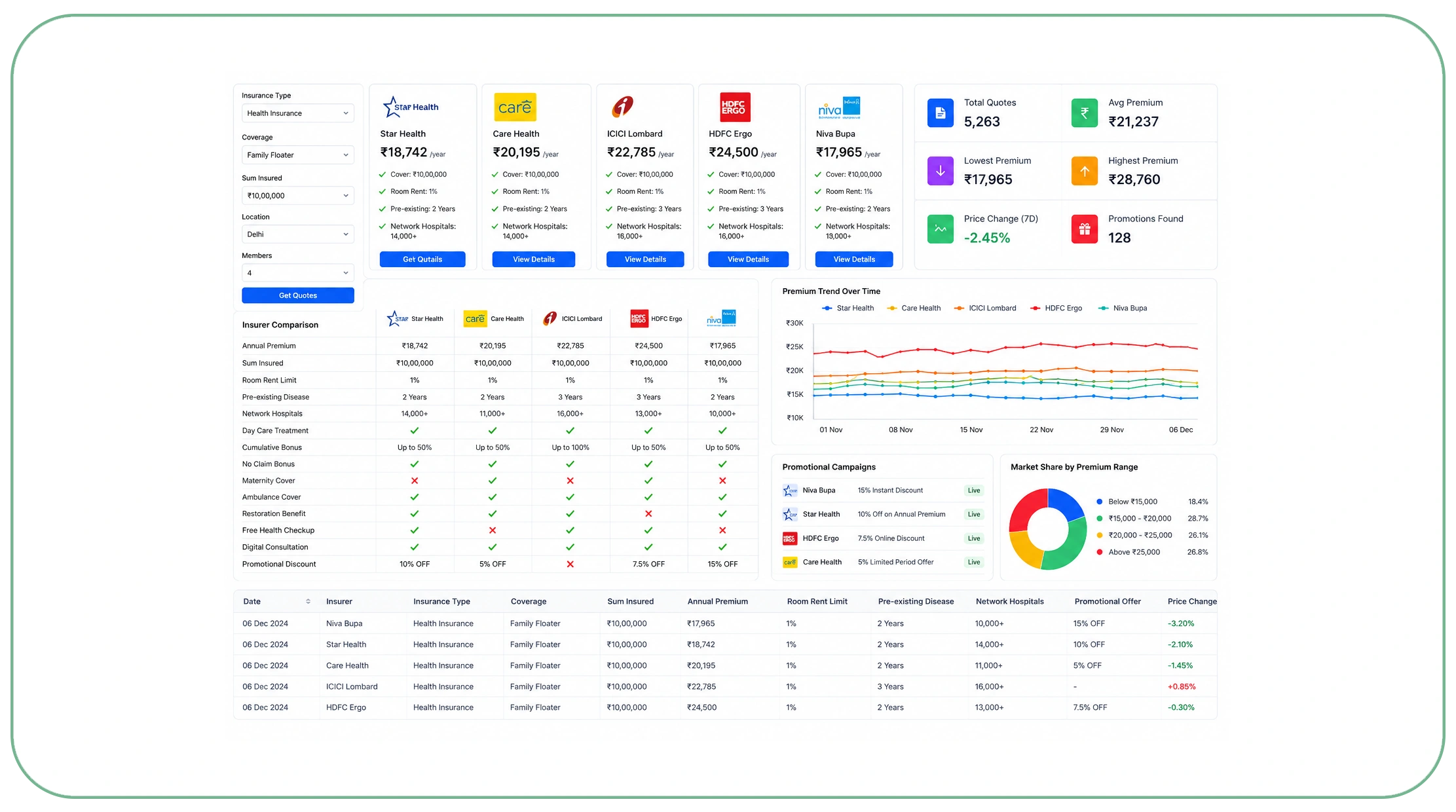
Insurance quotes change frequently due to underwriting rules, customer profiles, seasonal promotions, and competitive pricing strategies. A PolicyBazaar insurance quote data scraper enables insurers, brokers, InsurTech firms, and financial analysts to collect updated quote information automatically, helping them make informed pricing decisions and respond quickly to market shifts.
Instead of manually checking hundreds of insurance quotes every day, businesses can automate data extraction and receive structured datasets containing premiums, policy features, insurer names, coverage limits, deductibles, rider options, and promotional discounts. This information supports pricing optimization, competitive benchmarking, and customer acquisition strategies.
Organizations also use automated quote intelligence to identify pricing anomalies, understand insurer positioning, and forecast future pricing trends. The result is faster decision-making backed by reliable, real-time market data.
Major Business Benefits
- Monitor competitor quote changes
- Compare premium structures
- Analyze coverage variations
- Detect promotional campaigns
- Improve underwriting models
- Support pricing automation
- Build insurance comparison platforms
- Enhance customer recommendation engines
Insurance Quote Analytics (2020–2026)
| Year | Average Quote Updates per Month | Businesses Using Quote Analytics | Estimated Pricing Accuracy Improvement |
|---|---|---|---|
| 2020 | 24 | 28% | 11% |
| 2021 | 29 | 35% | 14% |
| 2022 | 35 | 43% | 18% |
| 2023 | 41 | 52% | 22% |
| 2024 | 47 | 60% | 26% |
| 2025 | 54 | 69% | 30% |
| 2026* | 60 | 77% | 34% |
Projected industry estimates.
Data Points Commonly Extracted
- Quote ID
- Insurance provider
- Premium amount
- Policy tenure
- Coverage limits
- Deductible values
- Optional riders
- Taxes and fees
- Discounts
- Renewal benefits
For buyer personas such as insurance companies, pricing analysts, aggregators, and fintech startups, quote intelligence reduces uncertainty while improving pricing transparency. Automated quote monitoring also enables businesses to react immediately when competitors launch attractive offers or modify premium structures, ensuring pricing strategies remain competitive in a rapidly evolving digital insurance marketplace.
Why Is Continuous Market Visibility Essential for Insurance Businesses?
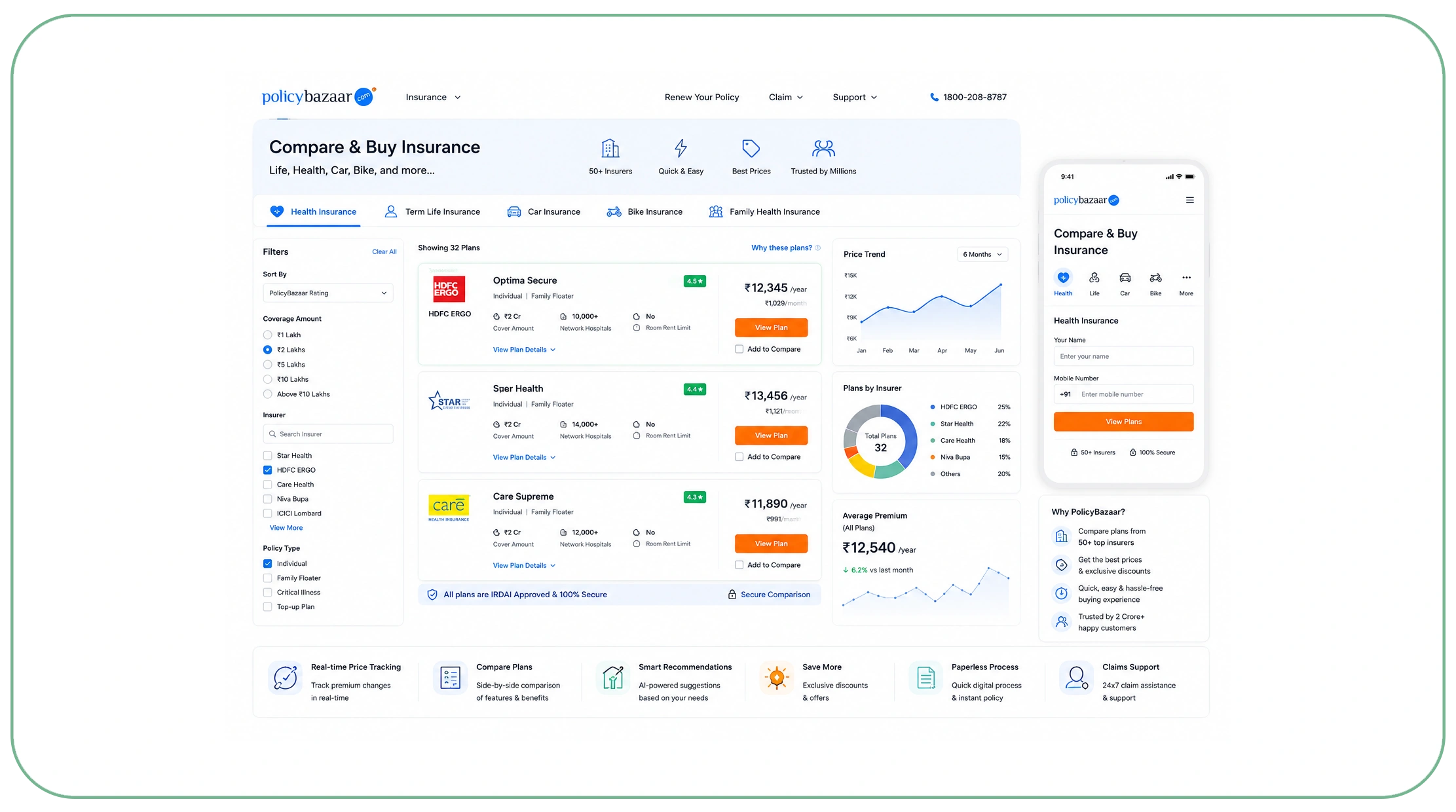
The insurance industry operates in a highly dynamic environment where product listings, premiums, discounts, and policy terms can change several times within a single day. Real-time PolicyBazaar insurance data collection allows businesses to continuously monitor these changes and maintain an accurate view of the competitive landscape.
Real-time intelligence supports quicker responses to market movements. Rather than relying on weekly or monthly reports, decision-makers receive updated information whenever pricing, product availability, or promotional campaigns change.
This approach benefits insurers launching new products, brokers optimizing customer recommendations, and market researchers tracking industry trends. Access to fresh data helps organizations improve forecasting, pricing models, and customer engagement strategies.
Advantages of Continuous Data Collection
- Instant visibility into competitor changes
- Faster product benchmarking
- Improved pricing decisions
- Better customer targeting
- Reduced manual monitoring
- Accurate trend forecasting
- Automated reporting dashboards
Real-Time Monitoring Growth (2020–2026)
| Year | Companies Using Real-Time Monitoring | Average Response Time to Market Changes | Data Refresh Frequency |
|---|---|---|---|
| 2020 | 23% | 7 Days | Weekly |
| 2021 | 31% | 5 Days | Every 3 Days |
| 2022 | 40% | 3 Days | Daily |
| 2023 | 52% | 24 Hours | Multiple Times Daily |
| 2024 | 64% | 12 Hours | Hourly |
| 2025 | 73% | 6 Hours | Near Real-Time |
| 2026* | 82% | Less Than 2 Hours | Continuous |
Projected estimates.
Practical Business Applications
- Dynamic premium analysis
- Competitor campaign monitoring
- Insurance portfolio optimization
- Market share analysis
- Product launch tracking
- Customer trend analysis
- Regional pricing comparisons
- Executive business intelligence dashboards
For insurance providers and digital comparison platforms, continuous monitoring transforms raw marketplace data into actionable insights. Businesses can quickly identify new competitors, detect premium fluctuations, monitor feature updates, and respond before competitors gain market advantage.
As digital insurance adoption continues growing through 2026, organizations equipped with real-time intelligence will be better positioned to improve customer satisfaction, strengthen pricing strategies, and increase profitability.
How Can Premium Intelligence Drive Better Insurance Strategies?
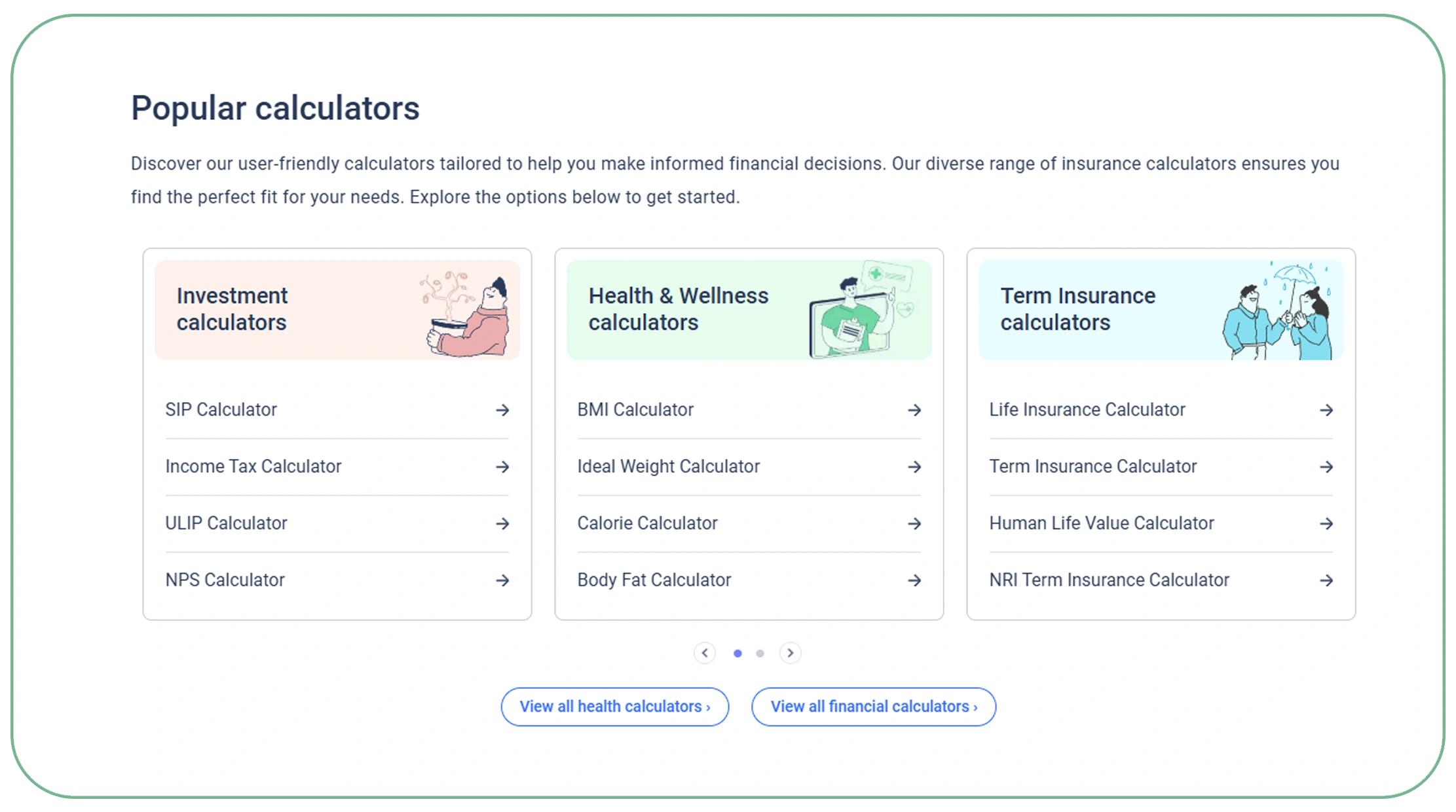
Insurance premiums are influenced by numerous factors, including customer demographics, risk profiles, policy coverage, vehicle type, health conditions, and competitive market dynamics. Through PolicyBazaar insurance premium data scraping, insurers, financial institutions, market researchers, and InsurTech companies gain valuable insights into premium fluctuations and pricing strategies across multiple insurance categories.
Premium intelligence enables organizations to compare pricing across insurers, identify market trends, evaluate promotional discounts, and optimize their own insurance offerings. Automated extraction eliminates manual monitoring and ensures access to fresh, structured data that supports informed business decisions.
Businesses also use premium data to evaluate regional pricing variations, benchmark competitors, and forecast future market conditions. These insights contribute to more effective underwriting models and customer-centric pricing strategies.
Benefits of Premium Data Analytics
- Track premium fluctuations
- Compare insurer pricing strategies
- Analyze discount trends
- Improve underwriting decisions
- Support actuarial modeling
- Enhance customer segmentation
- Forecast pricing movements
- Build competitive dashboards
Premium Monitoring Trends (2020–2026)
| Year | Average Premium Updates Monitored Monthly | Organizations Using Premium Analytics | Estimated Improvement in Pricing Decisions |
|---|---|---|---|
| 2020 | 180 | 30% | 12% |
| 2021 | 240 | 37% | 15% |
| 2022 | 320 | 45% | 19% |
| 2023 | 410 | 54% | 24% |
| 2024 | 520 | 63% | 29% |
| 2025 | 650 | 72% | 34% |
| 2026* | 800 | 81% | 39% |
Projected industry estimates.
Business Value
Organizations leveraging premium analytics can:
- Launch competitive products faster
- Improve renewal pricing
- Detect pricing gaps
- Optimize customer acquisition
- Support predictive analytics
- Increase profitability through informed pricing
For insurance providers and aggregators, premium intelligence serves as the foundation for data-driven pricing strategies that improve competitiveness while maintaining profitability in an increasingly digital insurance ecosystem.
What Should Businesses Look for in a Data Extraction Partner?
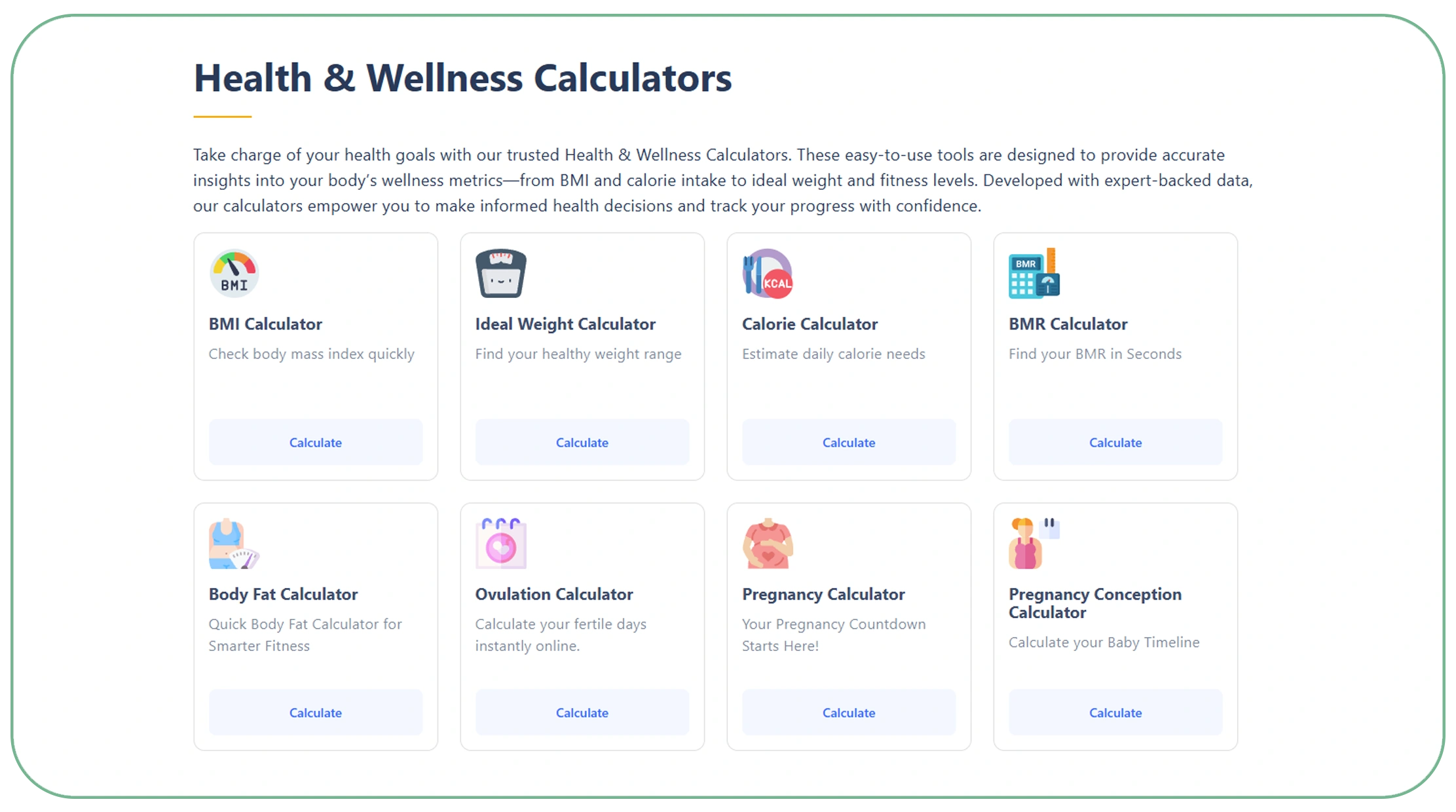
Choosing the right technology partner is just as important as selecting the right data source. Professional Web Scraping Services help organizations scrape insurance data from PolicyBazaar efficiently while delivering clean, structured, scalable, and reliable datasets for business intelligence.
A trusted data provider ensures high-quality extraction pipelines, automated updates, customizable delivery formats, and enterprise-grade infrastructure capable of handling large-scale insurance datasets.
Rather than investing significant internal resources in crawler development and maintenance, businesses can focus on analytics and strategic decision-making while outsourcing data collection to experienced specialists.
Essential Features to Consider
- High data accuracy
- Scalable infrastructure
- Scheduled data delivery
- API integration
- Cloud-ready datasets
- Multiple export formats
- Automatic updates
- Quality assurance
- Enterprise security
- Technical support
Adoption of Professional Data Services (2020–2026)
| Year | Enterprises Outsourcing Data Collection | API-Based Integrations | Automated Insurance Dashboards |
|---|---|---|---|
| 2020 | 34% | 29% | 21% |
| 2021 | 41% | 36% | 28% |
| 2022 | 49% | 44% | 36% |
| 2023 | 58% | 53% | 45% |
| 2024 | 67% | 62% | 55% |
| 2025 | 75% | 71% | 66% |
| 2026* | 83% | 80% | 76% |
Projected estimates.
Professional scraping solutions enable insurers, aggregators, consulting firms, and researchers to transform raw marketplace information into actionable business intelligence. With automated workflows and scalable infrastructure, organizations reduce operational costs while improving data quality and decision speed.
Why Choose Real Data API?
Real Data API provides enterprise-grade insurance data extraction solutions designed for organizations seeking accurate, scalable, and real-time market intelligence. Whether your objective is Market Research or to scrape insurance data from PolicyBazaar, our platform delivers structured datasets that power analytics, pricing optimization, and competitive benchmarking.
Why Businesses Trust Real Data API
- Enterprise-scale web scraping infrastructure
- High-frequency automated data collection
- Real-time API integrations
- Customizable data delivery formats (JSON, CSV, XML, API)
- High data accuracy and validation
- Scalable solutions for startups and enterprises
- Secure and compliant data workflows
- Dedicated technical support
- Flexible scheduling options
- Industry-specific scraping expertise
Our solutions empower insurers, brokers, fintech companies, market researchers, and business intelligence teams with reliable datasets that support smarter decision-making and sustainable growth.
Conclusion
The insurance industry is becoming increasingly digital, competitive, and data-driven. Organizations that leverage automated data extraction gain faster access to pricing intelligence, product comparisons, customer trends, and competitive insights. Whether your goal is pricing optimization, product development, or strategic Market Research, the ability to scrape insurance data from PolicyBazaar provides a significant competitive advantage.
Using reliable tools such as an Instant Data Scraper alongside enterprise-grade solutions from Real Data API helps businesses automate data collection, improve operational efficiency, and transform marketplace information into actionable intelligence.
Ready to unlock powerful insurance market insights? Contact Real Data API today to automate your insurance data strategy and confidently scrape insurance data from PolicyBazaar with scalable, accurate, and real-time data solutions!
Latest posts
How to Scrape Dynamic pricing strategies powered by travel data for Smarter Travel Pricing and Revenue Optimization
How to Use Flight fare monitoring data scraper for pricing optimization to Maximize Airline Revenue and Competitive Advantage
How Best GeM procurement strategies for government contracts Help Businesses Improve Bid Success Rates?
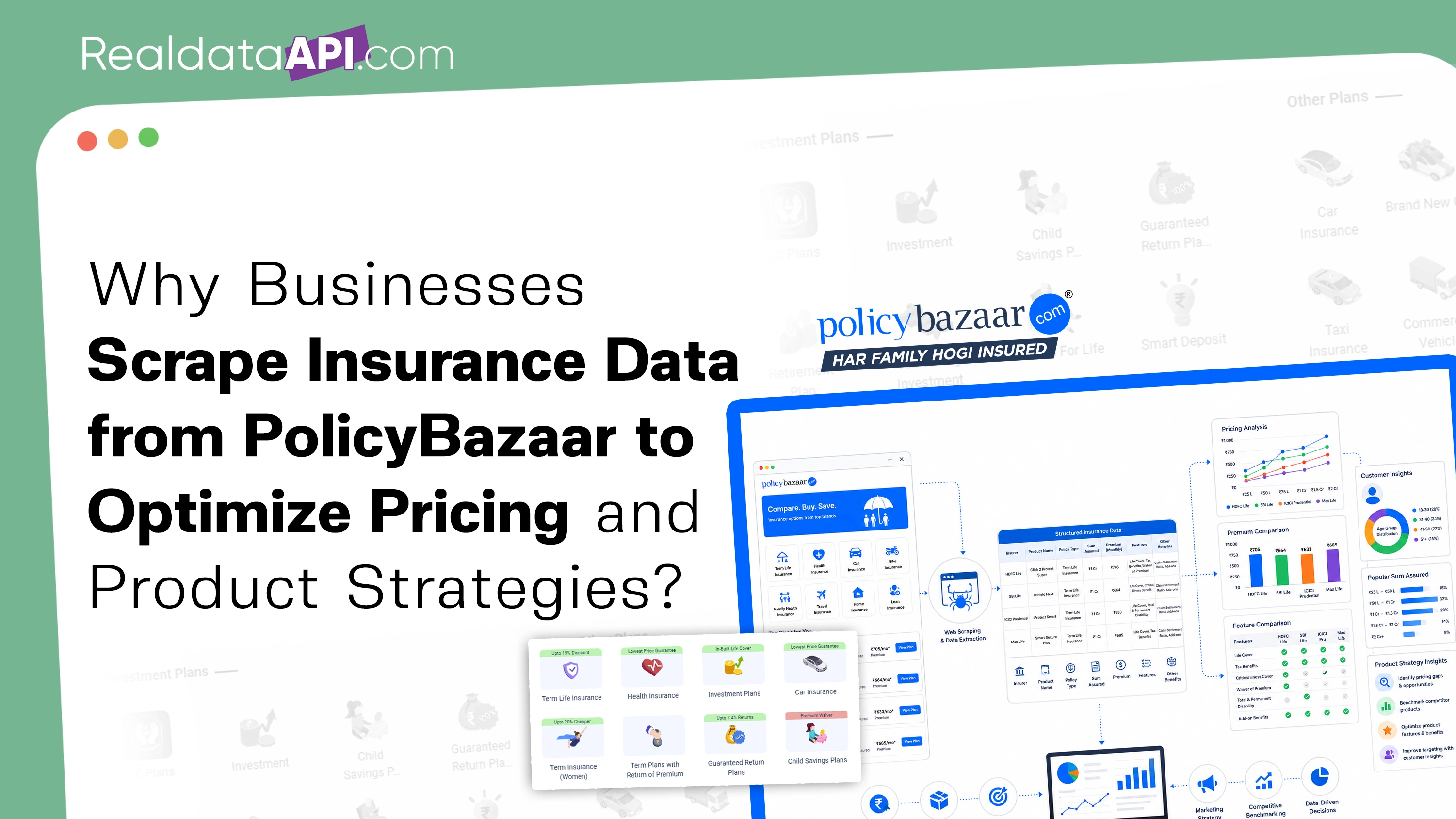
Why Businesses Scrape Insurance Data from PolicyBazaar to Optimize Pricing and Product Strategies?

Real Data API stands out as one of the premier global companies specializing in web data Scraping and web extraction.





.png)


Rating 4.7
Rating 4.7
Rating 4.5
Rating 4.7
Rating 4.7


Disclaimer : RealData API functions solely as an independent data infrastructure and technology solutions provider. We build customized automation workflows designed to collect publicly accessible web data based exclusively on client instructions. RealData API neither owns proprietary datasets nor engages in the sale or redistribution of extracted information. Our operations are limited strictly to lawful public web data processing and never involve unauthorized access to restricted systems or private networks. Any company names, trademarks, logos, or brand references displayed on this website are used purely for demonstrative and illustrative purposes to showcase our technical capabilities and do not imply endorsement, partnership, or affiliation. Use of our platform and services remains subject to our Terms of Service.