Introduction
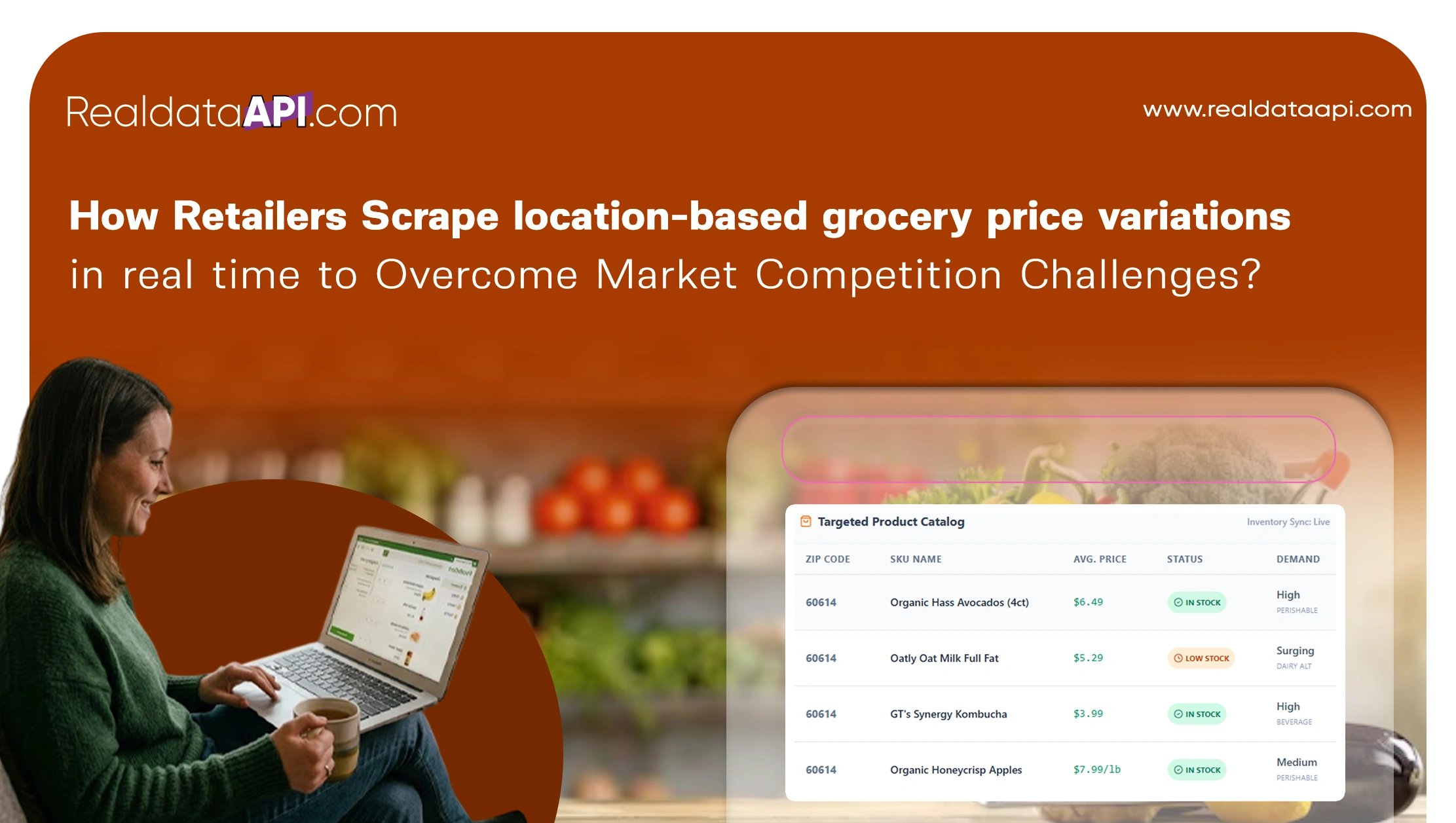
In today's highly competitive retail environment, pricing is no longer static—it varies by location, demand, supply chain conditions, and local competition. Retailers that can Scrape location-based grocery price variations in real time gain a critical advantage by understanding how prices fluctuate across cities, neighborhoods, and even individual store locations. This level of intelligence allows businesses to fine-tune pricing strategies, optimize margins, and respond instantly to competitor changes.
With the rise of digital transformation, tools like the Grocery Data Scraping API have made it easier than ever to collect, process, and analyze large-scale grocery pricing data. These solutions automate the extraction of product prices, promotions, and availability across multiple regions, ensuring businesses always have access to the latest market insights.
Between 2020 and 2026, the grocery sector has seen significant shifts in pricing dynamics due to inflation, supply chain disruptions, and evolving consumer behavior. As a result, real-time, location-specific data has become essential for retailers looking to stay competitive and make data-driven decisions.
Building Multi-Location Price Intelligence
Retailers need a strong foundation to track pricing across different store locations. By implementing systems to Extract grocery prices for different store locations, businesses can collect granular data that reflects regional pricing differences and local demand patterns.
From 2020 to 2026, studies show that retailers leveraging multi-location data improved pricing accuracy by over 30%. This is because localized pricing insights reveal hidden opportunities that national averages often miss.
| Year | Multi-Location Data Usage (%) | Pricing Accuracy Improvement |
|---|---|---|
| 2020 | 42% | Moderate |
| 2022 | 55% | High |
| 2024 | 68% | Very High |
| 2026 | 78% | Exceptional |
By collecting store-level data, businesses can identify regional price disparities, optimize promotions, and align pricing strategies with local market conditions. This approach ensures that pricing decisions are not only competitive but also tailored to specific customer segments, improving both sales and customer satisfaction.
Automating Price Monitoring Across Stores
Automation plays a crucial role in managing large-scale grocery data. An automated grocery store-level price monitoring system enables retailers to track price changes across thousands of products and locations in real time.
Between 2020 and 2026, automation adoption in retail analytics increased by nearly 40%, significantly reducing manual workload and improving response times. Retailers using automated systems reported a 25% increase in operational efficiency and a 20% boost in pricing responsiveness.
| Feature | Benefit |
|---|---|
| Real-time monitoring | Instant price updates |
| Automated alerts | Faster decision-making |
| Data aggregation | Centralized insights |
| Scalability | Handles large datasets |
Automation ensures that businesses can react quickly to competitor pricing changes and market fluctuations. It also minimizes errors and ensures consistent data collection, making it easier to maintain accurate and reliable pricing intelligence across all store locations.
Understanding Regional Pricing Trends
Regional pricing trends provide valuable insights into consumer behavior and market dynamics. Through Web Scraping grocery prices by store and region, businesses can analyze how prices vary across different geographic areas and identify patterns that influence purchasing decisions.
Data from 2020 to 2026 indicates that regional price variations in groceries have increased by 15–20%, driven by factors such as logistics costs, local competition, and demand fluctuations.
| Region Type | Avg Price Variation (%) | Key Drivers |
|---|---|---|
| Urban | 12% | High demand, competition |
| Suburban | 15% | Balanced supply-demand |
| Rural | 18% | Logistics and availability |
By understanding these trends, retailers can adjust pricing strategies to match local conditions. This not only improves competitiveness but also enhances customer satisfaction by offering prices that align with regional expectations.
Leveraging Location-Based Data for Strategy
Location-specific data is essential for developing targeted pricing strategies. Using Location based grocery pricing data extraction, businesses can gather detailed insights into how pricing varies at a granular level, enabling more precise decision-making.
Between 2020 and 2026, retailers that adopted location-based analytics saw a 22% increase in profit margins and a 17% improvement in customer retention. This is because localized pricing strategies better reflect consumer preferences and purchasing power.
| Metric | Impact |
|---|---|
| Profit Margins | +22% |
| Customer Retention | +17% |
| Pricing Efficiency | +25% |
By leveraging location-based data, businesses can design targeted promotions, optimize inventory distribution, and improve overall operational efficiency. This approach ensures that pricing strategies are not only competitive but also aligned with local market conditions.
Utilizing Structured Data for Better Insights
Structured datasets are critical for effective analysis and decision-making. A comprehensive Grocery Dataset provides businesses with detailed information on product pricing, promotions, and availability across multiple locations.
From 2020 to 2026, the use of structured datasets in retail analytics has grown by over 35%, enabling businesses to improve forecasting accuracy and reduce operational costs.
| Year | Dataset Usage (%) | Forecast Accuracy Improvement |
|---|---|---|
| 2020 | 50% | Moderate |
| 2022 | 62% | High |
| 2024 | 72% | Very High |
| 2026 | 80% | Exceptional |
With structured data, businesses can perform advanced analytics, identify trends, and make data-driven decisions. This leads to better pricing strategies, improved inventory management, and increased profitability.
Expanding Business Applications with Data Solutions
Modern data solutions offer a wide range of applications for grocery retailers. By leveraging Top Grocery Scraping API Use Cases, businesses can unlock new opportunities for growth and innovation.
Between 2020 and 2026, the adoption of API-driven solutions has increased significantly, with over 70% of retailers using APIs for data extraction and analytics.
| Use Case | Benefit |
|---|---|
| Price monitoring | Real-time insights |
| Competitor analysis | Strategic advantage |
| Demand forecasting | Improved inventory planning |
| Promotion tracking | Better marketing strategies |
These use cases demonstrate the versatility of scraping APIs in addressing various business challenges. By integrating these solutions into their workflows, retailers can enhance efficiency, improve decision-making, and stay ahead of the competition.
Why Choose Real Data API?
Real Data API provides a powerful and scalable solution for grocery data extraction and analytics. It enables businesses to Scrape grocery Product Pricing, Origin and Nutrition Data, offering a comprehensive view of the market. Additionally, it allows retailers to Scrape location-based grocery price variations in real time, ensuring access to accurate and up-to-date pricing insights.
The platform is designed to handle large-scale data extraction, providing structured outputs that integrate seamlessly with analytics tools. With features like real-time updates, customizable endpoints, and high reliability, Real Data API simplifies complex data workflows.
Businesses can automate data collection, reduce operational costs, and focus on deriving actionable insights. This makes it an ideal choice for retailers looking to enhance their pricing strategies and improve overall performance.
Conclusion
In an increasingly competitive retail environment, data-driven strategies are essential for success. By leveraging advanced tools and APIs, businesses can Scrape location-based grocery price variations in real time to gain valuable insights into pricing trends, regional dynamics, and competitor strategies.
From building scalable data pipelines to automating price monitoring and leveraging structured datasets, the benefits of real-time data extraction are undeniable. Retailers that embrace these technologies can optimize pricing, improve customer satisfaction, and drive sustainable growth.
Start using Real Data API today to Scrape location-based grocery price variations in real time and unlock powerful insights that transform your retail strategy!
Latest posts

How Louis Vuitton Fashion Dataset Enables Better Analysis of Luxury Products, Prices, Brands, and Fashion Trends?
How Blinkit Grocery Dataset Enables Smarter Analysis of Products, Prices, Availability, and Quick-Commerce Trends?

How Chanel Fashion Dataset Enables Smarter Analysis of Luxury Products, Prices, Categories, and Fashion Trends?
How Foodpanda Food Dataset Helps Businesses Track Restaurants, Menus, Prices, Ratings, and Food Delivery Trends?






.png)



