
Introduction
Quick commerce has transformed how consumers purchase groceries, household essentials, personal care products, electronics, and daily necessities. Instead of waiting days for delivery, shoppers now expect products to reach their doorstep within minutes. This shift has made inventory visibility one of the most valuable competitive assets for retailers, brands, suppliers, and market intelligence firms. Every product displayed as available, unavailable, or low in stock directly influences customer purchasing decisions.
Businesses that rely on accurate inventory intelligence need automated solutions capable of tracking thousands of products across multiple cities and fulfillment centers throughout the day. Manual monitoring is simply too slow and inefficient in today's dynamic quick commerce ecosystem.
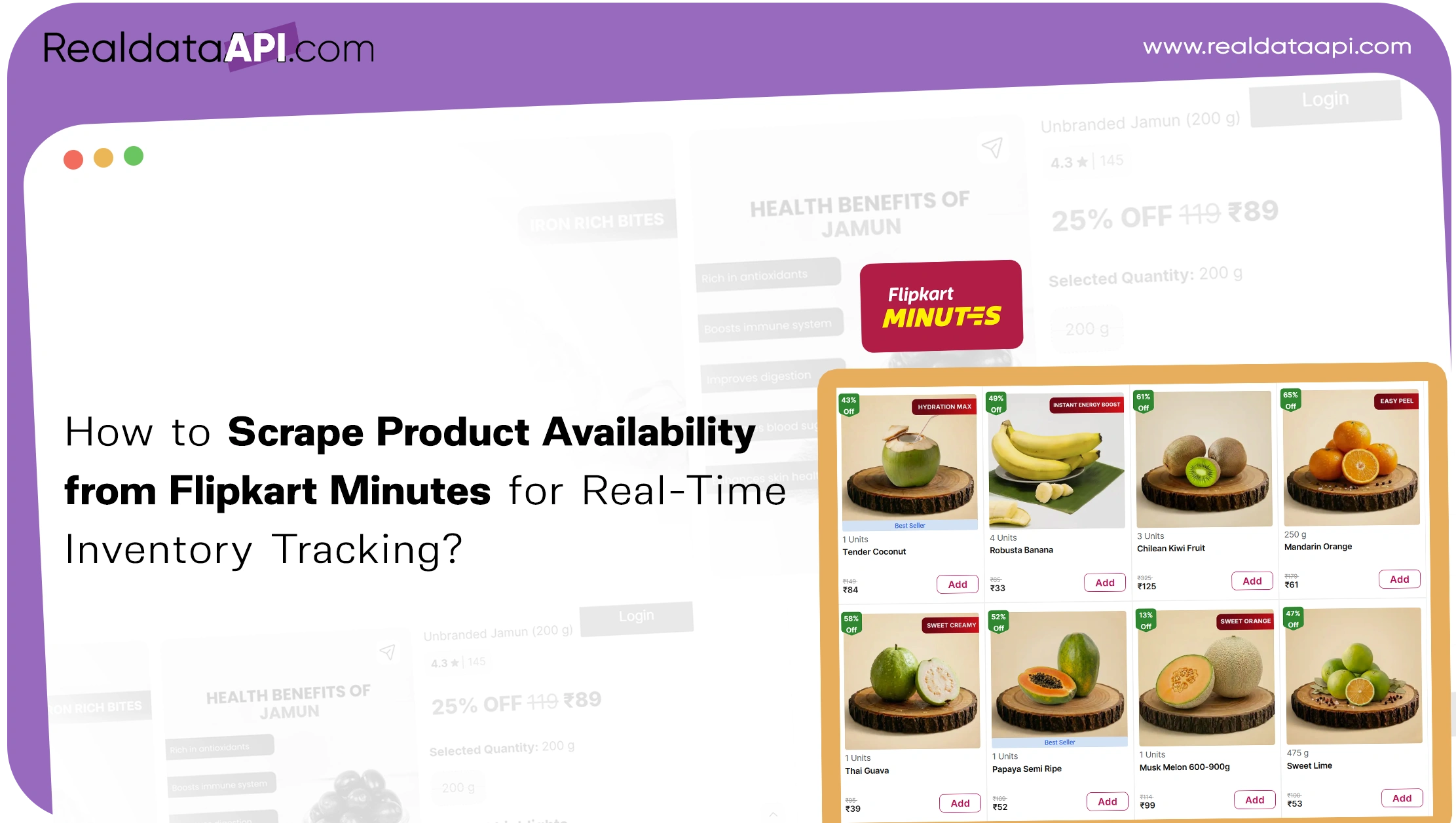
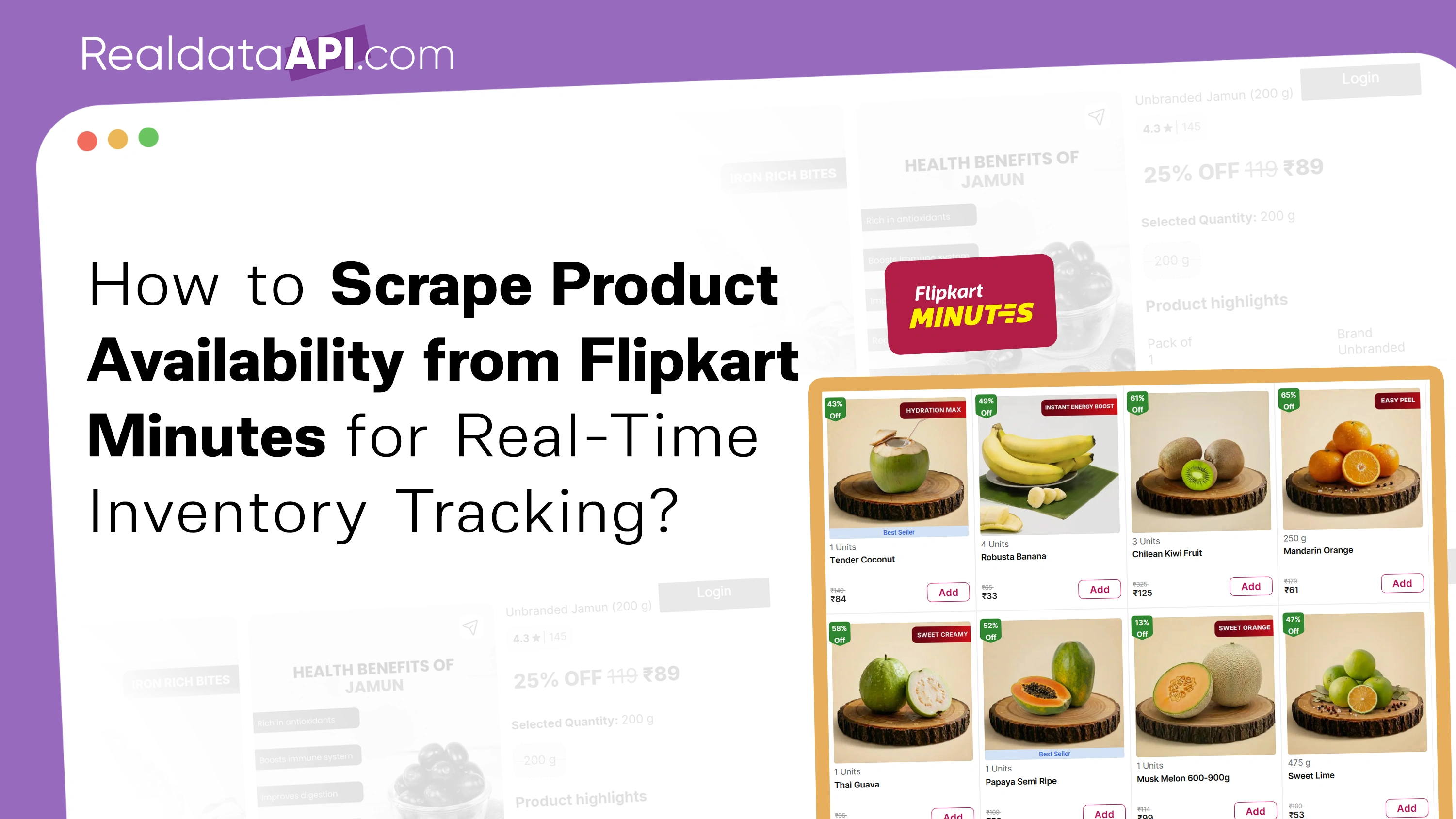
The strategy to scrape product availability from Flipkart Minutes Scraper enables organizations to capture live inventory information, monitor product availability changes, detect stockouts, and analyze fulfillment performance across different regions.
Flipkart Minutes inventory data scraping by location helps businesses understand how inventory differs between neighborhoods, cities, and dark stores, providing highly localized market intelligence.
Flipkart Minutes dark store data scraper makes it possible to monitor inventory at fulfillment center level, helping retailers identify replenishment efficiency, regional demand patterns, and operational performance.
Why Product Availability Matters in Quick Commerce?
Unlike traditional eCommerce, quick commerce operates through localized fulfillment centers known as dark stores. Each store serves a limited delivery radius, meaning product availability varies significantly based on customer location.
A product available in one neighborhood may be unavailable only a few kilometers away because each dark store maintains its own inventory.
Real-time inventory intelligence helps businesses answer important questions such as:
- Which products are consistently available?
- Which SKUs frequently go out of stock?
- Which cities have the highest inventory turnover?
- How often are products replenished?
- Which categories experience recurring shortages?
- Which competitors maintain superior inventory consistency?
Instead of relying on occasional manual checks, automated scraping continuously captures inventory updates throughout the day via Flipkart Supermart Grocery Scraping API.
Understanding Flipkart Minutes Inventory
Flipkart Minutes continuously updates product availability based on local inventory inside nearby fulfillment centers.
Each product page generally contains valuable information including:
- Product Name
- Brand
- Category
- Selling Price
- Discount
- Delivery ETA
- Stock Status
- Available Quantity
- Variant Availability
- Location Availability
- Promotional Offers
- Delivery Charges
Capturing these fields at regular intervals creates a powerful inventory intelligence database.
Business Benefits of Monitoring Product Availability
Real-time inventory data delivers actionable insights across multiple business functions.
- Retailers can benchmark their stock availability against competitors.
- Consumer brands can evaluate distribution efficiency across cities.
- Manufacturers can detect recurring shortages that affect sales.
- Market researchers can measure demand fluctuations during festivals, weekends, and promotional campaigns.
- Pricing analysts can correlate stock availability with price changes.
- Supply chain managers can identify fulfillment bottlenecks before they become larger operational problems.
Product Availability Data That Can Be Collected
The following table illustrates typical information captured while monitoring Flipkart Minutes inventory.
| Data Field | Description |
|---|---|
| Product Name | Complete product title |
| Brand | Manufacturer or seller brand |
| Category | Grocery, Personal Care, Dairy, etc. |
| Product Variant | Weight, Size, Pack |
| Selling Price | Current listed price |
| Discount | Percentage or flat discount |
| Stock Status | Available / Out of Stock |
| Estimated Delivery | Delivery time shown |
| Seller Information | Listed seller |
| Product Rating | Customer ratings |
| Reviews Count | Total customer reviews |
| Location Availability | Area-specific inventory |
Sample Product Availability Across Flipkart Minutes
The table below shows an example of inventory monitoring across popular categories.
| Product Category | Sample Product | Availability | Delivery Time | Inventory Status |
|---|---|---|---|---|
| Fresh Fruits | Apple Premium Pack | Available | 12 Minutes | High Stock |
| Dairy Products | Amul Taaza Milk | Available | 10 Minutes | Medium Stock |
| Snacks | Lay's Classic Chips | Limited Stock | 15 Minutes | Low Stock |
| Personal Care | Dove Shampoo | Available | 13 Minutes | High Stock |
| Beverages | Coca-Cola 750ml | Out of Stock | Not Available | Stockout |
| Household Essentials | Surf Excel Detergent | Available | 14 Minutes | Medium Stock |
How Location-Based Inventory Monitoring Works?
Every customer sees inventory based on their delivery location.
Changing the delivery PIN code or GPS coordinates often changes:
- Available products
- Delivery estimates
- Product pricing
- Promotional offers
- Inventory status
- Package sizes
Location-aware scraping allows businesses to compare inventory across dozens or even hundreds of delivery zones.
For example, the same cooking oil may be available in Bengaluru but unavailable in Pune, while another brand may dominate inventory in Delhi.
This localized intelligence provides valuable regional demand insights.
Detecting Real-Time Stockouts
Inventory changes happen rapidly throughout the day.
Products can move from:
- Available
- Limited Stock
- Running Low
- Out of Stock
- Back in Stock
Tracking these transitions helps businesses estimate inventory turnover rates and replenishment frequency.
Web Scraping Flipkart Minutes Shelf Availability data provides continuous monitoring of these inventory changes, allowing businesses to detect trends instead of isolated events.
Similarly, organizations can extract Flipkart Minutes out-of-stock data to identify recurring stock shortages, understand seasonal demand spikes, and evaluate fulfillment consistency across multiple locations.
Categories That Benefit Most from Inventory Tracking
Several product categories experience rapid inventory movement.
- Fresh groceries require continuous replenishment because of perishability.
- Dairy products often sell out during morning hours.
- Frozen foods experience demand spikes during weekends.
- Personal care products remain relatively stable but fluctuate during promotional campaigns.
- Household cleaning supplies often witness bulk purchases during festive seasons.
- Beverages experience seasonal demand depending on weather conditions.
Monitoring these categories enables better forecasting and procurement planning.
Business Use Cases
- Brands use inventory monitoring to verify product visibility across cities.
- Retail chains compare stock consistency with competing quick commerce platforms.
- Manufacturers evaluate whether distributors maintain sufficient inventory.
- Pricing teams analyze relationships between discounts and stock availability.
- Investors monitor operational efficiency through fulfillment performance.
- Research firms produce regional inventory intelligence reports.
- Supply chain teams identify fulfillment gaps before customers experience repeated stockouts.
Advantages of Automated Inventory Scraping
Automation significantly improves both speed and data quality.
Instead of manually checking hundreds of products daily, automated systems monitor thousands of SKUs across multiple cities.
Benefits include:
- Continuous monitoring
- Historical inventory tracking
- Regional comparison
- Automated reporting
- Faster decision-making
- Accurate stock intelligence
- Reduced manual effort
- Improved competitive benchmarking
Businesses can also integrate scraped data into dashboards, BI platforms, ERP systems, and forecasting models.
Role of APIs in Quick Commerce Intelligence
Modern data pipelines require structured, scalable data collection rather than manual exports.
A dedicated Flipkart Quick Quick Commerce Scraping API enables automated retrieval of inventory, pricing, availability, and product metadata in structured formats such as JSON or CSV.
These APIs simplify integration with business intelligence tools, machine learning models, demand forecasting systems, and enterprise analytics platforms.
Organizations can schedule data collection at regular intervals to maintain an always-updated view of market availability.
Challenges in Monitoring Inventory
Quick commerce inventory changes rapidly.
Common challenges include:
- Frequently changing product listings
- Dynamic inventory updates
- Location-specific catalogs
- Session-based pricing
- Delivery radius restrictions
- Anti-bot protections
- High-frequency inventory fluctuations
Advanced scraping infrastructure using rotating proxies, intelligent request scheduling, browser automation, and automated validation helps maintain reliable data collection.
Future of Product Availability Intelligence
As quick commerce expands into more cities, inventory intelligence will become increasingly valuable.
- Artificial intelligence models will rely on continuously updated inventory feeds to predict stock shortages before they occur.
- Brands will optimize replenishment using historical availability patterns.
- Retailers will improve dark store efficiency through predictive inventory planning.
- Investors will evaluate operational performance using inventory consistency metrics instead of relying solely on sales figures.
Real-time product availability data will continue to become a core component of competitive intelligence in the quick commerce ecosystem.
How Real Data API Can Help You?
Our data scraping services deliver accurate, real-time product availability, pricing, inventory, and location-based insights from Web Scraping Flipkart Minutes Dataset. With automated data collection and scalable solutions, businesses can monitor market changes, improve forecasting, benchmark competitors, and make faster, data-driven decisions using reliable, structured datasets.
- Real-time product availability and inventory monitoring across multiple locations.
- Automated collection of pricing, stock status, and promotional data.
- Custom datasets delivered in JSON, CSV, Excel, or API integrations.
- Scalable scraping solutions with high accuracy, scheduling, and dedicated support.
Conclusion
Monitoring inventory in quick commerce has become essential for retailers, manufacturers, brands, logistics providers, and market researchers seeking accurate operational insights. Automated inventory tracking enables businesses to monitor stock levels, identify regional demand trends, detect recurring stockouts, benchmark competitors, and improve supply chain planning through continuous data collection.
A reliable Flipkart Minutes Scraper helps organizations automate inventory monitoring across multiple locations while reducing manual effort and improving decision-making accuracy.
Comprehensive Web Scraping Flipkart Minutes Dataset solutions allow businesses to build historical databases for forecasting, pricing analysis, and market intelligence.
Organizations looking to expand grocery analytics capabilities can also leverage a Flipkart Supermart Grocery Scraping API to collect structured grocery product data, pricing information, promotions, and inventory insights that support smarter business strategies across India's rapidly growing quick commerce landscape.
Ready to Unlock Real-Time Flipkart Minutes Inventory Intelligence? Partner with Real Data API to access accurate product availability, pricing, and inventory data from Flipkart Minutes. Contact us today to build your custom data extraction solution.
Latest posts
Why Do 87% of Brands Benchmark Competitor Reviews Using Web Scraping for Better Market Growth?
How to Scrape Product Availability from Flipkart Minutes for Real-Time Inventory Tracking?

How Does Web Scraping Vivino Competitor Price Analysis Help Wine Retailers Stay Competitive?

Why Is Retail Data Scraping From Boots UK Essential for Smarter Retail Pricing and Market Analysis?
What Role Does Comprehensive SKU Mapping and Price Benchmarking Play in Smarter Pricing Analysis?

Real Data API stands out as one of the premier global companies specializing in web data Scraping and web extraction.





.png)


Rating 4.7
Rating 4.7
Rating 4.5
Rating 4.7
Rating 4.7


Disclaimer : RealData API functions solely as an independent data infrastructure and technology solutions provider. We build customized automation workflows designed to collect publicly accessible web data based exclusively on client instructions. RealData API neither owns proprietary datasets nor engages in the sale or redistribution of extracted information. Our operations are limited strictly to lawful public web data processing and never involve unauthorized access to restricted systems or private networks. Any company names, trademarks, logos, or brand references displayed on this website are used purely for demonstrative and illustrative purposes to showcase our technical capabilities and do not imply endorsement, partnership, or affiliation. Use of our platform and services remains subject to our Terms of Service.