Introduction
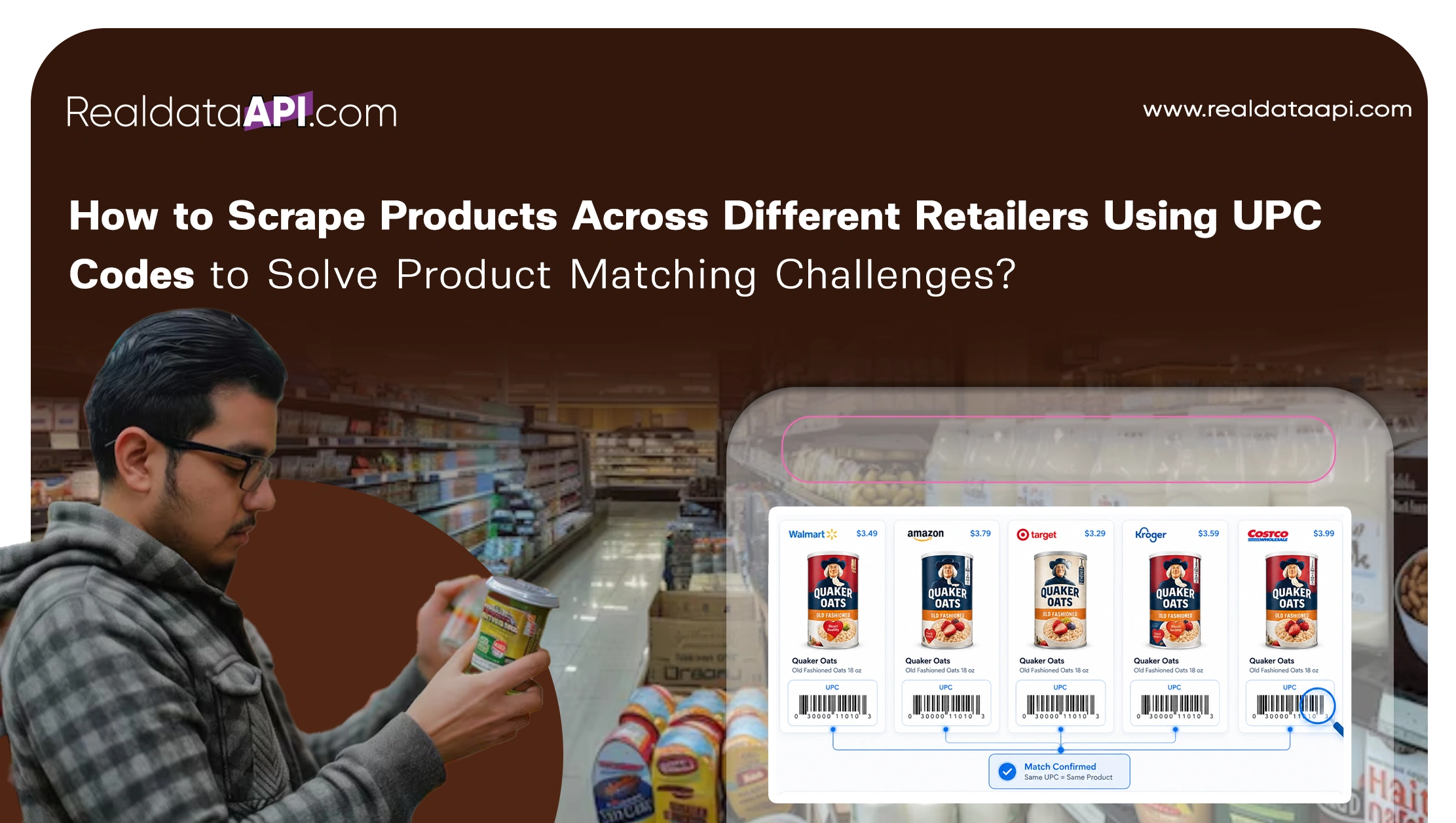
In the rapidly evolving e-commerce landscape, product data consistency is critical for accurate pricing, catalog management, and competitive intelligence. However, retailers often face challenges due to duplicate listings, inconsistent product descriptions, and mismatched SKUs across platforms. To overcome these issues, businesses increasingly rely on the ability to Scrape products across different retailers using UPC codes, ensuring accurate product matching and streamlined data management.
UPC (Universal Product Code) serves as a unique identifier that allows businesses to track and match products across multiple retailers with precision. By leveraging solutions like Extract Grocery Product Data via UPC-Level Matching, companies can unify their product catalogs, eliminate redundancies, and improve decision-making.
Between 2020 and 2026, the growth of multi-channel retailing has significantly increased the complexity of product data. As more retailers expand their online presence, the need for UPC-based matching has become essential for maintaining consistency and accuracy. This blog explores how advanced scraping technologies and APIs can help businesses solve product matching challenges and unlock actionable insights.
Building unified mapping systems across stores
One of the biggest challenges in retail data management is mapping identical products across multiple platforms. By implementing automated UPC product mapping across multiple stores, businesses can ensure accurate product identification and reduce mismatches.
From 2020 to 2026, the number of SKUs across major retailers increased by over 50%, making manual mapping nearly impossible. Automated UPC-based systems enable businesses to match products efficiently and maintain consistency across catalogs.
SKU Growth and Mapping Efficiency
| Year | Total SKUs (Millions) | Mapping Accuracy (%) | Manual Errors (%) |
|---|---|---|---|
| 2020 | 12 | 70 | 22 |
| 2022 | 15 | 78 | 18 |
| 2024 | 18 | 86 | 12 |
| 2026 | 21 | 94 | 6 |
These systems not only improve accuracy but also enhance operational efficiency by reducing the time required for product mapping. Businesses can focus on analysis and strategy rather than manual data processing.
Achieving consistency in multi-retailer datasets
Inconsistent product data across retailers can lead to incorrect pricing comparisons and poor customer experience. Using normalize product data across retailers using UPC codes, businesses can standardize product attributes and create a unified dataset.
Between 2020 and 2026, companies implementing data normalization saw a 38% reduction in inconsistencies and a 30% improvement in catalog accuracy. This is particularly important for marketplaces that aggregate data from multiple sources.
Data Normalization Impact
| Metric | 2020 | 2023 | 2026 |
|---|---|---|---|
| Data Consistency (%) | 62 | 76 | 90 |
| Catalog Accuracy (%) | 65 | 80 | 92 |
| Duplicate Listings (%) | 25 | 16 | 9 |
Standardization ensures that businesses can compare products accurately, optimize pricing strategies, and improve search functionality. It also supports integration with other systems, such as inventory management and analytics platforms.
Step-by-step approach to structured catalog management
Effective catalog management requires a systematic approach. By following retail product catalog normalization step by step, businesses can transform unstructured data into a clean and organized format.
From 2020 to 2026, structured catalog management improved operational efficiency by 35% and reduced data processing time significantly. The process involves data collection, cleaning, standardization, and validation.
Catalog Management Efficiency
| Metric | 2020 | 2023 | 2026 |
|---|---|---|---|
| Processing Time (hrs) | 80 | 50 | 30 |
| Error Rate (%) | 20 | 12 | 6 |
| Data Usability Score | 60 | 75 | 88 |
A structured approach ensures that product data is accurate, consistent, and ready for analysis. This enables businesses to make informed decisions and improve overall performance.
Enabling accurate cross-platform comparisons
Accurate product comparison is essential for competitive analysis. By leveraging cross-platform product matching using UPC identifiers, businesses can compare prices, availability, and promotions across retailers effectively.
Between 2020 and 2026, companies using UPC-based matching improved comparison accuracy by 32% and reduced mismatched comparisons significantly. This enables better pricing strategies and improved customer trust.
Comparison Accuracy Metrics
| Metric | 2020 | 2023 | 2026 |
|---|---|---|---|
| Matching Accuracy (%) | 68 | 82 | 94 |
| Comparison Errors (%) | 22 | 14 | 7 |
| Pricing Insight Depth | Medium | High | Very High |
UPC-based matching ensures that comparisons are made between identical products, eliminating discrepancies and improving reliability. This is crucial for maintaining competitiveness in the market.
Expanding datasets with enriched product information
Building comprehensive datasets is essential for advanced analytics. By leveraging Extract an Indian Grocery Item Database with Pictures and UPC Codes, businesses can enrich their data with additional attributes such as images and detailed descriptions.
From 2020 to 2026, enriched datasets improved customer engagement by 28% and increased conversion rates significantly. These datasets provide a holistic view of products, enabling better decision-making.
Dataset Enrichment Impact
| Metric | 2020 | 2023 | 2026 |
|---|---|---|---|
| Conversion Rate (%) | 52 | 64 | 76 |
| Customer Engagement (%) | 48 | 60 | 72 |
| Data Completeness (%) | 58 | 72 | 85 |
Enriched datasets also support advanced analytics, such as recommendation engines and demand forecasting. This enables businesses to optimize their strategies and improve overall performance.
Leveraging scalable API solutions for data extraction
Modern e-commerce analytics relies on scalable solutions for efficient data collection. Using E-Commerce Data Scraping API, businesses can automate data extraction and integrate it seamlessly into their systems.
Between 2020 and 2026, API adoption increased by over 50%, driven by the need for scalability and real-time insights. APIs provide flexibility, enabling businesses to customize data extraction and analysis based on their requirements.
API Adoption Trends
| Year | API Adoption (%) | Integration Time (days) | Data Processing Speed |
|---|---|---|---|
| 2020 | 30 | 12 | Moderate |
| 2023 | 45 | 8 | Fast |
| 2026 | 58 | 5 | Very Fast |
APIs also ensure real-time updates, allowing businesses to stay informed about the latest product data. This capability is essential for maintaining competitiveness in a dynamic market.
Why Choose Real Data API?
Real Data API provides advanced solutions for product data extraction and analysis. With capabilities like AI product mapping and Scrape products across different retailers using UPC codes, businesses can achieve accurate product matching and gain a competitive edge.
Key benefits include:
- Real-time data extraction across multiple retailers
- High accuracy in UPC-based matching
- Scalable solutions for large datasets
- Seamless API integration
By leveraging Real Data API, businesses can enhance their data strategies, improve decision-making, and stay ahead in the competitive e-commerce landscape.
Conclusion
As multi-channel retail continues to grow, the importance of accurate product matching cannot be overstated. The ability to Scrape products across different retailers using UPC codes enables businesses to overcome data inconsistencies, improve pricing accuracy, and enhance customer experience.
By adopting advanced scraping technologies and analytics solutions, companies can transform raw data into actionable insights and gain a competitive edge.
Start leveraging Real Data API today to Scrape products across different retailers using UPC codes and unlock the full potential of your e-commerce data with precision and efficiency!
Latest posts
How ecommerce scraping API for real-time product data Helps Businesses Track Prices, Inventory, and Competitor Changes
How Web Scraping APIs for Business Data Improve Pricing and Product Insights
How Extracting Bilibili API Data for Social Media Analytics Helps Brands Track Content, Engagement, and Audience Trends
How Prom.ua scraper Helps Businesses Collect Marketplace Data for Competitive Pricing and Product Intelligence






.png)