Introduction
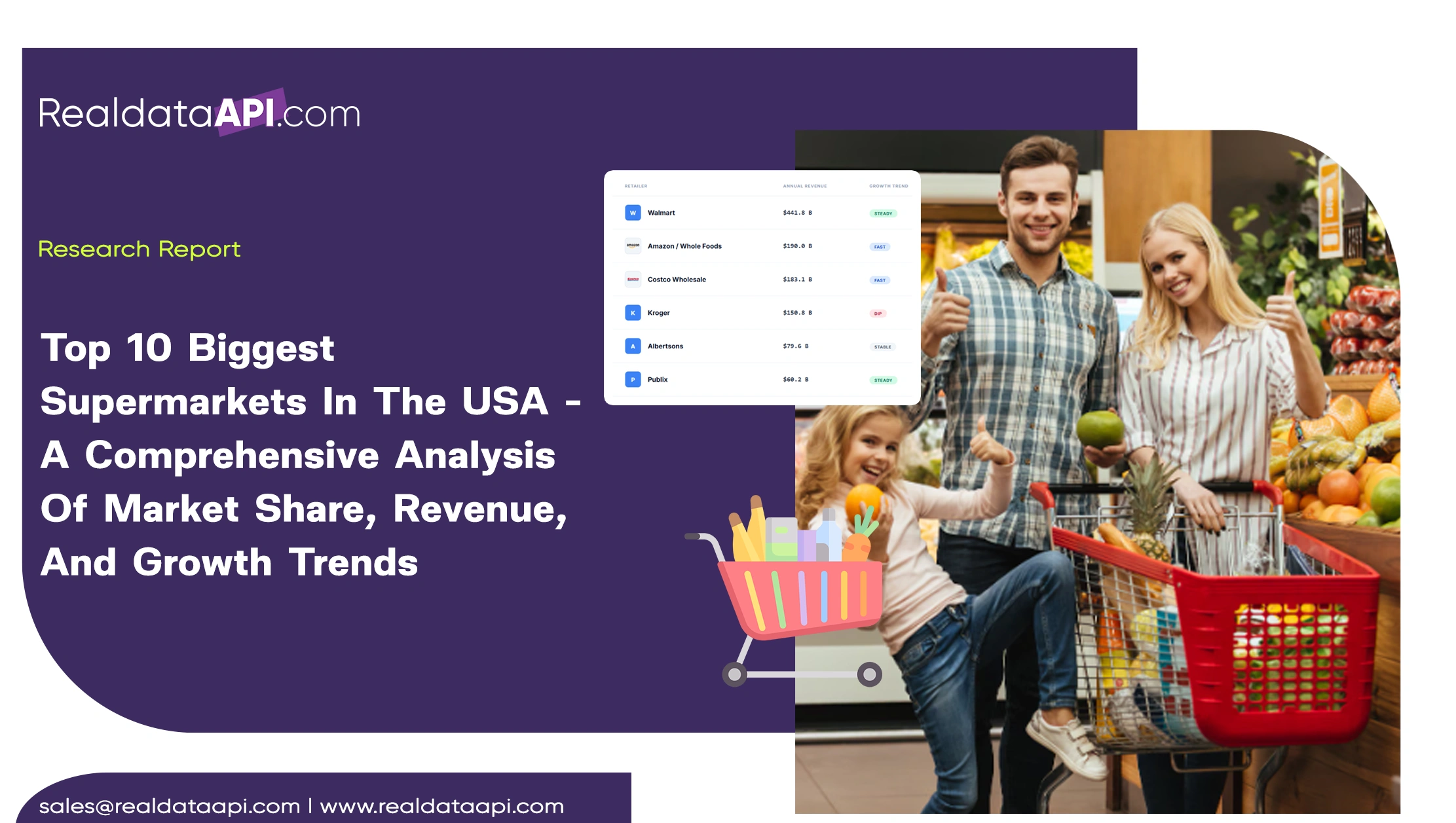
The U.S. grocery retail industry is one of the most competitive and data-driven sectors globally, with a handful of dominant players shaping consumer behavior, pricing strategies, and supply chain innovation. Understanding the top 10 biggest supermarkets in the USA is essential for businesses, analysts, and investors seeking insights into market share, revenue growth, and competitive positioning.
From retail giants like Walmart to regional leaders such as Publix and H-E-B, these supermarkets collectively control a significant portion of the grocery market. Walmart alone accounts for over 21% of total grocery spending in the U.S., while Kroger and Costco follow closely behind in market share.
With increasing digital adoption, omnichannel strategies, and price competition, the supermarket landscape continues to evolve rapidly. This report explores key players, their performance metrics, and how data scraping technologies can unlock actionable insights from grocery datasets.
Walmart – Market Leader Driving Retail Dominance
Walmart stands at the top of the U.S. grocery industry, making it a cornerstone of the top 10 biggest supermarkets in the USA. With over $440 billion in revenue and more than 5,000 stores nationwide, Walmart dominates both physical and digital grocery retail.
| Year | Revenue ($B) | Stores | Market Share (%) |
|---|---|---|---|
| 2020 | 341 | 4,756 | 20% |
| 2022 | 393 | 4,900 | 21% |
| 2024 | 440 | 5,100 | 21% |
| 2026* | 480 (Proj.) | 5,300 | 22% |
Using tools to Scrape best supermarkets in the USA for grocery shopping, businesses can track Walmart's pricing strategies, product assortment, and regional demand patterns.
Walmart's success lies in its low-price leadership, extensive supply chain, and strong e-commerce integration. Its ability to offer competitive pricing across categories makes it a benchmark for competitors.
Additionally, Walmart's investment in automation, AI-driven inventory systems, and last-mile delivery continues to strengthen its position in the evolving retail ecosystem.
Kroger – Leading Traditional Supermarket Chain
Kroger is the largest traditional supermarket operator in the U.S., with over 2,700 stores and $150+ billion in annual revenue.
| Year | Revenue ($B) | Stores | Market Share (%) |
|---|---|---|---|
| 2020 | 132 | 2,750 | 9% |
| 2022 | 148 | 2,780 | 8.9% |
| 2024 | 150 | 2,800 | 8.5% |
| 2026* | 165 (Proj.) | 2,900 | 9% |
Through Price comparison of top grocery chains in the USA, Kroger's pricing strategy can be benchmarked against competitors like Walmart and Costco.
Kroger's strength lies in its diversified business model, including pharmacy, fuel, and private-label brands. It also leverages data analytics to personalize customer experiences.
By analyzing Kroger's operations, businesses can gain insights into how traditional supermarkets compete with large-scale retailers and warehouse clubs.
Costco – High-Volume Membership Retail Model
Costco operates on a membership-based warehouse model, generating over $176 billion in U.S. sales.
| Year | Revenue ($B) | Stores | Market Share (%) |
|---|---|---|---|
| 2020 | 166 | 550 | 7.6% |
| 2022 | 192 | 570 | 7.9% |
| 2024 | 210 | 600 | 8.4% |
| 2026* | 240 (Proj.) | 650 | 9% |
As one of the best supermarkets in the USA for grocery shopping, Costco offers bulk pricing and high-quality private-label products.
Costco's model focuses on limited SKUs, high inventory turnover, and strong supplier relationships. Its ability to offer lower prices than competitors has made it a preferred choice for cost-conscious consumers.
Albertsons – Strong Multi-Brand Presence
Albertsons operates over 2,300 stores under multiple banners such as Safeway and Vons, generating approximately $79 billion in revenue.
| Year | Revenue ($B) | Stores | Market Share (%) |
|---|---|---|---|
| 2020 | 62 | 2,200 | 5% |
| 2022 | 72 | 2,250 | 5% |
| 2024 | 79 | 2,300 | 4.9% |
| 2026* | 85 (Proj.) | 2,400 | 5% |
Albertsons' strategy focuses on regional dominance, loyalty programs, and private-label expansion.
Publix – Customer Experience Leader
Publix is known for exceptional customer service and strong regional presence in the Southeast.
| Year | Revenue ($B) | Stores | Market Share (%) |
|---|---|---|---|
| 2020 | 44 | 1,250 | 4% |
| 2022 | 54 | 1,300 | 4% |
| 2024 | 60 | 1,350 | 4.1% |
| 2026* | 68 (Proj.) | 1,400 | 4.3% |
Publix differentiates itself through in-store experience, quality products, and strong brand loyalty.
H-E-B – Regional Powerhouse
H-E-B dominates the Texas grocery market with competitive pricing and strong local supply chains.
| Year | Revenue ($B) | Stores | Market Share (%) |
|---|---|---|---|
| 2020 | 32 | 340 | 2% |
| 2022 | 38 | 360 | 2% |
| 2024 | 43 | 380 | 1.9% |
| 2026* | 50 (Proj.) | 420 | 2.2% |
Its focus on local sourcing and community engagement drives its success.
ALDI – Discount Retail Disruptor
ALDI is known for its low-cost model and efficient operations.
| Year | Revenue ($B) | Stores | Market Share (%) |
|---|---|---|---|
| 2020 | 27 | 2,100 | 2.6% |
| 2022 | 32 | 2,200 | 2.8% |
| 2024 | 36 | 2,300 | 2.8% |
| 2026* | 42 (Proj.) | 2,500 | 3% |
ALDI's private-label focus and minimalistic store design reduce costs and attract budget-conscious shoppers.
Target – Hybrid Retail Model
Target combines grocery with general merchandise, creating a unique shopping experience.
| Year | Revenue ($B) | Stores | Market Share (%) |
|---|---|---|---|
| 2020 | 93 | 1,900 | 2.5% |
| 2022 | 107 | 1,950 | 2.4% |
| 2024 | 110 | 2,000 | 2.3% |
| 2026* | 120 (Proj.) | 2,100 | 2.5% |
Amazon / Whole Foods – Digital Grocery Innovation
Amazon and Whole Foods represent the digital transformation of grocery retail.
| Year | Revenue ($B) | Stores | Market Share (%) |
|---|---|---|---|
| 2020 | 386 | 500+ | 1.6% |
| 2022 | 434 | 520 | 1.6% |
| 2024 | 500 | 550 | 1.6% |
| 2026* | 580 (Proj.) | 600 | 2% |
Amazon's integration of online grocery delivery and AI-driven recommendations is reshaping the industry.
Ahold Delhaize USA – Multi-Brand Efficiency
Ahold Delhaize operates brands like Food Lion and Stop & Shop.
| Year | Revenue ($B) | Stores | Market Share (%) |
|---|---|---|---|
| 2020 | 43 | 2,000 | 4.3% |
| 2022 | 50 | 2,100 | 4.1% |
| 2024 | 55 | 2,200 | 4% |
| 2026* | 62 (Proj.) | 2,300 | 4.2% |
Data-Driven Grocery Intelligence
Modern grocery analytics relies on tools like a Grocery Data Scraping API to extract real-time pricing, inventory, and consumer behavior data.
Businesses also leverage a Grocery Dataset to analyze trends across multiple retailers, enabling better forecasting and decision-making.
Advanced Data Applications in Grocery Retail
With Top Grocery Scraping API Use Cases, companies can:
- Monitor competitor pricing
- Track product availability
- Analyze consumer demand
- Optimize supply chains
One key application is Real-Time Price Data Monitoring for Grocery Prices and Discounts, which helps businesses stay competitive in a price-sensitive market.
Why Choose Real Data API?
In a highly competitive grocery retail landscape, accessing accurate and real-time data is critical for staying ahead. Real Data API provides advanced solutions designed to extract, process, and deliver actionable insights from the top 10 biggest supermarkets in the USA. Whether you're analyzing pricing trends, product availability, or customer demand, Real Data API ensures you have reliable data at your fingertips.
With a powerful Grocery Data Scraping API, businesses can automate the collection of large-scale data from multiple supermarket chains, eliminating manual effort and improving efficiency. This enables seamless tracking of price fluctuations, promotional offers, and inventory changes across leading retailers.
Additionally, access to a structured Grocery Dataset allows organizations to perform in-depth analysis, including competitor benchmarking and demand forecasting. Businesses can also leverage Top Grocery Scraping API Use Cases to enhance decision-making, optimize pricing strategies, and improve supply chain efficiency.
One of the key advantages is Real-Time Price Data Monitoring for Grocery Prices and Discounts, which helps companies stay competitive in a price-sensitive market. By integrating these capabilities, Real Data API empowers businesses to transform raw grocery data into strategic insights that drive growth and innovation.
Conclusion
The top 10 biggest supermarkets in the USA play a critical role in shaping the retail landscape through innovation, pricing strategies, and market expansion. From Walmart's dominance to Amazon's digital disruption, each player contributes to a highly competitive ecosystem.
By leveraging advanced data scraping technologies and real-time analytics, businesses can gain deeper insights into market trends, optimize pricing strategies, and stay ahead of the competition.
Start leveraging Real Data API today to unlock powerful grocery market insights and transform your retail strategy with data-driven intelligence!
Latest posts
How to Scrape Best Buy Atlanta Product Availability and Prices Using API to Power Smarter Pricing Decisions
Use SHEIN API to Scrape the Website - Unlock Actionable Fashion Ecommerce Insights
How to Build Grocery Shopping Apps with the Esselunga API for Real-Time Retail Data Integration
How Businesses Can Improve Profitability with web scraping Dynamic pricing using marketplace data?







.png)



