Introduction
Modern consumers openly share their experiences through online reviews, ratings, and feedback across eCommerce platforms, mobile applications, and social channels. Every review contains valuable information about product quality, usability, expectations, and recurring concerns that businesses can transform into actionable decisions. Organizations that continuously analyze customer feedback are better positioned to refine products, reduce defects, and respond quickly to changing consumer preferences.
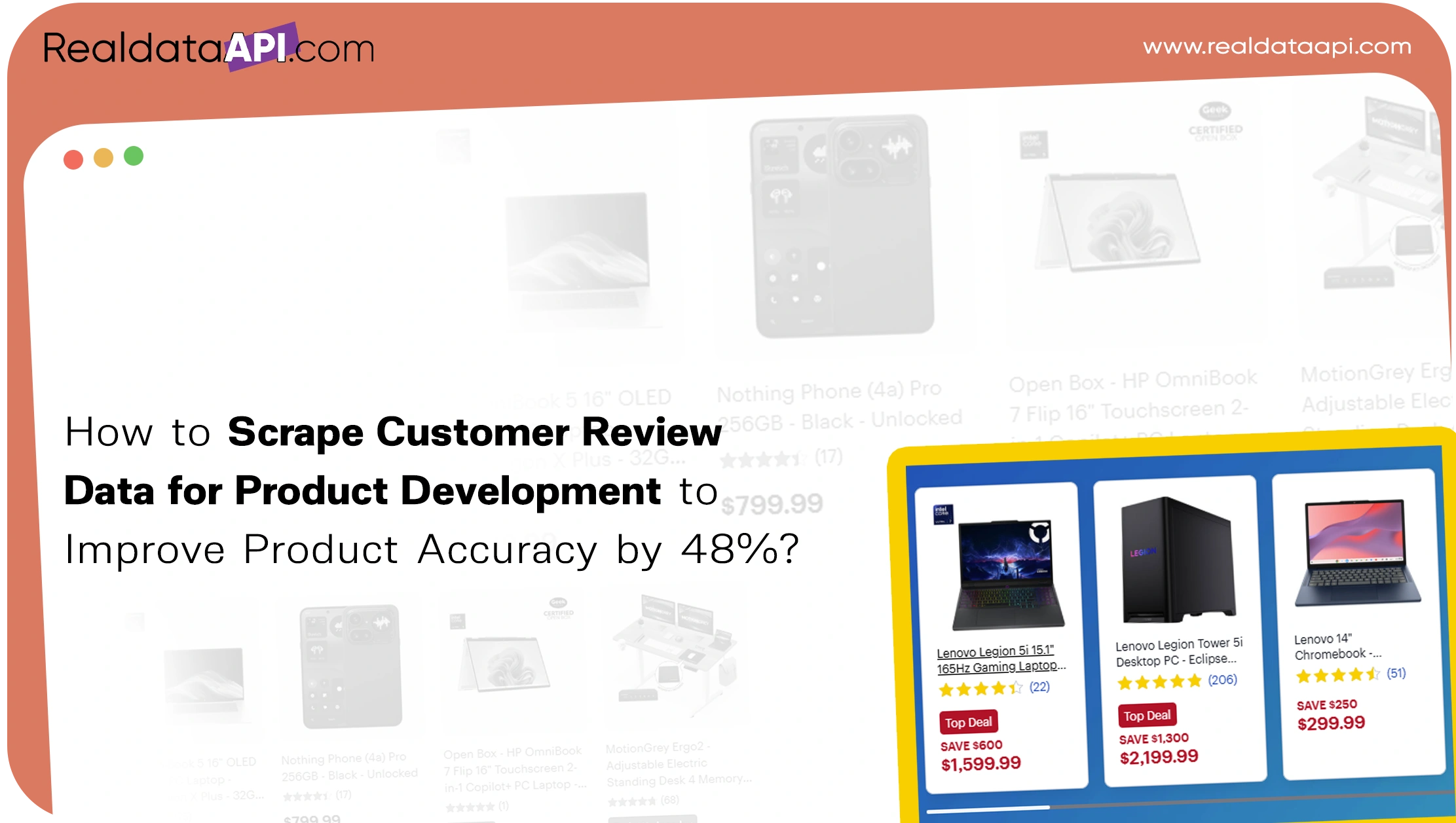
Industry research indicates that companies incorporating customer feedback into product decisions can improve product accuracy by nearly 48% while increasing customer satisfaction and retention. Businesses that Scrape Customer Review Data for Product Development create structured datasets from thousands of authentic reviews instead of relying on isolated opinions.
When organizations Scrape Product Reviews and Ratings for Sentiment Analysis, they receive measurable insights that support roadmap planning, feature prioritization, and quality enhancement without manually reviewing thousands of comments. Rather than making assumptions, businesses use evidence-driven insights that improve decision-making, shorten development cycles, and align products with evolving customer expectations.
Transforming Customer Opinions into Actionable Product Quality Insights
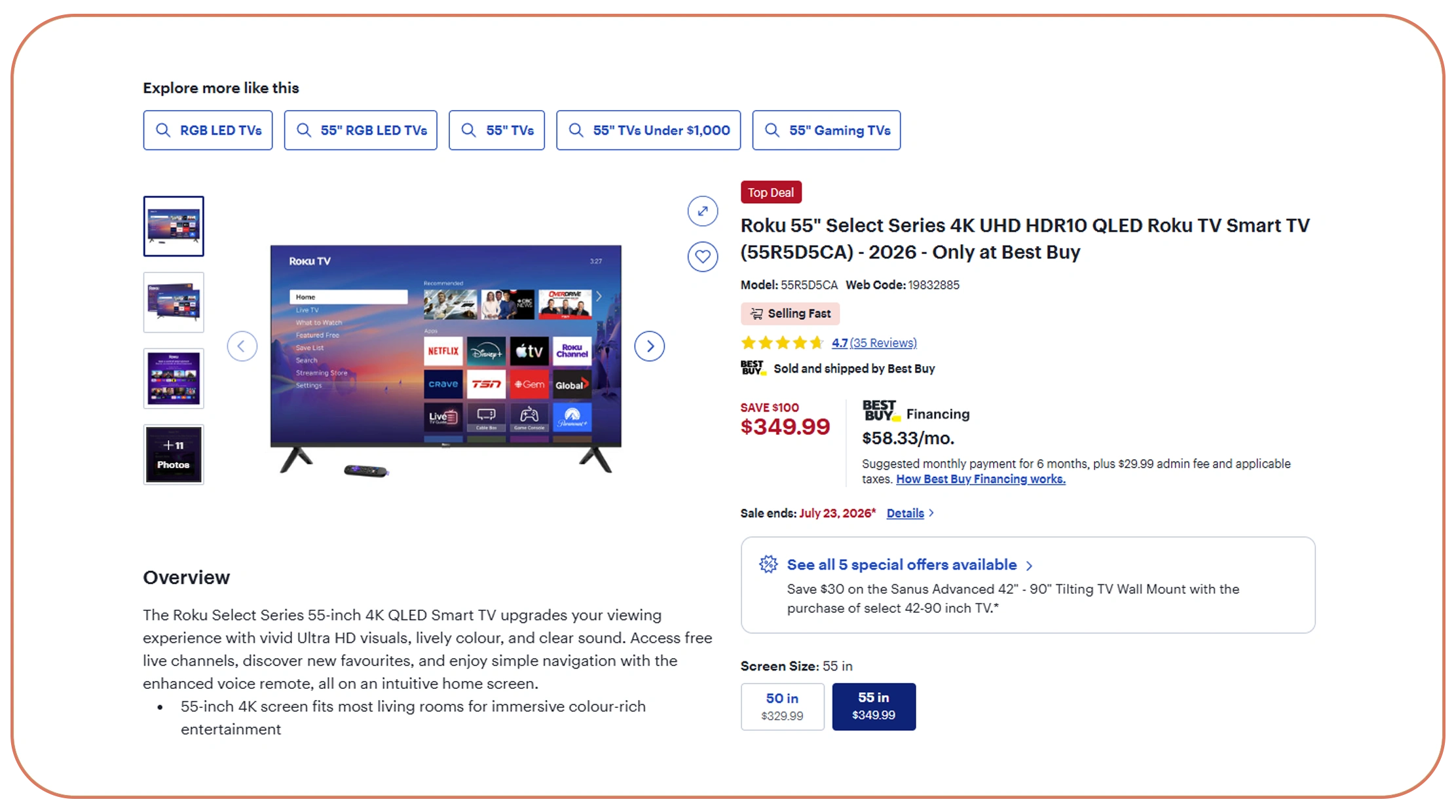
Customer feedback offers one of the most dependable sources of information for identifying product strengths and recurring concerns. Every review, rating, and comment reflects genuine user experiences that can guide meaningful improvements when analyzed systematically. Instead of relying solely on surveys or internal assumptions, organizations aggregate review data from multiple digital platforms to recognize patterns that influence purchasing decisions.
Industry reports indicate that businesses using structured review intelligence improve issue identification speed by nearly 35%, allowing teams to address customer concerns before they affect long-term satisfaction. In the middle of this process, Sentiment Analysis helps categorize positive, negative, and neutral responses, enabling decision-makers to focus on recurring issues with greater confidence.
As review volumes continue to grow, companies increasingly adopt automated collection methods to organize thousands of customer opinions into structured datasets. Businesses applying Web Scraping Consumer Feedback Analytics for Brands can identify feature requests, usability challenges, and quality concerns across multiple online marketplaces, helping them prioritize improvements based on authentic customer experiences rather than assumptions.
Key Benefits:
- Detects recurring customer concerns quickly.
- Classify review trends efficiently.
- Measure satisfaction across multiple platforms.
- Prioritize quality improvements using verified feedback.
Teams can compare product performance across launches, monitor recurring complaints, and evaluate whether implemented improvements have reduced negative feedback. These measurable insights support faster response times while improving confidence in future enhancement decisions.
| Challenge | Data-Driven Solution | Business Impact |
|---|---|---|
| Repeated complaints | Automated review categorization | Faster issue resolution |
| Customer confusion | Feature trend analysis | Better usability |
| Rating inconsistencies | Centralized review collection | Reliable insights |
| Negative experiences | Structured feedback monitoring | Improved customer satisfaction |
Strengthening Product Decisions Through Verified Customer Experiences

Reliable customer feedback provides valuable direction when deciding which improvements should receive immediate attention. Every review contains practical observations that reveal how customers interact with products under real-world conditions. Rather than investing resources based on assumptions, organizations evaluate measurable evidence gathered from review platforms to prioritize updates that deliver greater customer value.
Industry findings suggest that companies using review intelligence reduce unnecessary feature investments by approximately 40%, while increasing release efficiency through data-supported planning. Well-structured datasets also simplify collaboration between engineering, marketing, and product teams by providing consistent evidence for decision-making. When businesses focus on Product Development, they benefit from clearer visibility into feature adoption, recurring defects, and customer expectations.
Historical comparisons, customer trend analysis, and recurring feature requests help teams validate whether recent improvements have positively influenced customer satisfaction. This structured approach supports long-term innovation while reducing costly product revisions.
Major Advantages:
- Prioritize requested features confidently.
- Reduce unnecessary enhancement efforts.
- Track customer satisfaction consistently.
- Support evidence-based release planning.
These insights help eliminate uncertainty while supporting efficient roadmap planning based on measurable user experiences. Organizations seeking continuous improvement increasingly rely on Product Improvement Using Customer Reviews Data Scraping to convert large volumes of feedback into meaningful business intelligence.
| Business Objective | Customer Insight | Expected Outcome |
|---|---|---|
| Feature planning | Review trend evaluation | Better prioritization |
| Quality assurance | Complaint frequency analysis | Reduced defects |
| Product updates | Customer expectation tracking | Faster releases |
| Performance review | Historical comparisons | Continuous improvement |
Expanding Competitive Intelligence Through Customer Feedback Analysis

Organizations seeking stronger market positioning increasingly analyze customer reviews to understand buying preferences, competitor performance, and emerging consumer expectations. Every customer opinion contributes valuable information that supports better planning across pricing strategies, feature comparisons, and quality improvements.
Businesses using organized review intelligence often identify overlooked opportunities before they become widespread market trends. Studies indicate that companies incorporating structured customer review analysis improve competitive responsiveness by nearly 30%, helping them adapt faster to changing consumer demands.
A comprehensive evaluation process also strengthens Market Research by providing measurable evidence of customer expectations across competing brands. Instead of depending only on traditional surveys, organizations compare authentic experiences shared by consumers, allowing teams to identify performance gaps and benchmark product quality more accurately.
Strategic Outcomes:
- Compare competitor performance effectively.
- Identify emerging customer expectations.
- Benchmark product quality consistently.
- Support long-term business planning.
Businesses further improve strategic planning by implementing Review Analytics Data Scraper for Product Optimization, enabling continuous monitoring of customer feedback from multiple review platforms.
| Competitive Focus | Customer Review Insight | Business Value |
|---|---|---|
| Competitor evaluation | Review benchmarking | Better positioning |
| Customer expectations | Feature demand tracking | Smarter planning |
| Product strengths | Positive feedback analysis | Marketing alignment |
| Improvement opportunities | Complaint monitoring | Continuous innovation |
How Real Data API Can Help You?
Through automated review extraction, organizations can Scrape Customer Review Data for Product Development across multiple marketplaces, retail platforms, and review websites while maintaining consistent, high-quality datasets for continuous decision-making.
How we helps organizations:
- Collect reviews from multiple online platforms automatically.
- Standardize customer feedback into structured datasets.
- Monitor changing review trends in real time.
- Detects recurring customer concerns quickly.
- Export clean datasets in multiple business-ready formats.
- Integrate review intelligence into existing business workflows.
These capabilities enable organizations to improve decision accuracy, reduce manual research, and accelerate innovation initiatives. Businesses also benefit from Web Scraping Consumer Feedback Analytics for Brands, helping product teams convert customer experiences into measurable improvements that strengthen long-term business performance.
Conclusion
Modern businesses increasingly depend on authentic customer opinions to improve products, reduce recurring issues, and align innovation with evolving market expectations. Organizations that Scrape Customer Review Data for Product Development create reliable decision-making frameworks supported by structured review intelligence instead of assumptions.
This approach also strengthens Extract Product Review Insights for Business Growth, enabling continuous product refinement through measurable customer feedback. Contact Real Data API today to build a customized customer review data solution that accelerates smarter product decisions and long-term business growth.
Latest posts
Why Brand Scrape Product Data From Shopee To Monitor Prices, Inventory, And Competitor Performance?

Why Businesses scrape OTA travel data to Track Hotel Rates, Flight Prices, and Travel Trends?
Why Manufacturers And Distributors Scrape Product Data From Grainger To Track Catalog Updates, Pricing, And Inventory?

How Can Real-Time Data Collection From Booking and Expedia Transform Travel Market Intelligence?
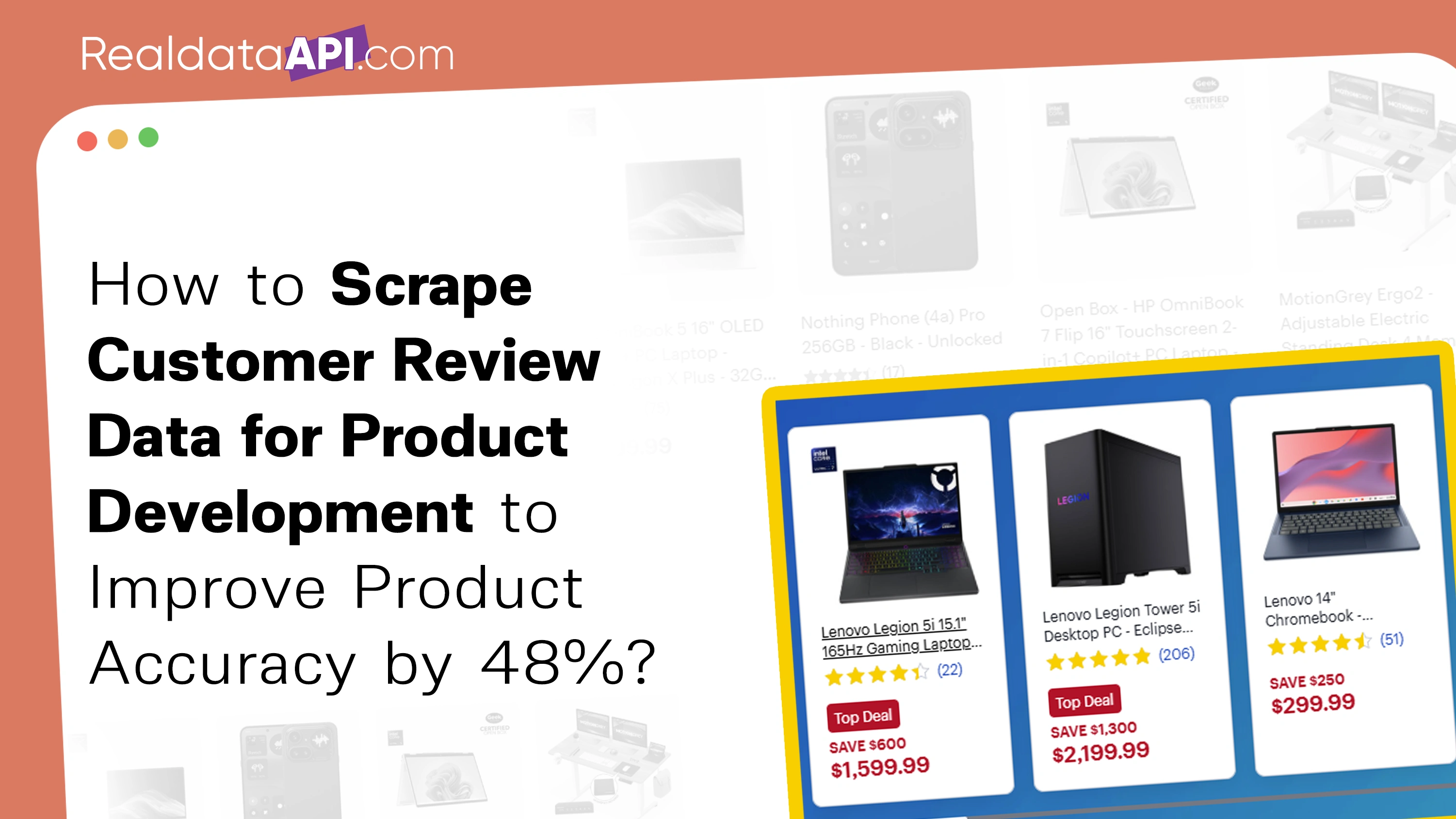
How to Scrape Customer Review Data for Product Development to Improve Product Accuracy by 48%?

Real Data API stands out as one of the premier global companies specializing in web data Scraping and web extraction.





.png)


Rating 4.7
Rating 4.7
Rating 4.5
Rating 4.7
Rating 4.7


Disclaimer : RealData API functions solely as an independent data infrastructure and technology solutions provider. We build customized automation workflows designed to collect publicly accessible web data based exclusively on client instructions. RealData API neither owns proprietary datasets nor engages in the sale or redistribution of extracted information. Our operations are limited strictly to lawful public web data processing and never involve unauthorized access to restricted systems or private networks. Any company names, trademarks, logos, or brand references displayed on this website are used purely for demonstrative and illustrative purposes to showcase our technical capabilities and do not imply endorsement, partnership, or affiliation. Use of our platform and services remains subject to our Terms of Service.