Introduction
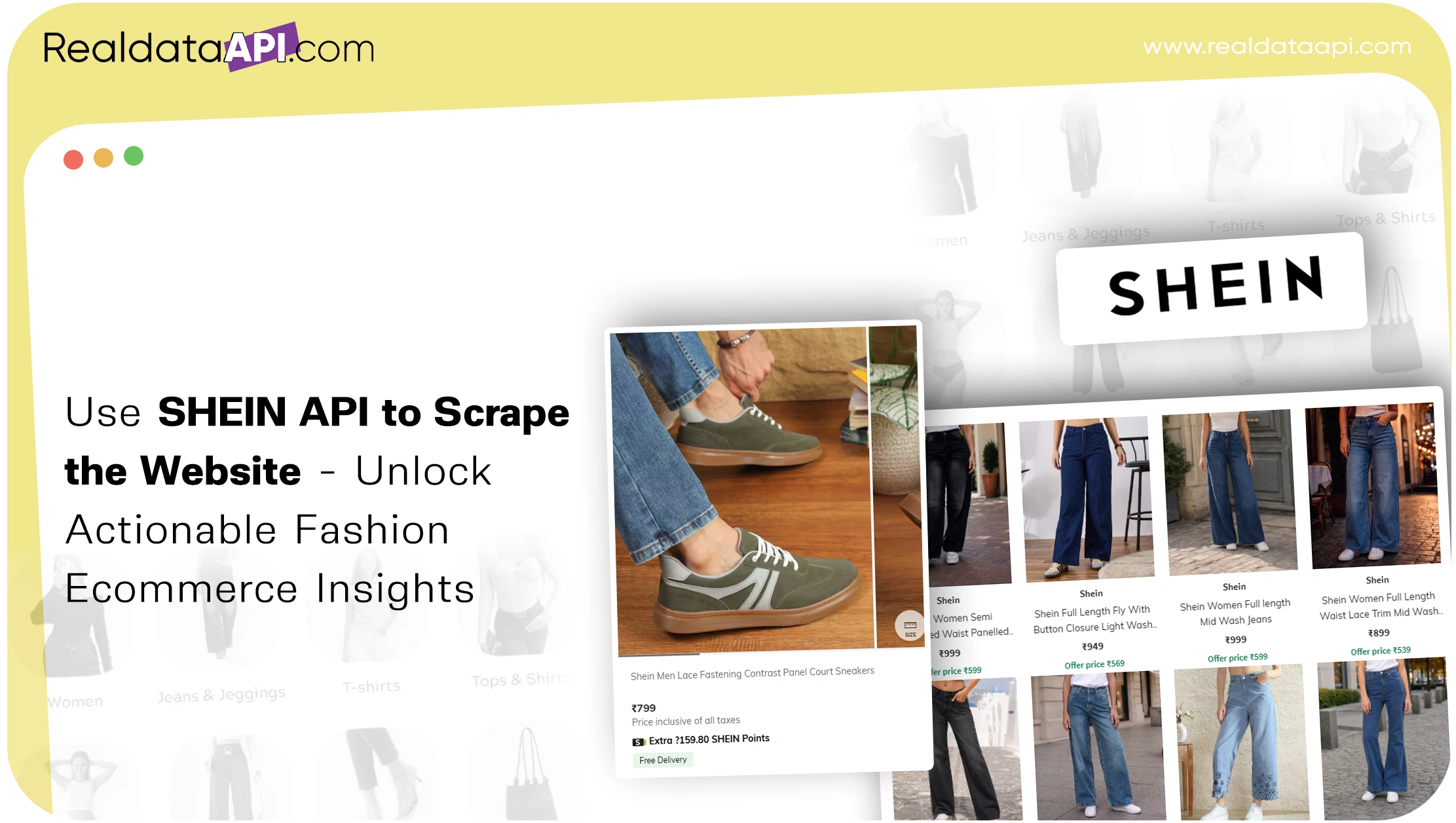
Businesses can efficiently collect real-time product, pricing, inventory, review, and category information from SHEIN using APIs and advanced data extraction solutions. This enables retailers, brands, analysts, and ecommerce platforms to monitor market trends, optimize pricing strategies, and make faster business decisions based on reliable data.
Industry Insight: According to market research, the global fashion ecommerce market is projected to surpass $1.6 trillion by 2030 , while AI-powered retail analytics adoption has increased by over 35% since 2022 . Businesses leveraging automated fashion data collection report up to 28% faster pricing decisions and 22% better inventory optimization .
For ecommerce brands, fashion retailers, marketplace sellers, pricing analysts, and market intelligence teams, staying ahead requires access to fresh and structured marketplace data. Manual tracking cannot keep pace with thousands of daily product updates, flash sales, and changing customer preferences.
Businesses increasingly Use SHEIN API to Scrape the Website to automate product intelligence, pricing analysis, inventory monitoring, and competitive benchmarking. Modern APIs deliver structured datasets that eliminate manual research while providing scalable access to valuable marketplace information.
Comprehensive SHEIN Product and Review Datasets further help organizations analyze customer sentiment, identify bestselling products, evaluate ratings, monitor new arrivals, and understand evolving fashion preferences. These insights support merchandising, dynamic pricing, marketing campaigns, assortment planning, and demand forecasting with greater confidence.
How Can Businesses Collect Accurate Product Information at Scale?
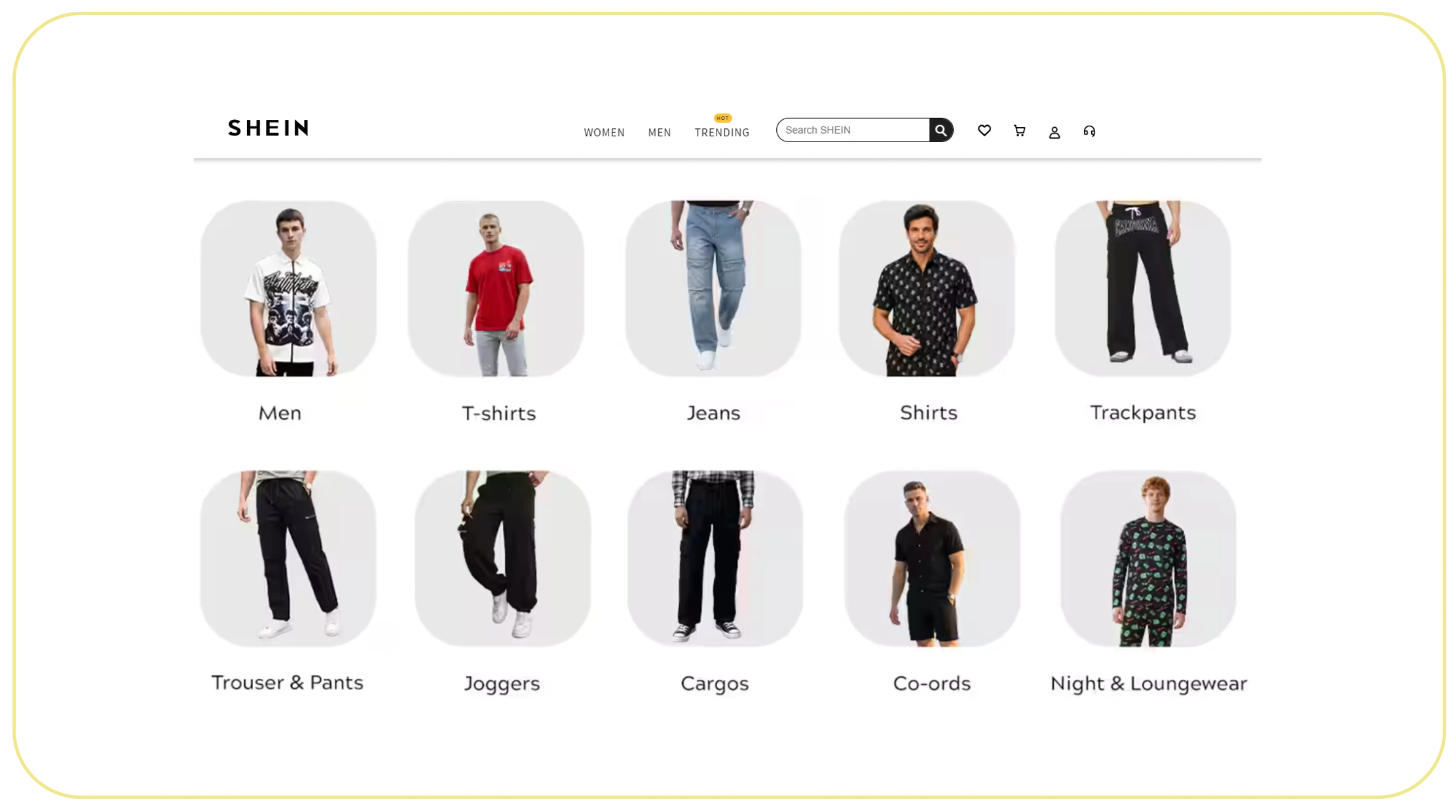
Modern ecommerce success depends on automated data collection. Retailers need access to product listings, prices, discounts, images, descriptions, availability, ratings, reviews, seller information, and category trends without manual intervention.
Businesses can Scrape SHEIN product data using API to collect structured information continuously across thousands of fashion products. APIs simplify large-scale data acquisition while improving consistency and reducing operational costs.
Organizations commonly extract:
- Product titles
- Product IDs
- Categories
- Prices
- Discounts
- Inventory availability
- Product images
- Variants
- Ratings
- Customer reviews
- Fabric information
- Colors
- Sizes
These datasets enable pricing intelligence, competitor benchmarking, assortment optimization, promotional analysis, and trend forecasting.
SHEIN Marketplace Growth (2020–2026)
| Year | Products Indexed | Categories | Daily Price Updates | Average Customer Ratings |
|---|---|---|---|---|
| 2020 | 2.1 Million | 320 | 120,000 | 4.28 |
| 2021 | 2.8 Million | 360 | 175,000 | 4.31 |
| 2022 | 3.6 Million | 420 | 260,000 | 4.35 |
| 2023 | 4.5 Million | 480 | 340,000 | 4.39 |
| 2024 | 5.3 Million | 520 | 425,000 | 4.42 |
| 2025* | 6.0 Million | 560 | 510,000 | 4.45 |
| 2026* | 6.8 Million | 600 | 600,000 | 4.48 |
*Projected estimates.
The steady marketplace expansion highlights why automated data extraction has become essential. Between 2020 and 2026, indexed fashion products are estimated to more than triple, while daily pricing updates increase nearly fivefold. Such rapid marketplace activity makes manual monitoring impractical. API-based extraction enables businesses to capture pricing movements, promotional campaigns, inventory fluctuations, and assortment changes in near real time. These insights help merchandising teams optimize catalogs, improve demand forecasting, and react faster to competitors entering or exiting product segments. Reliable datasets also improve analytics accuracy across multiple business functions, including procurement, category management, marketing, and revenue optimization.
Why Is Marketplace Intelligence Critical for Fashion Retailers?
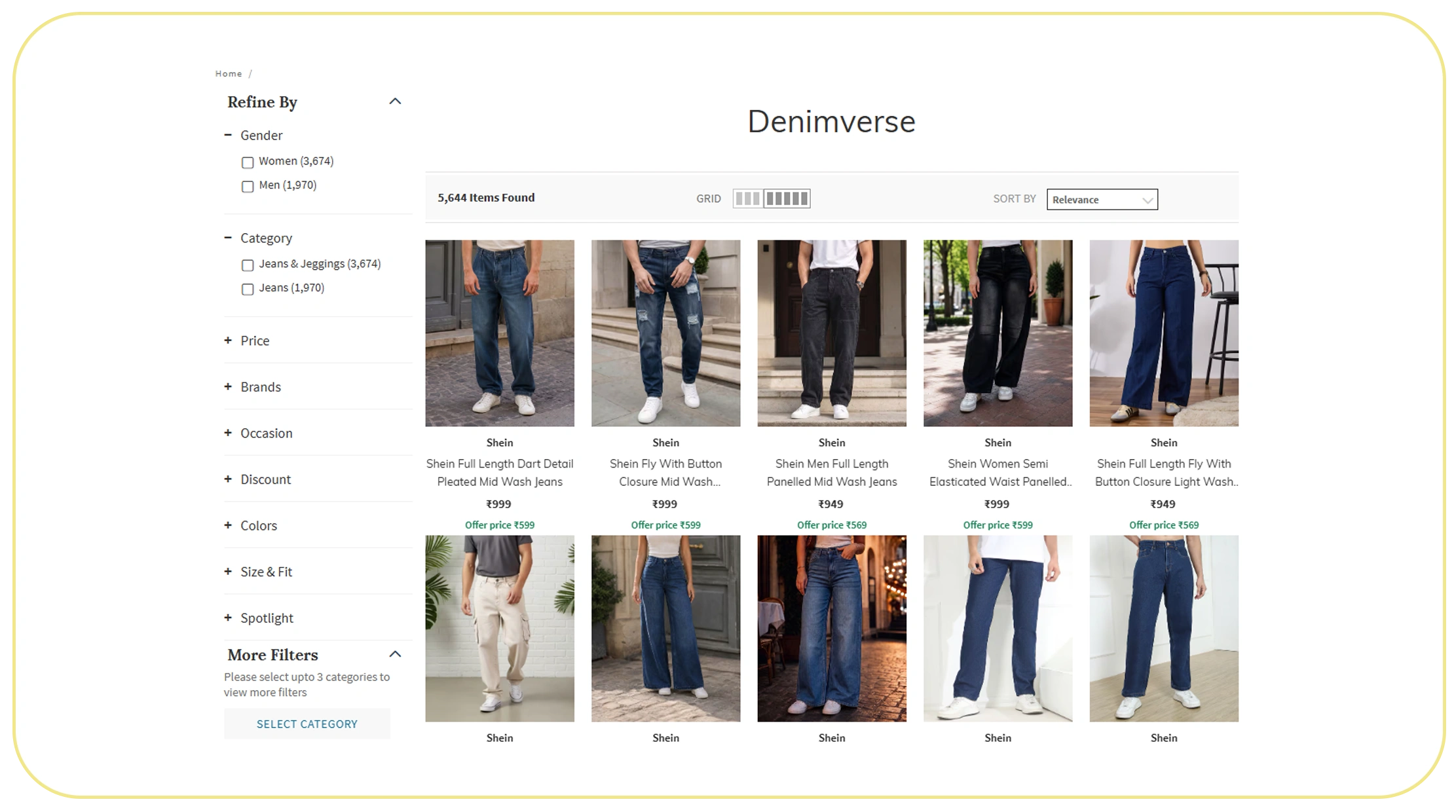
Fashion marketplaces evolve rapidly. Thousands of products appear daily, discounts change hourly, and customer preferences shift with every season. Businesses require continuous visibility into these market movements.
Fashion marketplace scraping using SHEIN API provides retailers with structured datasets that simplify monitoring of pricing trends, category growth, new launches, bestselling products, and promotional activity across the marketplace.
Key business benefits include:
- Competitive pricing analysis
- Bestseller identification
- Inventory visibility
- Category performance tracking
- Consumer preference analysis
- Promotional monitoring
- Assortment benchmarking
These capabilities support faster decision-making and improve market responsiveness.
Fashion Marketplace Analytics (2020–2026)
| Year | Active Fashion Categories | Monthly New Listings | Promotional Campaigns | Average Discount |
|---|---|---|---|---|
| 2020 | 320 | 180,000 | 720 | 24% |
| 2021 | 355 | 245,000 | 890 | 26% |
| 2022 | 410 | 330,000 | 1,050 | 28% |
| 2023 | 465 | 420,000 | 1,280 | 30% |
| 2024 | 520 | 510,000 | 1,470 | 32% |
| 2025* | 565 | 610,000 | 1,690 | 33% |
| 2026* | 610 | 730,000 | 1,920 | 35% |
*Projected estimates.
Marketplace intelligence has become a competitive necessity rather than an optional capability. As promotional campaigns become more frequent and product launches accelerate, businesses need reliable visibility into changing consumer demand. Structured API datasets reveal which product categories gain traction, which promotions generate engagement, and which pricing strategies outperform competitors. Retailers can identify emerging fashion segments, monitor seasonal demand, evaluate discount effectiveness, and optimize assortment decisions before market trends shift. These insights also help suppliers and marketplace sellers improve inventory planning, strengthen pricing strategies, reduce stock imbalances, and increase profitability through evidence-based decision-making instead of relying on historical assumptions alone.
What Makes Intelligent Data Extraction More Valuable Than Traditional Scraping?
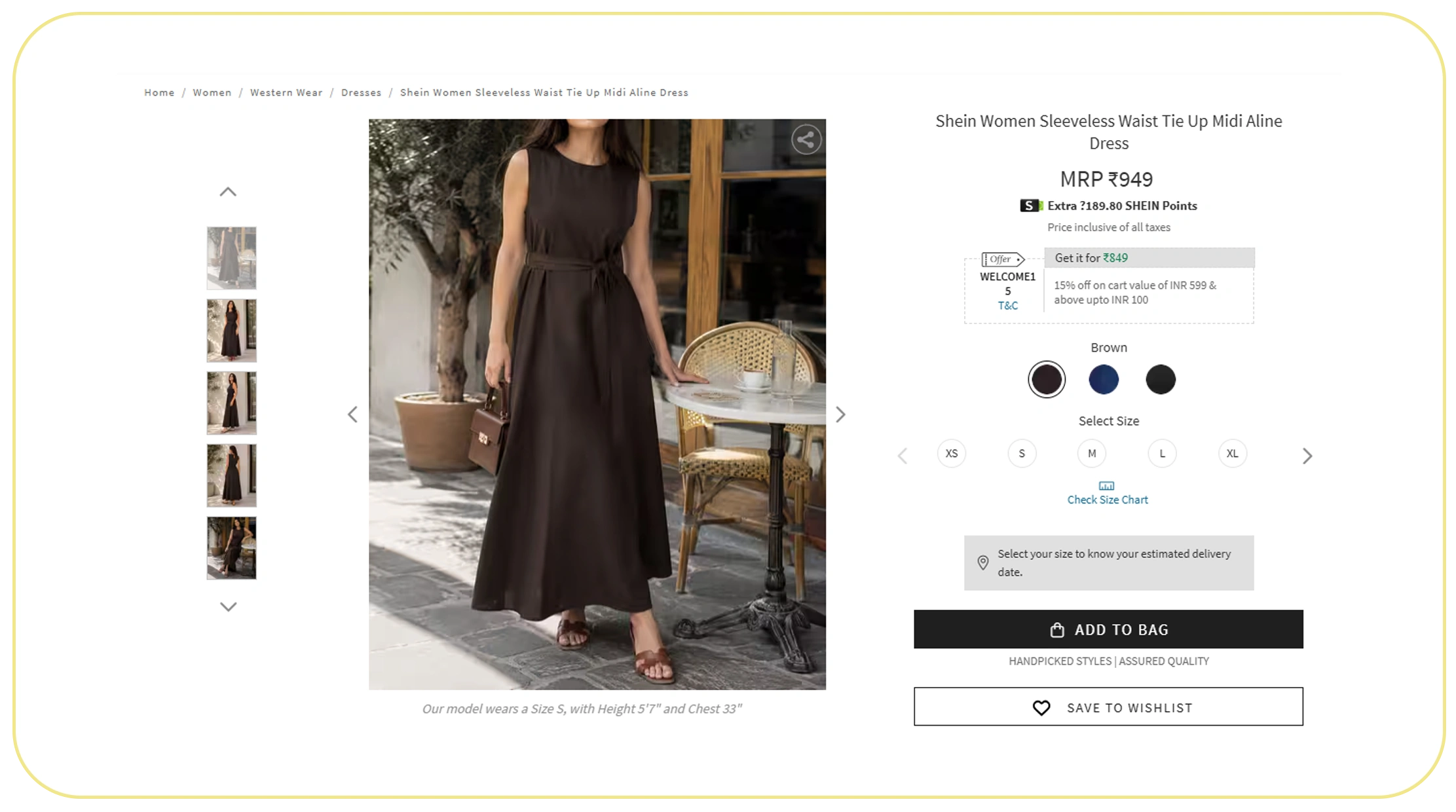
Traditional web scraping often struggles with dynamic content, changing website structures, and rapidly updating inventories. Modern businesses require smarter solutions that deliver consistent, scalable, and high-quality datasets with minimal maintenance.
AI-powered SHEIN data extraction solutions combine automation, machine learning, and intelligent parsing techniques to capture structured marketplace data efficiently. These solutions adapt to frequent catalog updates, enabling organizations to maintain accurate datasets for analytics, forecasting, and competitive benchmarking.
Key capabilities include:
- Intelligent product classification
- Automated duplicate detection
- Review sentiment categorization
- Image metadata extraction
- Dynamic pricing monitoring
- Variant mapping
- Trend identification
- Category relationship analysis
These capabilities reduce manual effort while improving data quality across enterprise analytics workflows.
AI-Driven Fashion Data Intelligence (2020–2026)
| Year | Products Processed (Millions) | AI Classification Accuracy | Duplicate Detection Rate | Average Processing Time |
|---|---|---|---|---|
| 2020 | 1.8 | 88% | 82% | 8.5 Hours |
| 2021 | 2.5 | 90% | 86% | 6.9 Hours |
| 2022 | 3.4 | 92% | 90% | 5.4 Hours |
| 2023 | 4.6 | 94% | 93% | 4.2 Hours |
| 2024 | 5.8 | 96% | 96% | 3.1 Hours |
| 2025* | 6.9 | 97% | 97% | 2.4 Hours |
| 2026* | 8.2 | 98% | 98% | 1.8 Hours |
*Projected estimates.
Artificial intelligence significantly improves marketplace data quality by identifying inconsistencies, validating extracted fields, and recognizing product relationships across millions of listings. From 2020 to 2026, AI classification accuracy is projected to increase from 88% to 98%, while processing times decline by nearly 80%. Faster extraction enables retailers to respond to price fluctuations, inventory shortages, and seasonal demand before competitors. Intelligent automation also minimizes duplicate records, improves catalog normalization, and enhances downstream analytics. These improvements empower merchandising teams, pricing analysts, and ecommerce managers to make data-driven decisions with greater confidence while reducing operational costs associated with manual validation and repetitive data preparation tasks.
How Can Businesses Simplify Large-Scale Marketplace Monitoring?
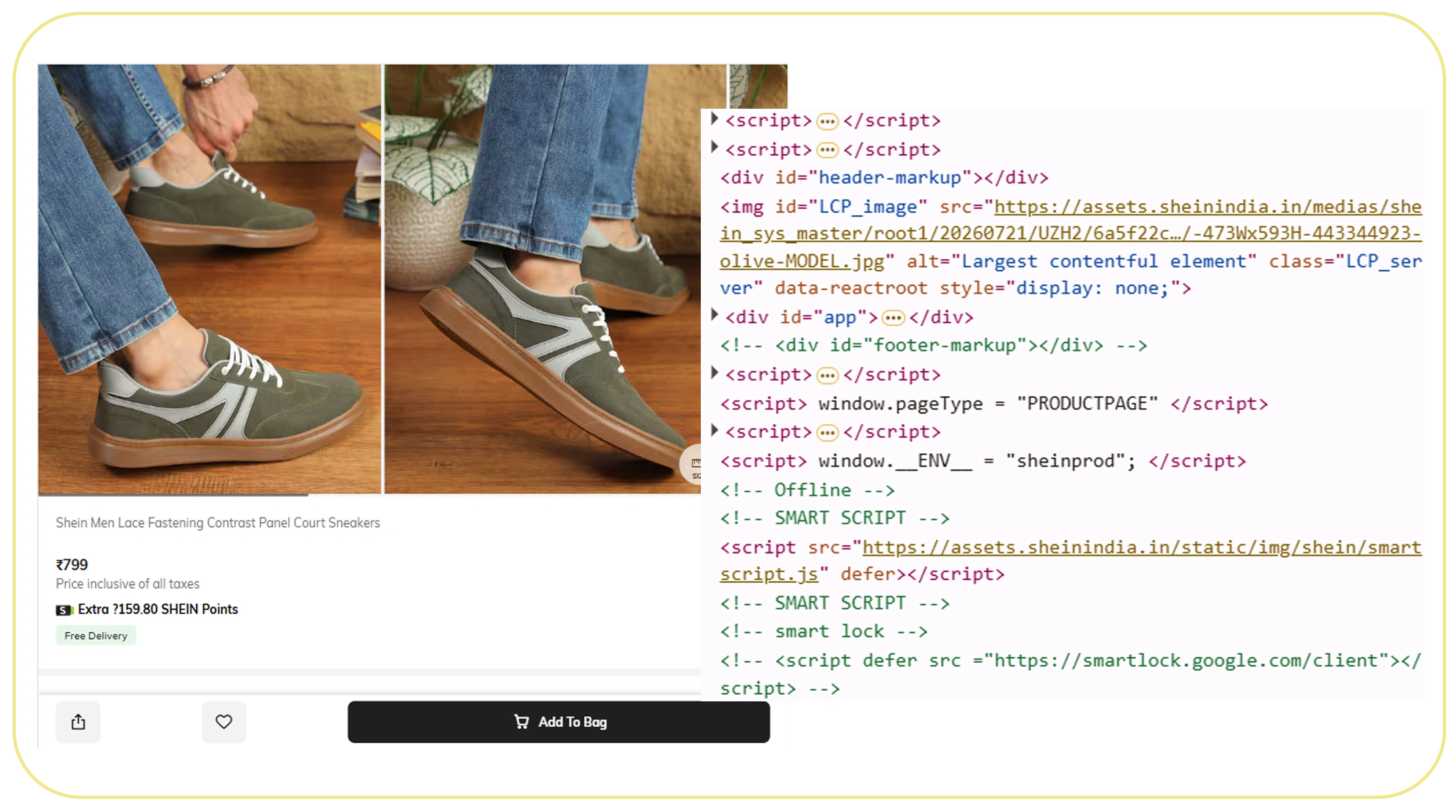
Monitoring millions of fashion products manually is unrealistic. Businesses need scalable infrastructure that continuously captures product information while maintaining structured, reliable datasets for reporting and analytics.
A robust Shein Scraping API enables organizations to automate product discovery, pricing updates, review collection, inventory monitoring, and category tracking through centralized data pipelines. Instead of relying on periodic manual exports, businesses receive consistent marketplace intelligence for strategic planning.
Common use cases include:
- Dynamic pricing intelligence
- Competitor assortment monitoring
- Promotion tracking
- New arrival detection
- Inventory availability analysis
- Product lifecycle monitoring
- Customer review aggregation
These datasets support retail operations, ecommerce optimization, and market research initiatives.
Marketplace Monitoring Performance (2020–2026)
| Year | Products Tracked | Daily API Requests | Inventory Updates | Pricing Accuracy |
|---|---|---|---|---|
| 2020 | 2.3 Million | 180,000 | 95,000 | 91% |
| 2021 | 3.0 Million | 250,000 | 138,000 | 93% |
| 2022 | 3.9 Million | 340,000 | 195,000 | 95% |
| 2023 | 4.9 Million | 450,000 | 268,000 | 96% |
| 2024 | 5.8 Million | 565,000 | 340,000 | 97% |
| 2025* | 6.7 Million | 690,000 | 425,000 | 98% |
| 2026* | 7.6 Million | 810,000 | 520,000 | 99% |
*Projected estimates.
Large-scale marketplace monitoring provides organizations with continuous visibility into pricing movements, inventory availability, and promotional activity. Between 2020 and 2026, tracked products are projected to grow from 2.3 million to 7.6 million, highlighting the increasing complexity of online fashion marketplaces. Automated APIs help businesses process this expanding data volume without compromising speed or accuracy. Retailers can quickly identify pricing changes, monitor competitor assortments, detect stock shortages, and evaluate campaign performance. Consistent marketplace intelligence also supports executive reporting, strategic planning, and demand forecasting, enabling organizations to react faster to evolving consumer preferences while improving operational efficiency across multiple ecommerce channels.
How Can Unified Retail Data Improve Business Intelligence?
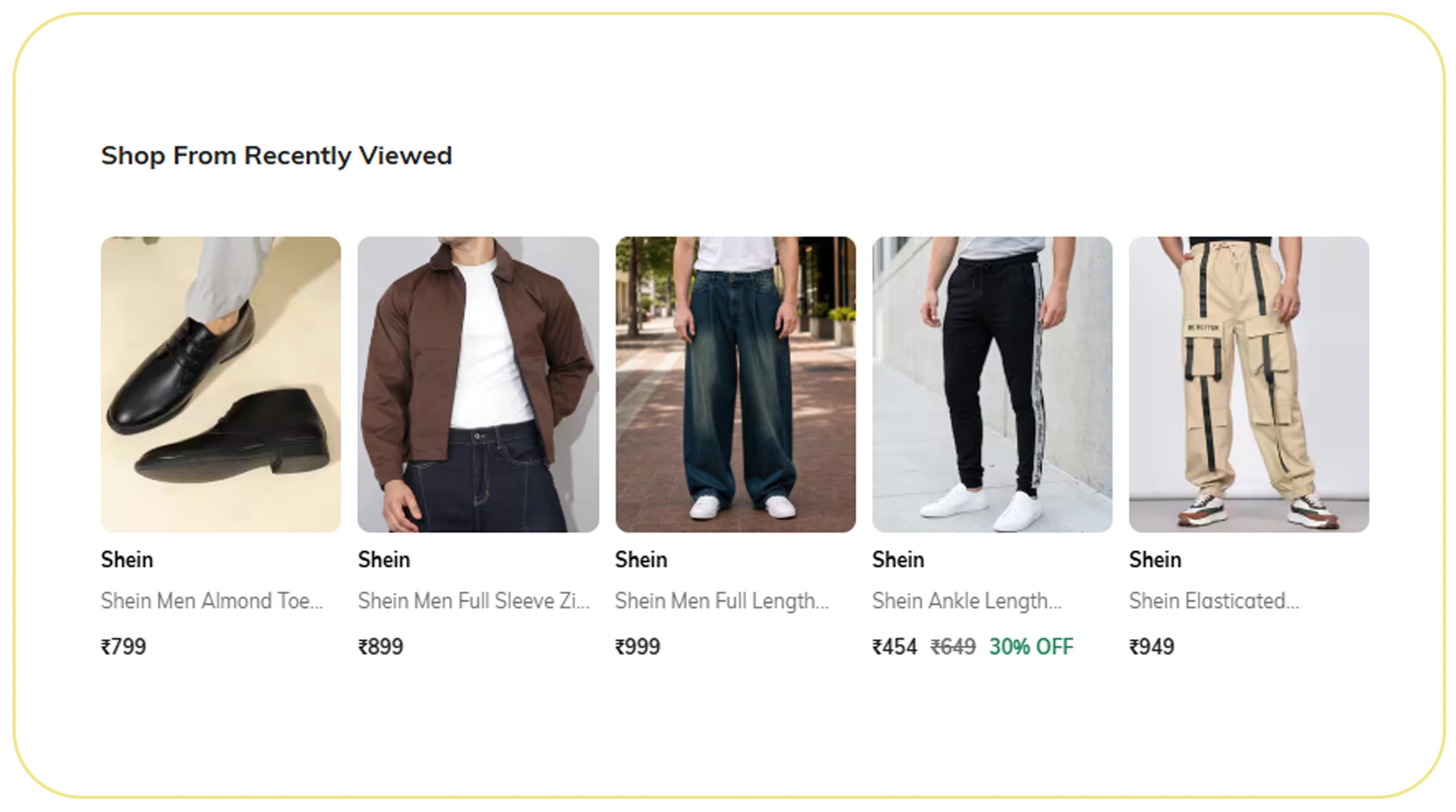
Modern retailers rarely depend on a single marketplace. They monitor multiple ecommerce platforms to understand customer behavior, compare pricing strategies, and identify new growth opportunities. Unified retail intelligence simplifies this process by consolidating structured datasets into one analytics ecosystem.
A comprehensive Lifestyle & Retail Data Scraping API enables businesses to collect marketplace information from fashion, lifestyle, beauty, and retail platforms while maintaining standardized data formats for analysis. This unified approach improves cross-platform benchmarking and delivers broader market visibility.
Organizations commonly analyze:
- Product catalog expansion
- Brand performance
- Seasonal demand
- Cross-market pricing
- Promotional effectiveness
- Customer engagement
- Category growth
- Inventory trends
Integrated datasets help teams identify opportunities faster and improve long-term strategic planning.
Cross-Retail Intelligence Trends (2020–2026)
| Year | Retail Platforms Monitored | Products Unified | Brand Profiles | Monthly Data Refreshes |
|---|---|---|---|---|
| 2020 | 12 | 5.5 Million | 4,800 | 18 |
| 2021 | 18 | 7.2 Million | 6,300 | 24 |
| 2022 | 24 | 9.6 Million | 8,400 | 30 |
| 2023 | 31 | 12.8 Million | 10,900 | 38 |
| 2024 | 39 | 16.5 Million | 13,700 | 46 |
| 2025* | 46 | 20.8 Million | 16,900 | 55 |
| 2026* | 54 | 25.6 Million | 20,400 | 64 |
*Projected estimates.
Unified retail intelligence enables organizations to compare marketplace performance across multiple ecommerce platforms instead of relying on isolated datasets. As monitored platforms and product catalogs continue expanding through 2026, centralized analytics become increasingly valuable for strategic decision-making. Businesses gain deeper visibility into pricing consistency, assortment gaps, promotional performance, and customer engagement across different retail ecosystems. Standardized datasets also simplify reporting, reduce data silos, and improve collaboration between merchandising, marketing, and analytics teams. With broader market coverage, organizations can identify emerging trends earlier, benchmark brand performance more accurately, and develop stronger growth strategies supported by comprehensive retail intelligence rather than fragmented marketplace observations.
How Can Fashion Trend Analytics Improve Retail Decision-Making?
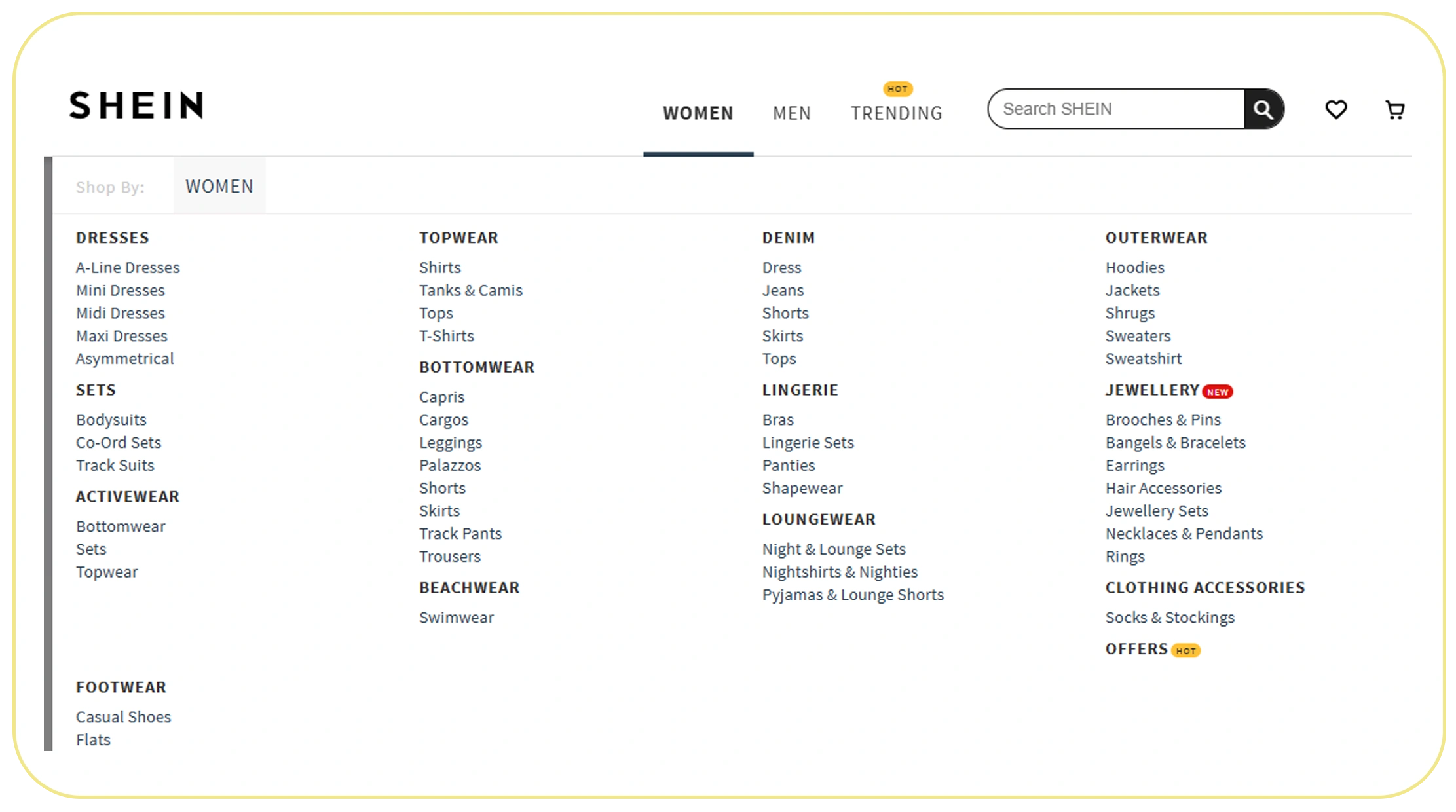
Fashion trends change rapidly, making continuous monitoring essential for retailers, brands, marketplace sellers, and market intelligence teams. Understanding which products gain popularity, which categories experience seasonal demand, and how consumer preferences evolve enables businesses to respond proactively instead of reacting after trends have shifted.
Organizations can scrape SHEIN product data for fashion trend analysis to identify emerging styles, bestselling products, customer buying behavior, pricing movements, inventory fluctuations, and review trends. These structured datasets support forecasting models, merchandising strategies, assortment planning, and promotional optimization.
Businesses typically analyze:
- Trending product categories
- Bestseller rankings
- Seasonal demand
- Price fluctuations
- Customer ratings
- Review sentiment
- Inventory movement
- Product lifecycle
- Brand popularity
- Regional preferences
Continuous fashion intelligence enables companies to align their product offerings with evolving consumer demand while reducing inventory risks and improving profitability.
Fashion Trend Intelligence (2020–2026)
| Year | Trending Products | Monthly New Fashion Styles | Average Rating | Trend Prediction Accuracy |
|---|---|---|---|---|
| 2020 | 210,000 | 48,000 | 4.22 | 78% |
| 2021 | 285,000 | 61,000 | 4.28 | 82% |
| 2022 | 390,000 | 78,000 | 4.33 | 86% |
| 2023 | 510,000 | 96,000 | 4.39 | 89% |
| 2024 | 655,000 | 118,000 | 4.43 | 92% |
| 2025* | 810,000 | 142,000 | 4.47 | 94% |
| 2026* | 980,000 | 168,000 | 4.51 | 96% |
*Projected estimates.
Fashion analytics continues to evolve as marketplaces introduce thousands of new products every week. Between 2020 and 2026, trending product volume is projected to increase by more than four times, while prediction accuracy approaches 96% through advanced analytics and machine learning. Organizations that continuously monitor fashion trends gain earlier visibility into consumer preferences, helping them optimize inventory allocation, launch targeted promotions, improve assortment planning, and reduce markdowns. Trend intelligence also supports product development teams by highlighting fast-growing categories, color preferences, material demand, and seasonal buying patterns that influence future collections.
Why Choose Real Data API?
Retail success depends on timely, accurate, and scalable marketplace intelligence. Real Data API delivers enterprise-grade ecommerce data solutions that help brands, retailers, manufacturers, pricing analysts, and market research firms transform raw marketplace information into actionable business insights.
Businesses worldwide Use SHEIN API to Scrape the Website through Real Data API to automate product intelligence, pricing analysis, review monitoring, inventory tracking, and category analytics with high-quality structured datasets.
Why businesses trust Real Data API
- Enterprise-scale API infrastructure
- Real-time product monitoring
- Automated pricing intelligence
- Product review analytics
- Inventory availability tracking
- AI-powered data validation
- High-frequency data updates
- Structured JSON and CSV outputs
- Custom API integrations
- Global ecommerce marketplace coverage
- Reliable technical support
- Scalable data delivery
Business Performance Benefits
| Capability | Business Advantage |
|---|---|
| Real-time Product Data | Faster merchandising decisions |
| Automated Price Monitoring | Improved competitive pricing |
| Inventory Intelligence | Better stock planning |
| Customer Review Analysis | Enhanced product strategy |
| Trend Analytics | Earlier market opportunity detection |
| Structured API Delivery | Faster integration with BI tools |
Real Data API focuses on delivering clean, reliable, and analytics-ready datasets that integrate seamlessly with business intelligence platforms, pricing engines, forecasting systems, and ecommerce dashboards. By eliminating manual data collection, organizations reduce operational costs while improving reporting accuracy and decision-making speed. Whether monitoring thousands or millions of products, businesses gain scalable infrastructure designed to support continuous retail intelligence across dynamic online marketplaces.
Conclusion
Fashion ecommerce continues to grow rapidly, making accurate marketplace intelligence more valuable than ever. Businesses that Use SHEIN API to Scrape the Website gain continuous access to product listings, pricing, discounts, inventory availability, customer reviews, ratings, and category insights that drive smarter decisions across merchandising, pricing, marketing, and supply chain operations.
From identifying emerging fashion trends to monitoring competitor pricing and analyzing customer sentiment, API-driven data collection enables organizations to replace manual research with automated, scalable, and reliable intelligence. Structured datasets improve forecasting, optimize inventory planning, strengthen promotional strategies, and enhance customer experiences through data-backed decisions.
As digital commerce becomes increasingly competitive, investing in high-quality marketplace analytics is no longer optional—it is a strategic advantage that supports sustainable growth and long-term profitability.
Partner with Real Data API today to unlock reliable SHEIN marketplace intelligence, automate ecommerce data collection, and transform real-time fashion insights into measurable business growth!
Latest posts
How to Scrape Best Buy Atlanta Product Availability and Prices Using API to Power Smarter Pricing Decisions
Use SHEIN API to Scrape the Website - Unlock Actionable Fashion Ecommerce Insights
How to Build Grocery Shopping Apps with the Esselunga API for Real-Time Retail Data Integration
How Businesses Can Improve Profitability with web scraping Dynamic pricing using marketplace data?







.png)