Introduction
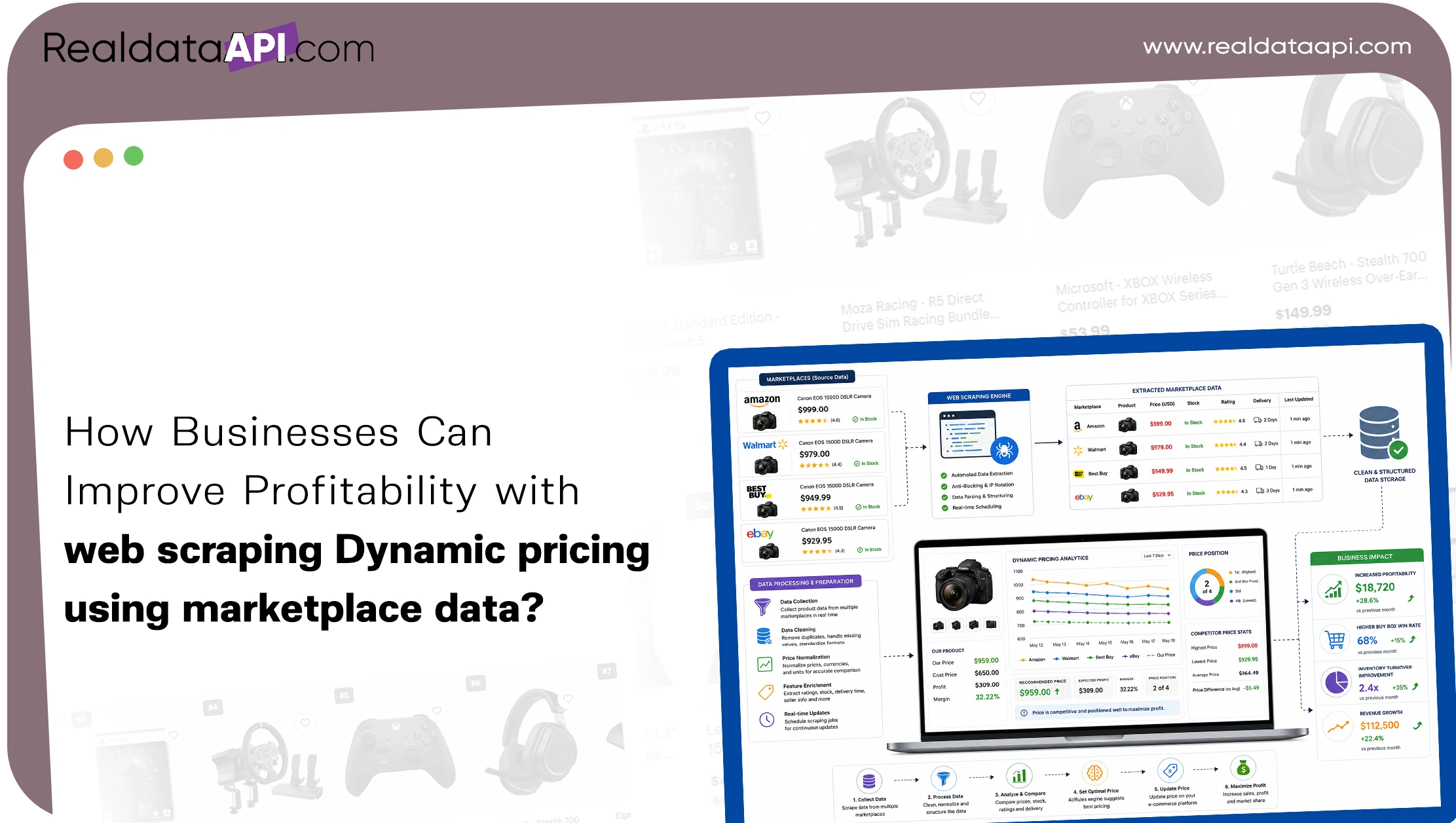
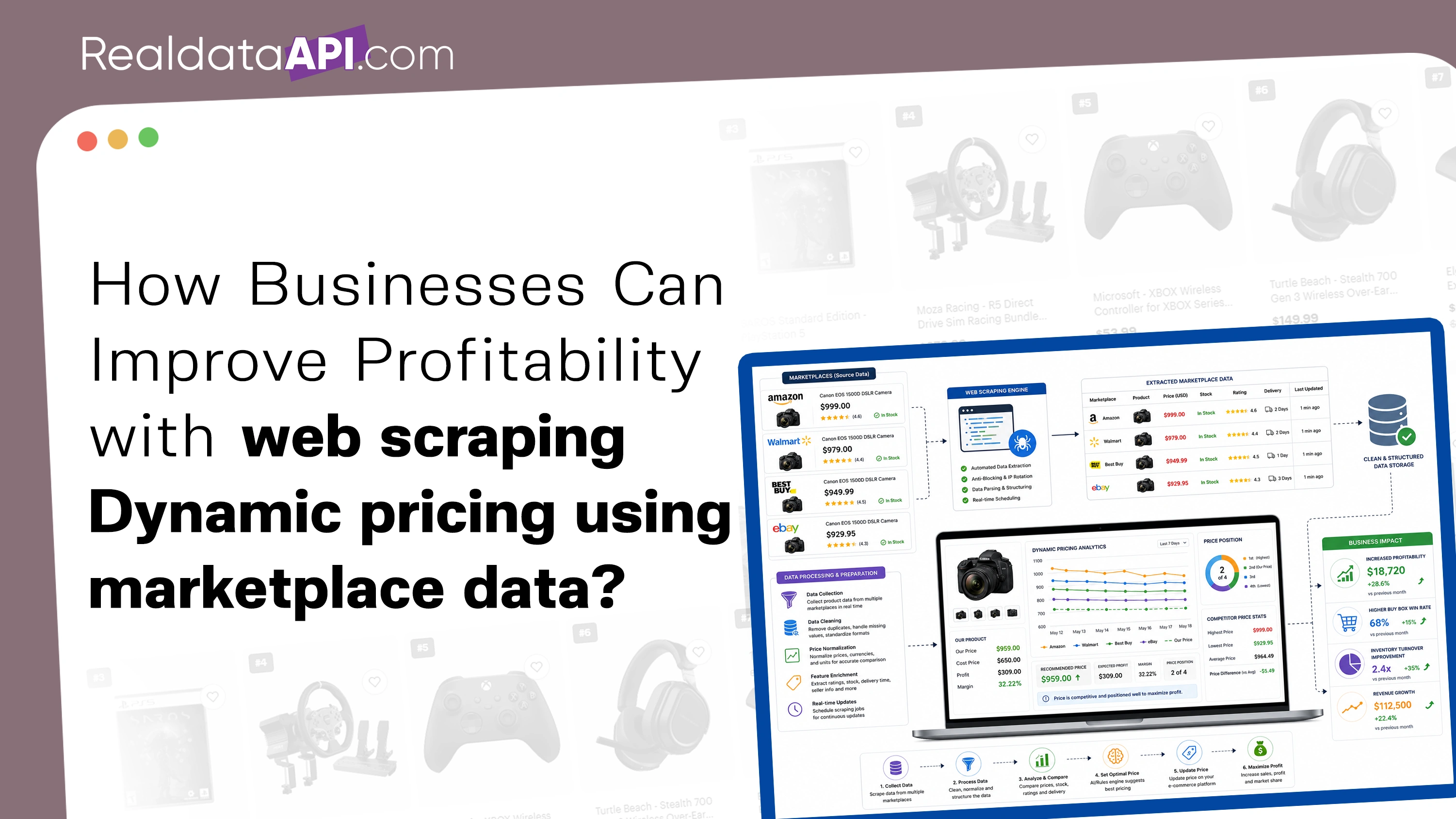
Bottom Line Up Front (BLUF): Businesses can significantly improve profitability by leveraging web scraping Dynamic pricing using marketplace data to monitor competitor prices, identify pricing trends, optimize promotions, and make faster pricing decisions. Combined with Price Monitoring , this approach enables retailers to maximize margins, enhance customer satisfaction, and stay competitive in dynamic online marketplaces.
According to industry estimates, companies that adopt data-driven pricing strategies can increase profit margins by 5–10% while improving pricing accuracy by over 30%. Between 2020 and 2026, global eCommerce sales have continued to rise rapidly, creating a greater need for real-time pricing intelligence. Retailers now compete across hundreds of marketplaces where prices change several times a day, making manual monitoring ineffective.
For eCommerce managers, pricing analysts, marketplace sellers, and retail decision-makers, timely market intelligence has become essential. Businesses need automated solutions that continuously collect pricing information, compare competitors, detect promotional changes, and generate actionable insights. These capabilities help companies respond quickly to market fluctuations, improve customer retention, and maximize revenue without sacrificing profitability.
This guide explains how marketplace pricing intelligence supports better pricing decisions, why automation matters, and how organizations can use data-driven strategies to gain a sustainable competitive advantage.
Industry Insight: Research suggests that more than 80% of online shoppers compare prices across multiple platforms before making a purchase, making competitive pricing one of the strongest factors influencing purchasing decisions.
How Can Marketplace Pricing Intelligence Improve Business Decisions?
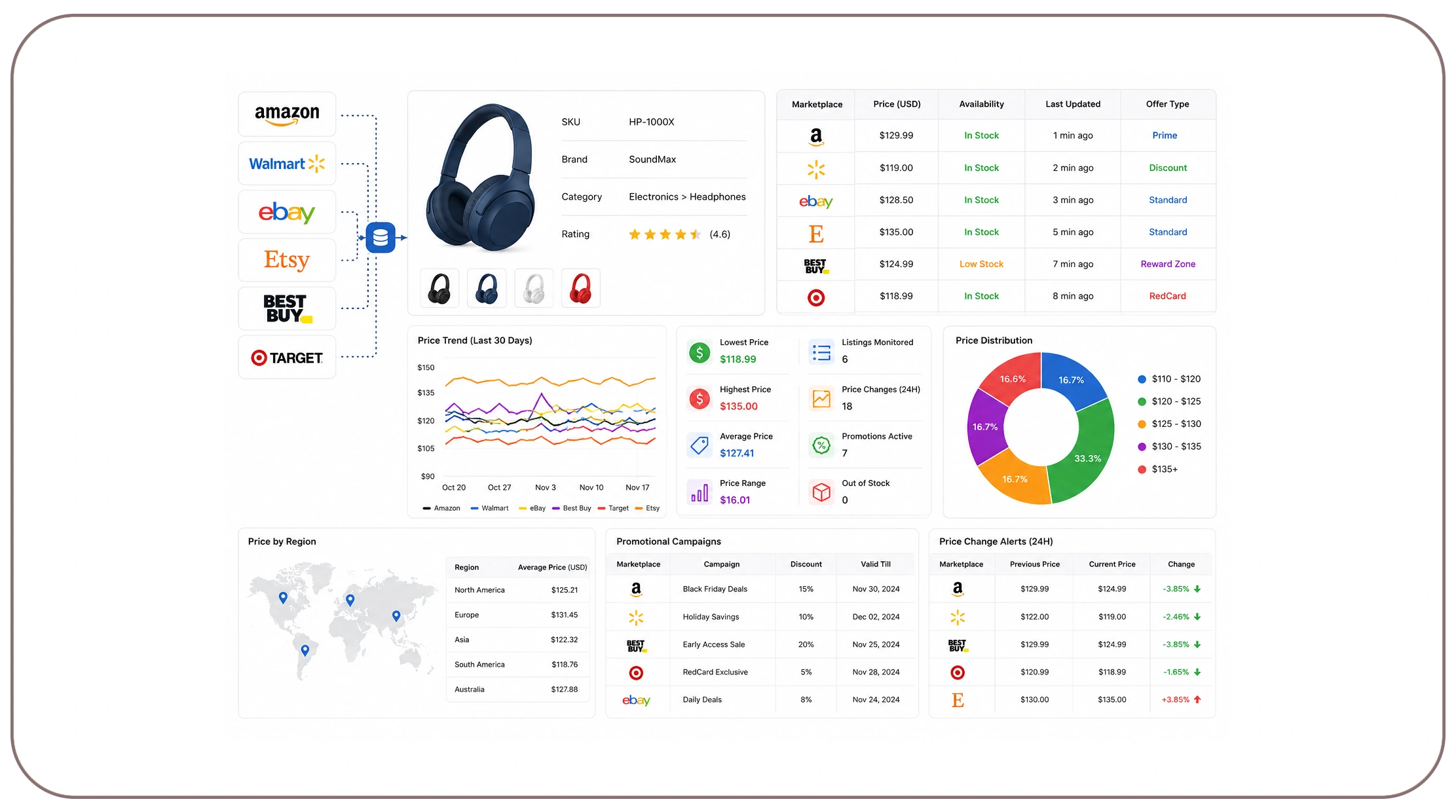
Modern retailers cannot rely on periodic price checks. Marketplaces update prices continuously based on competitor actions, inventory availability, seasonal demand, and promotional campaigns. Businesses that fail to respond quickly often lose customers and revenue.
One effective approach is using scrape Marketplace pricing data intelligence for eCommerce to collect structured pricing information from multiple marketplaces in real time. Instead of manually reviewing hundreds of listings, organizations receive accurate pricing intelligence that supports faster and more informed decision-making.
This data enables businesses to:
- Track competitor pricing across multiple marketplaces.
- Identify premium and discount pricing trends.
- Compare prices by brand, category, and SKU.
- Monitor promotional campaigns and limited-time offers.
- Detect sudden price fluctuations.
- Evaluate regional pricing differences.
- Improve assortment planning.
- Support inventory optimization.
Marketplace pricing intelligence also improves forecasting. Historical pricing data reveals seasonal trends and recurring promotional cycles that help businesses prepare future pricing strategies. Retailers can identify the best time to launch campaigns, adjust inventory, and optimize discounts while protecting profit margins.
Another advantage is improved product positioning. Companies can determine whether products should compete on price, premium value, exclusive bundles, or promotional offers instead of relying solely on discounting.
Marketplace Pricing Intelligence Trends (2020–2026)
| Year | Businesses Using Pricing Intelligence | Average Daily Price Changes | Pricing Accuracy Improvement |
|---|---|---|---|
| 2020 | 38% | 6 | 18% |
| 2021 | 45% | 8 | 21% |
| 2022 | 53% | 11 | 25% |
| 2023 | 61% | 15 | 29% |
| 2024 | 69% | 19 | 32% |
| 2025 | 76% | 24 | 36% |
| 2026* | 83% | 30+ | 40% |
Projected industry estimates.
As marketplaces continue to expand globally, businesses that invest in automated pricing intelligence gain better visibility into market conditions and improve decision-making speed compared to competitors relying on manual analysis.
Why Should Retailers Continuously Adapt Their Pricing Strategy?
Customer expectations continue to evolve as shoppers compare prices across numerous marketplaces before making a purchase. Static pricing models no longer provide enough flexibility to remain competitive.
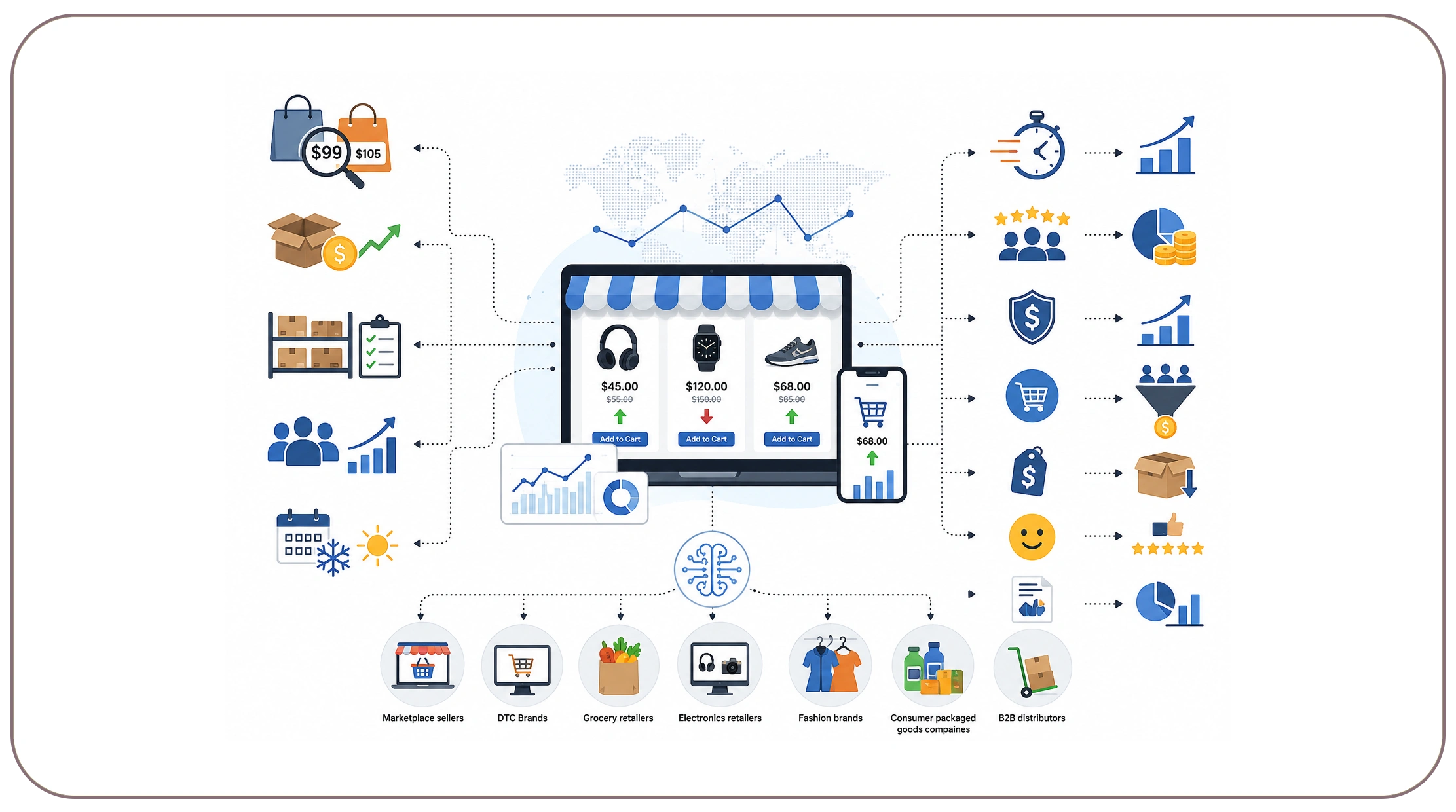
Businesses increasingly rely on Dynamic pricing strategies for online retailers to adjust prices based on market conditions, competitor activity, inventory levels, customer demand, and seasonal fluctuations. Rather than maintaining fixed prices, retailers continuously optimize pricing to maximize both sales volume and profitability.
Dynamic pricing offers several important advantages:
- Respond faster to competitor price changes.
- Maximize revenue during periods of high demand.
- Protect margins when supplier costs increase.
- Increase conversion rates with competitive pricing.
- Improve promotional effectiveness.
- Reduce inventory holding costs.
- Enhance customer satisfaction through fair pricing.
- Support data-driven business planning.
Retailers also benefit from predictive analytics. Historical marketplace data combined with AI models helps forecast future pricing movements, enabling businesses to make proactive decisions instead of reacting after competitors have already changed prices.
Dynamic pricing supports multiple retail models, including:
- Marketplace sellers
- Direct-to-consumer brands
- Grocery retailers
- Electronics retailers
- Fashion brands
- Consumer packaged goods companies
- B2B distributors
Instead of applying uniform discounts across all products, businesses can tailor pricing by category, location, customer segment, or inventory availability. This targeted approach preserves margins while maintaining competitiveness.
Dynamic Pricing Adoption (2020–2026)
| Year | Retailers Using Dynamic Pricing | Revenue Improvement | Margin Improvement |
|---|---|---|---|
| 2020 | 32% | 4% | 3% |
| 2021 | 40% | 5% | 4% |
| 2022 | 49% | 6% | 5% |
| 2023 | 58% | 7% | 6% |
| 2024 | 67% | 8% | 7% |
| 2025 | 74% | 9% | 8% |
| 2026* | 82% | 11% | 10% |
Projected industry estimates.
As AI, automation, and advanced analytics continue to evolve, adaptive pricing will become a core capability for successful retailers. Businesses that continuously monitor market conditions and optimize pricing strategies are better positioned to improve profitability, strengthen customer loyalty, and achieve sustainable growth.
How Can Automation Simplify Competitive Pricing Operations?
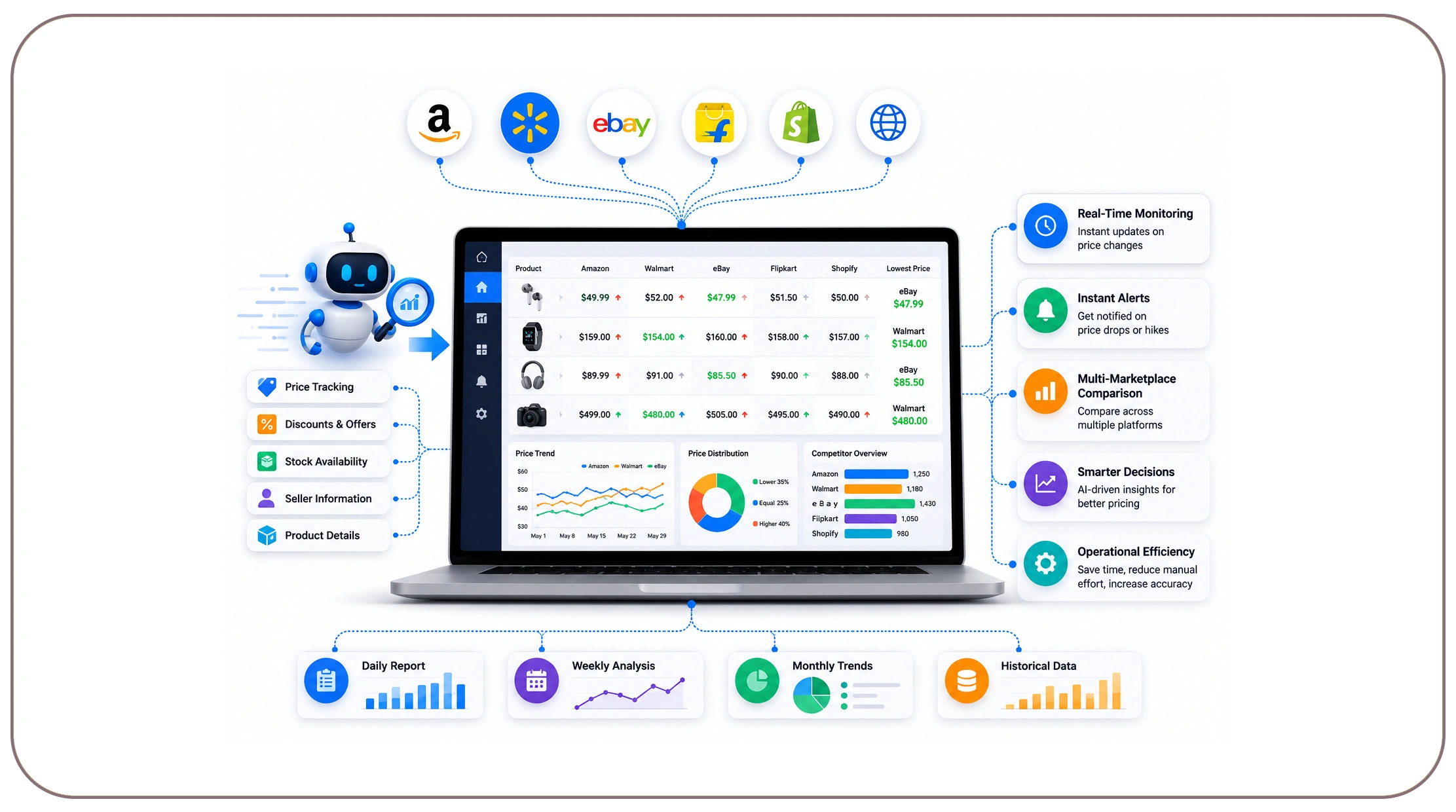
Manual price tracking is time-consuming and often inaccurate in fast-moving marketplaces. A retailer selling thousands of products across Amazon, Walmart, eBay, and other platforms cannot realistically monitor every price change throughout the day. This is where automation becomes essential.
Businesses are increasingly adopting Automated marketplace price monitoring services to collect pricing data continuously and deliver real-time competitive insights. Automated systems crawl marketplace listings, capture product prices, discounts, stock availability, seller information, and promotional offers, then organize the data into dashboards and reports.
Automation offers several operational benefits:
- Monitor millions of SKUs simultaneously.
- Receive instant alerts on competitor price changes.
- Track flash sales and promotional events.
- Compare prices across multiple marketplaces.
- Reduce manual research time.
- Improve pricing consistency across channels.
- Enable faster pricing decisions.
- Support AI-driven pricing recommendations.
Another key advantage is scalability. Whether a business monitors 500 products or 5 million SKUs, automated solutions can process large datasets with speed and accuracy. This enables pricing teams to focus on strategy instead of repetitive data collection.
Automation also improves cross-functional collaboration. Marketing teams gain visibility into promotional pricing, procurement teams understand supplier cost impacts, and executives access dashboards that summarize market trends. This shared intelligence supports more informed business decisions.
Retailers can also schedule automated reports daily, weekly, or monthly to analyze pricing performance over time. Historical pricing records reveal competitor behavior, seasonal trends, and recurring promotional cycles that help shape future pricing strategies.
Marketplace Automation Growth (2020–2026)
| Year | Businesses Using Automated Monitoring | Avg. Daily SKUs Monitored | Time Saved |
|---|---|---|---|
| 2020 | 29% | 20,000 | 35% |
| 2021 | 37% | 35,000 | 42% |
| 2022 | 46% | 55,000 | 50% |
| 2023 | 56% | 85,000 | 58% |
| 2024 | 66% | 120,000 | 65% |
| 2025 | 75% | 180,000 | 71% |
| 2026* | 84% | 250,000+ | 78% |
Projected industry estimates.
Automation transforms pricing intelligence from a reactive process into a proactive strategy. Businesses can identify opportunities before competitors, respond to market changes instantly, and optimize pricing decisions with greater confidence.
Why Is Continuous Product Tracking Important for Retail Growth?
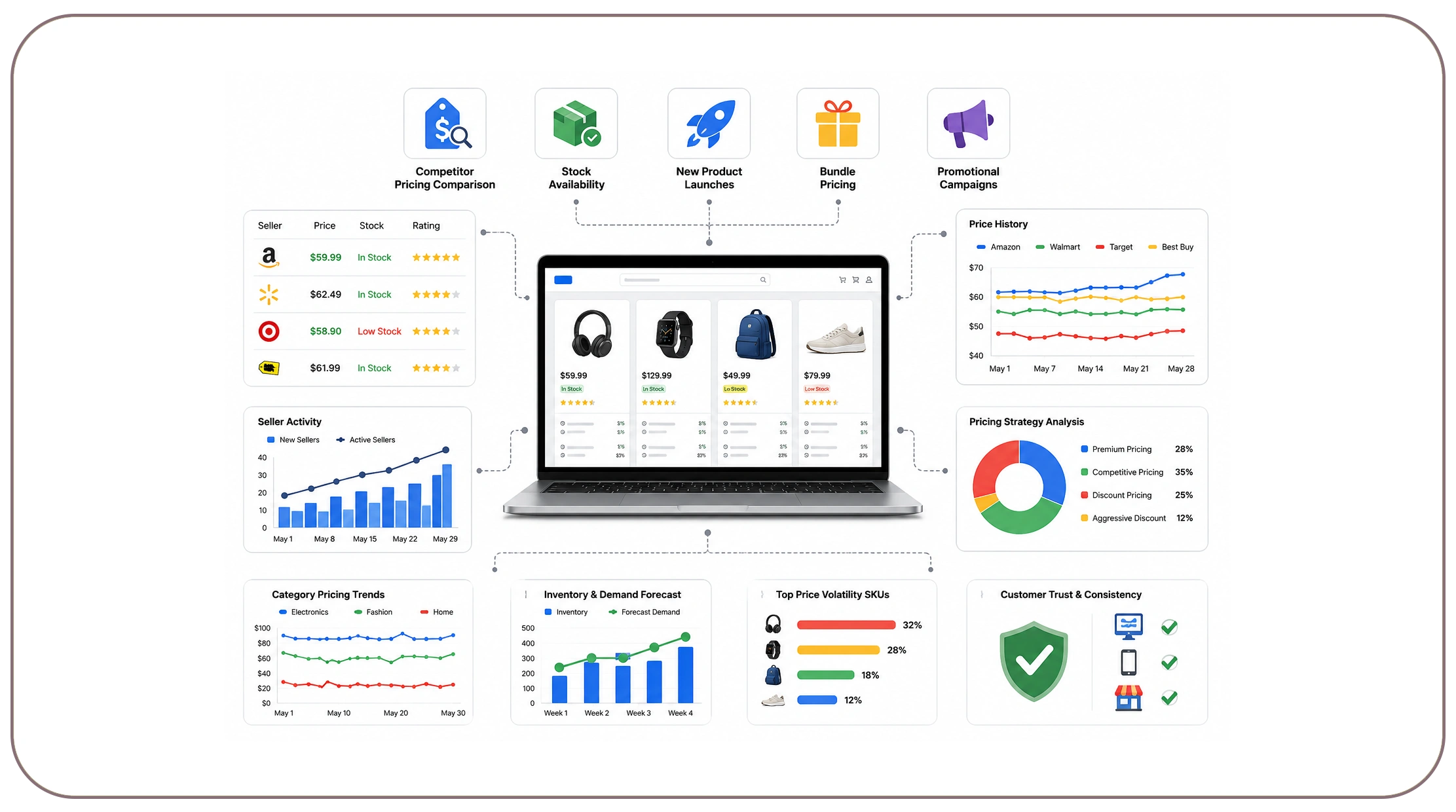
Successful retailers understand that pricing is only one part of the competitive landscape. Product availability, discounts, seller ratings, bundled offers, and inventory changes also influence customer purchasing decisions. Continuous monitoring provides a complete picture of marketplace performance.
Many organizations invest in Product price monitoring for retail businesses to gain deeper visibility into competitor activities and consumer behavior. Instead of checking prices occasionally, they track product performance throughout the day and analyze how pricing decisions affect sales.
Continuous product tracking helps businesses:
- Compare competitor pricing across regions.
- Monitor stock availability.
- Detect new product launches.
- Track bundle pricing.
- Analyze promotional campaigns.
- Identify premium and discount pricing strategies.
- Measure category-level pricing trends.
- Improve assortment planning.
Retailers also benefit from monitoring marketplace seller activity. A sudden increase in third-party sellers or aggressive discounting may require pricing adjustments to remain competitive. Historical tracking enables businesses to distinguish between temporary promotions and long-term pricing shifts.
Product-level insights also improve demand forecasting. Businesses can evaluate which SKUs experience the highest pricing volatility and determine the optimal inventory levels for peak shopping seasons.
Another advantage is customer trust. Consistent pricing across online channels reduces confusion, improves shopping experiences, and strengthens brand reputation.
Product Monitoring Trends (2020–2026)
| Year | Products Tracked Daily | Retailers Using Continuous Monitoring | Pricing Accuracy |
|---|---|---|---|
| 2020 | 10 Million | 34% | 78% |
| 2021 | 16 Million | 41% | 81% |
| 2022 | 24 Million | 50% | 84% |
| 2023 | 35 Million | 60% | 87% |
| 2024 | 48 Million | 69% | 90% |
| 2025 | 63 Million | 77% | 93% |
| 2026* | 82 Million | 85% | 95% |
Projected industry estimates.
Continuous monitoring empowers retailers to make informed pricing decisions based on real-time market conditions rather than assumptions. This leads to stronger profitability, better inventory utilization, and improved customer satisfaction.
What Makes Adaptive Pricing a Long-Term Competitive Advantage?

Pricing is no longer a one-time business decision. In today's digital marketplace, prices must evolve alongside customer demand, competitor behavior, inventory levels, and seasonal trends. Companies that adapt quickly gain a measurable competitive advantage.
Implementing Dynamic Pricing enables businesses to respond intelligently to changing market conditions without relying on manual interventions. AI-powered algorithms and pricing models evaluate multiple variables simultaneously, helping retailers determine the most profitable price at any given moment.
Key benefits include:
- Maximize revenue during high-demand periods.
- Increase conversion rates with competitive prices.
- Protect profit margins during cost fluctuations.
- Reduce excess inventory through optimized discounts.
- Improve customer retention.
- React instantly to competitor pricing changes.
- Support personalized pricing strategies.
- Strengthen long-term business growth.
Adaptive pricing also allows businesses to segment pricing strategies by geography, customer behavior, loyalty programs, and product categories. Instead of applying blanket discounts, retailers can create targeted promotions that improve profitability while maintaining customer value.
As artificial intelligence continues to advance, adaptive pricing systems will increasingly predict future market movements rather than simply responding to them. Predictive pricing models help businesses prepare for seasonal demand spikes, supplier cost changes, and promotional events before they occur.
Adaptive Pricing Adoption (2020–2026)
| Year | Businesses Using Adaptive Pricing | Revenue Growth | Customer Retention |
|---|---|---|---|
| 2020 | 30% | 4% | 72% |
| 2021 | 39% | 5% | 74% |
| 2022 | 48% | 6% | 77% |
| 2023 | 57% | 7% | 80% |
| 2024 | 66% | 8% | 83% |
| 2025 | 75% | 9% | 86% |
| 2026* | 84% | 11% | 89% |
Projected industry estimates.
Businesses that embrace adaptive pricing can improve operational efficiency, respond faster to market dynamics, and build sustainable competitive advantages in an increasingly data-driven retail environment.
How Can Real-Time Intelligence Help Businesses Make Faster Pricing Decisions?
In modern retail, pricing opportunities can appear and disappear within hours. Flash sales, inventory shortages, competitor promotions, and seasonal demand can rapidly change market conditions. Businesses that rely on outdated reports often miss valuable opportunities to improve profitability.
Modern retailers increasingly depend on Real-Time Retail Pricing Intelligence API Solutions to access continuously updated marketplace information. APIs automatically collect, process, and deliver pricing intelligence from multiple online marketplaces into business dashboards, ERP platforms, pricing engines, and analytics systems.
Real-time pricing intelligence helps businesses:
- Monitor competitor prices 24/7.
- Detect promotional campaigns immediately.
- Track product availability across marketplaces.
- Analyze pricing by region and seller.
- Improve forecasting accuracy.
- Power AI-driven pricing models.
- Automate reporting and alerts.
- Support enterprise-wide pricing decisions.
Unlike manual reporting, API-based intelligence delivers structured data instantly, enabling organizations to react before competitors. Retailers can automatically trigger price adjustments, promotional updates, or inventory decisions based on predefined business rules.
These APIs also integrate seamlessly with business intelligence platforms, allowing pricing analysts, category managers, and executives to access the same reliable data. This improves collaboration across departments while reducing delays caused by manual data collection.
For organizations operating across multiple countries or marketplaces, real-time APIs provide a unified view of pricing performance, making it easier to compare regional trends and identify new growth opportunities.
Real-Time Pricing Intelligence Adoption (2020–2026)
| Year | Businesses Using Pricing APIs | Avg. Response Time | Pricing Decision Speed |
|---|---|---|---|
| 2020 | 26% | 12 Hours | 68% |
| 2021 | 34% | 8 Hours | 72% |
| 2022 | 43% | 5 Hours | 77% |
| 2023 | 54% | 2 Hours | 84% |
| 2024 | 66% | 45 Minutes | 90% |
| 2025 | 77% | 20 Minutes | 95% |
| 2026* | 86% | Real Time | 98% |
Projected industry estimates.
Organizations that invest in real-time pricing intelligence gain faster decision-making capabilities, better competitive visibility, and improved profitability through timely market responses.
Why Choose Real Data API?
Real Data API empowers retailers, brands, manufacturers, and marketplace sellers with enterprise-grade pricing intelligence solutions that simplify data collection and support smarter business decisions. Whether you need competitor analysis, marketplace monitoring, or pricing optimization, our scalable APIs deliver reliable and actionable insights.
Our solutions help organizations Perform Price Elasticity Analysis Using Scraped Retail Data to understand how price changes influence customer demand and purchasing behavior. By combining historical pricing trends with live marketplace intelligence, businesses can identify the optimal pricing strategy that balances revenue growth and profitability.
With expertise in web scraping Dynamic pricing using marketplace data , Real Data API provides:
- Real-time marketplace price monitoring.
- Multi-marketplace product tracking.
- SKU-level pricing intelligence.
- Historical pricing datasets.
- Promotion and discount monitoring.
- Inventory and availability tracking.
- AI-ready structured data.
- Secure, scalable, and customizable APIs.
- Automated reporting dashboards.
- Global marketplace coverage.
Our technology is designed for retailers, pricing analysts, eCommerce businesses, market researchers, manufacturers, and enterprise organizations seeking accurate and reliable pricing intelligence at scale.
By automating marketplace data collection, businesses can eliminate manual work, improve pricing accuracy, respond faster to market changes, and make confident data-driven decisions.
Conclusion
Profitability in today's digital marketplace depends on accurate, timely, and actionable pricing intelligence. Businesses that continuously monitor competitors, analyze pricing trends, automate data collection, and implement intelligent pricing strategies consistently outperform those relying on manual processes.
Leveraging web scraping Dynamic pricing using marketplace data enables organizations to respond quickly to market fluctuations, optimize promotional campaigns, improve customer satisfaction, and maximize revenue opportunities. Combined with AI-driven analytics and real-time pricing intelligence, businesses can build sustainable competitive advantages while protecting profit margins.
As online marketplaces continue to evolve through 2026 and beyond, investing in automated pricing intelligence will become a strategic necessity rather than a competitive advantage.
Ready to transform your pricing strategy? Contact Real Data API today to leverage advanced marketplace intelligence solutions and unlock smarter, faster, and more profitable pricing decisions with enterprise-grade data solutions!
Latest posts
How to Scrape Best Buy Atlanta Product Availability and Prices Using API to Power Smarter Pricing Decisions

Use SHEIN API to Scrape the Website - Unlock Actionable Fashion Ecommerce Insights
How to Build Grocery Shopping Apps with the Esselunga API for Real-Time Retail Data Integration
How Businesses Can Improve Profitability with web scraping Dynamic pricing using marketplace data?






.png)



