Quick Summary
- Coupang Scraper helps retailers, brands, marketplace analysts, and e-commerce teams organize product, price, seller, review, and availability information for recurring market monitoring.
- Coupang Product Data Scraping supports structured historical datasets that can reveal product assortment changes, pricing movements, seller activity, and customer-feedback patterns.
- The resulting datasets can strengthen competitive intelligence, marketplace research, assortment planning, and data-driven pricing decisions.
Introduction
Businesses can monitor Coupang marketplace changes more systematically by collecting structured information on products, prices, sellers, reviews, ratings, and availability. Coupang Scraper workflows can turn frequently changing marketplace information into organized datasets that support competitor research, product intelligence, pricing analysis, and seller monitoring.
Coupang is a major South Korean e-commerce platform, and its scale makes marketplace visibility increasingly important for brands and retailers operating in or researching the Korean market. Coupang reported total net revenue of $34.53 billion in 2025, compared with $30.27 billion in 2024 and $24.38 billion in 2023. Product Commerce generated $29.59 billion in 2025.
For a retailer, the challenge is not simply finding product information. The bigger challenge is maintaining a consistent historical view when prices, listings, seller participation, customer feedback, and availability can change. Coupang Product Data Scraping can address this challenge by creating structured records that can be refreshed on a defined schedule.
This is particularly useful for brands managing large product catalogs, marketplace sellers tracking competitors, distributors researching assortment opportunities, and analysts studying South Korea's e-commerce ecosystem. A well-designed dataset can connect product-level attributes with timestamps, seller information, prices, ratings, review counts, and availability indicators.
The key question is therefore straightforward: How can businesses monitor products, prices, sellers, reviews, and market changes on Coupang without relying on manual checks? The answer is a recurring data pipeline that captures relevant marketplace fields, validates them, stores historical snapshots, and makes the information available for analysis.
How can structured product monitoring improve marketplace visibility?

Coupang product data web scraping can help businesses build a structured product universe containing product names, categories, brands, SKUs or product identifiers where accessible, prices, discounts, ratings, review counts, availability, URLs, and other relevant attributes.
For a brand manager, this creates a searchable view of the marketplace rather than isolated observations. Products can be grouped by category, brand, price range, rating, seller, or availability status. This makes it easier to identify assortment gaps, newly appearing products, changes in product positioning, and competing offers.
A practical workflow should begin by defining the business questions. A pricing team may need product IDs, current prices, discounts, and timestamps. A category manager may require product names, brands, categories, pack sizes, ratings, reviews, and availability. A marketplace team may require seller information and listing-level attributes.
| Year | Coupang total net revenue | Key operating context |
|---|---|---|
| 2020 | $11.97B | Active Customers reached 14.85M in Q4 |
| 2021 | $18.41B | Active Customers reached 17.94M in Q4 |
| 2022 | $20.58B | Active Customers reached 18.12M in Q4 |
| 2023 | $24.38B | Product Commerce revenue reached $23.59B |
| 2024 | $30.27B | Product Commerce revenue reached $26.70B |
| 2025 | $34.53B | Product Commerce revenue reached $29.59B |
| 2026 | — | 2025 annual results provide the latest full-year benchmark |
Sources: Coupang SEC filings. 2020–2022 figures are reported by Coupang; 2023–2025 figures come from its subsequent annual filings. 2026 is shown as the current reporting year rather than an invented full-year result.
The 2020–2026 period shows why recurring marketplace monitoring matters. In 2020, Coupang reported $11.97 billion in total net revenue and approximately 14.85 million Active Customers in Q4. In 2021, annual revenue increased to $18.41 billion, while Q4 Active Customers reached approximately 17.94 million. In 2022, total revenue reached $20.58 billion and Q4 Active Customers increased to 18.12 million.
In 2023, revenue reached $24.38 billion, followed by $30.27 billion in 2024 and $34.53 billion in 2025. Coupang's Product Commerce segment reached $29.59 billion in 2025.
For businesses, this growth provides context for the amount of marketplace information that may need to be monitored. As assortment and transaction activity expand, manually checking individual listings becomes difficult to maintain. A structured collection process makes product monitoring repeatable and gives analysts a historical record rather than a one-time snapshot.
How can customer feedback become measurable marketplace intelligence?
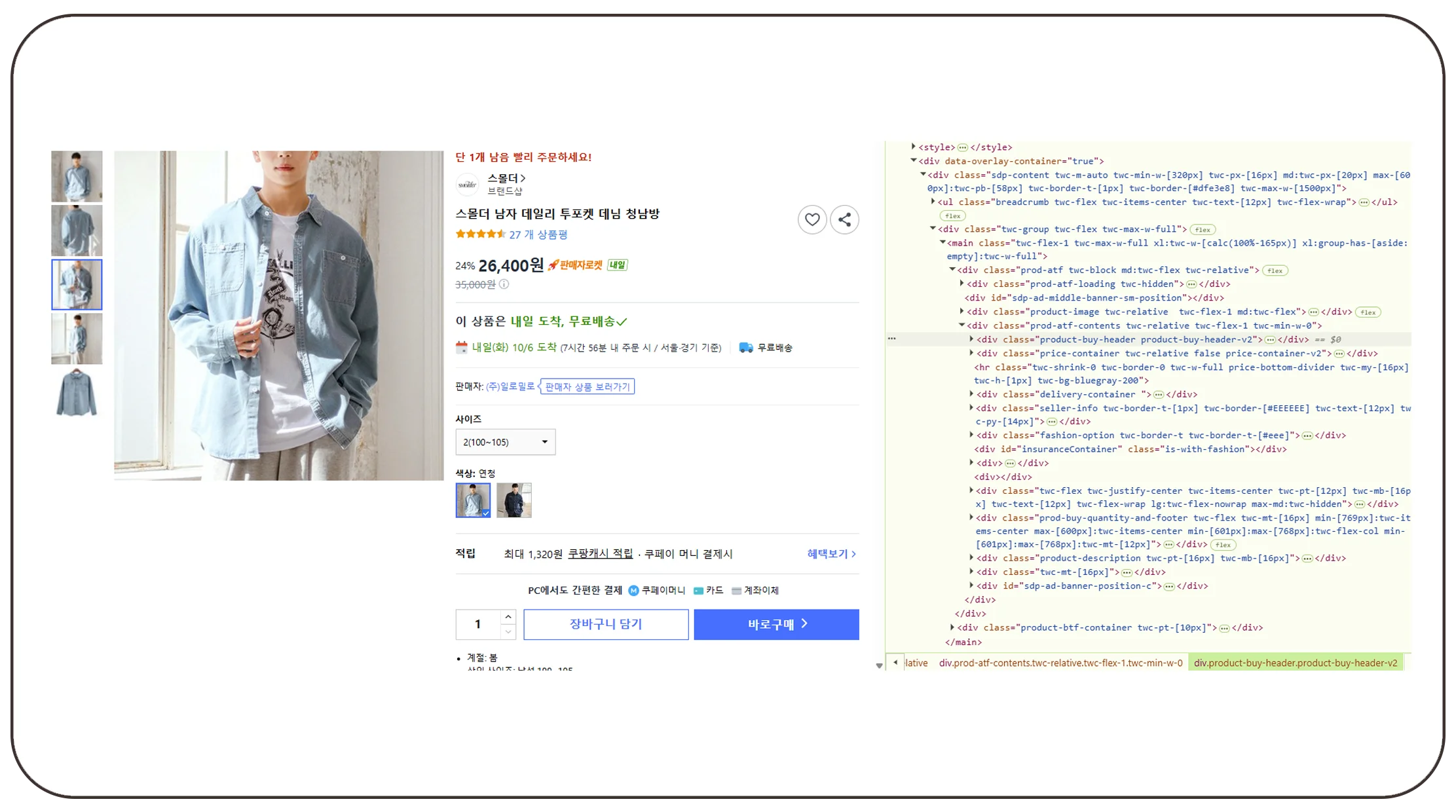
Customer reviews can reveal information that product and price fields cannot. Review counts, ratings, rating distributions, review growth, and recurring customer themes can help businesses understand how consumers respond to products.
Coupang review data collection services can organize publicly displayed review-related information into datasets that analysts can connect with product, brand, seller, and price attributes.
For example, a product with a 4.8-star rating and 40 reviews represents a different customer-engagement signal from a product with a 4.5-star rating and 20,000 reviews. Neither measurement should be interpreted in isolation. Review volume provides context for the rating, while changes over time can reveal increasing customer attention.
| Metric | What it can show | Example application |
|---|---|---|
| Average rating | Overall customer evaluation | Product comparison |
| Review count | Customer engagement volume | Product momentum |
| Rating distribution | Spread of customer scores | Quality analysis |
| Review growth | Change in engagement | Launch monitoring |
| Review themes | Common customer topics | Product research |
| Review timestamp | Recency | Trend monitoring |
The 2020–2026 period is relevant because Coupang's customer base expanded significantly. Coupang reported approximately 14.85 million Active Customers in Q4 2020 and 17.94 million in Q4 2021. Q4 2022 Active Customers reached approximately 18.12 million.
This growth means customer feedback can become an increasingly valuable component of product intelligence. In 2021, Coupang also reported that Active Customers increased 21% year over year and that paid WOW membership approached 9 million customers at the end of the year.
By 2023, 2024, and 2025, Coupang's total revenue had increased to $24.38 billion, $30.27 billion, and $34.53 billion respectively.
For brands, historical review data can help identify products receiving increasing attention, products with changing rating patterns, and categories where customer feedback is particularly active. For retailers, review information can supplement assortment decisions. For product teams, recurring review themes can provide an additional input for product development.
The key is consistency. A dataset should preserve collection dates so that analysts can distinguish current ratings from historical ratings. It should also retain product identifiers wherever possible, helping prevent products from being treated as new records simply because their listing details change.
How can seller intelligence reveal marketplace changes?
Seller information adds another layer to product-market analysis. A product can remain unchanged while the competitive environment around that product changes substantially through new sellers, different offers, stock conditions, or price movements.
A Coupang seller data API workflow can structure accessible seller-level information alongside product records. Depending on the available fields, datasets can include seller names or identifiers, product associations, listed prices, ratings, review-related information, availability, and other marketplace attributes.
| Seller signal | Monitoring objective |
|---|---|
| Seller identity | Identify marketplace participants |
| Product association | Map sellers to products |
| Price | Compare seller offers |
| Availability | Identify listing changes |
| Seller rating | Monitor seller performance indicators |
| Review volume | Track customer engagement |
| Listing status | Detect marketplace changes |
Seller monitoring becomes especially relevant when multiple marketplace participants offer similar or identical products. A recurring dataset can help businesses compare seller-level changes rather than analyzing only the product itself.
From 2020 through 2022, Coupang's reported revenue expanded from $11.97 billion to $20.58 billion. Its Active Customer count in Q4 increased from 14.85 million in 2020 to 18.12 million in 2022.
Coupang also reported that third-party merchant services generated $1.87 billion in 2022, compared with $1.70 billion in 2021 and $789.6 million in 2020. The company described these merchant services as including commissions, advertising, and delivery fees earned from merchants and restaurants selling through its online business.
This information demonstrates why seller-level data can matter to marketplace researchers. The marketplace includes activity beyond direct product sales, creating a need to understand merchant participation and offer-level changes.
From 2023 to 2025, Coupang's total revenue increased from $24.38 billion to $34.53 billion, while Product Commerce revenue rose from $23.59 billion to $29.59 billion.
For brands and marketplace teams, seller monitoring can therefore support competitor identification, offer comparison, channel research, and marketplace structure analysis. The most useful datasets preserve historical seller-product relationships so that changes can be studied over time.
Turn changing marketplace activity into structured intelligence with recurring product, seller, pricing, and customer-data monitoring!
Get Insights Now!How does real-time pricing information support competitive analysis?
Price is one of the most dynamic variables in e-commerce. A product can move from a regular price to a promotional price, return to its standard price, become unavailable, or receive a different offer from another seller.
real-time Coupang price data can help businesses monitor these changes at scheduled intervals and compare price observations against historical records.
A useful pricing dataset should include the product identifier, product name, seller where available, current price, previous observed price, discount information, currency, availability, URL, and timestamp.
| Field | Example purpose |
|---|---|
| Product ID | Record matching |
| Product name | Product identification |
| Seller | Offer-level comparison |
| Current price | Current market view |
| Previous price | Historical comparison |
| Discount | Promotion analysis |
| Availability | Stock-status context |
| Timestamp | Change detection |
Coupang's financial scale provides a useful backdrop. Total net revenue increased from $11.97 billion in 2020 to $18.41 billion in 2021, $20.58 billion in 2022, $24.38 billion in 2023, $30.27 billion in 2024, and $34.53 billion in 2025.
The 2020–2026 period also illustrates why historical price data should not be confused with a single current price. In 2020, Coupang reported that changes in consumer behavior during the COVID-19 pandemic affected net retail sales. The company also attributed 2020 growth partly to increased product selection and additional offerings.
In 2021, the company continued reporting strong customer and revenue growth. In 2022, it reported that Product Commerce revenue increased 12% year over year, driven partly by growth in Active Customers, increased owned-inventory selection, and customer engagement across more product categories.
By 2024 and 2025, Product Commerce revenue had reached $26.70 billion and $29.59 billion respectively.
For a pricing team, these market-scale changes reinforce the need for historical datasets. A daily or weekly snapshot can reveal price movements that would otherwise disappear after a listing changes. Analysts can calculate price differences, identify promotional periods, compare seller offers, and segment changes by category or brand.
Real-time collection should be designed around the business requirement. Some organizations need frequent monitoring for fast-moving categories, while others may require daily or weekly snapshots. The appropriate frequency depends on product velocity, pricing volatility, and the decisions the dataset supports.
What should a scalable monitoring pipeline include?
A Coupang Scraper should be treated as a data pipeline rather than a simple extraction script. The strongest workflow begins with a defined product universe, collects relevant fields, validates the records, normalizes values, stores historical snapshots, and delivers the output in an analytics-ready format.
For Real Data API projects, the pipeline can be designed around the buyer's specific monitoring requirements instead of collecting every possible field.
| Stage | Main activity | Business benefit |
|---|---|---|
| Discovery | Identify target products and pages | Defined monitoring universe |
| Extraction | Collect required marketplace fields | Structured raw data |
| Validation | Check missing or invalid records | Better data quality |
| Normalization | Standardize values and formats | Easier comparisons |
| Deduplication | Match repeated products | Cleaner datasets |
| Historical storage | Preserve snapshots | Trend analysis |
| Delivery | API, CSV, JSON, or database | Workflow integration |
| Analytics | Build dashboards and reports | Faster decisions |
A scalable pipeline is especially useful because marketplace information is not static. Product names may change, prices may move, sellers may appear or disappear, and review counts can increase continuously.
The 2020–2026 timeline illustrates the expansion of the underlying marketplace. Coupang's annual revenue rose from $11.97 billion in 2020 to $34.53 billion in 2025. Product Commerce revenue increased from $17.84 billion in 2021 to $29.59 billion in 2025.
Coupang's Q4 Active Customers also increased from approximately 14.85 million in 2020 to 17.94 million in 2021 and 18.12 million in 2022.
For data buyers, these figures do not directly measure the number of marketplace listings or the amount of data available for extraction. Instead, they provide context for the scale and growth of Coupang's commercial ecosystem.
A repeatable pipeline should therefore preserve timestamps and historical versions. Overwriting yesterday's price with today's price destroys useful information. Storing both observations creates a time series that can be analyzed later.
The same principle applies to seller and review information. A seller relationship that exists today may not exist tomorrow. A review count that increases from one collection period to another represents a measurable change. Historical storage turns those individual changes into an analyzable sequence.
Data quality is equally important. Automated validation can identify missing product names, malformed prices, duplicate records, unexpected field changes, and inconsistent availability values before the dataset reaches the analytics layer.
How can marketplace data connect with broader e-commerce intelligence?
Marketplace data becomes more valuable when it can be combined with information from other e-commerce channels. A brand may want to compare product positioning across retailers, analyze category-level price differences, monitor seller presence, or combine review trends with product assortment data.
E-Commerce Data Scraping can provide a broader framework for collecting structured online retail information across multiple permitted sources. A standardized schema can make datasets easier to compare even when individual websites present product information differently.
| Data layer | Key question |
|---|---|
| Product | What products are available? |
| Brand | Which brands are represented? |
| Price | How are products priced? |
| Seller | Who is offering the product? |
| Reviews | What customer feedback is visible? |
| Availability | Is the product currently listed? |
| Time | How has the information changed? |
The 2020–2026 period provides clear evidence of Coupang's expansion. Annual revenue increased from $11.97 billion in 2020 to $18.41 billion in 2021 and $20.58 billion in 2022. It then increased to $24.38 billion in 2023, $30.27 billion in 2024, and $34.53 billion in 2025.
In 2020, Coupang reported that its Active Customer base reached approximately 14.8 million in Q4, up 25.9% from Q4 2019. The company also reported a 59% increase in net revenue per Active Customer for that quarter.
In 2021, Active Customers increased 21% year over year, and Coupang reported that paid WOW membership approached 9 million by year-end. In 2022, Q4 Active Customers reached 18.115 million, compared with 17.936 million in Q4 2021.
For 2023–2025, the continued increase in reported revenue reinforces the importance of structured marketplace intelligence, while the 2026 reporting period requires care because a complete 2026 annual result is not yet available.
Cross-marketplace datasets can help businesses create a consistent analytical layer across products, sellers, prices, reviews, and availability. They can also support category research, competitor monitoring, assortment analysis, and pricing dashboards.
For example, an electronics brand could maintain a product-level table containing its own SKU, Coupang listing information, competitor offers, seller details, price observations, review counts, and timestamps. A separate analytics layer could then identify price changes, seller movements, review growth, and assortment changes.
The important principle is normalization. Product names may vary across marketplaces, currencies may differ, and product identifiers may not always align. A standardized data model makes those differences manageable and enables more reliable analysis.
Why Choose Real Data API?
A marketplace data project needs a repeatable process that combines extraction, validation, normalization, scheduling, and delivery. The technical solution should also match the buyer's actual use case.
Real Data API can support an Ecommerce Scraping API approach for businesses that need structured e-commerce information integrated into dashboards, databases, research workflows, or internal applications.
Important capabilities to consider include:
- Product-level data collection
- Price and discount monitoring
- Seller-level information
- Rating and review fields
- Availability monitoring
- Scheduled data refreshes
- Historical data storage
- Data validation and normalization
- API-based delivery
- Scalable data processing
- Analytics-ready formats
For marketplace intelligence teams, the value comes from turning raw web information into a consistent dataset. A structured schema can make it easier to compare records across collection dates and connect product information with seller, price, and review attributes.
Data quality should remain a core consideration. Duplicate records, missing values, inconsistent product identifiers, changing URLs, and unexpected page structures can affect downstream analysis. Automated validation and monitoring can help detect these issues before they affect business reports.
Businesses should also define the collection scope carefully. Requirements may include specific categories, brands, product lists, geographic markets, refresh frequencies, fields, and output formats. Data collection should be conducted in accordance with applicable laws, privacy requirements, intellectual-property considerations, and the relevant website's terms and technical restrictions.
Conclusion
Coupang's growth from $11.97 billion in total revenue in 2020 to $34.53 billion in 2025 illustrates the scale of the commercial ecosystem businesses may need to understand. Its reported Active Customer base also expanded from approximately 14.85 million in Q4 2020 to 18.12 million in Q4 2022.
For brands, retailers, marketplace sellers, distributors, and e-commerce analysts, the challenge is converting frequently changing marketplace information into reliable historical intelligence. Product information, prices, sellers, reviews, ratings, and availability each provide a different perspective on marketplace activity.
A structured monitoring framework can preserve these signals over time. Historical snapshots make it possible to identify price movements, assortment changes, seller activity, review growth, and other marketplace changes without depending on manual checks.
The most useful implementation is not simply a large dataset. It is a consistent, validated, timestamped data pipeline designed around specific business questions and measurable use cases. Real Data API can help businesses build such workflows and transform marketplace data into structured, actionable intelligence.
Build a scalable marketplace intelligence workflow today and turn product, pricing, seller, review, and availability changes into structured data for faster e-commerce decisions!
FAQs
1. What is the main purpose of a Coupang Scraper?
A Coupang Scraper can collect publicly accessible marketplace information into structured datasets, helping businesses monitor products, prices, sellers, reviews, ratings, and availability over time.
2. What product information can businesses collect?
Coupang Product Data Scraping can organize product names, categories, brands, prices, discounts, ratings, review counts, availability, URLs, and other accessible attributes for analysis.
3. Why monitor customer reviews?
Coupang product data web scraping can complement product information with review-related fields, helping businesses track customer engagement, rating changes, review growth, and product feedback patterns.
4. How can seller information support marketplace analysis?
Coupang review data collection services can provide structured customer-feedback information that businesses can connect with products, brands, sellers, prices, and timestamps for broader marketplace analysis.
5. Can seller monitoring be integrated into an API workflow?
Yes. Coupang seller data API workflows can help businesses integrate seller-related marketplace information into internal databases, dashboards, analytics systems, and recurring monitoring processes. Real Data API can support this structured approach.
Latest posts

How WhatsApp Scraper Helps Businesses Extract Public Business Profiles and Contact Data

How Businesses Use Instagram profile scraper to Track Profiles, Followers, Engagement, and Social Media Data

How Ixigo API Helps Businesses Solve Flight, Train, Hotel, Travel, and Pricing Data Challenges

How to Extract Restaurants, Menus, Prices, Ratings, and Business Data for Market Insights







.png)