.gif)
.gif)
Introduction
Not every data project needs a live feed. Many teams simply need a large, clean snapshot of what is on sale today: every product, with its brand, category, description, MRP, selling price and image. A new price-comparison app may need such a snapshot to seed its catalogue. A market researcher may need it to size categories. A brand may want it for a one-time competitive audit. In India, two platforms offer very different but complementary catalogues for this: Blinkit, the quick-commerce leader, and Amazon Fresh, Amazon's grocery and daily-needs delivery service. This guide explains how a one-time extraction of up to 50,000 product records per platform is planned and delivered. For broader ecommerce data scraping, the same structured approach can be applied across multiple online retail sources.
What Is A One-Time Dataset?
A one-time dataset is a single, complete extraction delivered as files, as opposed to a recurring feed or an API. You define the scope, the data is collected over a defined period and you receive a final package. There is no ongoing maintenance, and no daily refresh. The advantages are lower cost, simpler planning and a clear deliverable. The trade-off is that the data begins to age the day after collection, so one-time datasets suit analysis, seeding and research more than live monitoring. If you need a ready-made snapshot rather than an ongoing feed, grocery datasets can be a useful delivery model for category, pricing and availability analysis.
Why Blinkit And Amazon Fresh Together
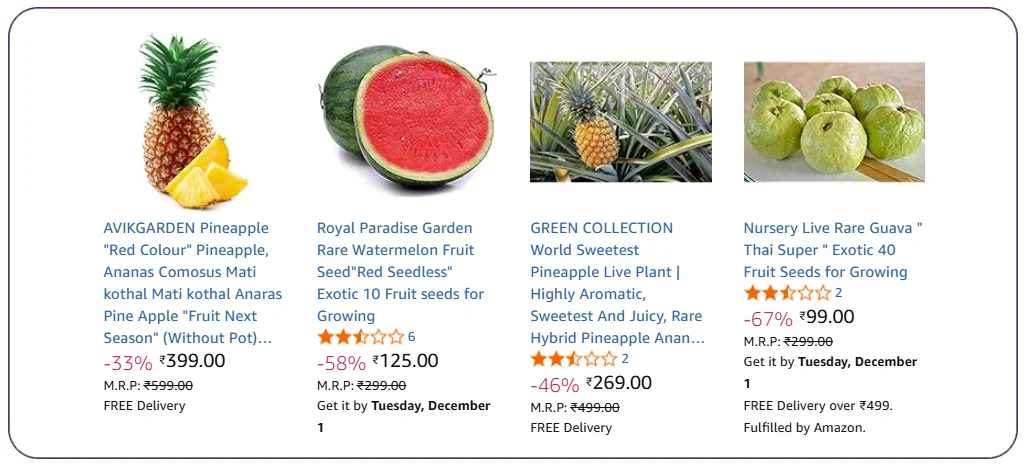
Blinkit and Amazon Fresh serve similar needs in different ways:
- Blinkit is built around speed. Its catalogue is organised by dark store, and each location shows a different range. It covers groceries, personal care, household goods, electronics accessories, home items and more.
- Amazon Fresh extends Amazon's much larger catalogue and logistics into grocery and daily needs, with its own pricing, delivery slots and brand mix.
Together they show how the same categories are priced and ranged by a quick-commerce specialist and a large e-commerce platform. A combined dataset is useful for price comparison, assortment gap analysis and market sizing. For projects that later expand into recurring collection, an ecommerce scraping API can support structured product, pricing and availability extraction at scale.
Scoping A 50,000-Record Extraction
The number 50,000 per platform is a useful planning figure, because it covers a large share of everyday categories without turning into an open-ended crawl. Scoping decisions include:
- Categories: groceries, personal care, household, electronics, baby products, pet supplies and others. List which top-level categories are in scope.
- Depth: whether to go down to every sub-category, or to cap the number of products per category.
- Location: both platforms show different results by delivery address, so a single pincode or a small set of pincodes must be chosen. The location should be recorded in the data.
- Record definition: whether each pack size and variant counts as a separate record. Usually it does.
- De-duplication rules: how to treat products that appear in several categories.
A short scoping call usually settles these points, and a small sample confirms them.
Data Fields In The Dataset
The typical fields for this use case are:
- Product name as shown on the platform
- Brand
- Category and sub-category (with the full path where available)
- Description: the product description and, where shown, key features
- MRP: the printed maximum retail price
- Selling price: the price at which the platform sells the product
- Discount: amount and percentage, calculated from MRP and selling price
- Product images: image URLs and, if requested, downloaded image files
- Pack size and unit
- Product URL and platform product ID
- Availability at the time of collection
- Collection date, time and pincode
Optional fields can include ratings, review counts, country of origin, ingredients, nutrition and manufacturer details, depending on what each platform displays.
Delivering Images In Downloadable Format
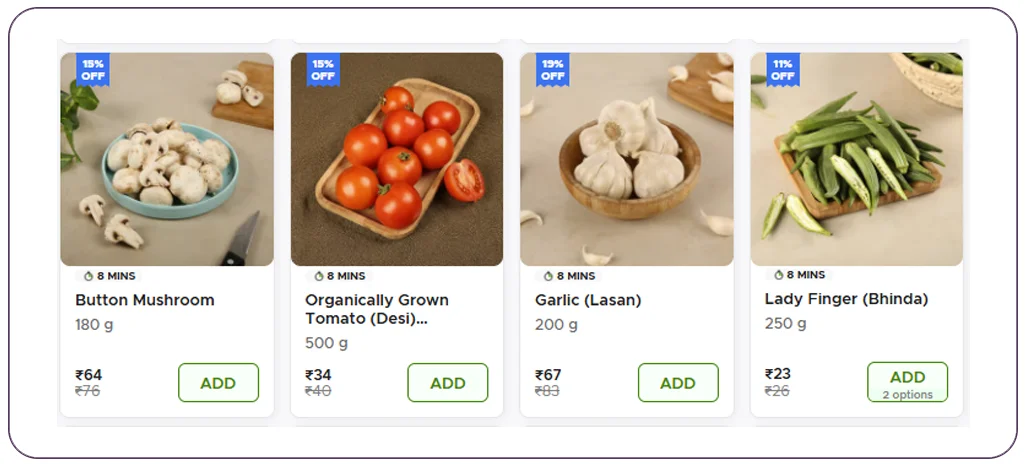
Images are an important part of this request. They can be delivered in two ways. The first is a column of image URLs in the dataset. The second is a packaged archive of image files, named by product ID so that each image links back to its record. Archives are large, so they are usually delivered through cloud storage. Images are the platforms' or brands' property and may be protected by copyright, so check whether your intended use, such as internal analysis versus public display, is permitted.
How The Extraction Works
- Set the location. Select the pincode on each platform, and verify that the displayed address matches.
- Map the category tree. Discover all categories and sub-categories in scope.
- Collect listings. Page through every category, scrolling until all products are loaded, and capture the summary fields.
- Open product pages. Collect descriptions, additional images and attributes that are not on listing pages.
- Handle variants. Capture each pack size or variant as its own record, linked to a parent product.
- Standardise. Clean brand names, normalise units and calculate discount percentages.
- De-duplicate. Remove repeated products and keep the category where they appear.
- Validate. Check that MRP is greater than or equal to the selling price, that required fields are filled and that record counts match expectations.
- Package and deliver. Create the final files, the data dictionary and, if needed, the image archive.
Reaching The 50,000 Mark
A platform's visible catalogue at one location can be smaller or larger than 50,000 items. If the visible catalogue is smaller, the dataset contains all of it. If it is larger, the scope must be prioritised, for example by selecting categories or by capping per category. If a platform shows fewer products at one pincode than you need, adding a second pincode can increase coverage, though it also raises the risk of duplicates, which de-duplication handles. If the project later requires repeated snapshots instead of a single collection, real-time product data extraction can support ongoing monitoring of product and pricing changes.
Technical Challenges
- Dynamic loading: both platforms load products as the user scrolls, so scrapers must continue until each list ends.
- Location dependence: the catalogue, price and stock depend on the pincode, so location setting must be reliable.
- Anti-bot protection: both platforms limit automated traffic. A large one-time run needs careful pacing and distribution across a longer collection window.
- App-first design: Blinkit is largely app-driven, which makes collection more involved than on a traditional website.
- Volume and time: 50,000 records with product-page visits and images takes planning. Collection is often spread over several days.
- Changes during collection: prices and stock change while the run is in progress, so all records should carry their own timestamp.
- Inconsistent field availability: not every product has a description, brand or image. Missing values must be marked clearly.
Quality Assurance For One-Time Datasets
Because you receive the data once, quality checks before delivery matter even more. Typical checks include the share of records with missing price, brand or category, price outliers by category, duplicate rate, image availability, and manual sampling against live pages. The delivery should include a short quality report so you know what you are getting. For larger competitive benchmarking projects, structured e-commerce datasets for competitive analysis can extend the analysis beyond a single snapshot.
Use Cases
- New e-commerce or comparison apps: seed the product catalogue with brands, categories, descriptions and images.
- Market researchers: size categories, compare price levels and study assortment across the two platforms.
- Brands: audit how their products and competitors are listed, described and priced.
- Retailers: benchmark MRP and selling price discounts across categories.
- Data science and AI teams: build training data for product classification, matching and pricing models.
- Investors and consultants: produce category and platform comparison reports.
Example: Seeding A Price-Comparison App
A start-up is building a grocery price-comparison app. It needs a large initial catalogue with brands, categories, MRP and images. It orders a one-time extraction of up to 50,000 records from Blinkit and Amazon Fresh for one metro pincode. After delivery, the team cleans and matches products across the two platforms, loads them into its own database and starts building features. A later project adds daily refresh for the most popular categories.
Example: A Discount-Depth Study
A researcher wants to know how deeply different categories are discounted from MRP. Using the one-time dataset, she calculates average discount by category and platform. She finds that personal care shows deeper average discounts on one platform, while staples show smaller discounts on both. The finding becomes part of a published market note.
Sample Output Structure
The delivery typically includes one file per platform with columns such as: platform, collection date and time, pincode, category, sub-category, product ID, product name, brand, variant, pack size, unit, description, MRP, selling price, discount percent, availability, image URL, image file name, product URL. A data dictionary explains each field, and a quality report summarises coverage.
Delivery Options
Files can be delivered as CSV or Excel for easy opening, or as JSON or Parquet for data teams. Large image archives are delivered through cloud storage links. If your team later needs updates, the one-time extraction can be converted into a scheduled feed.
Responsible Data Collection
Collect only publicly visible product information, avoid personal data, keep request rates reasonable and follow each platform's terms and applicable laws. Descriptions and images may be protected by copyright, so review usage rights for your intended purpose.
Why Choose Real Data API For One-Time Product Datasets
Real Data API plans the scope with you, builds location-aware scrapers for Blinkit and Amazon Fresh, and delivers a clean, documented dataset with a quality report. A small sample of a few hundred records confirms the fields and format before the full run. Real Data API also provides dedicated grocery data scraping solutions for product, price, availability and related grocery data.
Conclusion
A one-time Blinkit and Amazon Fresh dataset gives teams a large, clean snapshot of product, price and category data without the cost of a continuous feed. With clear scoping, location-aware collection, careful quality checks and well-documented delivery, 50,000 records per platform become a solid base for analysis, comparison and product building.
Need a one-time product dataset? Real Data API can deliver a sample and a full extraction for your categories. You can also explore grocery data scraping services for one-off datasets and other grocery data requirements.
FAQs
Is 50,000 records a fixed number?
It is a planning target. If a platform shows fewer products for your location, you receive all of them. If more, we agree on how to prioritise.
Can I choose the pincode?
Yes. Pick the location that matters to you, and it will be recorded in the data. More pincodes increase coverage but also cost.
Will I receive the images as files?
Yes, if you ask. You can receive image URLs, downloaded image files or both.
Can the one-time dataset be updated later?
Yes. You can repeat the extraction or convert it into a scheduled feed.
Which categories are included?
Any categories that the platforms show for the chosen location, such as groceries, personal care, electronics and household goods. You can limit the scope.
Latest posts
Multi-Country, Multi-Category E-commerce Data: How to Plan a Global Scraping Project
Walmart Real-Time Product & Price API by ZIP Code: From Jersey City to Nationwide
Hotel Price Comparison Data Scraping: Daily Rate Tracking Across MakeMyTrip, Goibibo, Booking.com & Agoda
How Restaurants Use Competitor Offers Data to Optimize Pricing in India (2026) and Improve Profit Margins Through Smarter Promotions




.png)


