.gif)
.gif)


Introduction
Germany is the largest car market in Europe, and mobile.de is one of its most important vehicle marketplaces. Hundreds of thousands of cars, vans, motorbikes and commercial vehicles are listed at any time by dealers and private sellers, with detailed specifications and asking prices. For used-car exporters, dealers, leasing companies, insurers, valuation tools and market analysts, this is a primary window into the German vehicle market. mobile.de scraping converts the listings into a structured, country-wide dataset for pricing, sourcing and research.
This guide explains what data is available, how a country-wide extraction is planned, how to deal with duplicates and data quality and how the data is used. For broader automotive projects, this workflow can also be extended through vehicle data scraping across additional sources.
Why Mobile.de Data Is Valuable
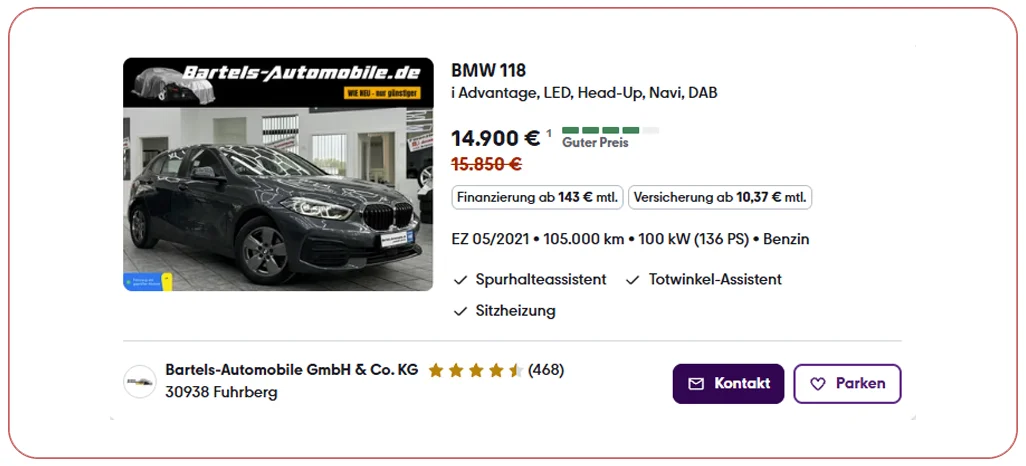
- Breadth: a large share of the German used-vehicle supply is visible on the platform.
- Detail: listings include technical specifications, equipment, mileage, registration date and seller type.
- Price transparency: asking prices reveal how the market values models by age, mileage and equipment.
- Dealer visibility: dealer names, locations and inventory sizes show who dominates regions.
- Time dimension: repeated collection reveals how long vehicles stay listed and how prices change.
For exporters and cross-border traders, German prices are a key benchmark.
What Data Is Available On Listings
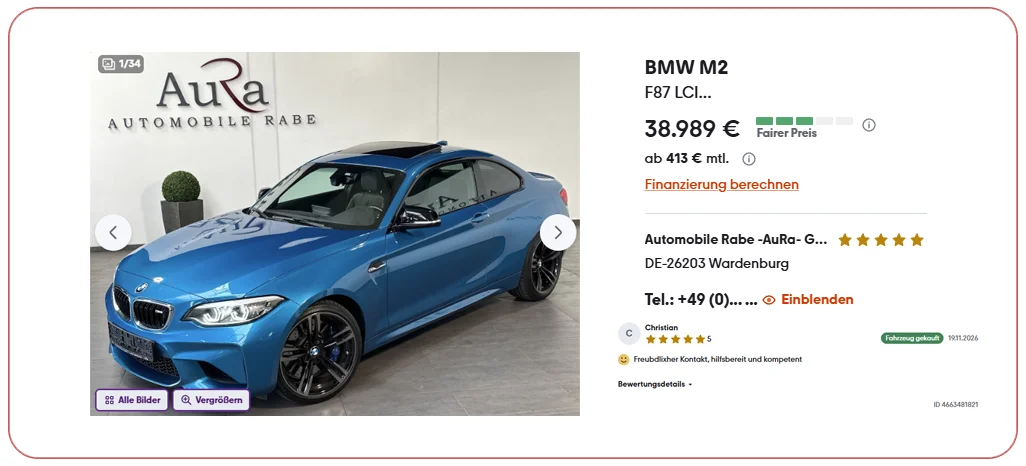
Vehicle identity: make, model, variant, body type, first registration date, previous owners, VIN where displayed and condition such as used, new or demo.
Technical data: fuel type, engine power in kW and PS, displacement, gearbox, drive type, emission class and consumption figures.
Usage data: mileage, general inspection (TUeV) validity, service history and accident-free status where stated.
Equipment and features: air conditioning, navigation, leather, driver assistance systems, trailer hitch and other options.
Price data: asking price, VAT status (gross price or net price for commercial sellers), price rating where displayed and financing offers.
Seller data: dealer or private seller, dealer name, location (city and postal code), seller rating and number of listings.
Listing data: listing ID, listing URL, images, listing date or time online and listing description text.
Planning A Country-Wide Extraction
The platform limits how many results a search can show, so a single search for all cars in Germany cannot return everything. A country-wide project uses partitioning:
- By make and model: search each make and model separately.
- By price range: split large groups, such as popular models, into price bands.
- By year and mileage ranges: further split dense segments.
- By region or postal code: use location filters and radius where needed.
- By vehicle type: cars, vans, trucks and motorbikes may be handled separately.
Splitting continues until each search returns fewer results than the platform's visible limit. This ensures that the dataset is close to complete.
How The Scraping Process Works
- Define scope. Choose vehicle types, makes, price and year ranges, and whether to include dealers only or private sellers too.
- Create the search partitions. Build combinations of filters that cover the whole target market without gaps.
- Collect search results. For each partition, load all result pages and capture the listing IDs, summary data and URLs.
- Open listing pages. Collect details such as equipment, specifications, seller data and description.
- De-duplicate. The same car can appear in several partitions. Remove repeats using listing IDs.
- Normalise. Standardise fuel, gearbox and body types, convert units and parse dates.
- Handle price formats. Record gross and net prices where shown, and add a VAT flag.
- Track listing lifecycle. Record when listings first appear and disappear, and when prices change.
- Deliver. Provide full datasets or incremental updates through files or API.
Handling German-Language Data
Listings contain German terms for fuel (Benzin, Diesel, Elektro, Hybrid), gearbox (Schaltgetriebe, Automatik) and condition (Gebrauchtwagen, Neuwagen, Jahreswagen). Data should be mapped to standard English values while preserving the original text. Number formats use decimal commas and thousand separators with dots, and dates use day-month-year formats. Special characters such as ä, ö, ü and ß must be stored correctly.
Duplicates And Data Quality
- Cross-posted listings: dealers sometimes list the same car more than once, with different IDs. Duplicates can be detected by VIN, or by a combination of make, model, mileage, registration date, price and location.
- Outdated listings: some listings stay online after a car is sold. Tracking disappearance and last-seen dates helps flag stale items.
- Inconsistent specifications: sellers may enter engine power or equipment inconsistently. Validation rules catch impossible values.
- Price anomalies: very low prices may indicate errors or non-standard offers, such as damaged vehicles. Flag them for review.
Technical Challenges
- Search result limits: require fine-grained partitioning.
- Anti-bot protection: the platform limits automated traffic, so collection needs careful pacing, rotation and monitoring.
- Dynamic content: results and listing details are loaded through scripts.
- Scale: a full-country extraction can include hundreds of thousands of listings, which need efficient storage and incremental updates.
- Frequent changes: new listings and price changes occur constantly, so freshness policy matters.
- Image-heavy pages: listings have many photos. Collect image URLs rather than downloading all images unless required.
- Legal and privacy considerations: private sellers are individuals. Collect only data needed and follow GDPR principles, avoiding personal contact details.
Use Cases
- Used-car exporters and traders: find undervalued vehicles and compare German prices with those in destination markets.
- Dealers: benchmark asking prices against the market and adjust pricing and stock. Teams can also use dealer data scraping to enrich inventory and competitor views.
- Leasing and finance companies: model residual values using real asking prices.
- Insurers and valuation tools: build and update valuation databases.
- Automotive analysts: study price trends by model, fuel type and region, including the shift to electric vehicles.
- Marketplaces and aggregators: enrich their own listings or build price-comparison features.
Example: An Exporter Sourcing Diesel SUVs
An exporter wants to buy used diesel SUVs for a market that values specific models and ages. It extracts all listings for chosen makes and models, with first registration between certain years and mileage under a limit. The dataset shows the price distribution by region, flags listings with prices below the median for their specification and tracks how long cars remain listed. The exporter targets dealers in regions with the lowest median prices and negotiates on cars that have been listed for a long time.
Example: A Dealer Group Managing Prices
A dealer group tracks competing dealers within 100 kilometres of each site for the same models. It monitors price changes daily and sees which competitors cut prices after about 30 days online. The group adjusts its own price-reduction schedule. This approach works well with price monitoring to maintain competitive positioning.
Sample Output
A row may include: listing ID, URL, make, model, variant, body type, first registration, mileage, fuel type, power in kW, gearbox, drive type, emission class, colour, price gross, price net, VAT flag, seller type, dealer name, city, postal code, price rating, first-seen date, last-seen date, price history and timestamp.
Data Quality Checks
- Check that listing counts by make match expectations and previous runs
- Validate numeric fields such as mileage, power and price
- Detect duplicates and measure the duplicate rate
- Flag listings with missing key attributes
- Sample manually against live pages
Delivery And Refresh
Datasets can be delivered as CSV, Parquet or JSON, or loaded into a data warehouse. A full refresh weekly, with daily incremental updates for new and changed listings, is a common pattern. For exporters who need quick action, daily or twice-daily delta files are useful.
Responsible Data Collection
Collect only public listing information, avoid personal data of private sellers, keep request volumes reasonable and follow the platform's terms and applicable laws, including GDPR and German competition and database rights. Take legal advice for commercial use of the data.
Why Choose Real Data API For Mobile.de Scraping
Real Data API builds partitioned, country-wide extraction for vehicle marketplaces, handles German-language fields and delivers clean, de-duplicated datasets with listing history. A pilot for a few makes helps validate coverage and quality before a full rollout.
Conclusion
mobile.de scraping gives dealers, exporters, lenders and analysts a country-wide, up-to-date view of the German vehicle market. With careful partitioning, German-language normalisation and listing-history tracking, the data supports pricing, sourcing and valuation decisions with real market evidence.
Need German vehicle listing data? Real Data API can deliver a pilot for your makes and regions.
FAQs
Can you extract every listing in Germany?
We can approach full coverage through fine-grained partitioning. The achievable completeness depends on the platform's limits, and a pilot gives a measured coverage figure.
Do you collect VINs?
Only where the listing shows them publicly, which is not common.
Can you track listing duration and price changes?
Yes. Repeated collection records first-seen and last-seen dates and price history.
Do you include dealer information?
Yes, business-level dealer details that are publicly displayed. Personal data of private sellers is avoided.
How often should data be refreshed?
Weekly full refresh with daily updates is common for trading and pricing use cases.
Latest posts

mobile.de Scraping: Country-Wide Vehicle Listing Data for Germany
Walmart & TikTok Shop Seller Data Scraping for the USA

Amazon Industrial & Scientific Category Data Extraction (USA)
Used Car Buying Prices from Turo, Priceline & Kayak for Multiple Locations




.png)


