.gif)
.gif)

Introduction
Amazon is no longer only a place for consumer goods. Its Industrial & Scientific category lists millions of products for factories, laboratories, workshops, hospitals and schools: fasteners, bearings, safety equipment, lab consumables, cutting tools, test instruments, packaging supplies and much more. For distributors, manufacturers, procurement teams and market researchers, this category is a rich source of pricing and specification data. But it is also a demanding one, because buyers search by technical attribute, not by brand alone. Amazon Industrial & Scientific data scraping, done with the right structure, makes the category searchable, comparable and analysable.
This guide explains what data is available in this category, how technical specifications are captured, which challenges are specific to industrial products and how B2B teams use the results.
Why Industrial And Scientific Data Is Different
In consumer categories, titles and images carry most of the meaning. In industrial categories, the specification is the product. Two bolts that look alike can differ in thread size, length, material, grade and coating. Two filters may differ in micron rating, size and compatibility. Buyers need exact matches. Data must therefore capture attributes in a structured way, not only titles and prices.
Category Structure
The Industrial & Scientific department is organised into many sub-departments. Examples include:
- Abrasive and finishing products
- Cutting tools
- Fasteners and hardware
- Filtration
- Hydraulics, pneumatics and plumbing
- Industrial electrical
- Janitorial and sanitation supplies
- Lab and scientific products
- Material handling
- Occupational health and safety products
- Packaging and shipping supplies
- Power transmission products
- Test, measure and inspect equipment
Each sub-department has its own set of important attributes.
Data Fields To Extract
This workflow also fits broader product data scraping projects where product attributes need to be standardised.
Core product data: ASIN, title, brand, manufacturer, manufacturer part number, model number, category path, images, description and bullet points.
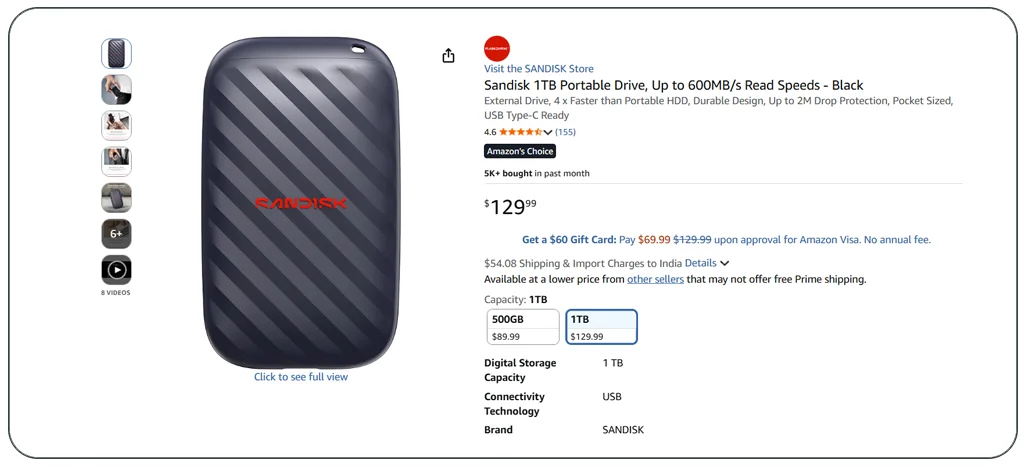
Technical specifications: the product details and specification table, which may include dimensions, weight, material, thread size, voltage, power, capacity, pressure rating, temperature range, certifications and compliance information. These differ widely by sub-category.
Pack and unit data: quantity per pack, unit of measure and unit price.
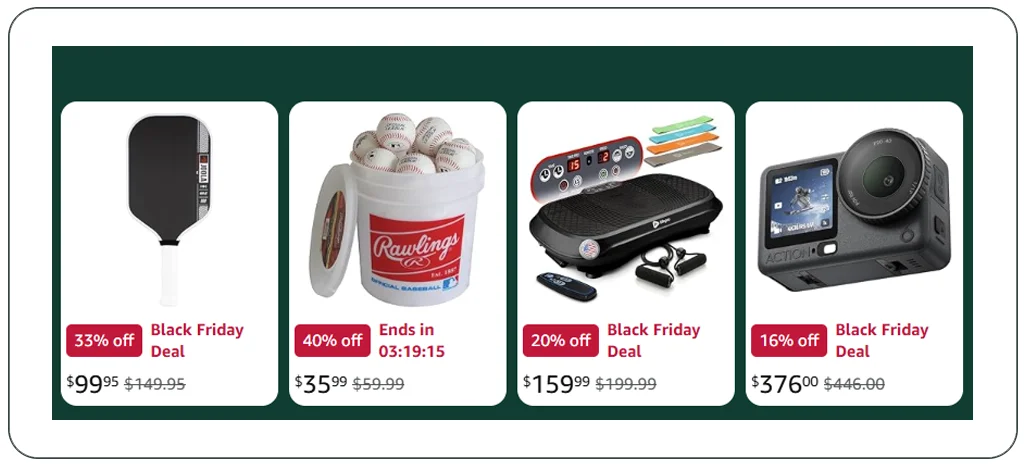
Price and offers: price, list price, discount, business or quantity discounts where displayed and shipping cost.
For ongoing price monitoring, price data scraping can complement the category-level extraction described here.
Availability: stock status, delivery estimate and fulfilment type.
Seller data: seller name, number of sellers, Buy Box seller, seller rating and whether fulfilled by Amazon.
Rankings and social proof: best-seller rank in category, rating, review count and questions and answers.
Compatibility data: compatible models, replacement part information or cross-reference numbers where listed.
How Category Extraction Works
For listing-level collection, Amazon product data scraping complements category discovery and filtering.
- Map the category tree. Discover sub-departments and sub-categories of interest, using category IDs where possible.
- Handle search depth. Search and category pages show a limited number of results per query, so use filters such as brand, price range and sub-category to reach all products.
- Collect listings. Capture the product list with ASIN, title, price and rank.
- Open product pages. Collect specification tables, bullets, seller information and offers.
- Parse specifications. Convert text such as 1/4 inch by 2 inch stainless steel into separate fields for diameter, length and material.
- Standardise units. Convert inches to millimetres, pounds to kilograms and so on, while keeping original values.
- Match to part numbers. Link Amazon listings to manufacturer part numbers and cross-references.
- Deliver and refresh. Provide structured files or APIs.
Parsing Technical Specifications
Specification parsing is the most valuable and most difficult part of industrial data work. Specification tables vary by listing and sometimes contain inconsistent or missing values. A robust approach includes:
- Capturing raw specification text exactly as shown
- Creating attribute dictionaries per sub-category, for example a fastener has thread size, length, head type, material and finish
- Using pattern rules and, where useful, language models to extract values from titles and bullets
- Normalising units and formats
- Marking confidence and leaving fields empty rather than guessing
Technical Challenges
- Anti-bot protection: Amazon limits automated traffic, so careful pacing, rotation and monitoring are essential.
- Result limits: each search shows a limited number of pages, so category coverage needs filter-based splitting.
- Variation families: one listing may contain many sizes or pack options, each with its own ASIN and price.
- Sparse or inconsistent attributes: some sellers fill specification tables well, while others do not.
- Multi-seller pricing: the Buy Box price can differ from other offers, so seller-level collection may be needed.
- Large volume: industrial categories contain millions of products, so projects usually define a precise sub-scope.
- Frequent price changes: third-party sellers adjust prices often.
Use Cases
The same methodology can support wider ecommerce data scraping projects across marketplaces and product categories.
- Industrial distributors: monitor online prices of competing products and find assortment gaps.
- Manufacturers and brands: track pricing, seller behaviour and counterfeit or unauthorised listings.
- Procurement teams: build a comparison table of equivalent parts and suppliers.
- E-commerce sellers: research profitable products by price, competition and demand signals.
- Market researchers and analysts: size sub-categories and track pricing trends.
- Software and catalogue companies: enrich product databases with specifications and cross-references.
Example: A Fastener Distributor
A distributor wants to see how its stainless steel fasteners compare with Amazon sellers. It scrapes the fasteners sub-category with filters for stainless steel, extracts thread size, length, material and pack size, and calculates unit prices. The analysis shows that on small pack sizes, Amazon sellers are priced below the distributor, while on bulk packs the distributor is competitive. The distributor adjusts its online pricing for small packs and promotes bulk offers.
Example: A Laboratory-Consumables Brand
A brand selling pipette tips and sample tubes tracks its listings and competitors weekly. It monitors price, seller count, rank and review count. It notices that a new seller is listing a similar product at a lower price with strong early reviews. The brand reviews its pricing, adds a larger pack option and increases its listing content to compete.
Sample Output
A row may include: ASIN, title, brand, manufacturer part number, sub-category, pack quantity, price, unit price, thread size, length, material, voltage, capacity, certifications, seller name, number of sellers, fulfilment type, best-seller rank, rating, review count, compatible models, product URL and timestamp.
Data Quality Checks
- Check that required attributes are filled for the sub-category
- Verify unit conversions with sample calculations
- Compare product counts by sub-category with previous runs
- Flag outlier prices
- Review a sample manually against live pages
Delivery And Refresh
Teams needing automated delivery can connect this workflow with an ecommerce scraping API for structured downstream use.
Data can be delivered as CSV, Excel or JSON via API, or loaded into a product information management system or data warehouse. Weekly collection suits catalogue building, and daily collection suits price monitoring.
Responsible Data Collection
Collect only public product information, avoid personal data, keep request rates reasonable and follow Amazon's terms and applicable laws. Product descriptions and images are protected, so review usage rights before republishing.
Why Choose Real Data API For Amazon Industrial & Scientific Data
Real Data API builds category crawlers that handle search limits, variation families and specification parsing. A pilot for one sub-category shows you the attribute coverage and data quality before you scale.
Conclusion
Amazon Industrial & Scientific category data extraction gives B2B teams a structured, searchable view of specifications, prices, sellers and rankings in a highly technical market. With careful specification parsing and regular refreshes, the data supports pricing, sourcing and product strategy decisions.
Need industrial category data from Amazon? Real Data API can deliver a pilot for your sub-category.
FAQs
Can you extract specification tables?
Yes. Raw specification text is captured, and key attributes are parsed into structured fields.
Can you match Amazon products to manufacturer part numbers?
Where part numbers are listed, yes. Cross-references are added where data is available.
How large a category can you cover?
Large categories can be covered by splitting them into sub-categories and filters. Scope is defined together with you.
Can you capture all sellers for a product?
Yes. Offer lists can be collected for selected products.
Do you capture quantity discounts?
Where Amazon displays them publicly, yes.
Latest posts

mobile.de Scraping: Country-Wide Vehicle Listing Data for Germany
Walmart & TikTok Shop Seller Data Scraping for the USA
Amazon Industrial & Scientific Category Data Extraction (USA)

Used Car Buying Prices from Turo, Priceline & Kayak for Multiple Locations



.png)


