.gif)
.gif)
Introduction
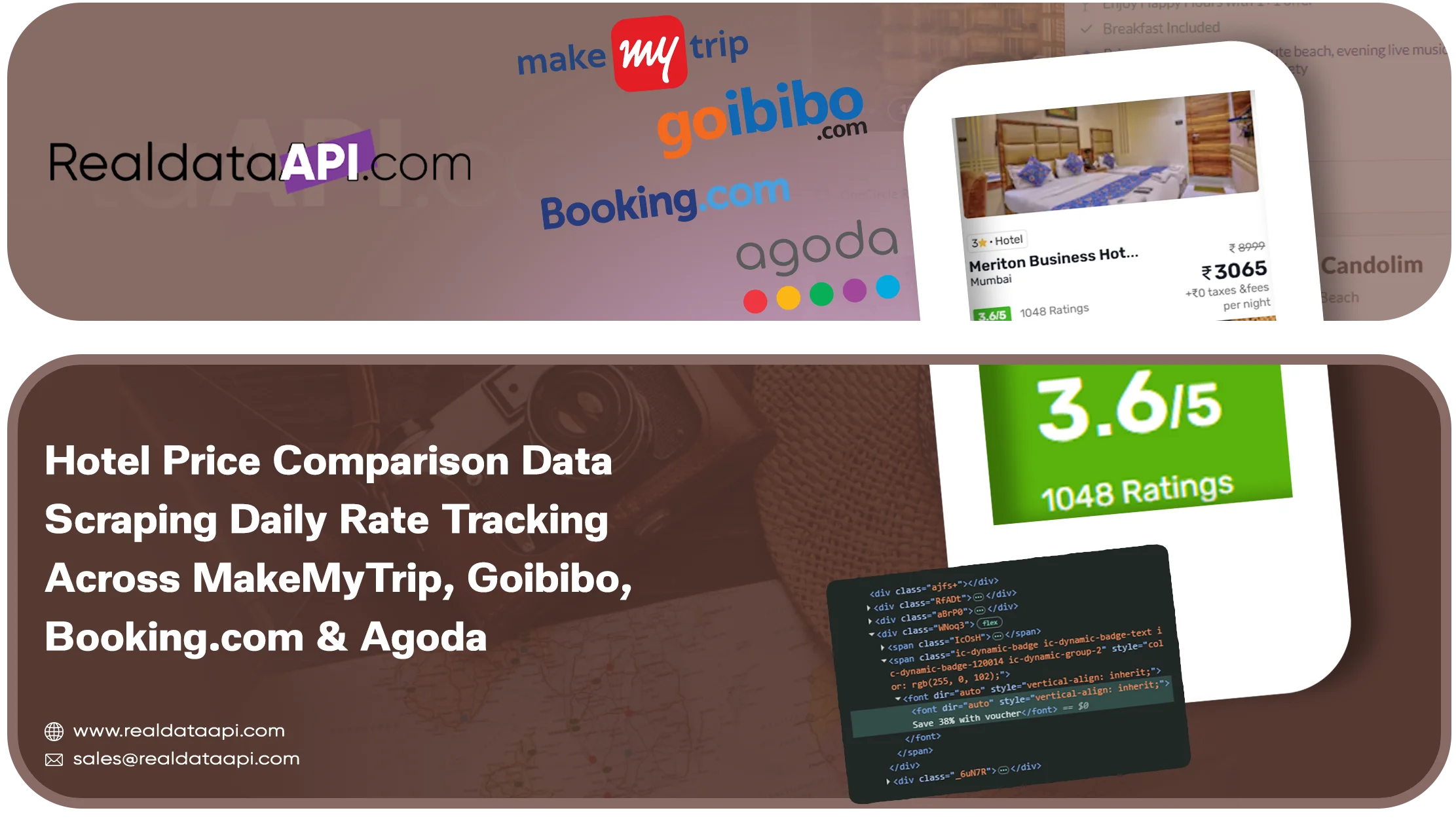
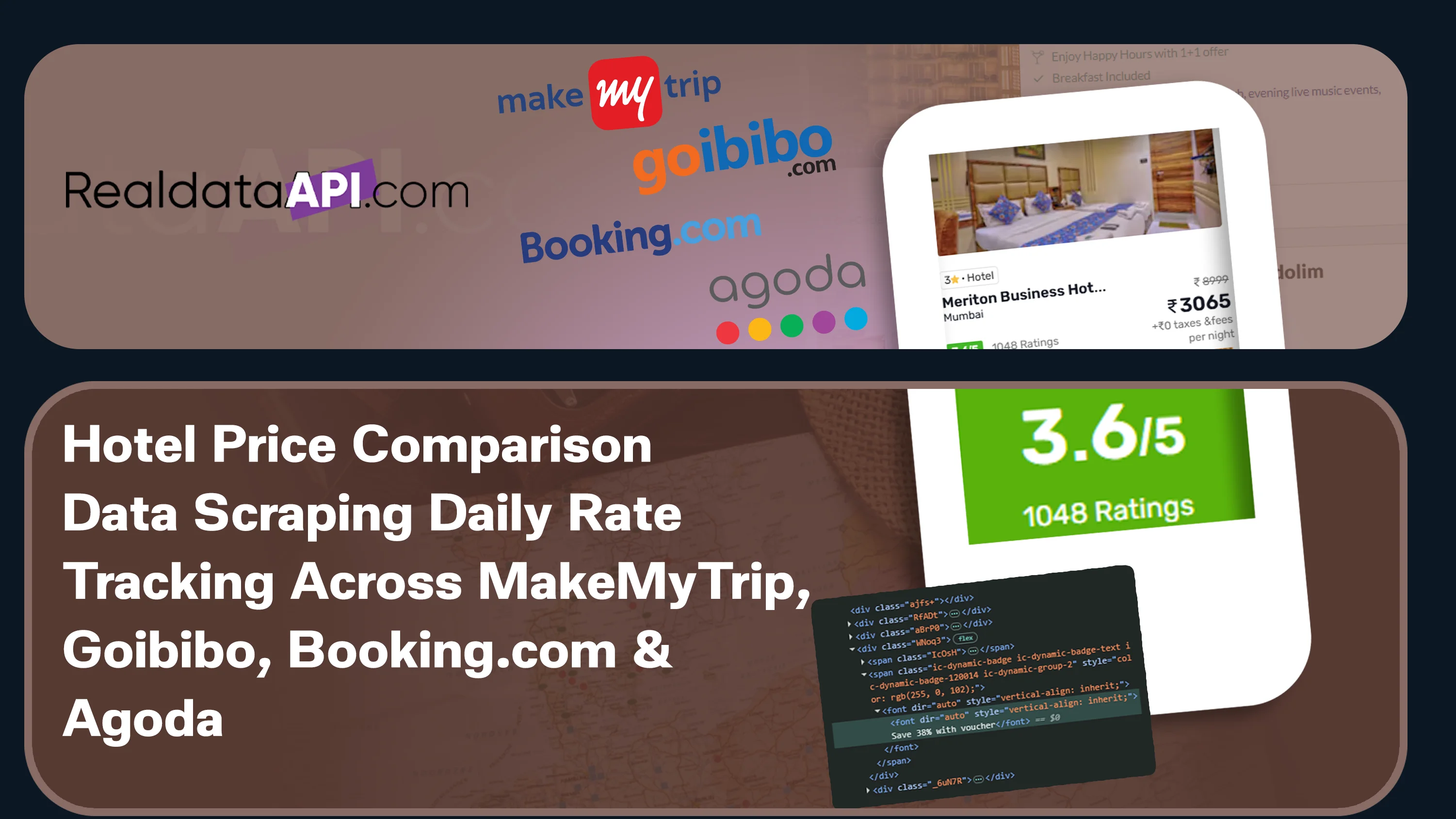
For a hotel, price is not a number set once. It is a moving target that changes by date, length of stay, room type, platform and competitor. The same room can be listed at different prices on a hotel's own website, MakeMyTrip, Goibibo, Booking.com and Agoda on the same night. Revenue managers, hotel chains, travel agencies and analysts need to see these differences daily to protect margins, keep rate parity and respond to competitors. Hotel price scraping automates that visibility.
This guide explains how daily hotel rate tracking works across the major online travel agencies (OTAs), what data is captured, how a project for around 100 hotels in India is organised, what challenges arise and how teams use the data.
For a broader overview of hotel, flight, availability and review extraction, explore our Travel Data Scraping solutions.
Why Hotels And Travel Businesses Track OTA Prices
- Rate parity: many hotels have agreements that their prices should not differ across channels. Monitoring finds breaches and lets the hotel act.
- Competitor benchmarking: see how nearby competitors price the same dates and room categories.
- Dynamic pricing support: use competitor rates and demand signals to adjust prices.
- Promotion tracking: record discounts, member rates and offers on each OTA.
- Distribution insight: see which hotels are sold out or restricted on which channels.
- Market analysis: track seasonal demand and event-driven price changes in a city.
The Four Platforms
MakeMyTrip and Goibibo are leading Indian OTAs with deep coverage of domestic hotels, strong mobile usage and frequent offers, including payment and loyalty discounts. They are both part of the same corporate group but display prices and offers separately.
For platform-specific collection requirements, see our MakeMyTrip data scraping solution.
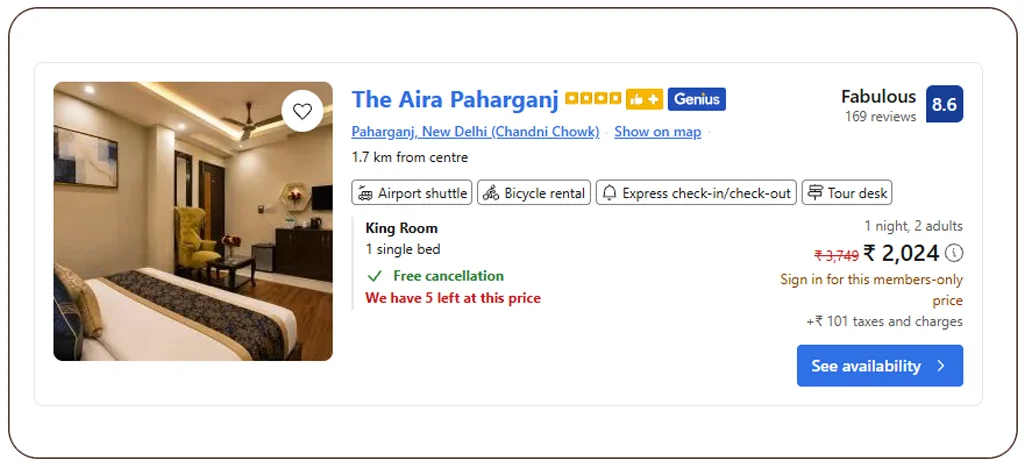
Booking.com is a global OTA with wide coverage in India and strong international traffic. It shows room types, cancellation policies, genius or member discounts and review scores.
For more detail on structured hotel pricing and availability extraction, see our Booking.com data scraping page.
Agoda is a global OTA with strong presence in Asia. It shows member prices, promotions and sometimes different price levels from other OTAs.
Businesses needing Agoda-specific room, pricing and availability fields can also explore our Agoda hotel data resources.
Together they provide a wide view of how a hotel sells online to domestic and international guests.
What Data Is Captured
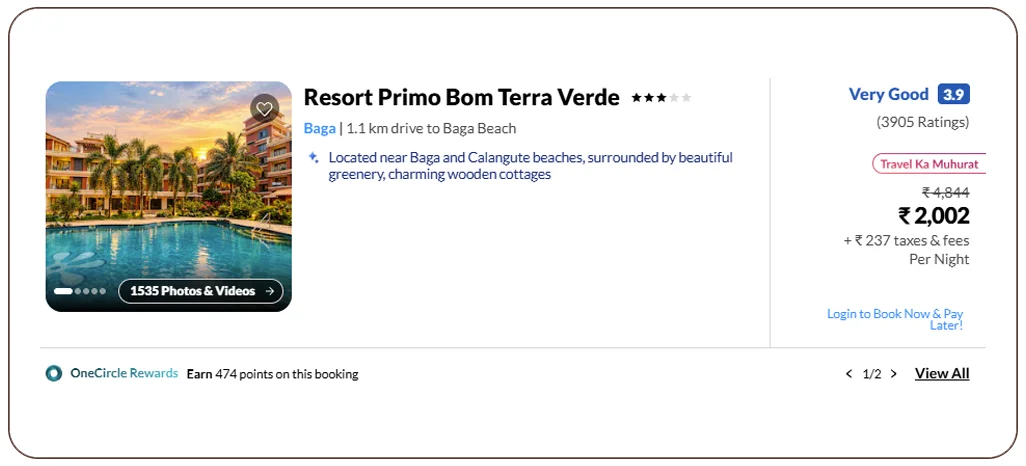
Search context: city or hotel, check-in date, check-out date, number of nights, number of adults and children, number of rooms and currency.
Hotel data: hotel name, address, star rating, review score and review count, facilities, location and OTA hotel ID.
Room and rate data: room type, bed type, occupancy, meal plan (room only, breakfast included, half board), cancellation policy, refundable or non-refundable and payment terms.
Price data: nightly rate, total price, taxes and fees, discounts, member or loyalty price, original price crossed out, and final payable price.
Availability: rooms left messages, sold-out status and minimum stay requirements.
Promotions: offer labels such as deal, limited time offer, bank offers and coupons shown on the page.
Setting Up A 100-Hotel Tracking Project
A typical project tracks around 100 hotels, which might include a client's own properties and their competitive set. The setup includes:
- Hotel list: names, cities and OTA links or IDs for each hotel on each platform.
- Matching across OTAs: the same hotel has different pages and IDs on each OTA, so each hotel is matched to its listing on all four platforms, with verification of address and name.
- Room mapping: room types are named differently across OTAs. A room-mapping table links equivalent room types, such as Deluxe Room on one site and Deluxe Double on another.
- Search matrix: define check-in dates (for example the next 30, 60 and 90 days), lengths of stay and occupancy. A common setup is one-night and two-night stays for two adults.
- Schedule: run daily, or several times a day for peak periods.
How The Scraping Works
- For each hotel, date and occupancy, open the OTA's hotel page or search results.
- Set the dates, guests and currency.
- Capture all room types and rate plans, with prices, meal plans and cancellation terms.
- Capture promotions, sold-out status and rooms-left messages.
- Standardise room names using the mapping table.
- Calculate parity metrics, such as the lowest price per OTA for a comparable room and plan, and the differences between OTAs.
- Store results with the search date so you can track how rates change as the stay date approaches.
When normalized hotel and OTA data needs to feed pricing or analytics systems, a Travel Scraping API can support an API-based workflow.
- Deliver dashboards, files or alerts.
Key Metrics
- Parity index: each OTA's price relative to the hotel's own direct price or reference price
- Competitor rate index: your rate relative to the average of your competitive set
- Rate change velocity: how quickly prices change as check-in approaches
- Sell-out rate: the share of dates and room types shown as sold out
- Promotion intensity: frequency and depth of discounts by OTA
- Meal-plan and cancellation mix: the share of refundable and non-refundable rates
Technical Challenges
- Strong anti-bot protection: OTAs invest heavily in protecting their content and pricing, so collection requires careful pacing, rotation and monitoring.
- Dynamic, personalised pricing: prices can vary by device, location, login status and time. Settings must be consistent and documented.
- Complex page structures: room and rate tables are complex and change often.
- Hotel and room matching: requires careful logic and verification.
- High request volume: 100 hotels across four platforms, many dates and daily runs produce a very large number of requests, so schedules and infrastructure must be planned.
- Taxes and fees: some OTAs show prices with taxes and others without. Standardise to a defined basis, for example the final payable price.
- Platform terms: OTAs have strict terms about automated access. Review terms and take legal advice, and consider official partner APIs or rate-intelligence feeds where available.
Use Cases
- Independent hotels and chains: monitor parity and adjust rates in line with competitors.
- Revenue managers: feed competitor rates into pricing tools and daily meetings.
- Travel agencies and tour operators: compare net costs across channels when sourcing hotels.
- Hotel investors and asset managers: track market rates and occupancy signals.
- Tourism boards and analysts: study seasonality, event impact and pricing by destination.
- Metasearch and comparison startups: build features based on cross-OTA price differences.
Example: A Hotel Group Monitoring Parity
A hotel group with 25 properties wants to keep its OTA prices consistent with its own website. It tracks rates for the next 60 days across the four OTAs daily. The reports show that on weekends one OTA shows a lower non-refundable rate than the hotel's direct price for two properties. The group contacts the OTA and adjusts its rate-plan setup, and its parity score improves.
Example: A Boutique Hotel Pricing Against Competitors
A boutique hotel in Goa tracks eight competitors for the next 90 days. The data shows that competitors raise prices sharply around a music festival, while the boutique hotel's price stays flat. The hotel raises its rates for those dates and fills rooms at a better average price.
Sample Output
A row may include: search date, check-in date, nights, adults, platform, hotel ID, hotel name, city, room type (OTA), room type (mapped), meal plan, cancellation policy, price per night, total price, taxes and fees, final payable price, original price, discount percent, rooms-left flag, sold-out flag, promotion text, review score and timestamp.
Data Quality Checks
- Check that the number of hotels and rate rows per OTA is stable
- Validate that totals match nightly price multiplied by nights plus taxes
- Review mappings between OTA room types regularly
- Flag sudden price jumps or drops for review
- Sample manually against live pages
Delivery And Refresh
Data can be delivered as daily CSV or Excel files, via API or directly into revenue-management tools and BI dashboards. Alerts can be configured for parity breaches and competitor price moves. Daily collection is the baseline, and peak seasons may need several runs a day.
For ready-made travel records and recurring delivery, explore our Travel Datasets offering.
Responsible Data Collection
Collect only public price and availability information, avoid personal data, keep request volumes reasonable and follow OTA terms and applicable laws. Because OTAs restrict automated access, check the legal position and consider official data partnerships where suitable.
Why Choose Real Data API For Hotel Price Scraping
Real Data API builds hotel-level rate tracking with careful hotel and room matching, consistent search settings and parity metrics. A pilot with 10 to 20 hotels for a few dates helps you validate accuracy and reporting before scaling to 100 hotels.
Conclusion
Hotel price scraping across MakeMyTrip, Goibibo, Booking.com and Agoda gives hotels and travel businesses daily visibility into parity, competitors and demand. With careful matching, consistent search settings and clear metrics, rate data becomes a practical tool for revenue management and distribution control.
For teams turning recurring travel data into reporting and forecasting workflows, our travel analytics dashboard approach is a useful next step.
Need daily hotel rate tracking? Real Data API can design a pilot for your hotels and OTAs.
FAQs
How many hotels can you track?
There is no fixed limit. A project of 100 hotels is a typical starting size, and it can be scaled.
Can you track my own hotel and competitors together?
Yes. Your properties and competitors are tracked in the same dataset.
Do you capture room-level prices?
Yes. Room types and rate plans are captured and mapped for comparison.
How do you ensure fair comparison between OTAs?
We standardise on comparable room, meal plan, cancellation terms and final payable price, and record any differences.
Can I receive parity alerts?
Yes. Alerts can be triggered when an OTA price falls below a reference price or when a competitor changes its rate sharply.
Latest posts

Multi-Country, Multi-Category E-commerce Data: How to Plan a Global Scraping Project
Walmart Real-Time Product & Price API by ZIP Code: From Jersey City to Nationwide
Hotel Price Comparison Data Scraping: Daily Rate Tracking Across MakeMyTrip, Goibibo, Booking.com & Agoda
How Restaurants Use Competitor Offers Data to Optimize Pricing in India (2026) and Improve Profit Margins Through Smarter Promotions




.png)


