Quick Summary
- web scraping APIs for business data help retailers, brands, and marketplaces collect pricing, product, availability, and competitor information at scale for faster commercial decisions.
- E-Commerce Data Scraping enables teams to convert changing online product information into structured datasets for price benchmarking, assortment analysis, catalog monitoring, and competitive intelligence.
- Automated collection reduces repetitive research and gives decision-makers historical data that can reveal pricing patterns, product movements, and market opportunities.
Introduction
Businesses improve pricing and product decisions when they can continuously access accurate information about competitors, products, availability, and market movements. web scraping APIs for business data make this possible by automating online data collection and converting changing web information into structured datasets that pricing, merchandising, and analytics teams can use.
The challenge is particularly important for e-commerce businesses. Online stores can contain thousands or millions of products, while prices, discounts, stock status, specifications, and seller information can change frequently. Manual monitoring cannot efficiently keep pace with these changes.
E-Commerce Data Scraping allows businesses to systematically collect relevant product information from permitted online sources. The collected records can then be cleaned, standardized, matched, stored, and compared against historical observations.
For a pricing manager, the value lies in knowing more than the current price. A useful dataset can show the previous price, discount level, competitor position, product availability, seller information, and time of change. For product teams, the same workflow can reveal new launches, assortment changes, discontinued products, and variations in product specifications.
The core objective is therefore not simply to collect more information. It is to create a reliable data pipeline that transforms online signals into commercially useful intelligence.
How Can Businesses Strengthen Competitor Price Monitoring?
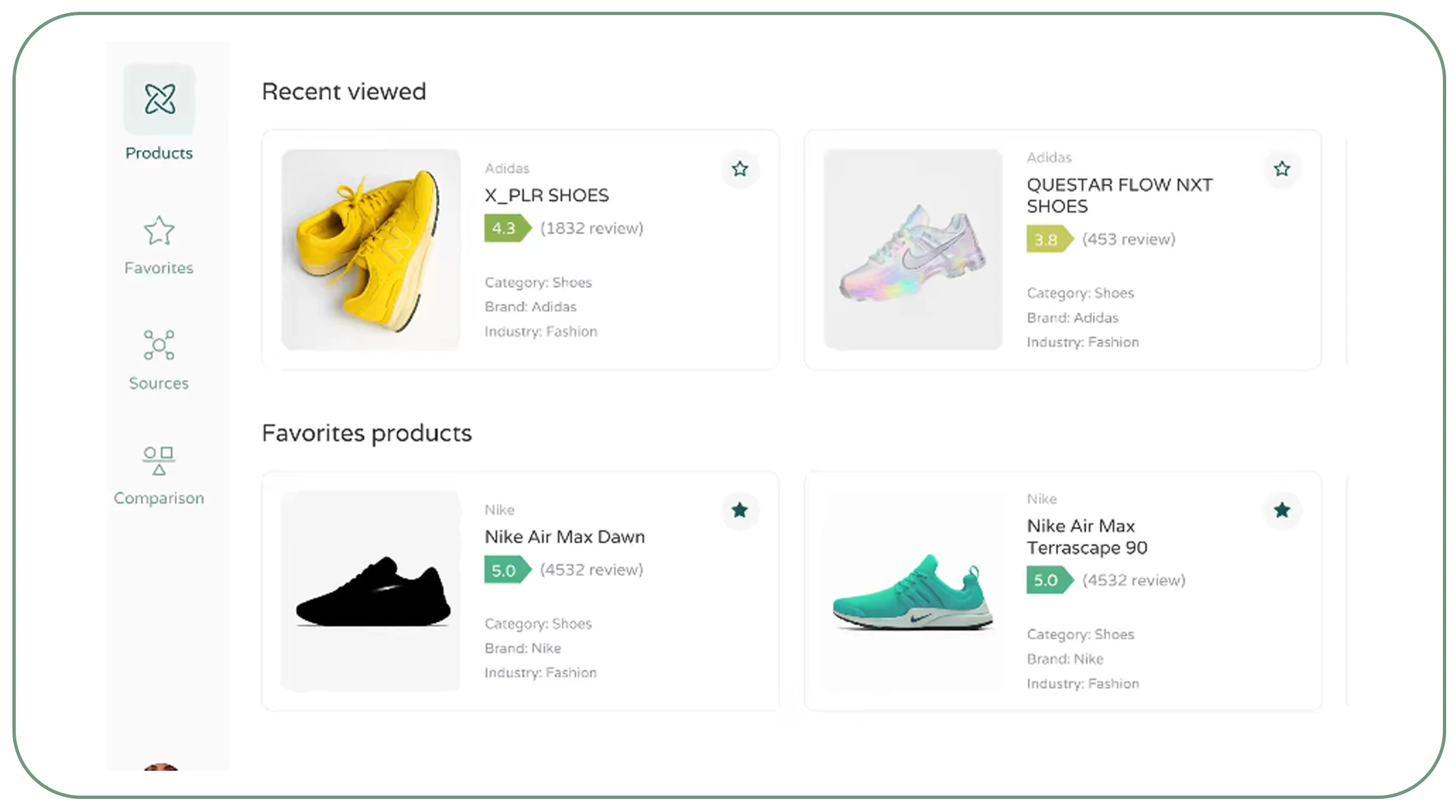
A competitive pricing strategy requires consistent visibility into what other sellers are offering. A web data scraper for competitor analysis can collect comparable product information at scheduled intervals and help businesses identify meaningful changes.
For example, a retailer monitoring 5,000 products across 10 competitors may need to compare thousands of price points every day. Automated collection makes this process more systematic than manually checking individual product pages.
What pricing teams can monitor
| Data Point | Pricing Application |
|---|---|
| Current price | Competitive benchmarking |
| Previous price | Price-change detection |
| Discount | Promotion analysis |
| Product availability | Supply comparison |
| Seller | Marketplace monitoring |
| Rating | Product perception |
| Review count | Demand signal |
| Product ID/SKU | Product matching |
| Timestamp | Historical analysis |
A business can establish thresholds for meaningful changes. For instance, a pricing team could flag products where a competitor reduces its price by more than 5%, while merchandising teams could monitor new products entering a target category.
2020–2026 progression
2020: Online purchasing growth increased the importance of digital price visibility.
2021: Retailers increasingly monitored competitor products and promotions as digital commerce expanded.
2022: Inflation and cost pressures made price benchmarking more important for protecting margins.
2023: Competitive monitoring expanded from basic prices to availability, discounts, sellers, and assortment.
2024: Businesses increasingly connected price intelligence with product and customer data.
2025: Automated monitoring became more valuable for businesses managing large product catalogs.
2026: Pricing teams increasingly require historical datasets, automated alerts, and faster access to competitive changes.
The years above describe industry evolution rather than a single-source statistical dataset.
| Catalog Size | Suggested Monitoring Approach* |
|---|---|
| 500 products | Daily |
| 5,000 products | 6–24 hours |
| 25,000 products | 4–12 hours |
| 100,000+ products | Custom frequency |
These are illustrative planning ranges, not guaranteed collection frequencies. Actual requirements depend on source behavior, infrastructure, product category, and business objectives.
The key insight is that competitive monitoring should prioritize business relevance. A company does not necessarily need every available data point. It needs the right information at a frequency that supports its pricing decisions.
What Business Information Can Companies Collect Automatically?
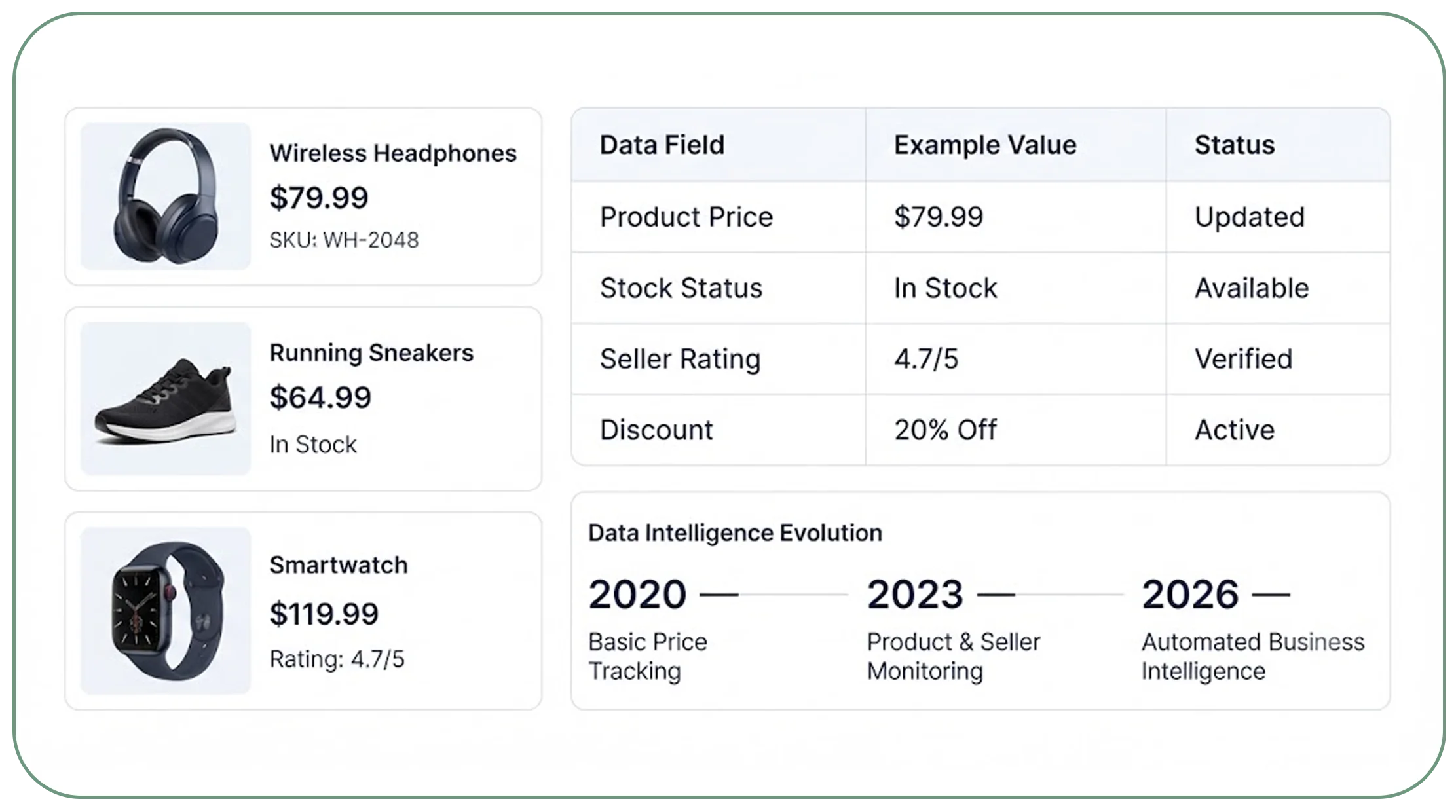
Businesses often need information beyond pricing. Product titles, SKUs, specifications, categories, sellers, ratings, availability, and promotional information can all contribute to better commercial intelligence.
Organizations can extract business data using web scraping APIs and structure the resulting information for databases, dashboards, analytics platforms, or internal applications.
A practical product intelligence dataset
| Data Category | Example Fields |
|---|---|
| Product identity | SKU, product ID, UPC |
| Product details | Name, description, specifications |
| Pricing | Current price, old price |
| Promotion | Discount, coupon, offer |
| Inventory | Stock status, availability |
| Seller | Seller name, rating |
| Customer feedback | Rating, review count |
| Classification | Category, subcategory, brand |
| Source | URL, collection timestamp |
The quality of this dataset depends heavily on normalization. The same product may appear with different titles or descriptions across websites. Product matching can therefore use stable identifiers such as SKU, model number, product ID, brand, or UPC where available.
2020–2026 evolution
2020: Businesses focused primarily on basic product and price collection.
2021: Product availability became more important as online demand increased.
2022: Catalog information became increasingly connected with pricing and inventory analysis.
2023: Brands began monitoring product listings across marketplaces and retail channels.
2024: Product datasets increasingly included ratings, reviews, seller information, and promotional attributes.
2025: Historical product snapshots became more valuable for identifying catalog changes.
2026: Product intelligence increasingly supports automated analytics and AI-assisted decision-making.
Recommended data-quality checks
- Validate product identifiers.
- Standardize currencies.
- Normalize units and pack sizes.
- Remove duplicate records.
- Track collection timestamps.
- Identify missing fields.
- Compare records against previous snapshots.
- Maintain source-level traceability.
The result is a dataset that can support pricing, merchandising, category management, product research, and competitive intelligence without requiring analysts to repeatedly collect information manually.
Why Does Real-Time Pricing Intelligence Matter?
Prices can change quickly, particularly in highly competitive categories. A real-time market data extraction API can support workflows that require frequently refreshed information and automated change detection.
Consider a consumer electronics retailer. If several competitors reduce the price of a popular product, waiting several days to identify that movement can affect pricing decisions and potentially reduce competitiveness.
Example pricing-change dataset
| Product | Previous Price | Current Price | Change | Status |
|---|---|---|---|---|
| Product A | $199 | $189 | -5.0% | Price reduced |
| Product B | $149 | $149 | 0% | No change |
| Product C | $299 | $279 | -6.7% | Price reduced |
| Product D | $99 | $109 | +10.1% | Price increased |
Businesses can create rules around these changes. A 2% movement may not require action, while a 10% change could trigger a pricing review.
2020–2026 development
2020: Businesses increasingly needed faster visibility into digital prices.
2021: Online promotions became a larger part of competitive retail strategies.
2022: Economic uncertainty increased attention toward frequent price movements.
2023: Retailers began connecting price changes with availability and promotional information.
2024: Historical price tracking became increasingly important for understanding competitor behavior.
2025: Automated alerts helped teams prioritize significant market changes.
2026: Faster data refreshes increasingly support dynamic pricing, competitive intelligence, and automated decision workflows.
What should trigger an alert?
- Competitor price decreases above a defined threshold.
- Major promotional campaigns.
- Product availability changes.
- New sellers entering a marketplace.
- Significant assortment changes.
- Products appearing or disappearing from key categories.
The most effective system does not overwhelm users with alerts. It prioritizes changes based on product importance, percentage movement, competitor relevance, and historical patterns.
Build a pricing intelligence workflow that captures meaningful market changes and delivers structured data to the teams responsible for pricing decisions!
Get Insights Now!How Can Automated Collection Improve Product-Level Decision-Making?
Product teams need visibility into what is available in the market, how products are positioned, and how competitors modify their catalogs. A web data extraction API can support recurring product monitoring and structured delivery.
When combined with web scraping APIs for business data, the workflow can connect product information with broader competitive and pricing datasets.
This is especially useful for organizations managing large assortments. A product manager might need to identify newly launched products, discontinued SKUs, changes in specifications, new package sizes, or competitor assortment gaps.
Product intelligence use cases
| Use Case | Data Signal |
|---|---|
| New product discovery | New product listings |
| Assortment analysis | Category and SKU coverage |
| Product matching | SKU/model identifiers |
| Pricing analysis | Current and historical prices |
| Promotion tracking | Discounts and offers |
| Inventory monitoring | Availability status |
| Marketplace analysis | Sellers and ratings |
| Catalog quality | Missing or changed attributes |
2020–2026 progression
2020: Product teams primarily focused on maintaining online catalogs.
2021: Assortment visibility became increasingly important across digital channels.
2022: Product availability and pricing became closely connected to commercial planning.
2023: Marketplace expansion increased the need for cross-channel product comparisons.
2024: Brands increasingly tracked digital shelf conditions and product presentation.
2025: Historical product datasets supported broader assortment and competitive analysis.
2026: Automated product intelligence increasingly supports AI-assisted research and analytics.
A practical product monitoring program should begin with a defined product universe. Businesses can prioritize strategic SKUs, high-revenue categories, high-competition products, and products with frequent price changes.
The collection process should then capture consistent fields at regular intervals and maintain historical records. This makes it easier to distinguish temporary changes from persistent market trends.
What Role Do Managed Data Workflows Play in Market Intelligence?
Large-scale data collection requires more than extraction. Websites change, product structures evolve, fields can become unavailable, and business requirements grow over time.
Web Scraping Services can help companies create recurring data workflows that include extraction, parsing, validation, normalization, storage, and delivery.
Typical workflow
| Process | Business Output |
|---|---|
| Source identification | Relevant websites and pages |
| Data extraction | Raw online information |
| Parsing | Structured records |
| Cleaning | Standardized datasets |
| Validation | Quality-controlled data |
| Matching | Comparable product records |
| Historical storage | Trend analysis |
| Delivery | API, CSV, JSON, database |
| Monitoring | Change detection |
2020–2026 evolution
2020: Businesses often depended on small, project-specific scripts.
2021: Growing data volumes increased the need for automated workflows.
2022: Data quality and recurring collection became more important.
2023: Businesses increasingly connected extraction with internal databases and analytics systems.
2024: Data validation and historical monitoring became central to large-scale projects.
2025: Managed workflows reduced the operational burden associated with maintaining collection pipelines.
2026: Businesses increasingly expect end-to-end data workflows that support analytics, automation, and AI applications.
A managed workflow can be particularly useful when the internal team lacks the engineering resources to maintain multiple extraction pipelines. However, companies should assess requirements carefully, including source complexity, collection frequency, data volume, quality expectations, and delivery format.
The best approach is one that aligns the technical pipeline with a measurable business outcome.
How Should Companies Evaluate API-Based Data Collection?
A Web Scraping API should be evaluated based on how effectively it supports the complete business workflow rather than simply how many requests it can process.
Organizations should assess scalability, reliability, data quality, integration, scheduling, historical access, and output formats before selecting an API-based solution.
The broader objective of web scraping APIs for business data is to create a repeatable information pipeline that can support pricing, product intelligence, competitive research, and market analysis.
API evaluation checklist
| Capability | Business Benefit |
|---|---|
| Scalable collection | Supports growing datasets |
| Structured output | Simplifies analysis |
| Scheduling | Enables recurring monitoring |
| Data validation | Improves reliability |
| Historical records | Enables trend analysis |
| API integration | Connects internal systems |
| Flexible formats | Supports different workflows |
| Monitoring | Helps identify collection issues |
2020–2026 progression
2020: Basic extraction tools addressed relatively small datasets.
2021: Businesses began demanding greater automation and repeatability.
2022: Reliability and data quality became more important as collection volumes grew.
2023: API-based delivery increasingly connected web data with internal business systems.
2024: Historical datasets became more important for competitive and pricing analytics.
2025: Businesses increasingly prioritized scalable workflows and flexible integrations.
2026: API-based collection is increasingly positioned as a data infrastructure component for analytics and AI-enabled workflows.
Questions buyers should ask
- Can the solution support our expected data volume?
- How frequently can data be refreshed?
- Can product records be matched consistently?
- What validation processes are available?
- Can historical snapshots be maintained?
- Which delivery formats are supported?
- Can the workflow integrate with our existing data warehouse?
- How are collection failures detected?
- Can fields be customized around our business objectives?
The right solution should make data easier to consume, not simply make extraction easier. Business teams should receive structured information that can move directly into analysis and decision-making workflows.
Why Choose Real Data API?
A reliable data partner should understand both the technical and commercial side of web data collection. Scraping Browser API capabilities can be useful when modern websites rely on browser-rendered content, dynamic elements, or interactive page behavior.
For businesses, the selection process should focus on practical outcomes:
- Scalable data collection
- Structured product datasets
- Competitive price monitoring
- Recurring extraction
- Data normalization
- Quality validation
- Historical tracking
- Flexible delivery
- Analytics integration
- Business-specific data fields
Real Data API can support organizations that need structured web information for pricing intelligence, product monitoring, competitive research, and broader market analysis.
The strongest projects begin with a clearly defined business question. Once the question is established, teams can determine the required sources, fields, refresh frequency, validation rules, and delivery mechanism.
Conclusion
Better pricing and product decisions depend on having timely, structured, and comparable market information. web scraping APIs for business data can help organizations automate the collection of online product, price, availability, seller, and competitive information and transform it into usable intelligence.
For pricing teams, historical observations can reveal competitor movements and promotional patterns. For product managers, recurring datasets can highlight assortment changes, new products, and catalog gaps. For business analysts, structured data can provide the foundation for dashboards, reports, forecasting, and AI-assisted research.
The most effective strategy is not to collect everything. It is to collect the information that directly supports business decisions, validate it consistently, retain useful history, and deliver it in a format that teams can act upon.
Ready to turn online product and pricing information into actionable business intelligence? Contact Real Data API to build a scalable data collection workflow tailored to your business goals!
FAQs
1. How do businesses use web scraping APIs for business data?
web scraping APIs for business data help companies collect structured pricing, product, competitor, availability, and market information automatically for faster analysis and informed commercial decisions.
2. What does E-Commerce Data Scraping provide?
E-Commerce Data Scraping can collect product names, SKUs, prices, discounts, availability, ratings, reviews, seller information, categories, specifications, and other permitted online data fields.
3. Why use a web data scraper for competitor analysis?
A web data scraper for competitor analysis helps businesses monitor competitor prices, products, promotions, availability, and assortment changes systematically instead of relying on manual research.
4. Can businesses extract product information automatically?
Yes. Companies can extract business data using web scraping APIs to build recurring datasets containing product attributes, prices, sellers, availability, ratings, and other relevant information.
5. How does Real Data API support market intelligence?
A real-time market data extraction API can help businesses receive frequently refreshed market information for pricing analysis, product monitoring, competitor tracking, and faster strategic decisions.
Latest posts
How ecommerce scraping API for real-time product data Helps Businesses Track Prices, Inventory, and Competitor Changes
How Web Scraping APIs for Business Data Improve Pricing and Product Insights
How Extracting Bilibili API Data for Social Media Analytics Helps Brands Track Content, Engagement, and Audience Trends

How Prom.ua scraper Helps Businesses Collect Marketplace Data for Competitive Pricing and Product Intelligence






.png)