TL;DR
- Dior fashion and structured product intelligence help luxury brands monitor changing assortments, price points, collections, availability, and market positioning across digital channels.
- Dior fashion data scraping can transform publicly available product and collection information into organized datasets that support competitive research, assortment planning, pricing analysis, and trend tracking.
- From 2020–2026, luxury fashion has become increasingly digital, making timely, structured product information valuable for retailers, analysts, marketplaces, and fashion intelligence teams.
Introduction
Luxury fashion businesses need more than product catalogs to understand a rapidly changing market. They need structured information covering products, prices, categories, collections, availability, materials, colors, sizes, and merchandising signals. Dior fashion dataset solutions help businesses organize these data points into a consistent research layer for competitive intelligence and market analysis.
The challenge is scale. A premium fashion website can contain hundreds or thousands of products across ready-to-wear, handbags, footwear, accessories, jewelry, and seasonal collections. Products may be added, removed, repriced, renamed, or moved between collections. Dior fashion data scraping can collect accessible product signals systematically rather than relying on manual research.
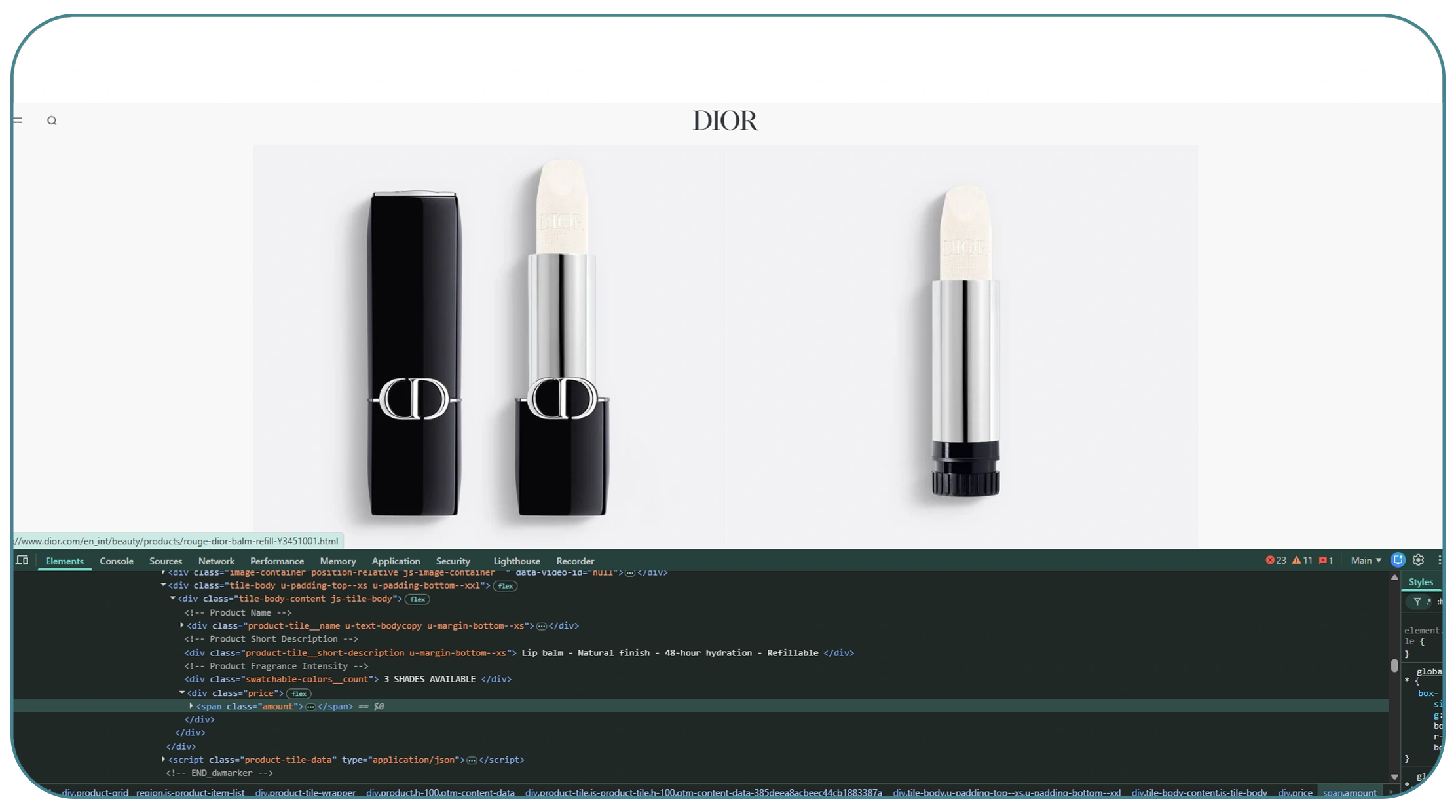
Dior's official digital properties demonstrate the breadth of information available for analysis. Its current women's ready-to-wear pages list hundreds of items, while product pages can include pricing, materials, product names, availability, and collection-related information.
For luxury retailers, fashion marketplaces, analysts, and ecommerce intelligence teams, the objective is not simply to collect product pages. The objective is to create a reliable historical view that answers questions such as:
- Which categories are expanding?
- How do prices change between seasons?
- Which products remain consistently visible?
- Which collections introduce new styles or materials?
- How does assortment composition change?
- Which products are available in specific markets?
- How quickly do new collections appear online?
This makes structured fashion data a useful input for pricing intelligence, competitive benchmarking, assortment optimization, trend research, and digital merchandising.
How can businesses build a reliable product intelligence layer?
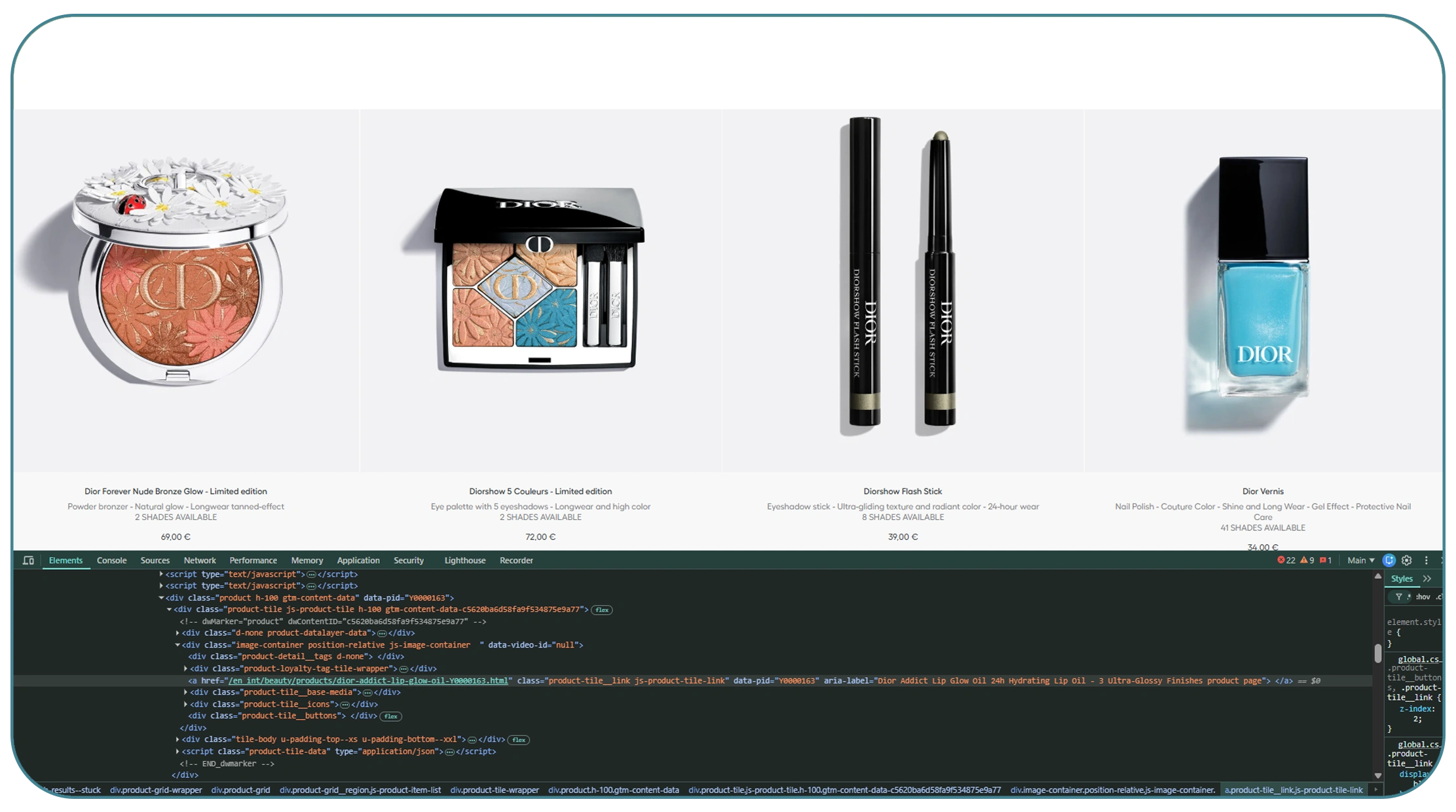
A luxury fashion intelligence project starts with identifying the product attributes that matter commercially. Instead of treating each webpage as an isolated record, businesses can organize information into standardized fields.
Extract Dior fashion product data enables companies to create records containing product names, product URLs, categories, subcategories, prices, currencies, colors, materials, sizes, availability, collection information, badges, and other accessible attributes.
A structured approach also makes historical comparison possible. For example, a business can compare the same product across different collection periods and determine whether its price, availability, or merchandising position has changed.
Example Data Structure
| Data Attribute | Business Use |
|---|---|
| Product Name | Product identification |
| SKU/Product ID | Product-level tracking |
| Category | Assortment analysis |
| Price | Pricing intelligence |
| Currency | Regional comparison |
| Availability | Stock visibility |
| Color | Trend analysis |
| Material | Product positioning |
| Collection | Seasonal analysis |
| Product URL | Record validation |
| Image URL | Visual catalog analysis |
| Timestamp | Historical monitoring |
The value becomes greater when records are collected repeatedly. A single snapshot answers what is visible today. A historical dataset can reveal how the assortment changed over time.
Dior's official website illustrates why this structure matters. Its current fashion pages include product names, materials, prices, "new" indicators, and category-level browsing. The Indian storefront, for example, currently displays products such as cashmere knitwear, Bar Jackets, Cannage pieces, and other ready-to-wear products with INR pricing.
2020–2026 Market Evolution
From 2020 onward, fashion discovery increasingly moved toward digital channels. During the early 2020s, retailers accelerated online merchandising, while subsequent years brought greater emphasis on omnichannel experiences, localized pricing, digital product presentation, and rapid collection launches.
By 2025–2026, luxury fashion websites had evolved beyond static catalogs. They increasingly function as digital storefronts containing product discovery, editorial storytelling, campaign content, collection pages, shop-by-look experiences, and regional merchandising.
Dior's official pages show this evolution through collection-led browsing and campaign storytelling. Its Spring-Summer 2025 collection, for instance, connected ready-to-wear products with a broader creative concept and shop-by-look experience.
For businesses, this means product data should be collected with both commercial and contextual fields. A modern dataset can connect individual products with categories, collections, campaigns, and time periods, creating a more useful foundation for analysis.
| Period | Key Digital Data Development |
|---|---|
| 2020 | Rapid acceleration of online product discovery |
| 2021 | Greater focus on digital catalogs and availability |
| 2022 | Expansion of omnichannel product intelligence |
| 2023 | More sophisticated pricing and assortment tracking |
| 2024 | Greater emphasis on collection and campaign analysis |
| 2025 | Richer shop-by-look and editorial commerce |
| 2026 | Growing demand for continuous fashion intelligence |
Why does continuous monitoring matter for luxury fashion?
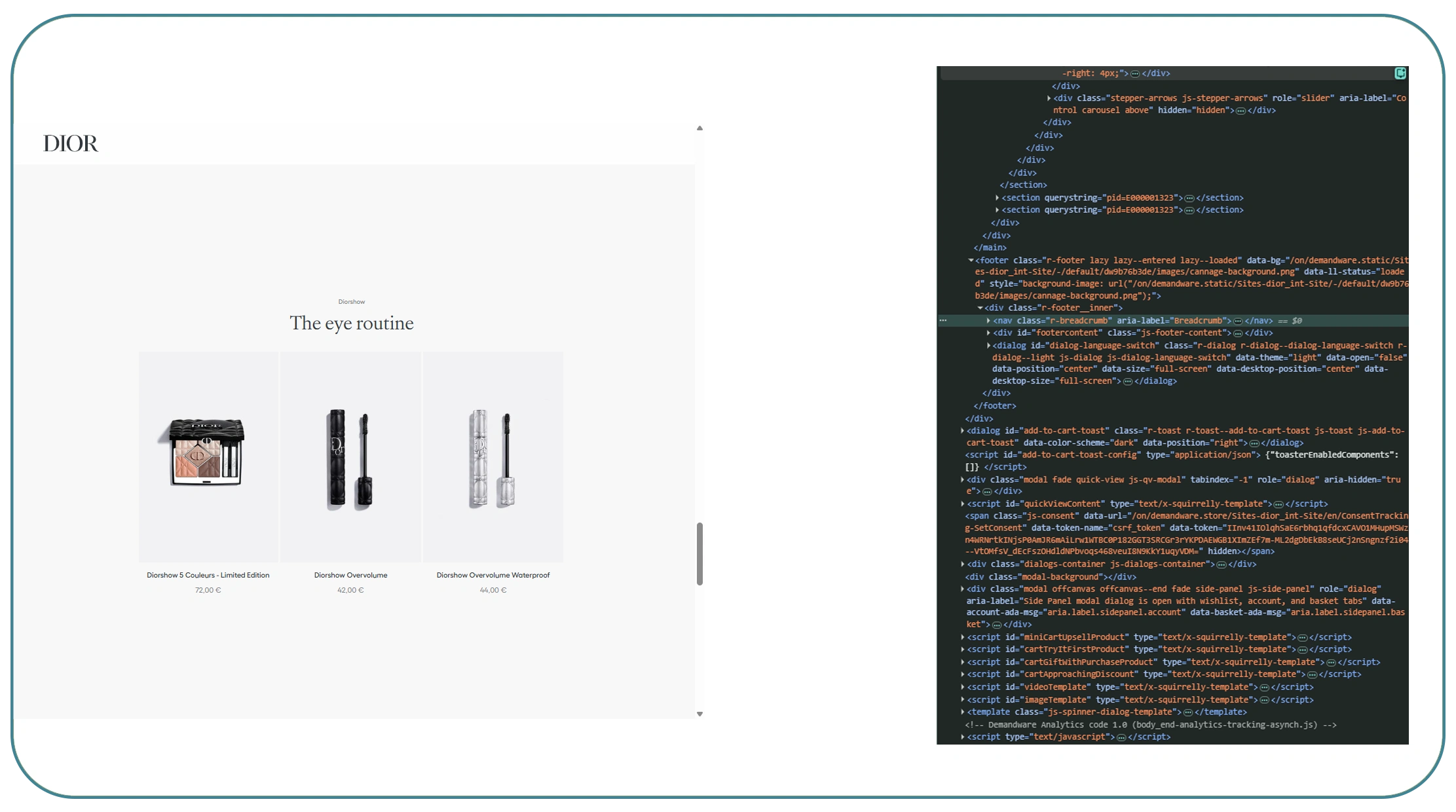
Luxury fashion changes quickly. A product may be introduced for a seasonal collection, receive a new color variation, become unavailable, return to stock, or disappear from an online assortment. Manual research can struggle to capture these changes consistently.
Real-time Dior fashion product data can support monitoring workflows where businesses collect information at predefined intervals and compare each new observation with historical records.
The purpose is not necessarily to collect data every second. Instead, businesses can select a monitoring frequency based on the business question. A daily schedule may be appropriate for pricing research, while weekly or collection-based monitoring may work for assortment analysis.
What Continuous Monitoring Can Reveal
| Signal | Potential Insight |
|---|---|
| New product detected | New assortment identification |
| Price changed | Pricing movement |
| Product unavailable | Potential stock signal |
| Product returns | Replenishment or merchandising signal |
| Category count changes | Assortment expansion/contraction |
| New collection label | Seasonal launch tracking |
| Color variation added | Design/trend movement |
| Product removed | Assortment lifecycle signal |
Dior's official fashion ecosystem demonstrates the importance of collection timing. Its Fall 2025 ready-to-wear collection included 71 looks on the official collection page, while its Cruise 2025 presentation featured 89 looks.
This type of collection information can be connected with product-level records to create a richer analytical model. A company could, for example, measure the number of products associated with a collection, compare price ranges, classify product categories, and monitor which products remain visible after a collection launch.
2020–2026 Progression
Between 2020 and 2026, the importance of continuous digital monitoring increased as fashion businesses became more dependent on online merchandising and rapid product discovery.
In 2020–2021, businesses were often focused on establishing reliable digital product visibility. In 2022–2023, competitive pricing and assortment tracking became more important as retailers expanded digital operations. By 2024–2025, collection-level storytelling and digital merchandising created additional data points beyond basic product and price fields.
In 2026, fashion intelligence can therefore combine product-level, collection-level, regional, and temporal information. Instead of asking only "What products are available?", analysts can ask "How did the assortment change?", "Which categories gained visibility?", and "How did pricing evolve across collection periods?"
This historical perspective makes recurring collection especially valuable for companies building proprietary market intelligence systems.
How can luxury brands use structured data for market research?
Dior Data Extraction for Luxury Fashion Market Research can help analysts transform publicly available digital information into structured research datasets.
For luxury fashion businesses, the objective is usually comparative rather than isolated. A brand may want to understand its own positioning against premium competitors, identify category gaps, examine price architecture, or observe how luxury collections evolve.
A useful research dataset can include:
- Product category and subcategory
- Product price and currency
- Product availability
- Collection or season
- Material and color
- Product positioning
- New-product indicators
- Regional storefront
- Product URL
- Historical timestamp
These fields can support several analytical models.
| Research Area | Data Application |
|---|---|
| Price Architecture | Compare entry, mid, and premium price bands |
| Assortment Analysis | Measure category breadth |
| Collection Research | Compare seasonal product composition |
| Regional Intelligence | Study market-specific pricing |
| Trend Research | Identify recurring colors/materials |
| Competitive Intelligence | Benchmark comparable products |
| Lifecycle Analysis | Track product introduction and removal |
What Changed From 2020 to 2026?
The luxury market's digital information environment became more detailed over this period. Product pages increasingly combined commerce information with editorial storytelling, campaign content, collection narratives, and visual merchandising.
Dior's 2025 campaigns provide a useful illustration. The Spring-Summer 2025 campaign connected clothing with the Amazon-inspired creative direction, while the Autumn-Winter 2025-2026 campaign referenced Dior's archives and introduced contemporary interpretations of historical design elements.
For analysts, these developments create opportunities to connect quantitative product information with qualitative fashion signals.
The resulting dataset can help answer questions about assortment depth, pricing structures, product families, and collection evolution without relying exclusively on manual research.
Want to turn luxury fashion websites into structured market intelligence? Explore Real Data API's scalable data extraction capabilities for product, pricing, collection, and competitive research!
Get Insights Now!How can an API make fashion intelligence more scalable?
Dior fashion data API workflows can provide businesses with a more scalable method for accessing structured product information and integrating it into internal systems.
Instead of downloading isolated files for individual research projects, API-driven workflows can support recurring data pipelines. Data can move into databases, dashboards, analytics platforms, business intelligence tools, or machine-learning workflows.
A well-designed API workflow can include:
- Source identification
- Automated extraction
- Data normalization
- Validation
- Deduplication
- Timestamping
- Structured delivery
- Historical storage
- API access
- Analytics integration
A recurring Dior fashion dataset can then become part of a larger fashion intelligence repository.
Why API Delivery Matters
| Requirement | API-Based Advantage |
|---|---|
| Recurring collection | Automated workflows |
| Large datasets | Scalable processing |
| Multiple regions | Structured regional records |
| Historical analysis | Timestamped datasets |
| Analytics | Direct system integration |
| Monitoring | Repeatable schedules |
| Reporting | Consistent schemas |
LVMH's published financial information shows the scale of the broader luxury fashion environment. Its Fashion & Leather Goods business generated €37.77 billion in revenue in 2025, compared with €41.06 billion in 2024 and €42.169 billion in 2023.
These figures are group-level and should not be interpreted as Dior-specific revenue. They nevertheless illustrate why structured competitive intelligence can matter in a large luxury ecosystem.
From 2020–2026, businesses have increasingly moved from one-time scraping projects toward reusable data infrastructure. The change reflects a broader need for historical records, automated refreshes, standardized schemas, and machine-readable information.
For fashion analysts, this means the data pipeline itself becomes strategically important. The more consistently information is collected and standardized, the easier it becomes to identify meaningful changes.
What can fashion datasets reveal about collections and consumer trends?
Dior Fashion Datasets can support a wide range of luxury-market research use cases when product records are collected consistently.
One important application is assortment mapping. Analysts can classify products by category and determine how the product mix changes between collection periods.
Another is price-band analysis. A business can group products into price ranges and monitor how the distribution changes over time. This can reveal whether an assortment is becoming more concentrated around premium price points or expanding into lower-priced categories.
Collection analysis can also connect individual products with broader creative themes. Dior's official collection pages show how seasonal fashion can combine clothing, accessories, craftsmanship, heritage references, and visual storytelling. Its Fall 2025 collection, for example, drew on Japanese cultural references, kimono construction, textile heritage, and historical Dior designs.
Practical Analytical Framework
| Analysis Area | Example Application |
|---|---|
| Category Mapping | Measure assortment breadth by category |
| Price Bands | Compare entry, mid, and premium price positioning |
| Collection Composition | Compare seasonal product mix |
| Material Analysis | Identify recurring materials and fabric trends |
| Color Trends | Track color variation introduction |
| Product Lifecycle | Monitor introduction and removal patterns |
| Regional Pricing | Compare market-specific price points |
2020–2026 Perspective
Fashion datasets have become increasingly useful as businesses seek historical context. In 2020, many digital research workflows focused on basic product availability and online assortment. By 2022, businesses increasingly needed competitive pricing and category-level information.
In 2023–2024, collection, campaign, and merchandising signals became more relevant to understanding premium positioning. By 2025–2026, fashion websites increasingly combine commerce, editorial, visual, and collection experiences.
Dior's current website provides an example of this richer environment. Its women's fashion section features current collections, new wardrobe selections, bags, and other product experiences, while its ready-to-wear page provides a large structured assortment with product names, materials, prices, and new-product markers.
For businesses, the key opportunity is to convert these changing digital signals into historical records that can be compared consistently.
How does automated collection improve fashion intelligence?
Fashion Data Scraping becomes more valuable when it is designed as a repeatable process rather than a one-time extraction exercise.
A robust workflow can identify relevant pages, collect structured fields, normalize values, validate records, detect changes, and deliver refreshed datasets on a scheduled basis.
For luxury fashion businesses, automation can reduce the operational burden associated with manually reviewing large catalogs. It can also make historical comparisons more reliable because every collection cycle follows a consistent data structure.
Recommended Workflow
Source → Extract → Normalize → Validate → Compare → Store → Analyze
| Stage | Output |
|---|---|
| Source Discovery | Relevant product and collection URLs |
| Extraction | Raw product records |
| Normalization | Consistent names, prices, categories |
| Validation | Quality-checked records |
| Change Detection | New, modified, or removed products |
| Storage | Historical dataset |
| Analytics | Dashboards and research outputs |
2020–2026 Evolution
The data collection process has moved from manually maintained spreadsheets toward automated data pipelines. In the early 2020s, manual catalog reviews could still support small research projects. However, increasing product variety, regional storefronts, frequent collection updates, and changing digital experiences made automation more practical.
By 2024–2025, businesses could benefit from combining recurring extraction with historical databases. In 2026, the next step is connecting those datasets directly with analytics and AI workflows.
The quality of the output depends on more than extraction volume. Schema consistency, duplicate management, timestamp accuracy, price normalization, URL validation, and missing-field handling all influence analytical reliability.
For example, a price-change analysis can become misleading if the same product appears under multiple naming conventions. Similarly, a collection comparison can produce inaccurate results if discontinued products are simply deleted rather than preserved with historical timestamps.
A strong pipeline therefore treats every observation as part of a time series. This enables businesses to reconstruct what the digital assortment looked like at different points in time.
Why Choose Real Data API?
Real Data API can support businesses that need structured, scalable, and repeatable web data workflows for e-commerce and market intelligence.
For luxury fashion research, the value extends beyond collecting product names and prices. Businesses may require normalized datasets that can be integrated into existing databases, dashboards, research systems, or analytics environments.
Key Capabilities to Consider Include:
- Scalable product data collection
- Structured product and pricing fields
- Recurring data extraction
- Historical dataset creation
- Data normalization and validation
- Custom fields based on business requirements
- API-ready delivery
- Regional and category-level collection
- Integration with analytics workflows
- Monitoring of product and assortment changes
A structured fashion dataset can become a reusable research asset rather than a one-time report.
For retailers, marketplace operators, fashion analysts, and luxury intelligence teams, this approach supports repeatable analysis across product, pricing, assortment, collection, and market trends.
Conclusion
The luxury fashion market is increasingly data-driven, and digital product information provides an important source of competitive intelligence. A structured Dior fashion dataset can help brands organize products, prices, collections, availability, and trend signals into a historical analytical resource.
The strongest approach combines automated collection, data validation, normalization, historical storage, and API-based delivery. This allows businesses to move from manual observation toward repeatable market intelligence.
Dior's evolving digital presence—from collection storytelling and campaign pages to large product catalogs—illustrates how much structured information can exist across modern luxury fashion websites.
Ready to build a scalable luxury fashion intelligence pipeline? Contact Real Data API to create structured, refreshed datasets tailored to your product, pricing, collection, and competitive research requirements!
FAQs
How can brands use a Dior fashion dataset for competitive intelligence?
A Dior fashion dataset helps brands compare products, prices, categories, collections, availability, and historical changes. This supports assortment benchmarking, pricing research, and luxury market analysis.
What information can Dior fashion data scraping collect?
Dior fashion data scraping can collect accessible product names, prices, categories, materials, colors, sizes, availability, URLs, collection details, and timestamps for structured market intelligence.
Why should businesses extract Dior fashion product data regularly?
Businesses can extract Dior fashion product data repeatedly to identify new products, price changes, assortment movements, availability changes, collection launches, and other digital merchandising signals.
How does real-time Dior fashion product data support monitoring?
Real-time Dior fashion product data can help analysts monitor changing prices, availability, product launches, and assortment signals, enabling faster competitive research and more timely luxury retail decisions.
How is Dior data useful for luxury fashion research?
Dior Data Extraction for Luxury Fashion Market Research can structure product, pricing, collection, and assortment information for competitive benchmarking, trend analysis, market research, and historical fashion intelligence.
Latest posts
How Foodpanda Food Dataset Helps Businesses Track Restaurants, Menus, Prices, Ratings, and Food Delivery Trends?

How IKEA E-commerce Dataset Helps Businesses Solve Product, Pricing, Category, and Retail Trend Challenges?
How Target e-commerce dataset Helps Brands Track Products, Prices, Availability, and Retail Market Trends for Smarter Insights?
How Dior fashion dataset Helps Brands Track Luxury Products, Prices, Collections, and Fashion Trends for Smarter Insights?






.png)