.gif)
.gif)
Quick Summary
- How to Scrape Amazon Fresh Grocery Delivery Data in 2026 explains how grocery retailers can collect structured pricing, product availability, promotional, and delivery information through authorized data-access methods.
- Amazon Fresh Grocery Data Scraping helps retailers compare product-level prices, identify competitive movements, and understand category-level assortment changes.
- Consistent grocery intelligence supports better pricing decisions, inventory planning, and profit-margin protection in a competitive quick-commerce environment.
Introduction
Grocery retailers operate in a highly competitive environment where product prices, discounts, stock availability, and delivery convenience influence purchasing decisions. Understanding How to Scrape Amazon Fresh Grocery Delivery Data in 2026 helps retailers develop a structured approach to collecting and analyzing marketplace information through authorized sources. Instead of relying on occasional manual checks, businesses can build repeatable monitoring processes that reveal competitive pricing movements and product-level changes.
Amazon Fresh provides an important reference point for studying online grocery retail. Amazon announced in January 2026 that its grocery delivery services reached more than 5,000 U.S. cities and towns, with plans to expand same-day fresh grocery delivery further. The company also stated that more than 150 million customers shop for groceries on Amazon annually.
For grocery chains, supermarkets, distributors, and e-commerce businesses, this creates an opportunity to understand how digital grocery assortments compete. Useful information includes product names, brands, package sizes, listed prices, promotional offers, availability, and delivery estimates.
The objective is not simply to collect product listings. Retailers need reliable, comparable information that helps them understand price differences, identify margin pressure, and make informed commercial decisions. This requires consistent product matching, location-aware monitoring, historical records, and clear data-quality controls.
How Can Retailers Build a Reliable Competitive Monitoring Process?
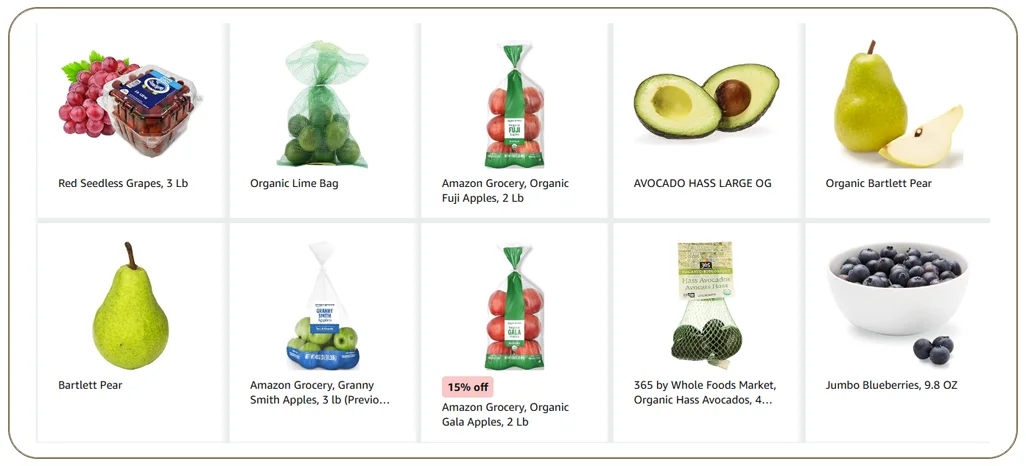
A reliable monitoring process begins by identifying the grocery categories and competitors that influence a retailer's pricing strategy. Businesses can use Amazon website data scraping as a research concept for authorized extraction workflows, provided they obtain the necessary permissions before collecting or reusing marketplace information.
The first step is to define the product universe. Grocery retailers should prioritize frequently purchased products such as milk, eggs, rice, cooking oil, packaged snacks, beverages, fruits, vegetables, and household essentials. These categories provide useful reference points for understanding price positioning and assortment differences.
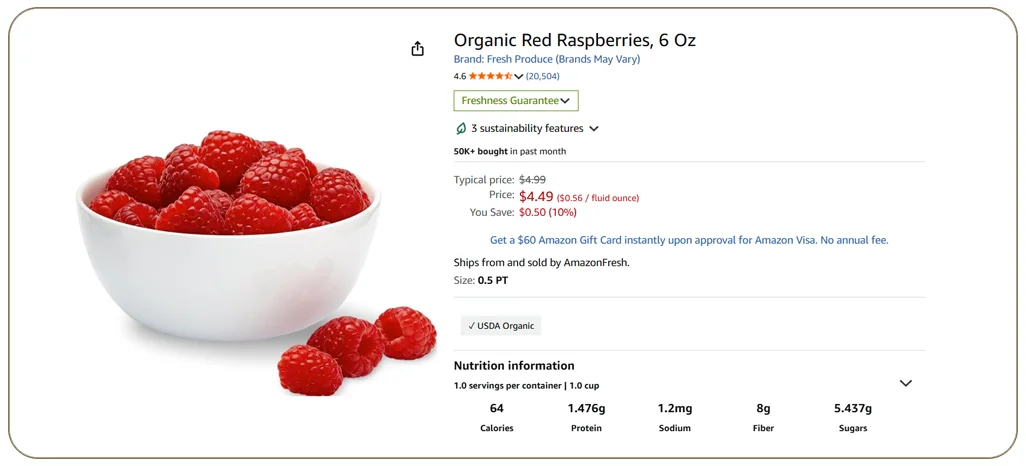
Next, retailers should establish a standardized collection structure. Every record should include a product identifier, brand, product name, package quantity, listed price, unit price, discount, availability status, delivery location, observation timestamp, and source reference. Unit-price normalization is particularly important because two products may have different package sizes.
The following historical figures demonstrate why grocery price monitoring matters. According to the U.S. Bureau of Labor Statistics, annual food-at-home CPI inflation was 3.5% in 2020, 3.5% in 2021, and 11.4% in 2022.
| Year | U.S. food-at-home CPI increase |
|---|---|
| 2020 | 3.5% |
| 2021 | 3.5% |
| 2022 | 11.4% |
| 2023 | 5.0% |
| 2024 | 1.2% |
| 2025 | 2.2%* |
| 2026 | Partial-year data |
Source: BLS historical figures and annual-average CPI data. The 2025 figure reflects eleven published months; 2026 is not a completed annual figure.
These figures represent broad U.S. grocery inflation, not Amazon Fresh-specific price changes. However, they demonstrate why retailers need historical comparisons rather than isolated price observations.
A useful monitoring process should include product matching, authorized collection, validation, historical storage, and scheduled reporting. This allows commercial teams to distinguish genuine price movements from changes caused by package sizes, promotions, or different product variants.
What Information Should Businesses Collect for Grocery Price Intelligence?
A structured Amazon grocery dataset extraction strategy should focus on fields that directly support competitive analysis and retail profitability. Collecting large volumes of unorganized product information does not automatically produce useful business intelligence. The value comes from connecting product attributes with price, availability, location, and time.
Retailers should begin with product-level information. Product names, brands, categories, package quantities, product identifiers, and product descriptions help identify comparable items across marketplaces. These attributes are essential when different retailers use slightly different naming conventions for the same grocery product.
Pricing information should include the displayed selling price, original price when available, discount amount, percentage discount, and normalized price per unit. For example, comparing the price of two different-sized cooking oil packages without calculating the price per litre can lead to incorrect conclusions.
Availability information is equally important. Businesses should distinguish between available, unavailable, temporarily out-of-stock, and delivery-restricted products whenever these statuses are explicitly provided by an authorized source.
| Data field | Business application | Profitability benefit |
|---|---|---|
| Product name | Product identification | Better product matching |
| Brand | Brand-level comparison | Competitive positioning |
| Package size | Quantity comparison | Accurate unit pricing |
| Selling price | Competitor benchmarking | Pricing decisions |
| Discount | Promotion tracking | Margin assessment |
| Availability | Stock monitoring | Demand and assortment planning |
| Delivery estimate | Service comparison | Fulfilment analysis |
| Timestamp | Historical tracking | Trend identification |
| Location | Regional comparison | Local pricing decisions |
Historical grocery spending also demonstrates the importance of category-level analysis. BLS reported that average annual U.S. household spending on fresh vegetables increased from $310 in 2020 to $353 in 2022. Spending on fresh fruits increased from $349 to $406 during the same period. These are expenditure figures, not product-price measurements.
Retailers can combine marketplace observations with their own procurement costs, selling prices, and operating expenses. This makes it possible to identify categories where competitive pressure is increasing while protecting the difference between selling price and total product cost.
Can an API Make Grocery Data Collection More Consistent?
An Amazon Fresh API should not be assumed to be a publicly available interface for retrieving every grocery listing, inventory status, local price, and delivery slot. Businesses must distinguish between officially documented Amazon APIs, permitted partner integrations, and third-party data services.
Amazon's product data access has also changed. Its official documentation states that Product Advertising API 5.0 has been deprecated and replaced by the Creators API. This is a product-catalog access option for eligible publishers and affiliate partners, not a universal grocery inventory or delivery API.
For retailers, the practical approach is to select an authorized data-access method that supports their specific requirements. Before implementation, teams should verify which fields are available, permitted usage, geographic coverage, update frequency, and retention conditions.
A structured API-based workflow can support several activities:
- Retrieve permitted product and pricing information from approved sources.
- Normalize product names, package quantities, and measurement units.
- Match equivalent products across different grocery retailers.
- Store dated observations for historical comparisons.
- Deliver validated information to dashboards and internal analytics systems.
The following table illustrates how data infrastructure can support different business decisions.
| Data workflow | Information processed | Business use |
|---|---|---|
| Product identification | Brand, SKU, category | Product matching |
| Price normalization | Selling price, unit price | Competitor comparison |
| Promotion analysis | Discounts, offers | Campaign planning |
| Availability tracking | Stock status | Assortment decisions |
| Historical storage | Dated price records | Trend analysis |
| Reporting | Aggregated metrics | Management decisions |
A consistent pipeline is particularly useful for retailers managing large product catalogs. Automated validation can flag missing prices, duplicate records, inconsistent package sizes, and unusual changes before the information reaches pricing teams.
Need structured grocery intelligence for better competitive decisions? Explore Real Data API's data collection and analytics capabilities for your business requirements!
Get Insights Now!How Can Inventory Monitoring Help Prevent Lost Sales?
Retailers need more than price comparisons to understand competitive performance. They must also understand whether comparable products are available and whether customers can receive them within an acceptable delivery window.
Businesses that Scrape Amazon Fresh inventory data through authorized methods can use explicit availability information to study assortment changes and potential supply gaps. The objective is to distinguish between a product being unavailable on a particular occasion and a longer-term assortment or supply issue.
Inventory intelligence becomes more valuable when combined with location information. Grocery availability can differ between delivery areas, fulfilment locations, and observation times. Therefore, retailers should record the relevant geographic area and timestamp instead of treating one product observation as representative of every market.
For example, a retailer may compare the availability of packaged dairy products across several monitored areas. If a product repeatedly becomes unavailable in one area, the retailer can investigate its own procurement, assortment, or replenishment strategy. This observation alone does not prove that a competitor has a supply-chain problem.
A useful monitoring framework includes:
| Monitoring metric | What it reveals | Recommended action |
|---|---|---|
| Product availability | Whether an item can be ordered | Review assortment gaps |
| Repeated unavailability | Recurring supply signals | Investigate replenishment |
| Delivery estimate | Customer fulfilment expectations | Compare service levels |
| Price movement | Competitive positioning | Review pricing strategy |
| Promotion frequency | Discount activity | Assess campaign performance |
| Category coverage | Assortment breadth | Identify missing products |
Retailers should connect these observations with internal inventory records. Competitor availability can inform commercial decisions, but actual replenishment quantities should also depend on the retailer's own demand forecasts, supplier lead times, storage capacity, and historical sales.
This combination helps businesses avoid reacting to isolated competitor changes. It creates a more balanced approach to assortment planning and operational efficiency.
How Can Mobile Grocery Shopping Insights Improve Competitive Analysis?
Mobile shopping has become an important part of digital grocery discovery. Customers use grocery applications to browse categories, compare brands, review discounts, and check delivery availability. For retailers, understanding how product information is presented across digital channels can improve their own shopping experience and competitive positioning.
An Amazon Fresh App Data Scraper is a useful term for a permitted mobile-data collection solution designed to analyze accessible grocery information. Any implementation must respect Amazon's applicable terms, permissions, and restrictions on automated collection.
Mobile grocery intelligence can help businesses examine several important elements:
Product presentation: Product titles, brand information, package quantities, images, and category placement help retailers understand how products are organized for customers.
Promotional visibility: Displayed discounts, offer labels, and promotional messaging provide insights into how grocery brands communicate value. Retailers can compare their own promotional strategies against observed market positioning.
Shopping convenience: Delivery estimates, product availability indicators, and location-specific information help businesses evaluate the customer experience offered across digital grocery channels.
Category navigation: The placement of staples, dairy, fresh produce, beverages, and household essentials can reveal how competitors organize their digital catalogs.
Retailers should avoid treating mobile and desktop observations as interchangeable. Product availability, prices, and delivery information may differ by location, account eligibility, platform, and observation time. Each record should retain its collection context.
For a reliable analysis, mobile observations should be standardized before comparison with other channels. Product identifiers, package sizes, and timestamps should be checked to prevent duplicate or misleading records.
The resulting insights can help grocery businesses improve their product presentation, identify missing categories, and make their digital shopping experience more competitive.
How Should Retailers Build a Historical Grocery Intelligence Database?
A structured Amazon Fresh Grocery Dataset can help retailers transform individual marketplace observations into useful historical intelligence. A single price check reveals what a product costs at one moment. A validated historical database helps businesses understand how prices, promotions, and availability change over time.
The database should maintain a consistent product identity across every observation. This means matching brand names, package quantities, product variants, and measurement units before calculating price movements. Without this step, a retailer may mistakenly compare different products or package sizes.
A practical database structure should include four important layers:
- Product master: Stores product names, brands, categories, package sizes, and standardized identifiers.
- Price history: Records selling prices, unit prices, discounts, and observation timestamps.
- Availability history: Maintains permitted stock-status observations and delivery information.
- Business intelligence: Connects marketplace observations with internal costs, margins, and sales performance.
The historical database should also maintain data provenance. Every record needs a source reference, collection timestamp, geographic context, and validation status. This allows analysts to investigate inconsistencies instead of accepting every observation as accurate.
| Period | Historical grocery trend | Business interpretation |
|---|---|---|
| 2020 | Food-at-home CPI increased 3.5% | Pandemic-era market disruption |
| 2021 | Food-at-home CPI increased 3.5% | Continued grocery price pressure |
| 2022 | Food-at-home CPI increased 11.4% | Significant inflationary pressure |
| 2023 | Annual food-at-home inflation was 5.0% | Slower price growth |
| 2024 | Annual food-at-home inflation was 1.2% | Further moderation |
| 2025 | Annual average increased 2.2%* | Continued, more moderate inflation |
| 2026 | Partial-year observations only | Monitor current market changes |
Source: BLS annual-average CPI data. Figures are U.S. food-at-home inflation rates, not Amazon Fresh price movements. The 2025 calculation reflects eleven published months.
Retailers can use historical observations to calculate price-change percentages, promotional frequency, product availability trends, and category-level competitive gaps. These indicators become more useful when connected to internal gross-margin data.
For example, a pricing team can investigate whether a frequently discounted competitor product is putting pressure on its own category performance. It can then evaluate procurement costs, supplier terms, and promotional budgets before changing its selling price.
The goal is to establish a dependable decision-support system rather than accumulate disconnected product records.
Why Choose Real Data API?
Grocery retailers need structured, consistent, and business-ready information to understand digital marketplace competition. Real Data API can support organizations that require scalable data collection, product intelligence, and customized datasets for their market research and retail analytics workflows.
Businesses can benefit from a structured approach that focuses on data quality, product-level comparisons, and actionable reporting.
Key advantages include:
- Customized data requirements: Define the product categories, brands, attributes, and geographic coverage relevant to business objectives.
- Structured datasets: Organize product details, prices, discounts, and other permitted fields into consistent formats.
- Competitive intelligence: Support category-level price comparisons and historical market analysis.
- Data validation: Identify missing fields, duplicate records, and inconsistencies before analysis.
- Business-ready delivery: Prepare information for dashboards, reporting systems, and internal analytics workflows.
Amazon Fresh Quick Commerce Data Scraping is relevant to retailers studying the growing importance of fast grocery fulfilment, product availability, and location-specific competitive pricing.
The most effective approach combines authorized marketplace information with internal sales, procurement, inventory, and margin records. This allows businesses to evaluate competitor movements without making pricing decisions based on incomplete observations.
Real Data API can help businesses define their data requirements and develop an appropriate collection and delivery workflow. Data availability, permitted access, and coverage should be confirmed for each project before implementation.
Conclusion
Monitoring digital grocery marketplaces is becoming an important part of modern retail competition. Prices, promotional offers, product availability, package sizes, and delivery information can all influence how customers compare grocery retailers.
A structured approach to How to Scrape Amazon Fresh Grocery Delivery Data in 2026 can help businesses understand competitor positioning, identify pricing changes, and strengthen their grocery intelligence processes. However, reliable results depend on authorized data access, consistent product matching, historical tracking, and accurate validation.
Retailers should also connect external marketplace observations with their internal procurement costs, inventory levels, sales performance, and operating expenses. This provides a more complete understanding of where margins are under pressure and which pricing decisions deserve attention.
Want to strengthen your grocery market intelligence and make more informed pricing decisions? Contact Real Data API to discuss customized grocery data collection, structured datasets, and competitive retail analytics solutions for your business!
FAQs
1. What is the best way to collect grocery product information?
Businesses should use authorized data sources, structured collection workflows, and validation processes to capture product names, brands, package sizes, prices, and availability.
2. How does grocery pricing intelligence help retailers?
It helps retailers compare competitor prices, identify promotional changes, evaluate category positioning, and make informed decisions about pricing strategies and profitability.
3. Can Amazon grocery prices vary by location?
Yes. Grocery prices, product availability, and delivery options can differ by location. Businesses should preserve geographic context and observation timestamps during data collection.
4. What should businesses consider before using an API?
Businesses should verify API documentation, access permissions, supported fields, geographic coverage, update frequency, and applicable usage restrictions before integrating an external data source.
5. How can Real Data API support grocery retailers?
Real Data API can help retailers plan structured data collection, organize product information, validate datasets, and develop competitive intelligence workflows for informed business decisions. Sources and References The following credible sources support the factual information used in this article: Amazon – Online Grocery Delivery and Whole Foods Expansion, 2026. Reuters – Amazon Grocery Delivery Expansion, 2026. U.S. Bureau of Labor Statistics – Consumer Expenditures 2022. U.S. Bureau of Labor Statistics – Consumer Expenditures 2023. BLS – Annual Food Expenditures by Category. U.S. Grocery Inflation – Historical CPI Data. Amazon Creators API – Official Documentation and PA-API Deprecation Notice. Amazon – Conditions of Use and Data Extraction Restrictions.
Latest posts
Quick Commerce Data Scraping - Tracking Blinkit, Zepto and Instamart During New Year 2026
Cashback Rate Tracking for Black Friday 2026: Monitor Competitor Offers & Optimize Promotional Strategies

Skyscanner Flight Price Scraping: Daily Fare Data for European and US Cities
How to Scrape Specific Supermarkets on Instashop: Store-Level Product Data




.png)


