
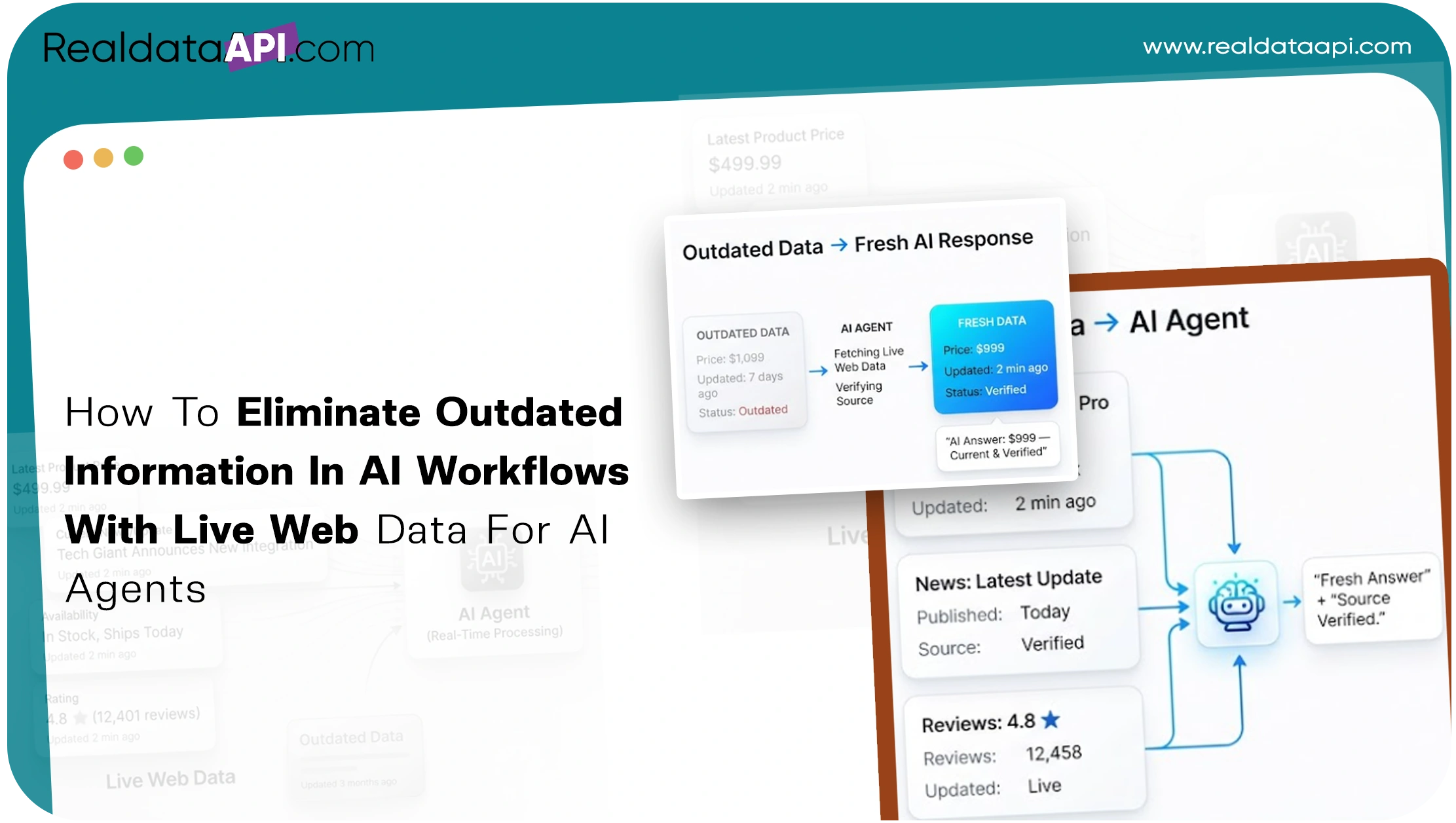
Introduction
live web data for AI agents helps AI systems work with current information instead of relying only on static datasets. Fresh web data can improve research, monitoring, recommendations, and automated decisions across e-commerce, travel, finance, real estate, and market intelligence.
AI Agents For Automated Data Collection and Analysis can continuously gather, structure, and analyze changing information. This approach helps businesses reduce the gap between what an AI system knows and what is happening in the market now.
Industry context: The amount of digital information generated worldwide continues to grow rapidly. For AI systems, the challenge is no longer only accessing information. It is accessing the right information at the right time.
Static datasets can become outdated quickly. Product prices change. Travel availability changes. News develops. Competitor websites update. Real estate listings disappear. An AI agent using old information may produce an answer that was once correct but is no longer useful.
Fresh web data addresses this problem.
Businesses can use live data workflows to:
- Monitor changing prices.
- Track product availability.
- Research competitors.
- Analyze market movements.
- Update AI knowledge pipelines.
- Verify current information.
- Trigger automated actions.
- Improve recommendations.
The goal is not to feed every webpage into an AI system. The goal is to collect relevant, structured, timely information that directly supports an AI task.
How Can Businesses Collect Current Web Information for AI?
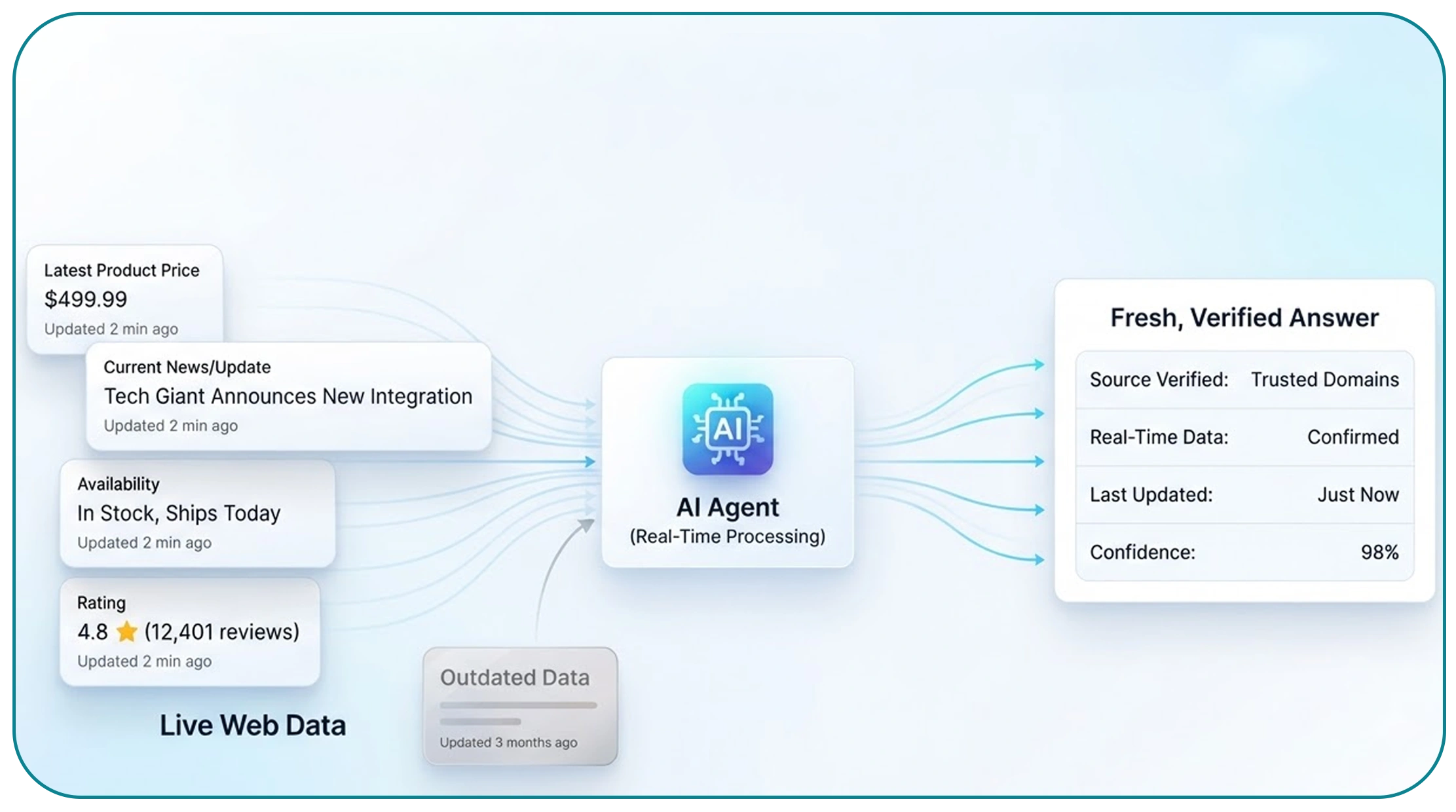
A web scraping API to collect real-time web data can provide AI applications with structured information from permitted web sources. Instead of depending only on a fixed dataset, an AI workflow can receive refreshed information according to a defined schedule or business requirement.
This is useful when information changes frequently. An e-commerce agent may need current product prices. A travel agent may need updated hotel availability. A market research agent may need current competitor information.
The workflow can follow a simple sequence:
- Identify the required sources.
- Define the data fields.
- Collect permitted information.
- Clean and normalize the records.
- Add timestamps.
- Deliver structured data to the AI system.
- Refresh the information as required.
- Store historical versions for comparison.
| Year | Hypothetical pages monitored | Refresh cycles | AI use case |
|---|---|---|---|
| 2020 | 50,000 | 12 | Research |
| 2021 | 80,000 | 18 | Monitoring |
| 2022 | 125,000 | 24 | Market analysis |
| 2023 | 200,000 | 30 | Competitive intelligence |
| 2024 | 325,000 | 36 | Automated research |
| 2025 | 500,000 | 48 | AI decision support |
| 2026 | 750,000 | 60 | Real-time intelligence |
These figures are hypothetical examples that illustrate how data-monitoring programs can scale.
Timestamps are important. They tell the AI when information was collected. This helps agents distinguish current observations from historical records.
Businesses should also validate the collected information. Missing fields, duplicate records, and stale pages can reduce the value of an AI workflow.
Freshness and quality must work together.
What Data Collection Tools Can AI Agents Use?
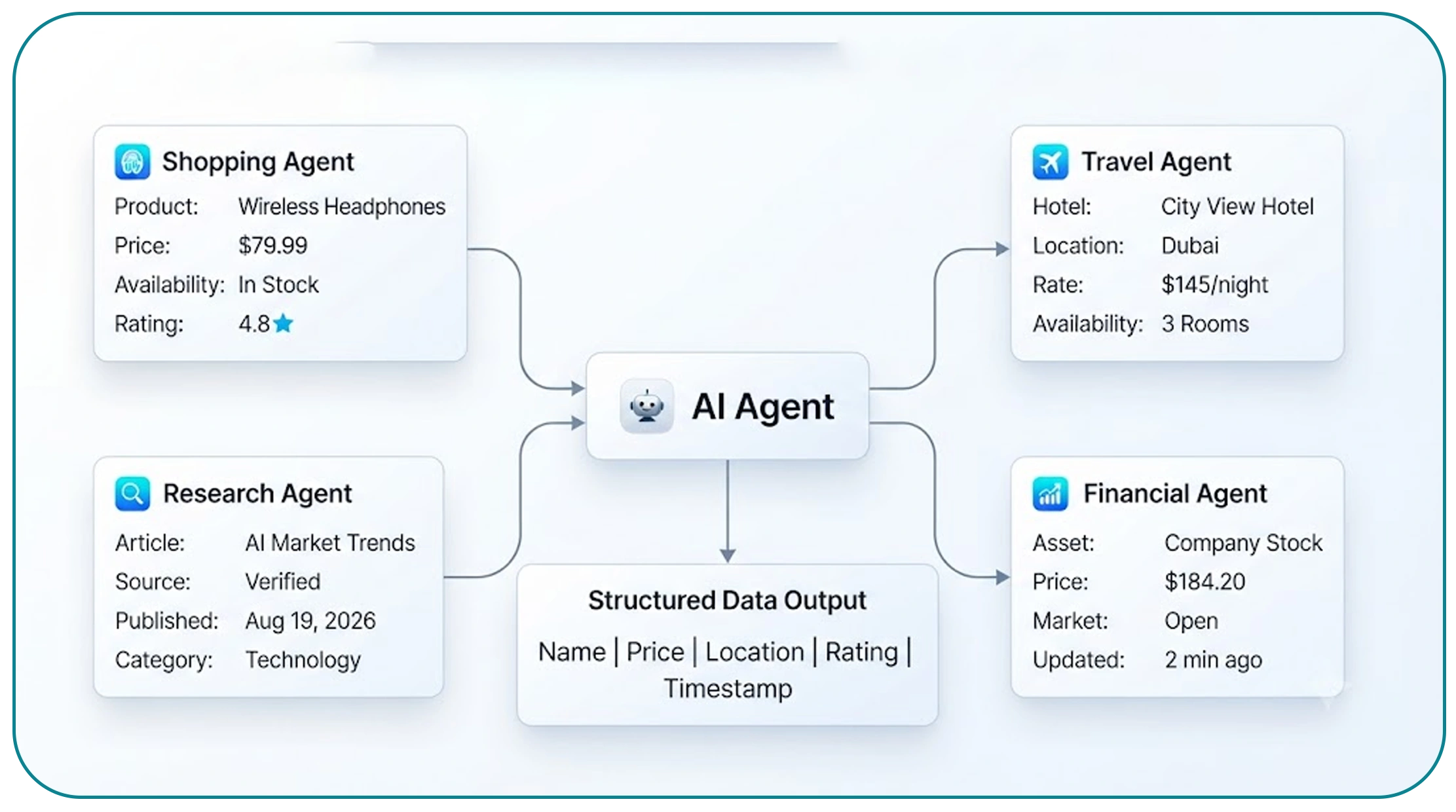
Data scraping tools for AI agents can help automate the process of finding, collecting, cleaning, and organizing web information. The right tool depends on the AI agent's objective and the type of data it needs.
An AI research agent may need article information. A shopping agent may require product details and prices. A travel agent may need hotel rates and availability. A financial research agent may need current market information from authorized sources.
Useful data fields can include:
- Product names.
- Prices.
- Availability.
- Dates.
- Categories.
- Locations.
- Ratings.
- Specifications.
- Article information.
- Collection timestamps.
| Year | Hypothetical data records | AI workflows | Primary purpose |
|---|---|---|---|
| 2020 | 100,000 | 20 | Basic automation |
| 2021 | 175,000 | 35 | Data collection |
| 2022 | 300,000 | 55 | Research agents |
| 2023 | 500,000 | 80 | Competitive monitoring |
| 2024 | 850,000 | 120 | AI analytics |
| 2025 | 1.4 million | 175 | Automated intelligence |
| 2026 | 2.2 million | 250 | Agent-based workflows |
The figures are illustrative rather than industry measurements.
AI agents need structured information. Raw HTML can contain large amounts of irrelevant content. A better workflow extracts only the fields needed for the agent's task.
For example, a pricing agent may only need product ID, product name, competitor price, availability, and timestamp.
This reduces unnecessary processing and helps the agent focus on relevant information.
Data collection tools can also support scheduled refreshes. An agent can receive new records at defined intervals and compare them against previous observations.
This enables change detection.
The agent does not simply ask, "What is the price?" It can ask, "Did the price change since the previous update?"
That difference makes fresh data much more valuable for automation.
How Does Fresh Web Information Improve AI Model Performance?
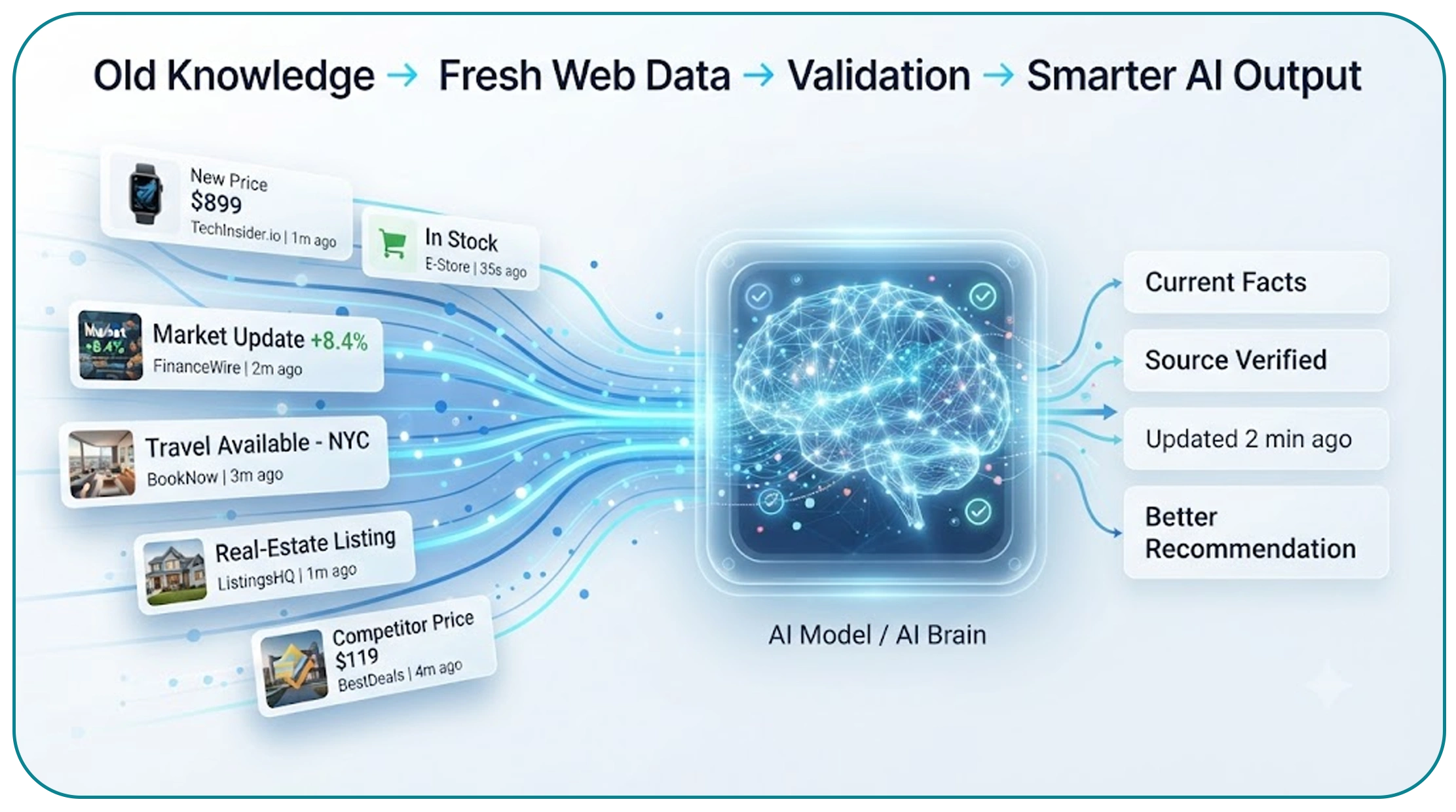
web data extraction for AI models can provide current information that complements a model's existing knowledge. AI models can be highly capable, but their built-in knowledge may not reflect events or changes that occurred after their training data.
Fresh web information can help with tasks that depend on current facts.
Examples include:
- Current product pricing.
- New product availability.
- Recent market changes.
- Updated travel information.
- Current real estate listings.
- Competitor activity.
- New business information.
| Year | Hypothetical extracted records | AI applications | Data focus |
|---|---|---|---|
| 2020 | 75,000 | Search assistance | Basic web data |
| 2021 | 125,000 | Research automation | Structured facts |
| 2022 | 225,000 | Recommendation systems | Current information |
| 2023 | 400,000 | AI assistants | Market data |
| 2024 | 700,000 | Agent workflows | Dynamic information |
| 2025 | 1.2 million | Automated research | Continuous updates |
| 2026 | 2 million | Autonomous workflows | Live intelligence |
These are hypothetical examples.
Fresh data does not automatically make an AI model accurate. The system still needs good source selection, validation, retrieval logic, and clear instructions.
Businesses should also distinguish between extraction and reasoning.
Extraction answers: What information is available?
Reasoning answers: What does that information mean?
An effective AI workflow connects both.
For example, a market research agent could collect competitor prices, compare them with historical records, identify significant changes, and summarize the impact.
This process creates a chain from data collection to analysis.
Fresh data also improves traceability. If each record includes a timestamp and source reference, businesses can review when the information was obtained.
That creates greater transparency for AI-generated decisions.
How Can Real-Time Data Pipelines Keep AI Agents Updated?
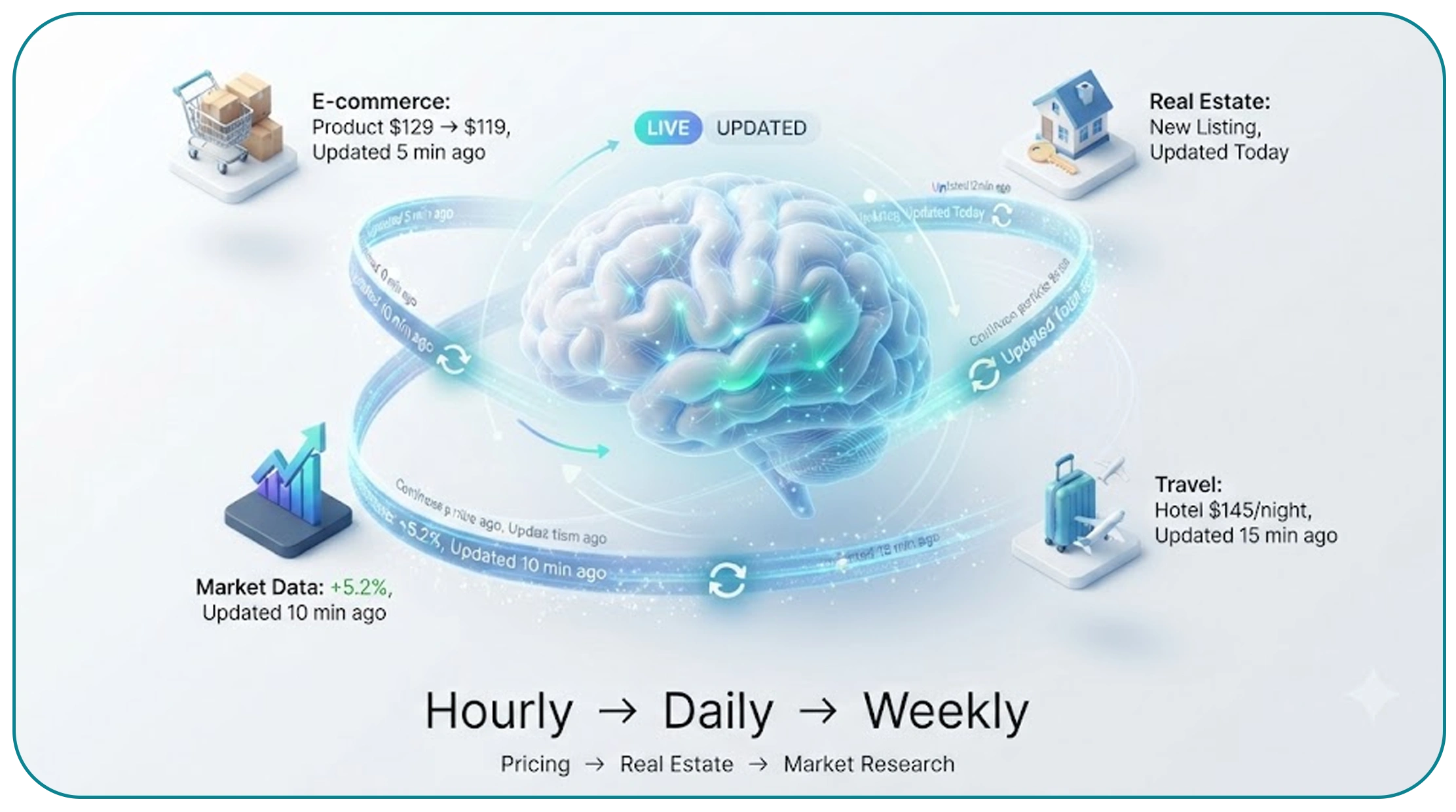
A Real-time Data Scraping API can support automated workflows that require frequently refreshed information from permitted sources. The exact refresh interval depends on the use case.
Not every AI application needs second-by-second updates.
A product-price agent may need hourly information. A real estate research system may need daily updates. A long-term market research workflow may only need weekly snapshots.
The important factor is matching refresh frequency with business requirements.
| Year | Hypothetical records refreshed | Average refresh frequency | Example application |
|---|---|---|---|
| 2020 | 100,000 | Weekly | Market research |
| 2021 | 175,000 | Weekly | Competitive monitoring |
| 2022 | 300,000 | Daily | Product intelligence |
| 2023 | 550,000 | Daily | AI research |
| 2024 | 900,000 | Multiple daily | Dynamic monitoring |
| 2025 | 1.5 million | Hourly | Pricing intelligence |
| 2026 | 2.5 million | Near real-time | Agent automation |
These figures are hypothetical planning examples.
A real-time pipeline can perform several tasks:
- Retrieve updated information.
- Detect changes.
- Normalize new records.
- Compare them with historical data.
- Trigger an AI workflow.
- Generate an alert or recommendation.
- Store the new observation.
Change detection is particularly useful.
Suppose a competitor lowers the price of a product. The system can identify the change and send the updated information to an AI pricing agent.
The agent can then evaluate the change against predefined rules.
This creates a responsive workflow instead of a static reporting process.
Businesses should also define acceptable delays. "Real-time" can mean different things for different applications. The correct goal is usually fresh enough for the decision being made.
How Can Continuous Crawling Support AI-Powered Research?
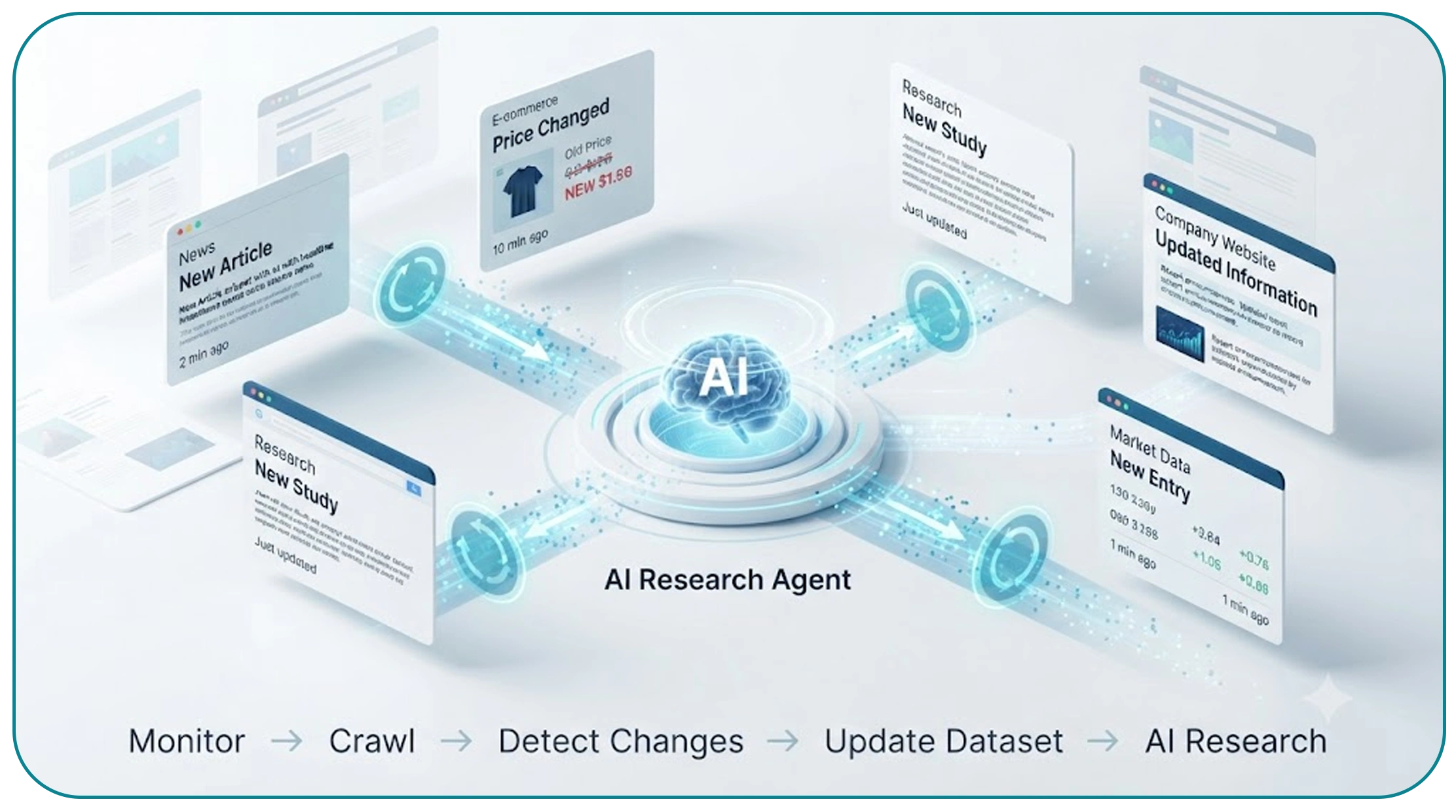
Live Crawler Services can support recurring web-data collection for AI applications that require changing information. Continuous crawling can help maintain a current dataset instead of relying on occasional manual updates.
This approach is useful for large websites and fast-changing categories. An AI research agent can monitor selected sources and receive new information as pages change.
A continuous workflow can monitor:
- New pages.
- Updated products.
- Price changes.
- Availability changes.
- New articles.
- Listing removals.
- Category changes.
- Updated specifications.
| Year | Hypothetical sources monitored | Changes detected | AI application |
|---|---|---|---|
| 2020 | 5,000 | 50,000 | Research |
| 2021 | 8,000 | 90,000 | Monitoring |
| 2022 | 12,000 | 150,000 | Market intelligence |
| 2023 | 18,000 | 250,000 | AI research |
| 2024 | 25,000 | 400,000 | Competitive analysis |
| 2025 | 35,000 | 650,000 | Automated monitoring |
| 2026 | 50,000 | 1 million | Agent intelligence |
These figures are illustrative examples.
Continuous collection should not mean crawling everything continuously. Businesses should define priorities.
High-value sources can receive more frequent updates. Stable sources can receive less frequent updates.
This reduces unnecessary processing and helps control data costs.
AI agents can also use event-driven workflows. Instead of processing every page after every crawl, the system can send only meaningful changes to the agent.
For example, if a product description remains unchanged, there may be no reason to send it again. If the price changes significantly, the system can trigger an analysis.
This creates a more efficient pipeline.
The combination of change detection and AI reasoning can turn continuous data collection into an intelligent monitoring system.
How Can an API Connect Fresh Data With AI Applications?
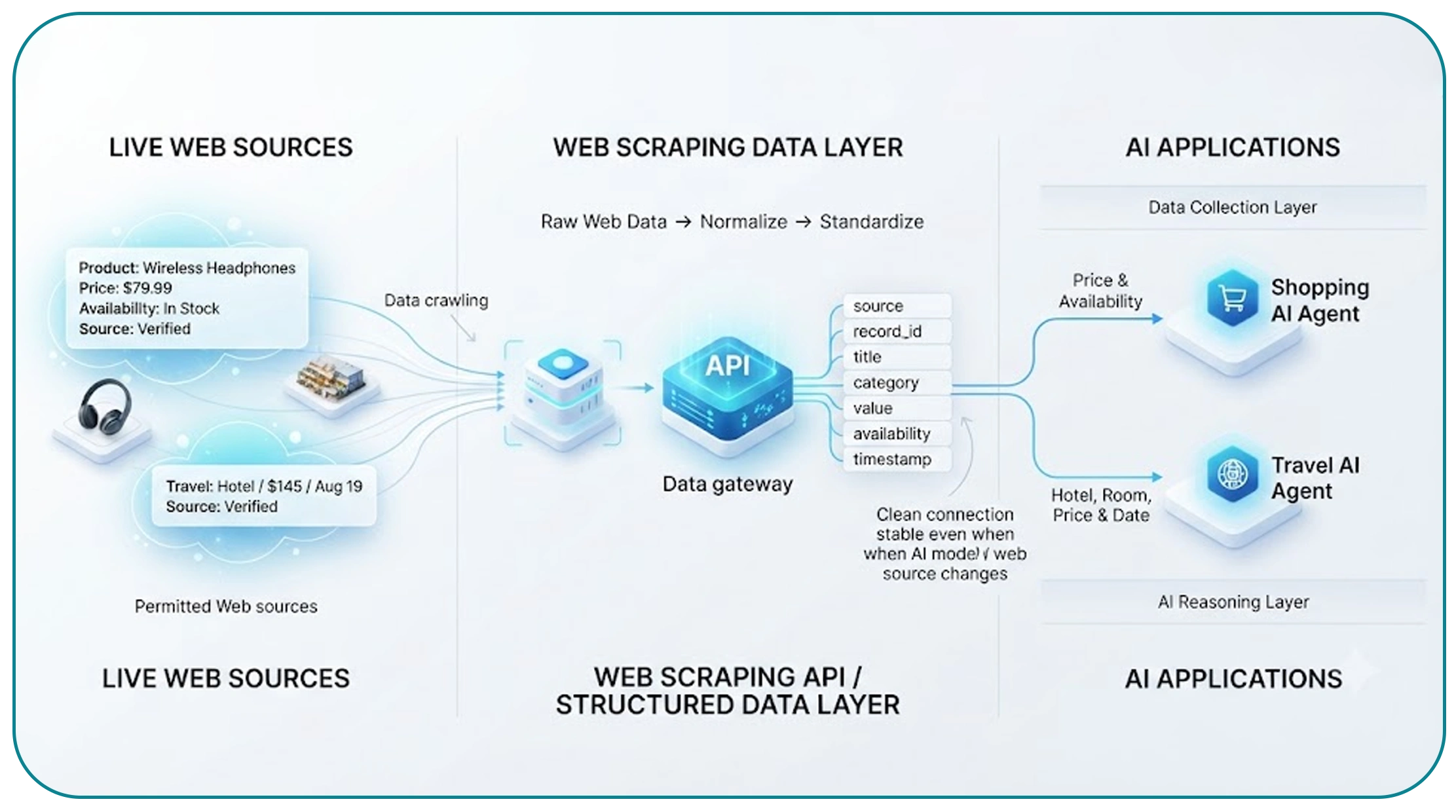
A Web Scraping API can act as a structured data layer between permitted web sources and AI applications. It can help businesses deliver current information in consistent formats that AI systems can process.
An API-based workflow can connect data collection with:
- AI agents.
- Databases.
- Analytics platforms.
- Dashboards.
- Recommendation systems.
- Business intelligence tools.
- Automated alerts.
| Year | Hypothetical API records | AI integrations | Main objective |
|---|---|---|---|
| 2020 | 150,000 | 25 | Data delivery |
| 2021 | 250,000 | 40 | Research automation |
| 2022 | 450,000 | 65 | AI analytics |
| 2023 | 750,000 | 100 | Agent workflows |
| 2024 | 1.2 million | 150 | Automated decisions |
| 2025 | 2 million | 225 | Real-time intelligence |
| 2026 | 3.2 million | 325 | Enterprise AI agents |
These figures are hypothetical examples for demonstrating possible growth.
The API layer can standardize information before it reaches an AI system. This matters because AI agents work better when the input follows a predictable structure.
A structured record might contain:
- source
- record_id
- title
- category
- value
- availability
- timestamp
The exact fields depend on the use case.
A product agent may receive price and availability fields. A travel agent may receive destination, hotel, room, price, and date fields.
This approach also supports modular architecture. The data collection layer can operate separately from the AI reasoning layer.
If the AI model changes, the data pipeline does not necessarily need to change.
If the source changes, the AI workflow can continue using the same standardized schema.
This separation makes AI systems easier to maintain and scale.
How Can AI Agents Turn Fresh Data Into Automated Decisions?
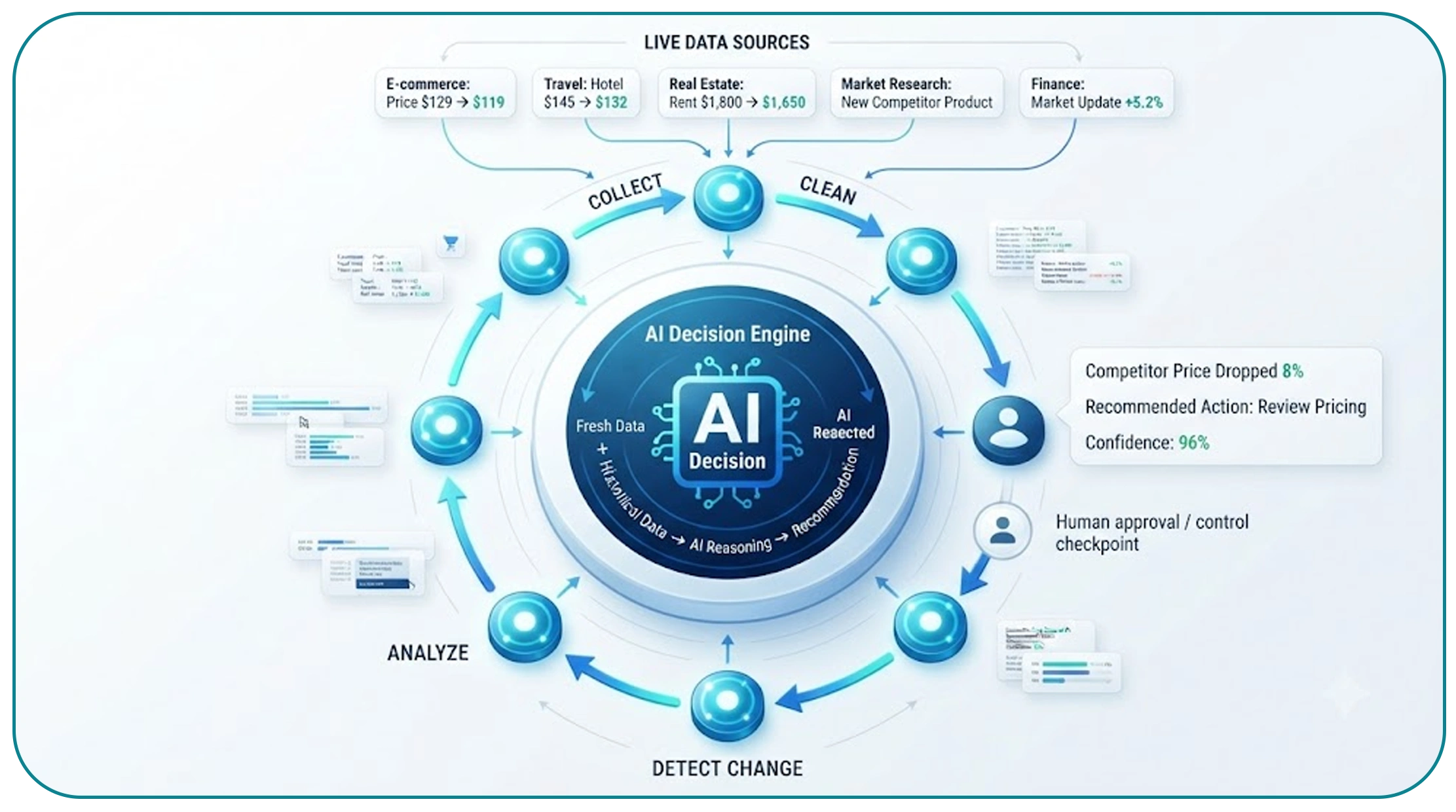
Fresh data becomes powerful when an AI agent can act on it.
A typical workflow looks like this:
Collect → Clean → Validate → Detect Change → Analyze → Decide → Act
For example:
- A data pipeline collects current competitor prices.
- The system validates the records.
- It compares them with historical prices.
- It detects a significant change.
- The AI agent evaluates the competitive impact.
- The agent generates a recommendation.
- A business system receives the recommendation.
This workflow can support many industries.
E-commerce
Monitor competitor prices and product availability.
Travel
Track hotel prices and availability.
Real Estate
Monitor rental listings and asking prices.
Market Research
Track competitor products and category changes.
Finance
Monitor permitted public market information.
The AI agent should not blindly act on every data change. Businesses should define rules, confidence thresholds, and human review requirements for high-impact decisions.
Automation should improve decision speed without removing appropriate controls.
What Are the Biggest Challenges With Fresh Web Data?
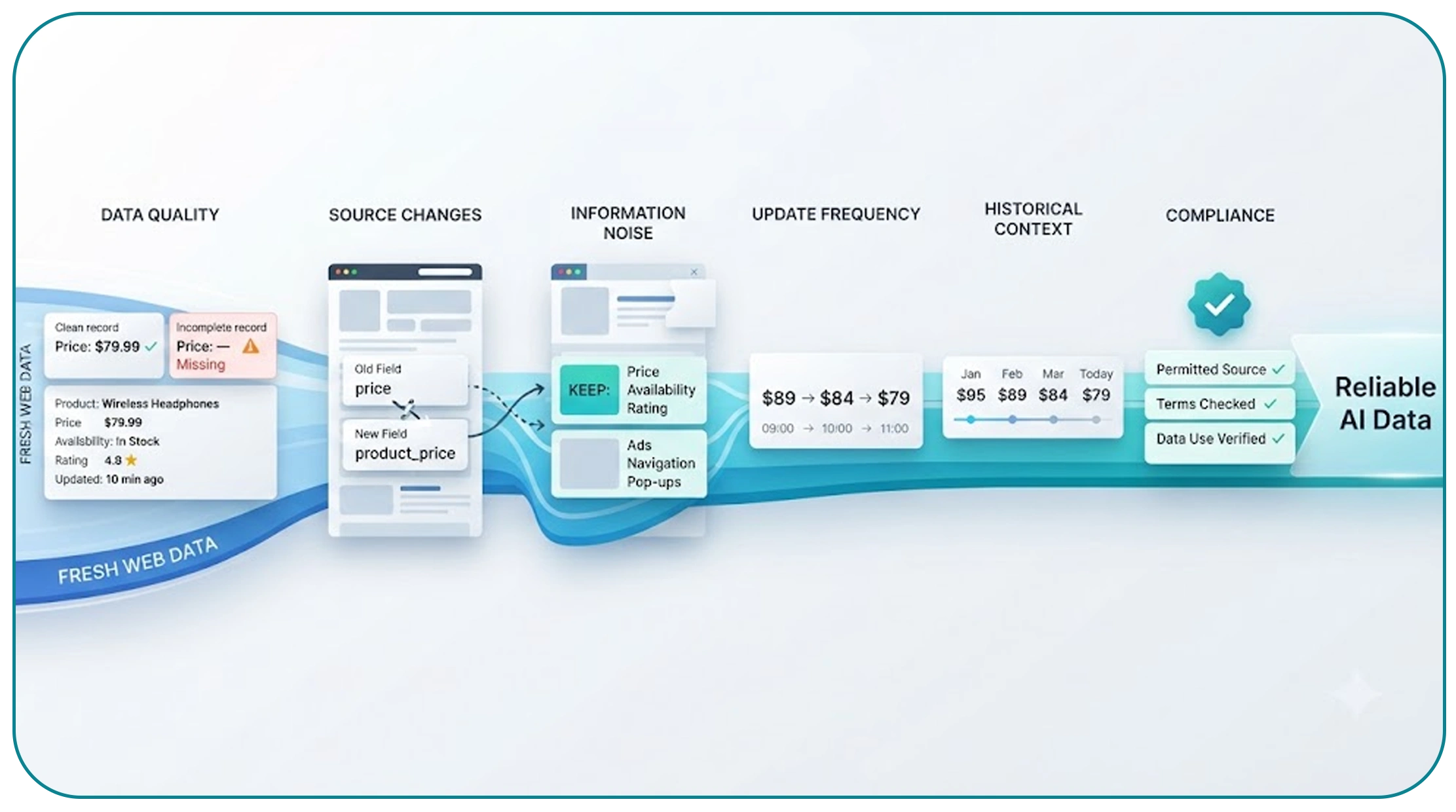
Fresh data solves the problem of outdated information, but it introduces new challenges.
Data Quality
Web pages can contain missing or inconsistent information. Validation is necessary.
Source Changes
Website structures can change. Data pipelines need monitoring and maintenance.
Information Noise
Not every webpage element is useful to an AI agent. Extraction should focus on relevant fields.
Update Frequency
Very frequent updates can increase processing requirements. Businesses should match refresh rates to actual needs.
Historical Context
Current information is useful, but historical records are needed to understand changes.
Compliance
Businesses should collect and use information according to applicable laws, website terms, permissions, and data-use requirements.
A mature AI data strategy addresses these issues from the beginning.
How Should Businesses Build a Fresh-Data AI Workflow?
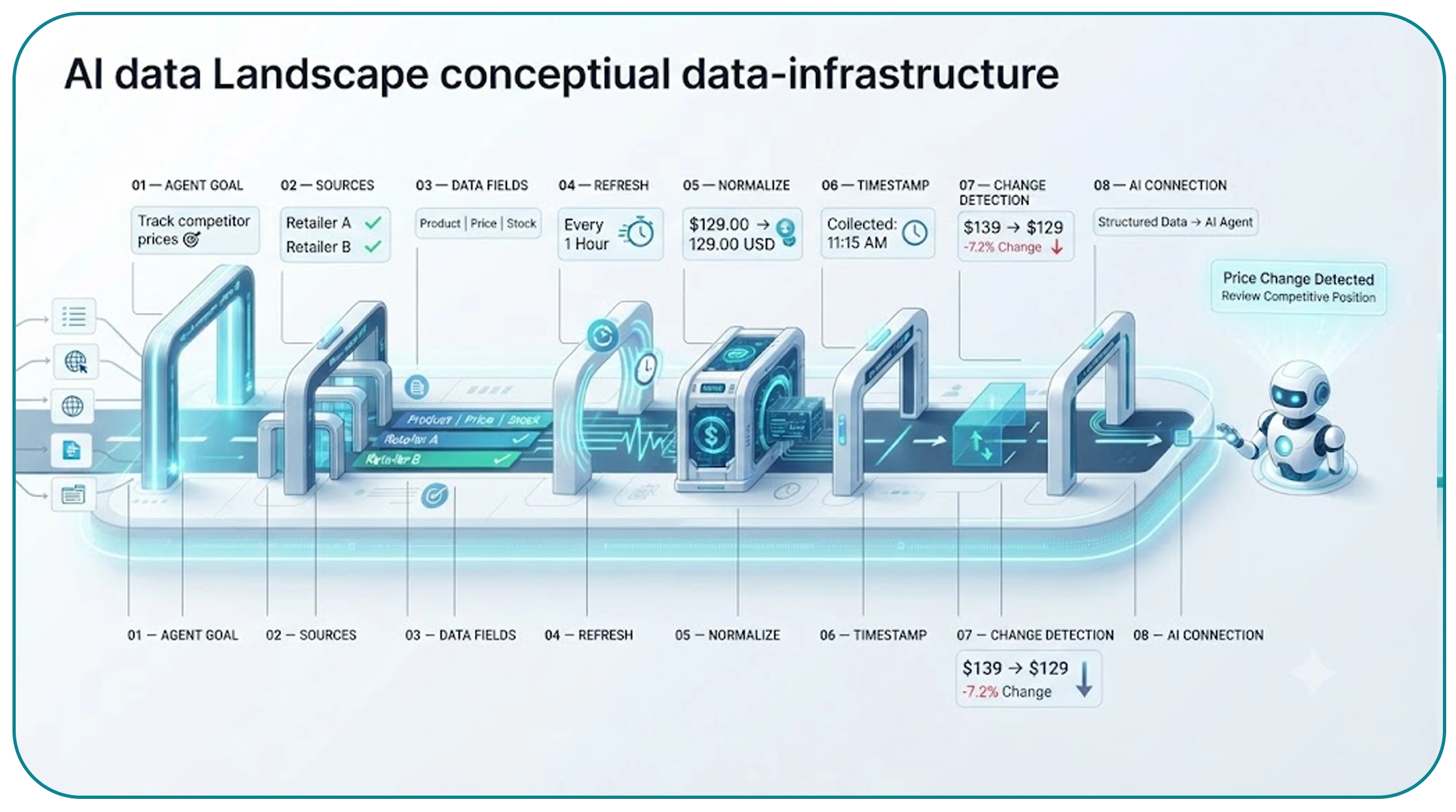
A practical implementation can follow eight steps:
- Define the agent's job. Decide exactly what the AI needs to know.
- Identify reliable sources. Select permitted sources relevant to the task.
- Choose data fields. Avoid collecting unnecessary information.
- Set refresh intervals. Match freshness to business requirements.
- Normalize the data. Use consistent schemas.
- Add timestamps. Preserve when each observation was collected.
- Detect meaningful changes. Avoid sending unchanged information repeatedly.
- Connect the data to the agent. Let the AI reason over the structured output.
This approach creates a clear connection between data and business value.
The AI agent should not become a replacement for data governance. It should operate within a controlled pipeline that provides reliable information.
Why Is Real-Time Context Important for AI Agents?
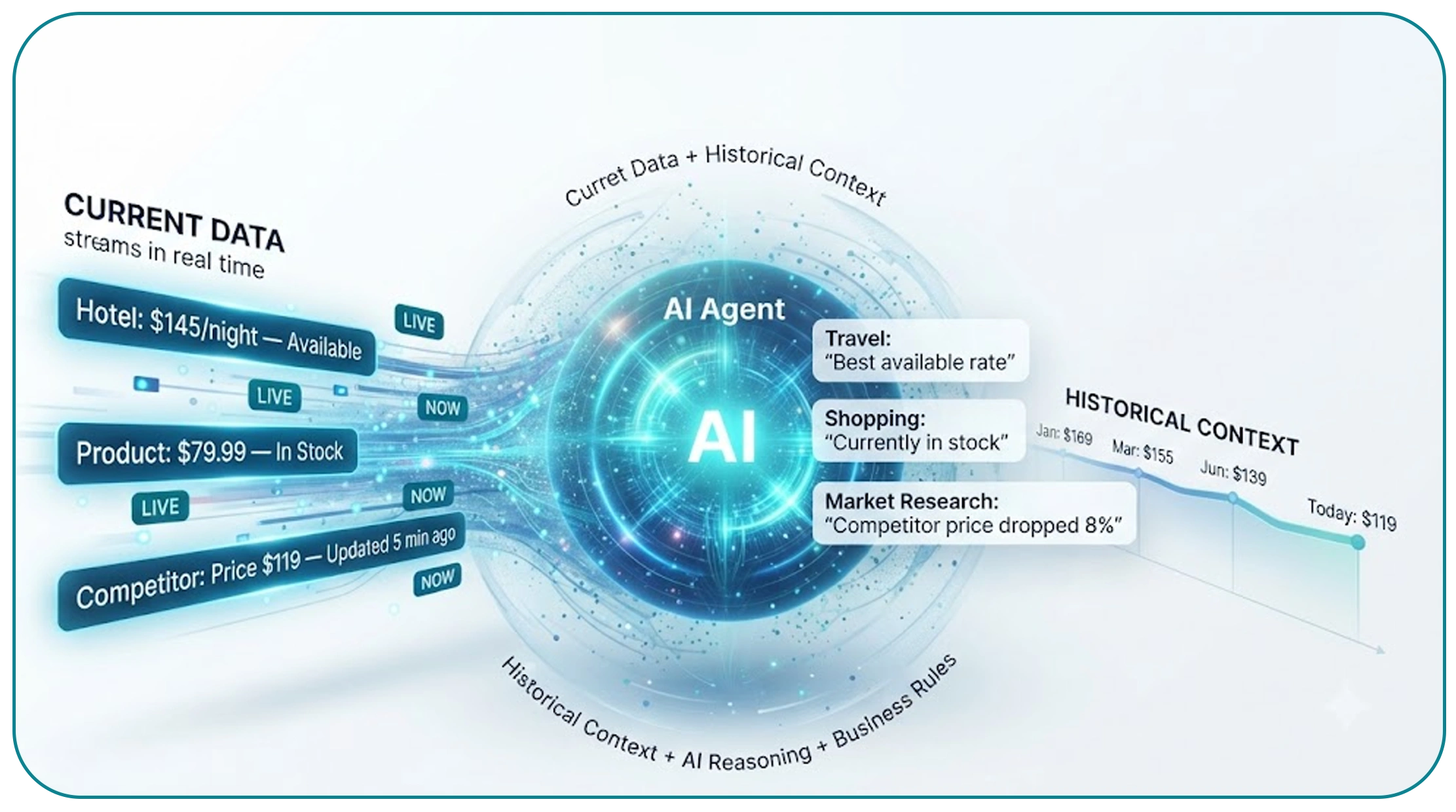
AI agents can perform complex tasks, but their usefulness depends heavily on the information they receive.
A travel agent with current hotel information can make more relevant recommendations than one using outdated prices.
A shopping agent with current product availability can provide better purchasing guidance.
A market research agent with fresh competitor information can identify changes faster.
The key benefit is context.
Fresh data gives AI systems a better understanding of what is happening now. Historical data explains how conditions changed. Combining both creates a stronger foundation for decision-making.
Businesses should therefore think of AI intelligence as a combination of:
Current data + historical context + reasoning + business rules.
This model is more practical than relying on AI knowledge alone.
Why Choose Real Data API?
Real Data API helps businesses build structured data workflows for AI applications that need current information. Fresh, normalized records can support AI agents, research systems, monitoring tools, recommendation engines, and automated analytics.
The focus should be on delivering relevant information in a format that downstream AI systems can process efficiently.
A structured workflow can include source monitoring, data extraction, normalization, timestamps, historical storage, and API delivery.
This reduces the gap between changing web information and automated business workflows.
For organizations building AI agents, reliable data infrastructure is just as important as the model itself. Better input can support better analysis, stronger recommendations, and faster responses.
live web data for AI agents can therefore become an important layer in modern AI architecture, helping businesses connect intelligent automation with current market information.
Conclusion
AI agents need more than intelligence. They need timely information.
Static datasets can become outdated as markets, products, prices, listings, and public information change. A structured fresh-data workflow gives AI systems a stronger connection to current conditions.
Businesses can use this approach for automated research, competitive monitoring, pricing intelligence, travel analysis, real estate research, product discovery, and many other use cases.
live web data for AI agents helps bridge the gap between AI reasoning and changing real-world information. When combined with historical context, validation, timestamps, and clear business rules, fresh data can make AI workflows more useful and responsive.
The strongest architecture separates data collection from AI reasoning. This creates a flexible system that can evolve as sources, models, and business requirements change.
Build smarter AI workflows with Real Data API and connect your agents to fresh, structured web information for faster research, better decisions, and more responsive automation!
Latest posts
How Foodpanda Food Dataset Helps Businesses Track Restaurants, Menus, Prices, Ratings, and Food Delivery Trends?

How IKEA E-commerce Dataset Helps Businesses Solve Product, Pricing, Category, and Retail Trend Challenges?
How Target e-commerce dataset Helps Brands Track Products, Prices, Availability, and Retail Market Trends for Smarter Insights?

How Dior fashion dataset Helps Brands Track Luxury Products, Prices, Collections, and Fashion Trends for Smarter Insights?






.png)