
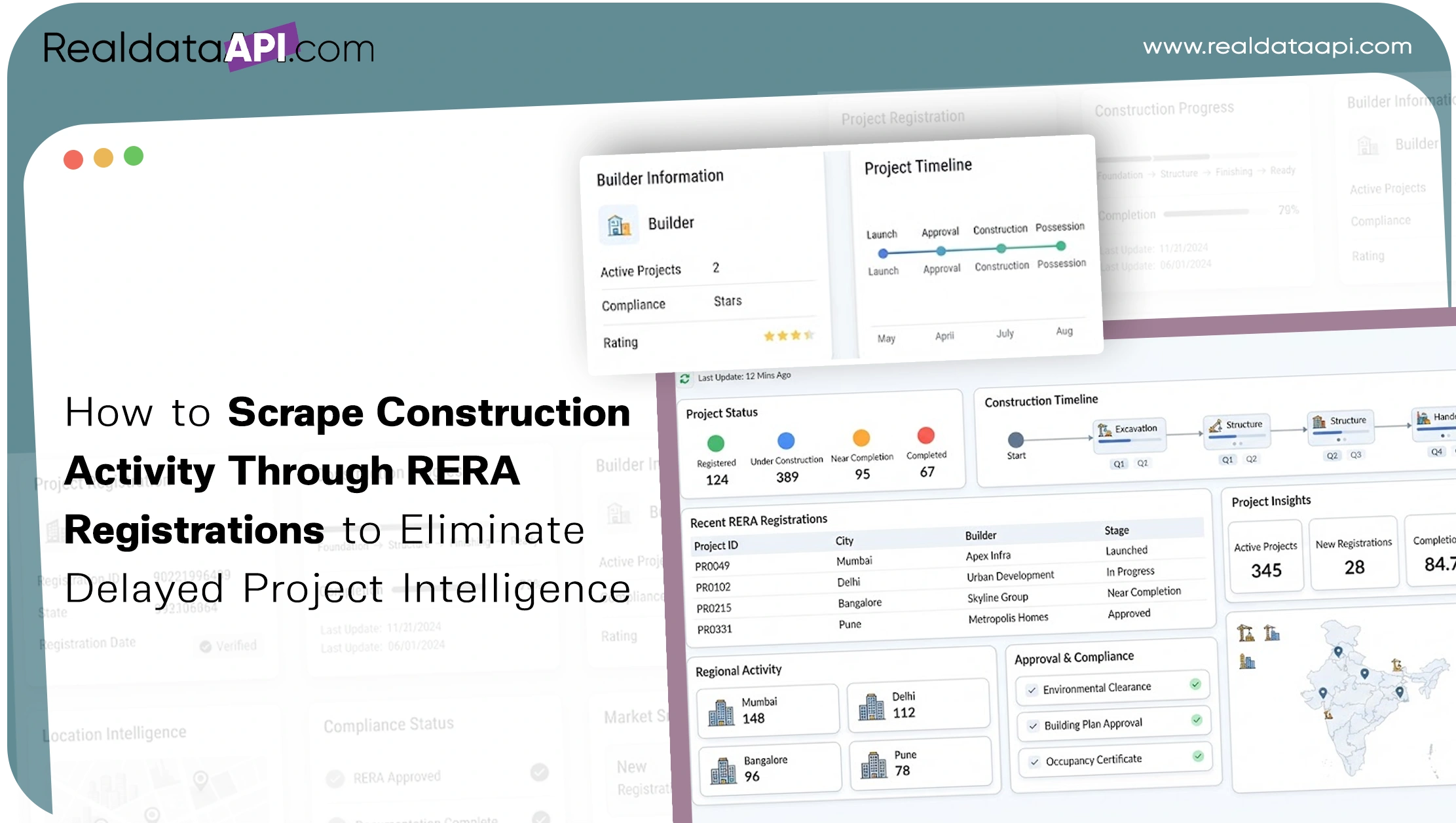
Introduction
Businesses can eliminate delays in construction intelligence by using automated RERA data scraping. APIs help collect project registrations, builder information, approvals, locations, timelines, and project status in real time. This enables developers, investors, lenders, and PropTech companies to make faster, data-driven decisions instead of relying on outdated manual research.
Industry Insight: According to industry estimates, India's real estate sector is expected to contribute nearly 13% of the country's GDP by 2030 . Between 2020 and 2026, digital adoption in real estate accelerated as organizations increasingly relied on regulatory datasets to monitor project launches, builder activity, and regional construction growth.
Target Audience: Real estate developers, PropTech companies, construction firms, investors, financial institutions, government agencies, and market research organizations.
Pain Point Solved: Delayed project intelligence, incomplete construction data, slow competitor tracking, and inefficient manual monitoring.
Organizations that scrape construction activity through RERA registrations gain access to continuously updated information on registered projects, developer profiles, project phases, approvals, completion timelines, and regulatory compliance. This reduces manual effort while improving forecasting and investment planning.
Many enterprises also rely on Leveraging RERA Data Scraping for Real Estate Insights to identify emerging construction hotspots, evaluate builder performance, monitor residential and commercial developments, and build comprehensive property intelligence platforms. Structured RERA datasets provide reliable, standardized information that supports analytics, AI models, competitive intelligence, and investment strategies across India's rapidly evolving real estate market.
How Can Businesses Monitor Construction Activity in Real Time?
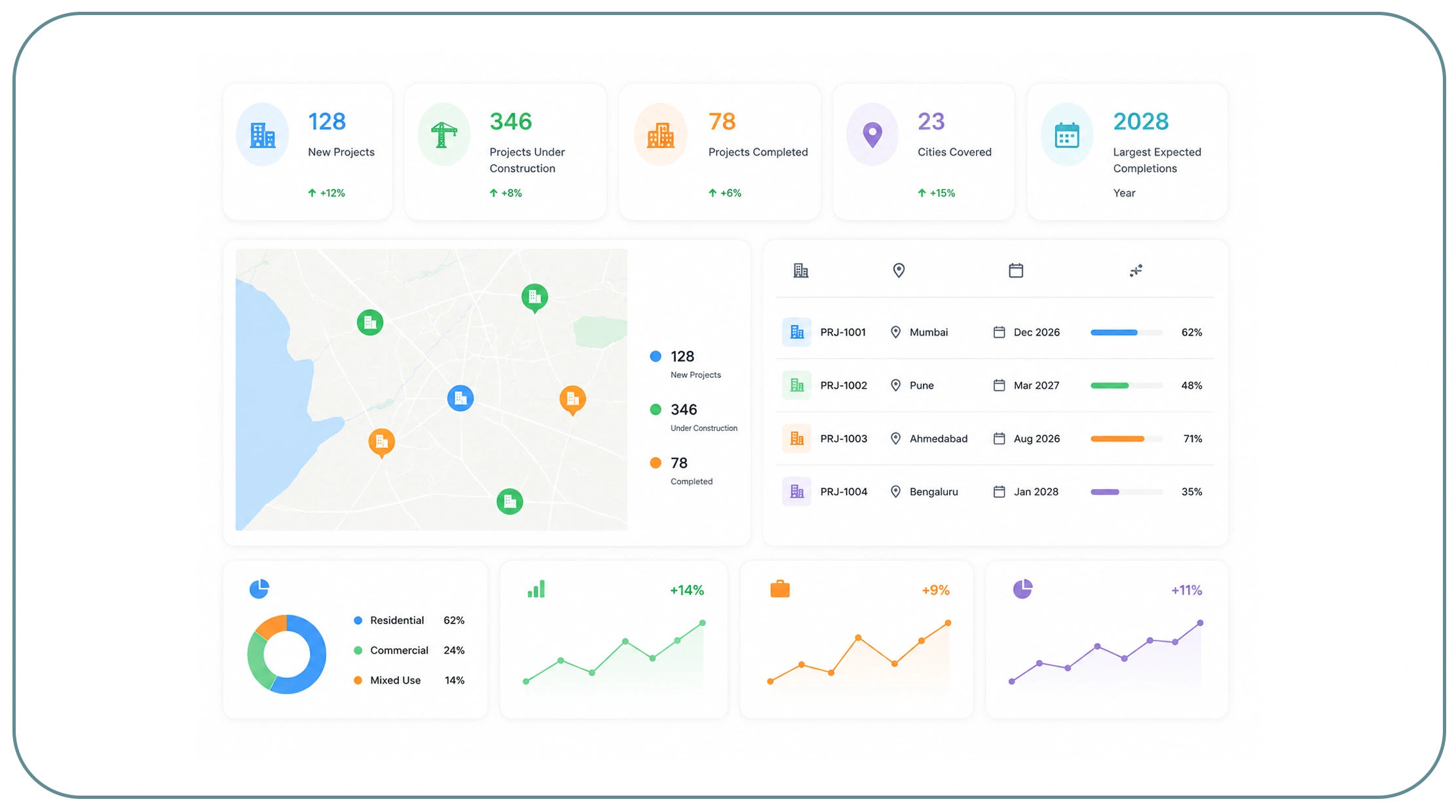
Real estate markets evolve rapidly as new projects receive approvals, builders launch developments, and construction progresses through multiple phases. Businesses need continuous visibility into these activities to stay competitive. Manual tracking often leads to outdated reports and missed opportunities.
One effective solution is Real-time construction data scraping with RERA records , which automates the collection of project registrations, approval dates, project status, developer information, completion schedules, project locations, and property categories. Automated updates provide organizations with reliable data that supports faster business decisions.
Real-time construction monitoring helps businesses:
- Identify newly registered projects.
- Monitor project completion progress.
- Track residential and commercial developments.
- Analyze regional construction activity.
- Compare builder performance.
- Detect emerging investment opportunities.
- Improve market forecasting.
- Support AI-powered property analytics.
For example, developers can identify underserved markets before competitors enter them. Financial institutions can evaluate construction pipelines before approving project financing. Investors can monitor cities experiencing rapid infrastructure growth.
Instead of waiting for periodic market reports, organizations receive continuously refreshed information that reflects the latest regulatory registrations and project updates.
Construction Registration Trends (2020–2026)
| Year | Registered Projects | Cities Monitored | Organizations Using Automated Monitoring |
|---|---|---|---|
| 2020 | 42,000 | 165 | 26% |
| 2021 | 48,500 | 182 | 35% |
| 2022 | 56,300 | 205 | 47% |
| 2023 | 64,900 | 228 | 60% |
| 2024 | 73,800 | 255 | 72% |
| 2025* | 82,600 | 282 | 83% |
| 2026* | 91,400 | 310 | 91% |
*Projected industry estimates.
Continuous monitoring enables organizations to react faster to market changes while improving investment planning, competitor analysis, and construction intelligence. Automated RERA data collection reduces research time and delivers more reliable insights for strategic decision-making.
How Can Companies Evaluate Builder Performance More Effectively?
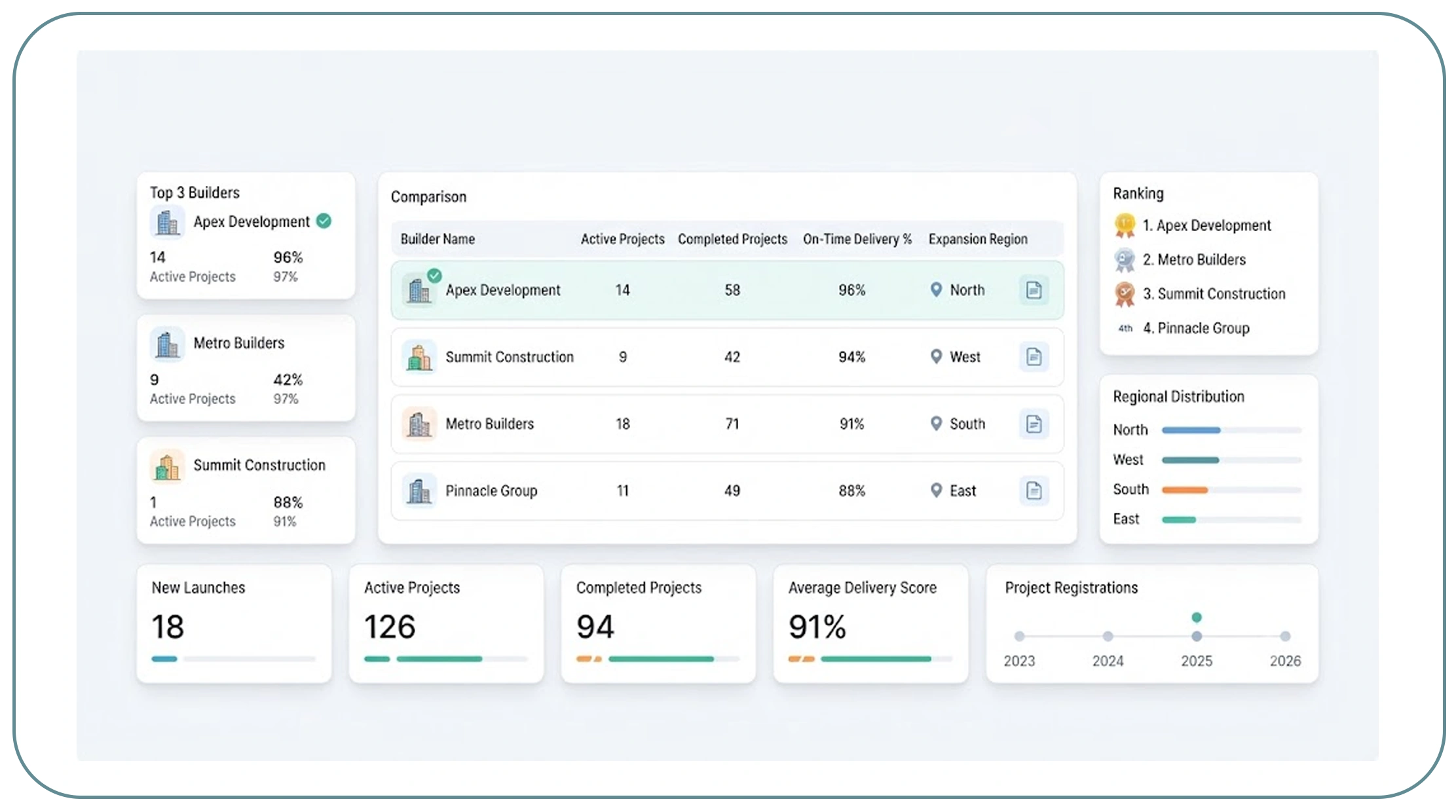
Understanding builder performance is essential for developers, investors, lenders, and property consultants. Businesses need accurate information about project history, delivery timelines, active developments, and geographic expansion to assess market credibility. Manual research across multiple RERA portals can be slow and inconsistent.
A reliable Builder activity analysis using RERA data scraper helps organizations automate the collection of builder-related information from registered projects. The extracted data typically includes developer names, project counts, registration dates, project status, completion timelines, project types, and operating locations. This structured information allows businesses to compare builders objectively and identify market leaders.
Builder intelligence supports several strategic objectives:
- Benchmark competing developers.
- Evaluate historical project performance.
- Identify rapidly expanding builders.
- Monitor new project launches.
- Assess regional market concentration.
- Support investment due diligence.
- Improve lending risk assessments.
- Build comprehensive developer profiles.
For example, banks can evaluate whether developers consistently complete projects on schedule before extending financing. PropTech platforms can rank builders based on project volume and delivery history. Market researchers can identify regional leaders in residential, commercial, or mixed-use developments.
Builder Activity Analysis (2020–2026)
| Year | Active Builders | Average Projects per Builder | Companies Performing Builder Analytics |
|---|---|---|---|
| 2020 | 11,800 | 3.2 | 24% |
| 2021 | 13,100 | 3.5 | 33% |
| 2022 | 14,900 | 3.9 | 46% |
| 2023 | 16,800 | 4.4 | 59% |
| 2024 | 18,700 | 4.9 | 72% |
| 2025* | 20,600 | 5.3 | 84% |
| 2026* | 22,400 | 5.8 | 91% |
*Projected industry estimates.
Builder analytics provides deeper visibility into construction activity and market competitiveness. Organizations that automate builder monitoring can identify growth opportunities, reduce investment risks, and make more informed business decisions based on reliable, up-to-date regulatory data.
How Can Organizations Build Reliable Construction Intelligence Databases?
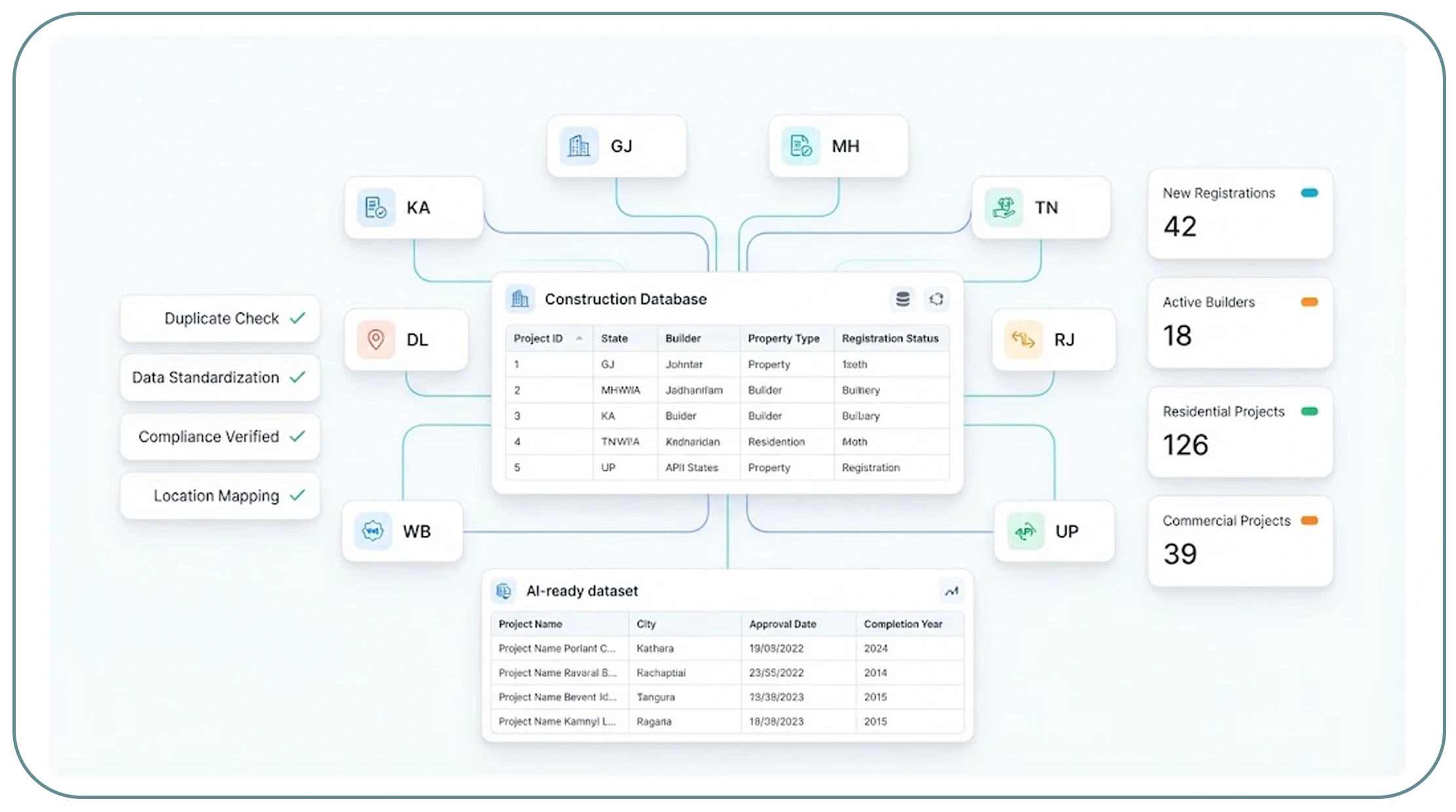
Accurate construction intelligence depends on consistent, structured, and frequently updated data. Real estate businesses often collect information from multiple state RERA portals, making manual aggregation slow and prone to errors. Automated APIs solve this challenge by creating centralized databases that support analytics, forecasting, and investment research.
One of the most effective approaches is RERA construction data collection , which automates the extraction of project registrations, builder details, project locations, property types, registration numbers, approval dates, expected completion timelines, and compliance information. This data helps organizations maintain a single source of truth for construction market intelligence.
Organizations use centralized construction databases to:
- Monitor newly registered projects.
- Track residential and commercial developments.
- Analyze regional construction activity.
- Measure builder performance.
- Support investment due diligence.
- Improve property valuation models.
- Feed AI-powered analytics platforms.
- Generate market intelligence reports.
For instance, a PropTech company can combine RERA records from multiple states to create a nationwide construction dashboard. Investment firms can identify cities experiencing rapid project growth, while financial institutions can assess project pipelines before approving commercial loans.
Automation also improves data consistency by reducing duplicate records and standardizing project information across different jurisdictions. This makes reporting faster and enables analysts to compare markets using reliable, structured datasets.
Growth in Construction Data Collection (2020–2026)
| Year | Projects Collected | States Covered | Organizations Using Centralized Databases |
|---|---|---|---|
| 2020 | 52,000 | 12 | 28% |
| 2021 | 61,500 | 16 | 38% |
| 2022 | 72,800 | 20 | 49% |
| 2023 | 86,400 | 24 | 63% |
| 2024 | 101,900 | 28 | 75% |
| 2025* | 118,700 | 31 | 86% |
| 2026* | 136,500 | 34 | 92% |
*Projected industry estimates.
Organizations that automate construction intelligence gain better visibility into market activity, improve forecasting accuracy, and reduce manual research costs. Centralized RERA datasets also enable faster reporting and support data-driven expansion strategies across India's growing real estate sector.
What Business Problems Can RERA Data APIs Solve?
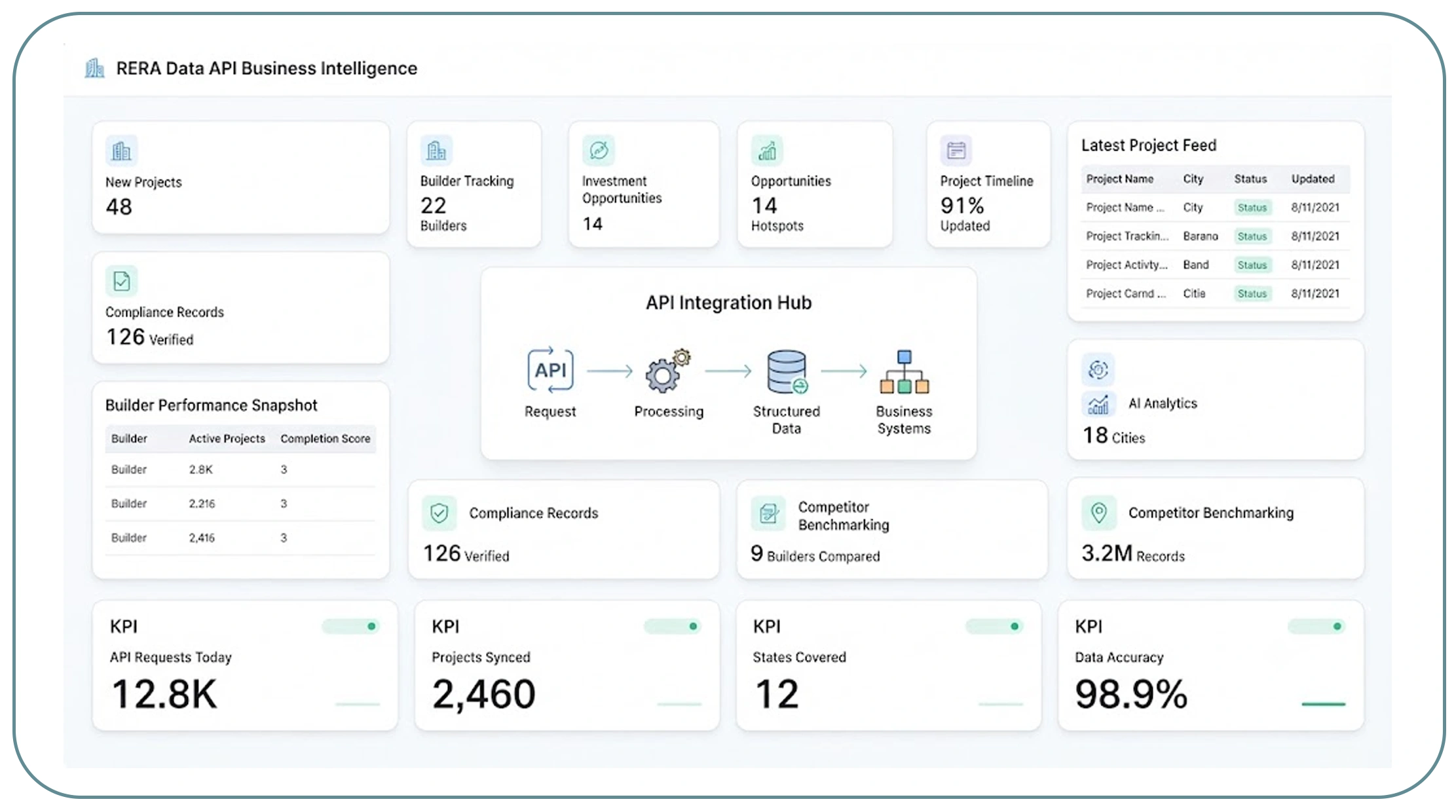
Real estate organizations face several operational challenges, including delayed project updates, incomplete builder information, fragmented regulatory records, and limited market visibility. Modern APIs address these issues by delivering structured, real-time regulatory data that integrates directly into business workflows.
Among the Top Use Cases of RERA Data APIs are market monitoring, investment analysis, project benchmarking, risk assessment, compliance tracking, and construction forecasting. Instead of manually reviewing thousands of records, businesses can automate data collection and receive continuously updated project information.
Key business applications include:
- Monitoring new residential and commercial project launches.
- Tracking builder expansion across cities and states.
- Supporting investment and lending decisions.
- Evaluating project completion timelines.
- Building PropTech platforms and real estate portals.
- Monitoring regional construction activity.
- Performing competitor benchmarking.
- Creating AI and business intelligence dashboards.
For example, an investment firm can identify emerging construction hotspots before competitors. A construction materials supplier can monitor upcoming projects to forecast product demand. Government agencies can analyze regional development trends to support infrastructure planning.
Enterprise Adoption of RERA Data APIs (2020–2026)
| Year | Organizations Using RERA APIs | Average Daily API Requests | Decision-Making Time Reduced |
|---|---|---|---|
| 2020 | 21% | 85,000 | 18% |
| 2021 | 31% | 145,000 | 27% |
| 2022 | 44% | 260,000 | 39% |
| 2023 | 58% | 420,000 | 52% |
| 2024 | 72% | 690,000 | 65% |
| 2025* | 84% | 980,000 | 77% |
| 2026* | 91% | 1.35 Million | 86% |
*Projected industry estimates.
As digital transformation accelerates across the real estate industry, automated RERA data solutions help organizations respond more quickly to market changes, improve operational efficiency, and make informed decisions based on reliable regulatory information. Businesses that leverage these APIs gain a stronger competitive advantage through timely insights and comprehensive construction intelligence.
How Can Businesses Choose the Right RERA Data Partner?
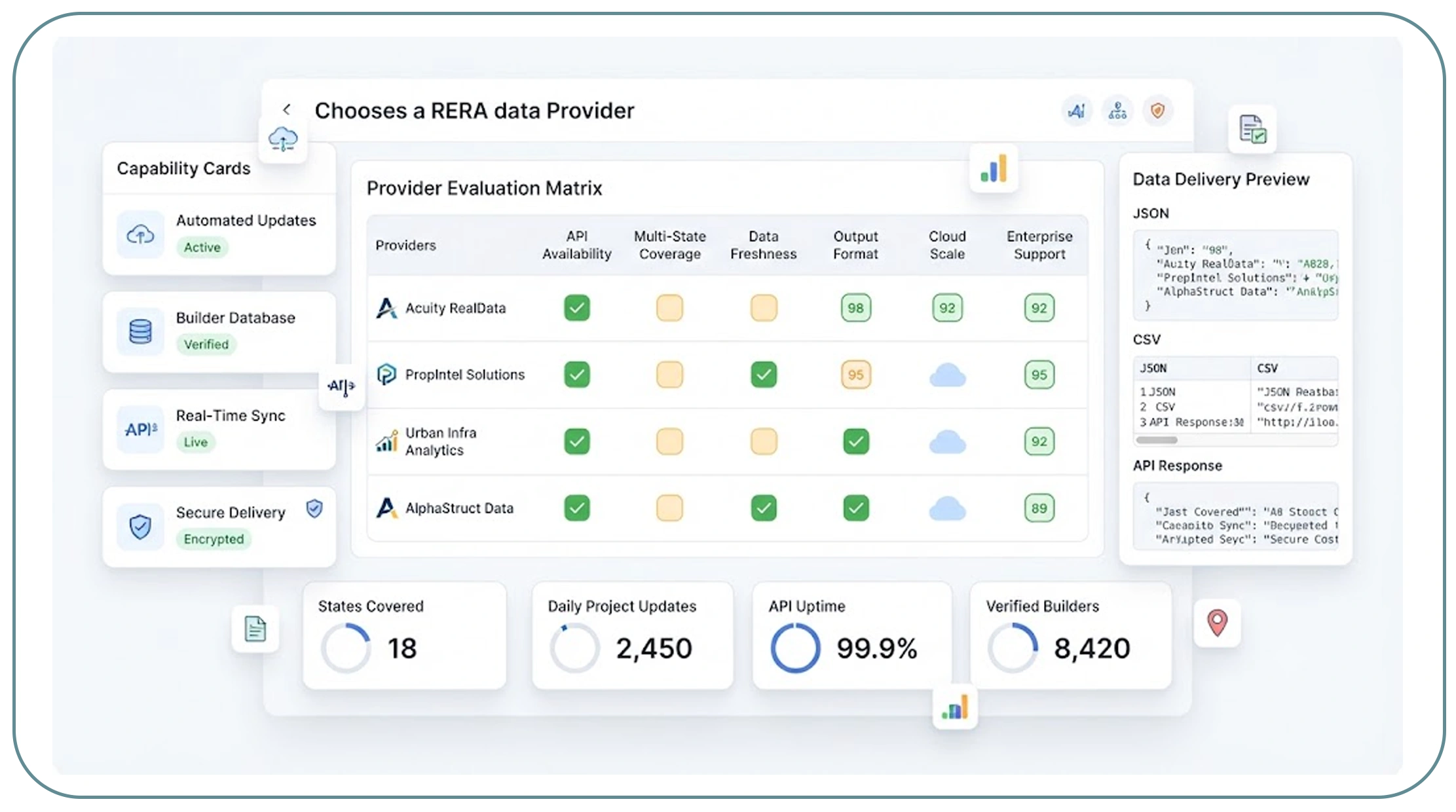
Selecting a reliable RERA data provider is essential for organizations that depend on accurate construction intelligence. A quality provider should deliver structured, scalable, and frequently updated data while minimizing manual effort. This allows businesses to focus on analytics and strategic planning instead of maintaining complex data collection processes.
Many enterprises look for the best RERA data scraping service provider in India to support investment research, market intelligence, PropTech platforms, lending decisions, and construction analytics. An enterprise-grade provider should offer automated updates, standardized datasets, API integration, and robust infrastructure capable of handling large-scale data requirements.
When evaluating a provider, consider the following capabilities:
- Automated project registration updates
- Comprehensive builder information
- Standardized JSON and CSV outputs
- Multi-state data coverage
- High API availability
- Scheduled and real-time data refreshes
- Easy integration with BI and AI platforms
- Dedicated enterprise support
- Scalable cloud infrastructure
- Secure data delivery
For example, a PropTech startup launching a nationwide property intelligence platform requires daily updates across multiple states. Likewise, banks and investment firms need accurate construction data to evaluate project viability and builder credibility before making financial commitments.
Enterprise Demand for Managed RERA Data Solutions (2020–2026)
| Year | Enterprises Using Managed RERA Data | Average Projects Processed Daily | Customer Satisfaction |
|---|---|---|---|
| 2020 | 19% | 45,000 | 82% |
| 2021 | 29% | 68,000 | 84% |
| 2022 | 42% | 96,000 | 87% |
| 2023 | 57% | 138,000 | 90% |
| 2024 | 71% | 191,000 | 92% |
| 2025* | 83% | 255,000 | 94% |
| 2026* | 91% | 330,000 | 96% |
*Projected industry estimates.
Organizations that partner with experienced RERA data providers benefit from faster implementation, lower operational costs, and higher-quality construction intelligence. Reliable datasets improve forecasting, support smarter investments, and enable long-term business growth.
How Can Companies Turn Regulatory Data into Business Intelligence?
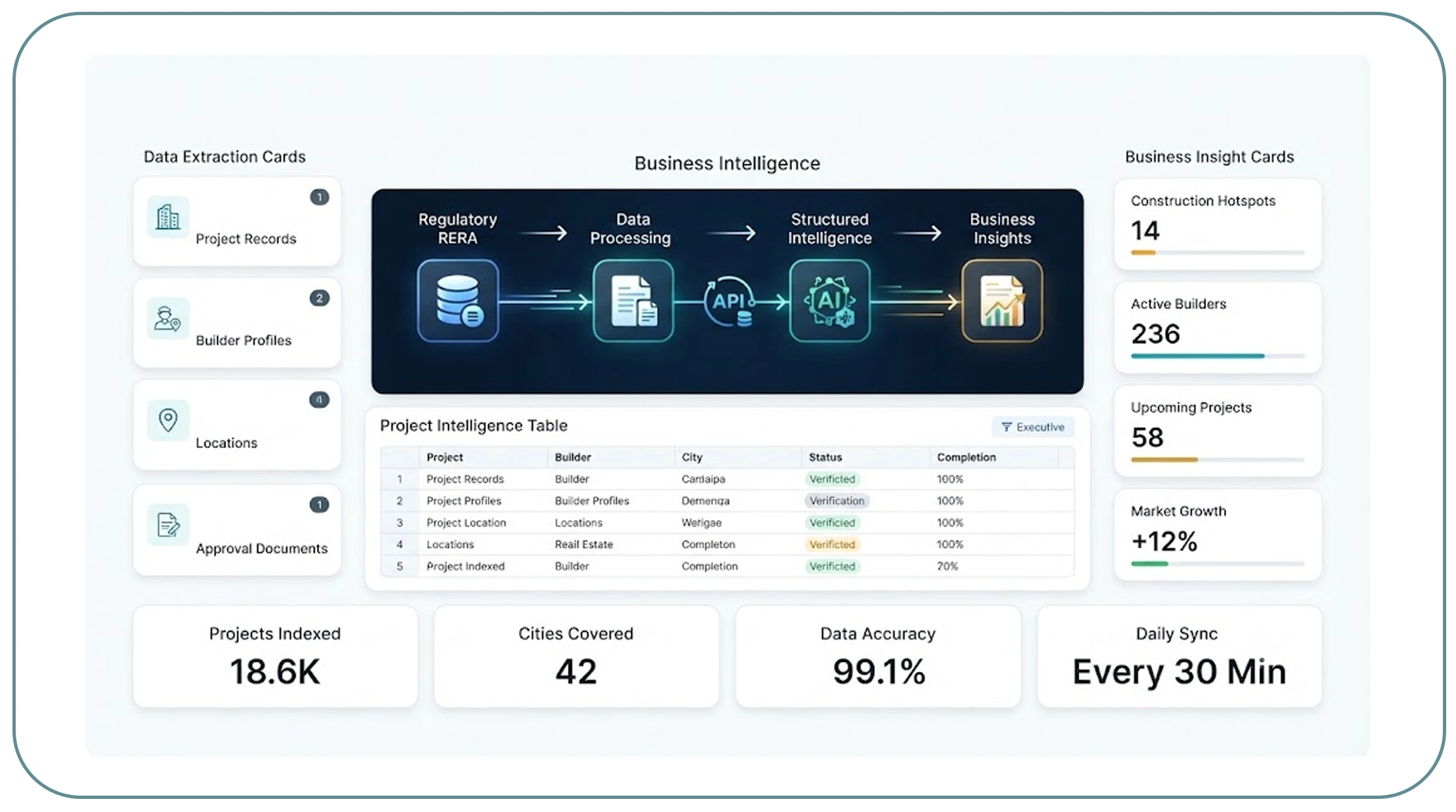
Construction registrations contain valuable information beyond regulatory compliance. When properly collected and analyzed, these datasets reveal market growth, developer expansion, regional demand, and investment opportunities. Businesses can convert raw regulatory records into actionable intelligence using automated APIs.
The ability to Extract RERA Project and Builder Data enables organizations to build comprehensive real estate intelligence platforms. Automated extraction captures project registrations, builder profiles, property types, approval dates, locations, completion schedules, and project status. These structured datasets support reporting, AI models, predictive analytics, and executive dashboards.
Organizations commonly use extracted RERA data to:
- Build property intelligence platforms.
- Identify emerging construction hotspots.
- Compare builder performance across regions.
- Forecast residential and commercial supply.
- Support infrastructure planning.
- Improve investment due diligence.
- Monitor market expansion.
- Create executive dashboards.
For example, construction material suppliers can anticipate demand by tracking new residential developments. Investors can compare project pipelines across multiple cities, while consulting firms can generate detailed market reports for clients using current regulatory information.
Business Intelligence Adoption from RERA Data (2020–2026)
| Year | Companies Using Construction BI | AI-Driven Real Estate Analytics | Average Reports Generated Monthly |
|---|---|---|---|
| 2020 | 24% | 14% | 320 |
| 2021 | 33% | 22% | 470 |
| 2022 | 46% | 34% | 690 |
| 2023 | 60% | 49% | 980 |
| 2024 | 74% | 64% | 1,360 |
| 2025* | 86% | 79% | 1,820 |
| 2026* | 93% | 89% | 2,350 |
*Projected industry estimates.
Organizations that transform regulatory records into business intelligence gain a clearer understanding of construction activity, developer performance, and regional growth patterns. Automated data pipelines enable faster reporting, improve forecasting accuracy, and help decision-makers respond quickly to changing market conditions.
Why Choose Real Data API?
Real Data API provides enterprise-grade real estate data solutions designed to help organizations automate construction intelligence with speed and accuracy. Whether you are a PropTech company, developer, investor, lender, research firm, or government agency, our platform delivers structured RERA datasets that simplify analysis and improve decision-making.
By choosing to scrape construction activity through RERA registrations , businesses can automatically collect project registrations, builder profiles, project status, locations, approval dates, completion timelines, and other essential regulatory information through scalable APIs and automated workflows.
Why organizations choose Real Data API:
- Real-time RERA data collection
- Comprehensive project and builder information
- High-speed API performance
- Structured JSON and CSV outputs
- Multi-state data coverage
- Seamless integration with BI and AI platforms
- Enterprise-grade scalability
- Reliable technical support
- Flexible data delivery options
Our solutions help businesses reduce manual research, accelerate market intelligence, and build reliable construction analytics platforms that support smarter investments and long-term growth.
Conclusion
Automated RERA data collection has become an essential capability for organizations seeking accurate and timely construction intelligence. Real-time access to project registrations, builder information, approvals, and development activity enables businesses to improve forecasting, monitor competitors, reduce research time, and make confident investment decisions.
Choosing to scrape construction activity through RERA registrations empowers developers, investors, financial institutions, and PropTech companies with structured regulatory data that supports analytics, AI applications, and strategic planning. As India's real estate market continues to expand, automated RERA data will play an increasingly important role in delivering actionable insights and maintaining a competitive advantage.
Ready to transform construction intelligence into measurable business value? Partner with Real Data API to scrape construction activity through RERA registrations and access accurate, scalable, and real-time project and builder data for smarter real estate decisions!
Latest posts
How to Scrape Construction Activity Through RERA Registrations to Eliminate Delayed Project Intelligence

How to Scrape Rightmove API for Real Estate Businesses to Solve Property Data Gaps and Improve Market Intelligence

How to Scrape Live Scores Using Flashscore API to Monitor Match Results, Player Stats & Live Sports Trends

Scrape Foodora Restaurant and Menu Data Using API to Monitor Menu Prices, Availability & Competitor Insights







.png)